Tag Archives: Minnesota

Where the Senate Stands

By Jim Ellis

Oct. 13, 2020 — Now, less than a month before the official Election Day, we see multiple polls coming regularly in almost every competitive Senate race. Democrats need a net conversion of three Republican seats if Joe Biden is elected president and four seats if he is not. With 16 races now on the competitive board, we look at where they each stand. At least two surveys are included for each race.

Looking at the current trends, we see a tightening Senate from the current 53R-47D majority. Under the current swing, Democrats could reach 51, but with several races remaining as toss-ups or in range where they still could go either way. It’s conceivable, at this point, that both parties could claim 49 seats with a fight for the remaining two that would decide the next majority.

All of the polling data is from late September and early October:


ALABAMA: Sen. Doug Jones (D) vs. Tommy Tuberville (R)
• Trend: Tuberville

POLLS:
• University of Auburn @ Montgomery (Sept. 30-Oct. 3; 1,072 registered Alabama voters)
  Tommy Tuberville (R) – 54%
  Sen. Doug Jones (D) – 42%

• Morning Consult (Sept. 11-20; 658 likely Alabama voters)
  Tommy Tuberville (R) – 52%
  Sen. Doug Jones (D) – 34%


ALASKA: Sen. Dan Sullivan (R) vs. Dr. Al Gross (I/D)
• Trend: Slightly Sullivan

POLLS:
• Alaska Survey Research (Sept. 25-Oct. 4; 676 likely Alaska voters)
  Sen. Dan Sullivan (R) – 48%
  Al Gross (I/D) – 44%

• Harstad Strategic Research (Sept. 20-23; 602 likely Alaska voters)
  Sen. Dan Sullivan (R) – 46%
  Al Gross (I/D) – 45%


ARIZONA: Appointed Sen. Martha McSally (R) vs. Mark Kelly (D)
• Trend: Kelly

POLLS:
• Latino Decisions (Sept. 28-Oct. 6; 600 likely Arizona voters)
  Mark Kelly (D) – 47%
  Sen. Martha McSally (R) – 42%

• Ipsos (Oct. 3-5; 550 likely Arizona voters)
  Mark Kelly (D) – 48%
  Sen. Martha McSally (R) – 44%

• Data Orbital (Oct. 3-5; 550 likely Arizona voters)
  Mark Kelly (D) – 49%
  Sen. Martha McSally (R) – 44%

• HighGround, Inc. (Sept. 28-Oct. 5; 400 likely Arizona voters)
  Mark Kelly (D) – 50%
  Sen. Martha McSally (R) – 44%


Continue reading

MN-2: Election Postponed

By Jim Ellis

Minnesota’s MN-2 Congressional District sits southeast of the Minneapolis-St. Paul metropolitan area, encompassing the region’s southern suburbs and traveling to the Wisconsin border.

Sept. 28, 2020 — A bizarre occurrence has happened in Minnesota that will apparently delay the 2nd Congressional District election until Feb. 9, 2021. Under state law, if a major party candidate passes away within 79 days of the general election date, the vote for the affected office is delayed for approximately three months.

Adam Weeks is the Legal Marijuana Now party congressional nominee, and under Minnesota election law this entity is recognized as a major party. Therefore, Weeks’ untimely and unexpected death earlier this week forces the congressional election of which he was a part to now be held Feb. 9. Though ballots are already printed, any votes cast for the 2nd District contest will not be recognized or counted.

The law came into effect after the death of Sen. Paul Wellstone (D) who perished along with his wife and daughter in a tragic plane crash 11 days before the 2002 election. Under Minnesota law at the time, a replacement nominee had to be chosen because the election would proceed as scheduled. That candidate became former vice president and Minnesota senator, Walter Mondale (D), who would go onto lose to Republican Norm Coleman in a close 50-47 percent election.

Taking action well after 2002, the state enacted the current statute that requires a postponement of the affected political contest. The situation directly touches freshman Rep. Angie Craig (D-Eagan) and Republican nominee Tyler Kistner. The Legal Marijuana Now party will have the opportunity to replace Weeks for the Feb. 9 election.

There are more ramifications than meet the eye here, however. First of all, Rep. Craig will have to leave office at the end of the current Congress because her term will expire. This means she will be out of office for more than one month of the new 117th session. This would put her at the end of the seniority list for the current freshman class if and when she eventually returns to the House.

Secondly, and perhaps the greater problem for all concerned, is that this particular Minnesota statute is likely to be found conflicting with the federal law that requires all states to hold a general election for federal offices on the same day, in this case Nov. 3, 2020.

The national election law also was the key factor in forcing Louisiana to hold its formatted jungle primary election concurrently with the general election date. Before, the Bayou State primary was held in September and anyone winning an absolute majority in that one election was declared the outright victor. The Justice Department ruled that the state could no longer hold an early jungle primary that allowed someone to win outright because it conflicted with the law requiring every state to hold a uniform and simultaneous general election.

Continue reading

Senate: A Polling Comparison

By Jim Ellis

Sept. 24, 2020 — Today, we look at the competitive Senate races and segment the group around polling consistency. Several races routinely report point spreads between the two major party candidates that are wildly inconsistent, while others vary over a small difference often within the same polling period.

The two most extreme surveys during the month are listed for each state with the most extreme first and the closest second. You will notice that the British firm, Redfield & Wilton Strategies, is often listed as the most extreme.

We begin, alphabetically by state, with the inconsistent group. Only the two Georgia races are in the September consistent segment.


INCONSISTENT


Arizona
Number of September polls: 14
Polling range: 16 points

Redfield & Wilton Strategies
(Sept. 12-16; 855 likely Arizona voters; combination online and live interview)
• Mark Kelly (D) – 52%
• Sen. Martha McSally (R) – 35%

ABC News/Washington Post
(Sept. 15-20; 579 AZ likely voters; live interview)
• Mark Kelly (D) – 49%
• Sen. Martha McSally (R) – 48%


Iowa
Number of September polls: 2
Polling range: 8 points

Fabrizio Ward/Hart Research (for AARP)
(Aug. 30-Sept. 5; 800 likely Iowa voters; live interview)
• Sen. Joni Ernst (R) – 50%
• Theresa Greenfield (D) – 45%

Selzer & Company
(Sept. 14-17; 658 likely Iowa voters; live interview)
• Sen. Joni Ernst (R) – 45%
• Theresa Greenfield (D) – 42%


Continue reading

Why Arizona is So Pivotal

By Jim Ellis

Does Arizona hold the key in a Trump-Biden election?

Sept. 16, 2020 — For several reasons, the Grand Canyon State of Arizona is possibly the most important state on the political map to determine the ultimate presidential election outcome.

Primarily, Arizona is one of five core states that President Trump must win to form a foundation for a favorable remaining state coalition map. The other four, geographically from west to east, are Texas, Georgia, Florida, and North Carolina. Should Joe Biden break through in any one of these five states, he will likely win the national election.

At this point, Arizona appears to be the most precarious of the Trump core states. While the President’s numbers are improving here, the September polls find him trailing Biden in all six publicly released surveys from a range of one to nine points among likely voters, with a mean average of Biden plus-4, and a median of Biden plus-3.5.

The five states are so critical to President Trump, or any Republican national candidate, because, as a unit, they yield a relatively easy remaining victory map. Carrying the five southern sector domains and assuming no leakage in Ohio or Iowa, and even while not winning Nevada or New Hampshire, the GOP nominee then claims the presidency with a victory in any one of the key Great Lakes states: Michigan, Minnesota, Pennsylvania, or Wisconsin. For a Democrat to win under this scenario, he or she would be forced to sweep the aforementioned quartet.

President Trump won the 2016 Electoral College vote 306-232, which means he can relinquish a net 36 electoral votes in 2020 and still win the national election. Under the scenario of him taking either Wisconsin or Minnesota, along with keeping Arizona, he would defeat Biden with exactly 270 electoral votes. This model also assumes he wins the 2nd Congressional District from both Nebraska and Maine, the two states that split their electoral votes. He won both in 2016. Under this scenario, Michigan and Pennsylvania would go to Biden.

Arizona, now potentially teetering toward the Democrats, is critical to the president’s prospects because Trump cannot afford to trade it for one of the western Great Lakes States, either Minnesota or Wisconsin. Such a loss would force the president to win two of the four Great Lakes, but only one could be Minnesota or Wisconsin since those two states have 10 electoral votes and Arizona has 11.

Therefore, simply put, losing Arizona because of its 11th electoral vote would mean that Trump would be forced to carry either Michigan or Pennsylvania in addition to one of the other three remaining Great Lakes States. A further scenario involving Trump losing Arizona and replacing it with both of the 10-electoral vote states (MN and WI) could result in the election ending in a 269-269 tie. This would force a tiebreaker to be decided in the US House of Representatives.

Let’s look at the chances of Trump winning Arizona by comparing his current standing to where he was at this point in 2016. Looking at the Real Clear Politics polling archives, we find that 19 Arizona polls were conducted during the entire 2016 election cycle. In 2020, just since the July 4th holiday break, 25 surveys were publicly reported in the Grand Canyon State.

Four years ago, at the end of August through mid-September, two individual polls came from Gravis Marketing (Aug. 25-27, 2016) and NBC News/Marist College (Sept. 6-8, 2016). These surveys yielded Trump four and one-point leads, respectively. Shortly thereafter, the trend began to turn Hillary Clinton’s way. The OH Predictive Insights survey (Sept. 28-30, 2016) found the two candidates tied at 42 percent apiece, while Emerson College (Oct. 2-4, 2016) and the Arizona Republic newspaper poll (Oct. 10-15, 2016) detected consecutive leads for Clinton of two and five points.

Therefore, Arizona did not turn toward Trump for good until the Monmouth University survey in late October (Oct. 21-24, 2016), which put him just one point ahead. Going into the election from that point, and remembering the 2016 election was on Nov. 8, Trump led in the final four polls from a two to five-point margin. He would eventually win the actual vote count by 3.6 percentage points, 48.7 – 45.1 percent, meaning a raw vote margin of 91,234 votes of more than 2.573 million ballots cast.

Because of Arizona’s fast population growth, the state has changed in four years. During that interval, the overall population expanded five percentage points to 7,278,717 individuals according to the Census Bureau’s July 2019 estimate, the latest available.

Minorities, specifically Hispanics and blacks, account for approximately 69 percent of the population gain, thus at least partially explaining Biden’s improved prospects in the state. Overall, Hispanics represent 31.7 percent of the overall Arizona population, and blacks 5.2 percent, as compared to the non-Hispanic white position receding to 54.1 percent.

The population changes suggest that this already tight political state will likely become even closer as we head for Nov. 3.

Senate Sleepers in Minnesota
and South Carolina

By Jim Ellis

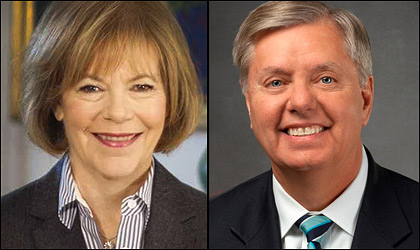
Are incumbents Sen. Tina Smith (D-MN), left, and Sen. Lindsey Graham (R-SC) in re-election trouble?

Sept. 8, 2020 — At the beginning of the 2020 election cycle, it appeared that Sens. Tina Smith (D-MN) and Lindsey Graham (R-SC) were set for re-election. That no longer appears to be the case.

Polling is now consistently showing close races in the two states, and Sen. Smith’s recent comments about the police have seemingly moved her re-election campaign closer to the toss-up category according to a just-released Harper Polling survey.

Looking at the HP data (Aug. 30-Sept. 1; 50 likely Minnesota voters via live interview), Sen. Smith’s ballot test edge has dropped to just 43-41 percent over former US Rep. Jason Lewis (R).

In May, Harper found Sen. Smith posting a 46-35 percent advantage over Lewis. After this release, Public Policy Polling forecast a 48-39 percent split toward the end of July. Lastly, Emerson College published what appears to be precursor data to the latest Harper findings. The Boston-based university poll (Aug. 8-10; 73 likely Minnesota voters) found a three-point split between the two contenders, 48-45 percent, again in Sen. Smith’s favor.

To the southeast of liberal Minnesota, in conservative South Carolina, veteran Sen. Lindsey Graham (R) has also fallen into a competitive contest with former state Democratic Party chairman Jaime Harrison, who had raised an incredible $29 million for his smaller state race through the end of June.

The most recent poll we have seen from the Palmetto State was released at the beginning of August. Quinnipiac University (July 30-Aug. 3; 91 registered South Carolina voters) detected a 44-44 percent tie between Sen. Graham and Harrison. From mid-July through the beginning of August, six surveys were conducted, including the Quinnipiac study, and Sen. Graham’s average lead was only 2.8 percentage points.

Continue reading

Where the Senate Stands

By Jim Ellis

Aug. 28, 2020 — A tough battle is underway for the US Senate majority, and both parties are fiercely attempting to assume control in the next Congress. Republicans hold a 53-47 majority, but a win in Alabama would send them to 54-46, and that makes the Democrats’ road to the majority all the more difficult.

Democrats need a net conversion of three Republican seats if Joe Biden is elected president, and four if President Trump wins re-election.

Today, we take a snapshot look at polling figures in the key campaign states. How the states listed below eventually fall will determine which party runs the Senate for the 117th Congress.

Below, we provide you the two most extreme results of recent publicly released surveys from the competitive campaigns. The Ellis Insight ratings depict where the race is today, which is not solely based upon polling.


ALABAMA – Lean R (possible conversion)

Morning Consult (July 24-Aug. 2; 80 likely Alabama voters)
• Tommy Tuberville (R) – 52%
• Sen. Doug Jones (D) – 35%

Auburn University at Montgomery (July 2-9; 55 registered Alabama voters)
• Tommy Tuberville (R) – 44%
• Sen. Doug Jones (D) – 36%


ARIZONA – Lean D (possible conversion)

Redfield & Wilton Strategies (Aug. 16-18; 856 likely Arizona voters)
• Mark Kelly (D) – 53%
• Sen. Martha McSally (R) – 34%

OnMessage (Aug. 2-4; 40 likely Arizona voters)
• Mark Kelly (D) – 48%
• Sen. Martha McSally (R) – 48%


COLORADO – Lean D (possible conversion)

Public Policy Polling (Aug. 18-19; 731 Colorado voters)
• Ex-Gov. John Hickenlooper (D) – 51%
• Sen. Cory Gardner (R) – 42%

Morning Consult (July 17-26; 61 likely Colorado voters)
• Ex-Gov. John Hickenlooper (D) – 48%
• Sen. Cory Gardner (R) – 42%


GEORGIA–A – Lean R/Toss

Garin Hart Yang Research Group (Aug. 10-13; 60 likely Georgia voters)
• Jon Ossoff (D) – 48%
• Sen. David Perdue (R) – 46%

Survey USA (Aug. 6-8; 62 likely Georgia voters)
• Sen. David Perdue (R) – 44%
• Jon Ossoff (D) – 41%


Continue reading

Presidential Polling Progress

By Jim Ellis

Aug. 27, 2020 — The Republican National Convention coverage featured several mentions of swing state polling getting closer between the two presidential candidates, and recent moves from both sides would seem to suggest that internal survey numbers also reflect such a trend.

Below, we compare the 10 most recent polls with the 10 prior surveys in each of the key states to better illustrate the campaign’s movement:


ARIZONA

Last 10 Public Polls: July 17 – August 23
• Biden Aggregate Average Lead: 3.2%

Previous 10 Public Polls: June 26 – July 24
• Biden Aggregate Average Lead: 4.4%

Swing: Trump +1.2%


FLORIDA

Last 10 Public Polls: July 17 – August 22
• Biden Aggregate Average Lead: 3.2%

Previous 10 Public Polls: June 8 – July 21
• Biden Aggregate Average Lead: 6.9%

Swing: Trump +3.7%


GEORGIA

Last 10 Public Polls: July 9 – August 15
• Trump Aggregate Average Lead: 0.4%

Previous 10 Public Polls: May 4 – July 2
• Trump Aggregate Average Lead: 0.1%

Swing: Trump +0.3%


MICHIGAN

Last 10 Public Polls: July 24 – August 23
• Biden Aggregate Average Lead: 7.0%

Previous 10 Public Polls: July 9 – July 26
• Biden Aggregate Average Lead: 7.4%

Swing: Trump +0.4%


Continue reading