
Tag Archives: John Fleming

Cassidy Crushed in New Poll

By Jim Ellis — Monday, April 6, 2026

Senate
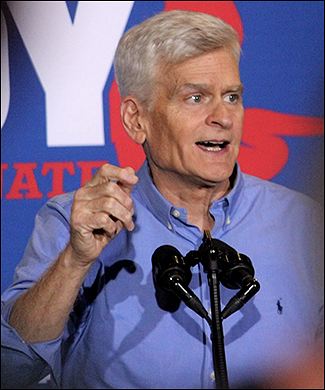
Louisiana Sen. Bill Cassidy (R)

A new American Pulse Research & Polling survey finds Louisiana GOP Sen. Bill Cassidy trending seriously downward in his fight for renomination.

According to the American Pulse data, Sen. Cassidy would be in danger of not even advancing to a runoff against Rep. Julia Letlow (R-Start) and State Treasurer and former Rep. John Fleming. In hypothetical runoff pairings, should Sen. Cassidy rebound, he would individually trail both Letlow and Fleming.

The American Pulse poll (March 20-24; 455 likely Louisiana Republican primary voters) sees Rep. Letlow topping Fleming and Sen. Cassidy, 31-25-21 percent, respectively. In a potential runoff, Rep. Letlow would lead Fleming, 37-34 percent. With 29 percent of the respondents unsure about this race, such a contest would be rated as too close to call.

Paired with incumbent Cassidy, Rep. Letlow would defeat him by a whopping 30 points according to this respondent sample, 54-24 percent. Fleming fares almost as well against the Senator. In a Fleming-Cassidy runoff, the challenger would lead the incumbent, 49-29 percent.

With a sample size of only 455 individuals for a statewide survey, the error factor would be high because of the small universe. These results, however, are so lopsided that even a wide error margin would still send Cassidy packing particularly because he fares so poorly in a runoff against either opponent.

Sen. Cassidy is facing serious obstacles. Obviously, these polling numbers reveal that the Senator is not popular within the Louisiana conservative vote base. Secondly, his vote to impeach President Trump associated with the January 6th conflict at the Capitol obviously put him at odds with the chief executive, though it is likely that the Senator believed doing so would not cause him future political problems because he obviously believed that Trump would never return to the White House.

As a result, President Trump has already endorsed Rep. Letlow, doing so even before she became an official Senate candidate.

Perhaps Sen. Cassidy’s most serious problem, however, is Louisiana’s new nomination structure for federal offices. Since the 1970s, Louisiana has featured a jungle qualification format for all offices. All candidates are placed on the same ballot in an election concurrent with the regular general election. If a candidate records majority support in the first vote, the individual is elected. If not, the top two finishers regardless of political party affiliation advanced to a post-general election runoff.

Under the new Louisiana primary system effective with the 2026 election, registered party members may only vote in their own party primary. If a person is registered as a “No Party” voter, the individual may choose a primary ballot at the polling place. Once selected, the “No Party” voter can then only participate in an associated runoff of the party in which he or she chose for the regular primary election.

In the jungle system, and particularly because the Democrats are currently very weak in Louisiana, Sen. Cassidy was able to attract a segment of their votes. This made him stronger in seeking re-election. In 2026, Democrats will not be allowed to crossover into the Republican primary, just as Republicans will not be allowed to vote in any 2026 Democratic primary.

Therefore, the new partisan primary system gives the Cassidy challengers a boost because endorsements, such as the one from President Trump, will carry more weight within the conservative Republican vote base without any adverse boomerang effect coming from crossover Democrats.

Added together, these obstacles spell trouble for Sen. Cassidy’s re-election chances as the current polls reflect.

The small sample American Pulse survey may not be completely indicative of where the entire Louisiana Republican electorate stands, but the Senator has fared poorly in other statewide polls, as well.

Looking at the last six publicly released Republican primary studies since Feb. 24, Sen. Cassidy has averaged only 26.7 percent support in the surveys testing a three-way contest among the Senator, Rep. Letlow, and Fleming.

As we head toward a May 16 Louisiana Republican primary election and a potential June 27 GOP runoff, Sen. Cassidy today looks to be the Senate incumbent most likely to fail to qualify for the general election.
Three Now Battling for
Louisiana Senate Seat

By Jim Ellis — Thursday, March 19

Senate

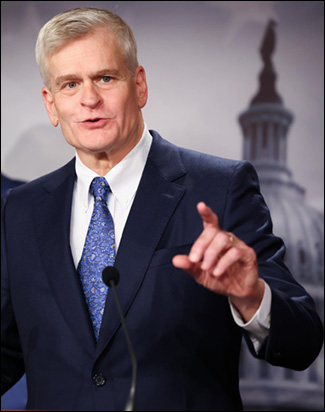
Sen. Bill Cassidy (R-LA) faces challengers to hold his US Senate seat.

It has been known for some time that Sen. Bill Cassidy (R) was going to face real competition in his fight for renomination this year, but a legitimate three-way race scenario was not often speculated upon.

A series of late February surveys and the most recent Cassidy campaign poll confirm that State Treasurer and former Congressman and ex-White House Deputy Chief of Staff John Fleming is a viable Republican Senate candidate. This, even though President Trump has endorsed Rep. Julia Letlow (R-Start) against Sen. Cassidy.

The two-term incumbent is not a Trump favorite because he is one of two GOP Senators on the ballot in 2026 – Maine’s Susan Collins is the other – who voted to impeach President Trump in early 2021 over the January 6 Capitol conflict.

Public Opinion Strategies, surveying for the Cassidy campaign (March 7-10; 500 likely Louisiana Republican primary voters; live interview), sees the Senator holding a 35-24-21 percent advantage over Rep. Letlow and Fleming. Testing a Cassidy-Letlow runoff, the incumbent would hold only a 45-43 percent edge. The Cassidy-Fleming runoff possibility was not tested, but it would not be surprising to see a similar preference division.

The February polls, however, show a stronger Fleming standing. The BDPC survey research organization, a bipartisan Louisiana firm, tested the Republican Senate race during the Feb. 21-23 period (600 likely Louisiana Republican primary voters) and found a closer ballot test result, 28-21-21 percent with Sen. Cassidy leading and Letlow and Fleming tied. According to this survey, Fleming would lead both Cassidy (43-32 percent) and Letlow (36-27 percent) in runoff scenarios.

Quantas Insights and JMC Analytics & Polling also project a three-way race in their February polling.

Quantas (Feb 23-24; 1,428 likely Louisiana Republican primary voters; online) saw a 34-25-20 percent split with Fleming leading, Rep. Letlow second, and the Senator dropping to third. A Fleming-Letlow runoff was tested and broke 42-32 percent in Fleming’s favor.

JMC Analytics, another regular Louisiana pollster (2/14-16; 645 Louisiana likely Republican primary voters; live interview), found a virtual three-way tie with Mr. Fleming holding a slight 26-25-22 percent lead over Rep. Letlow and Sen. Cassidy.

The renomination road for Sen. Cassidy is more difficult than in his first two elections. The state has moved away from its jungle primary system that featured all candidates on the same ballot in a vote scheduled concurrently with the general election. If a contender received majority support, the individual was elected outright in the one election. If no one attained the 50 percent plateau, the top two finishers, regardless of political party affiliation, would advance to an early December runoff election.

In 2024, the legislature and Governor changed the law for federal and some state offices, concluding that their freshmen federal officials were at an organizational disadvantage in Congress because some of their members were joining the body a month after all others. Therefore, the legislative leaders and Gov. Jeff Landry (R) believed that the state was penalizing itself in terms of key committee assignments and in some leadership elections. This, even though the Speaker and Majority Leader both hail from Louisiana.

A reason less talked about for the change is the Senate race. Clearly, the legislators were aware that returning to a partisan primary/runoff system would make re-election much more difficult for Sen. Cassidy, who is viewed as less conservative than the typical Louisiana Republican legislator and primary voter.

Therefore, under the new nomination system, we see a closed primary (voters must be registered party members) scheduled for Saturday, May 16 with a runoff if no one receives majority support calendared for June 27.

Sen. Cassidy is certainly prepared for a tough challenge. He reported over $10.1 million cash-on-hand (COH) at the end of 2025, which is a 4:1 COH advantage over Rep. Letlow, and 5:1 opposite Fleming.

Considering the Trump endorsement for Rep. Letlow and the GOP/MAGA base expressing anti-Cassidy sentiments, the Senator will need every bit of his financial advantage to fight his way through to renomination.

Louisiana’s Cassidy Strikes Back

By Jim Ellis — Friday, January 30, 2026

Senate

Already, the Louisiana Senate Republican primary is taking shape, and we are witnessing a highly competitive and largely negative race beginning to unfold.

Louisiana Sen. Bill Cassidy (R)

Rep. Julia Letlow (R-Start) attracted a great deal of political attention last week as she announced her Republican primary challenge to Sen. Bill Cassidy along with an endorsement from President Trump. Now, the Senator is seizing the offensive.

The Cassidy campaign just released the results of a Public Opinion Strategies poll (Jan. 20-22; sample size not publicized) that largely outlines what promises to be the Cassidy campaign’s line of attack against Rep. Letlow.

According to the POS survey, Sen. Cassidy leads Rep. Letlow and state Treasurer and former Congressman John Fleming, 32-21-16 percent. State Sen. Blake Miguez (R-New Iberia) and Public Service Commissioner Eric Skrmetta trail the group with nine and one percent support levels.

Another recently released survey, this from JMC Analytics & Polling for the Fleming campaign (Jan. 12-14; 650 likely Louisiana Republican primary voters) finds an entirely different ballot test result. This data projects Fleming with a 23-22 percent edge over Sen. Cassidy. The remaining candidates split an aggregate 16 percent of the preference responses. The JMC poll was conducted before Rep. Letlow entered the race; hence, she was not included.

Under the Cassidy POS poll’s “informed ballot” result, meaning a series of messages about the poll sponsor’s opponent(s) that are usually negative, the Cassidy lead increases to 55-13-13 percent over Rep. Letlow and Treasurer Fleming. When the push questions isolate Rep. Letlow, the one-on-one “informed” ballot test moves to a whopping 69-22 percent in Cassidy’s favor.

While the query verbiage was not included in the poll analysis, the summary indicates that Rep. Letlow’s stock transactions will be at the forefront of the attack against her, and it is probable the information is at least somewhat sensationalized.

In the poll analysis, the text claims that Rep. Letlow has “over 200 violations of the Stock Act.” When reading the supporting story from the NOTUS (News of the United States) website, we see that the violations were for the late reporting of a group of 210 stock transactions on her financial disclosure report. The combined value of the transactions is reported in the range of $225,000 to $3.3 million. The disclosure report does not delineate further, but the campaign inference will be that she hid millions of dollars in stock transactions.

It appears that the Cassidy campaign is also targeting Letlow as a “RINO” (Republican In Name Only), claiming that her voting record is to the left of the Senator’s. Another attack, as also outlined in the poll analysis, is her taking a trip to Qatar “funded by a pro-Doha group.”

The most serious early campaign obstacle for Rep. Letlow and the other candidates is overcoming Sen. Cassidy’s large war chest. Again, according to the Cassidy polling analysis, the Senator’s campaign reports having $26 million in the bank, the year-end Federal Election Commission filing to be released early next month.

According to Rep. Letlow’s Sept. 30 campaign filing, she held just under $2.3 million in her account, but her total will likely be larger when the latest disclosure reports are made public. For his part, Fleming posted slightly over $2 million.

As previously reported, Louisiana has a new nominating system. Instead of a jungle primary held concurrently with the general election, Louisiana nominations for federal and certain state offices will revert to a traditional partisan primary and runoff procedure. If no candidate receives majority support in the first vote on May 16, the top two finishers advance to a June 27 runoff election.

In addition to Sen. Cassidy, Rep. Letlow, Treasurer Fleming, and Sen. Miguez, seven more Republicans have entered the race. The candidate filing deadline is Feb. 13, so it remains to be seen just how many of these individuals actually follow through and complete their final statement of candidacy. State Rep. Julie Emerson (R-Carencro) had also announced her candidacy but withdrew after Rep. Letlow entered the race.

The Louisiana and Texas Republican primaries feature the party’s two incumbent Senators, Cassidy and John Cornyn, who are in danger of losing their renomination efforts. Both the Texas primary on March 3 and Louisiana in May will be closely watched until the vote count is complete. Expect both the Texas and Louisiana campaigns to run at a frenetic pace throughout the remainder of the primary calendar.

Sen. Cassidy Draws New Opponent

By Jim Ellis — Thursday, June 19, 2025

Senate

Sen. Bill Cassidy (R-LA)

In an attempt to deny Sen. Bill Cassidy (R-LA) renomination, Louisiana state Sen. Blake Miguez (R-New Iberia) announced early this week that he will enter the 2026 Republican Senate primary. Already in the race is State Treasurer John Fleming, along with four minor GOP candidates.

Cassidy is one of the seven Republican Senators (just three remain in office) who voted to impeach President Trump in post-election 2020; therefore, Cassidy earning an endorsement from Trump seems unlikely. Trump’s public support in Republican primaries has, for the most part, been extremely helpful to the anointed candidate.

Hence, Sen. Cassidy faces some obstacles toward his 2026 re-election bid. In addition to his problems with the President and facing credible opponents, he also must navigate an entirely new election system.

In 2024, Gov. Jeff Landry (R) and the state legislature changed Louisiana election law. For federal races, the jungle primary system is eschewed, and a partisan structure reimposed. The new primary schedule means that Sen. Cassidy, and all other federal incumbents, must stand for renomination on April 18, 2026, with a runoff election scheduled for May 30 if no candidate secures majority support on the first vote.

In Louisiana’s previous system, and one that still holds for most state races, all candidates are placed on the same ballot for an election scheduled in November. If a leading candidate fails to receive majority support, the top two finishers advance into a December runoff.

The argument for adopting the new law for federal elections was accentuated with change proponents saying that the Louisiana freshmen US House members forced into December runoffs were put in an adverse position that hurt the state. They pointed out their new members were getting lesser committee assignments and behind in other internal House matters because the entire body was elected a full month earlier.

According to Louisiana’s Advocate news site, Sen. Cassidy was actively opposing the new election law even after adoption. He was lobbying the legislature this year to eliminate the law’s runoff provision in order to allow plurality victories. The current session ended without the legislature making such a change.

Incumbents forced into runoff elections generally fare poorly because a majority of primary voters have already chosen a different candidate. Such is likely the principal reason Sen. Cassidy was attempting to convince the legislature to change the new law.

John Fleming, a physician, was elected State Treasurer in 2023. He previously served four terms in the US House, succeeding former House Ways and Means Committee chairman Jim McCrery in the 4th Congressional District and immediately preceding now-Speaker Mike Johnson. Rep. Fleming ran for US Senate in 2016, losing the Republican nomination to now-Sen. John Kennedy (R).

Upon leaving the House, Dr. Fleming was appointed by President Trump as Assistant Secretary of Commerce for Economic Development, and later Deputy White House Chief of Staff. In the House, Dr. Fleming was an original co-founder of the House Freedom Council.

In the initial Federal Election Commission campaign finance disclosure report for the 1st Quarter of 2025, Dr. Fleming self-funded his campaign with a $2.03 million cash influx but raised only $269,479 from other sources. It remains to be seen how well he does in the 2nd Quarter, which will end on June 30.

Blake Miguez was first elected to the state House of Representatives in a 2015 special election. He secured full terms later in 2015 and 2019 before winning a state Senate seat in 2023. During his tenure in the House, Miguez was elected Majority Leader in 2020. Professionally, he is an oil and gas company executive and has won national handgun shooting contests.

We can expect a primary campaign to be dominated with attacks against Cassidy arguing that he is a “RINO” (Republican In Name Only) because he voted to impeach Trump and for his votes, stances, and public statements on certain other issues.

With at least two major candidates making similar arguments against the Senator, the possibility grows that he will be forced into a runoff. If so, Cassidy’s chances of winning renomination would become diminished.

The Louisiana Senate primary will be a race to watch early next year because Sen. Cassidy’s renomination appears far from certain. We have yet to see any major action on the Democratic side, but it is certain the party will file a credible nominee.

Endorsing NJ’s First Lady;
GOP Primary Challenge in SC-4; Washington’s Surprising Republican Contender; Louisiana Runoff Results

By Jim Ellis — Tuesday, Nov. 21, 2023

Senate

Tammy Murphy, New Jersey’s First Lady

New Jersey: Tammy Murphy Scoring Key Endorsements — Being New Jersey’s First Lady certainly has its perks. Since announcing her Senate challenge to indicted incumbent Sen. Bob Menendez (D-NJ) late last week, Tammy Murphy, the wife of incumbent Gov. Phil Murphy (D), already has secured four important county party endorsements.

In New Jersey, official county party endorsements mean more than in other states because the favored candidates received substantially better ballot positions in addition to having access to party resources. So far, the state’s two largest Democratic local party organizations, Bergen and Middlesex Counties, along with those in Camden and Hudson, have awarded Ms. Murphy their endorsements.

Additionally, Rep. Josh Gottheimer (D-Wycoff), who is reportedly testing the waters for a 2025 gubernatorial race when Mr. Murphy is ineligible to seek re-election, became the state’s first sitting US House member to endorse the First Lady. Aside from Sen. Menendez, who has yet to say whether he will seek re-election, US Rep. Andy Kim (D-Moorestown) is in what is already becoming a highly competitive statewide Democratic primary campaign.

House

SC-4: Rep. Timmons Facing Potentially Strong Primary — In 2022, South Carolina Rep. William Timmons (R-Greenville) found himself winning his renomination campaign with just 53 percent of the vote against what were thought to be minor opponents. A highly publicized extra-marital affair that included accusing the congressman of using his office resources to conceal his activity was largely the reason his primary was so close.

On Friday, state Rep. Adam Morgan (R-Taylors) announced that he will challenge Rep. Timmons in the June primary election. Since Morgan will be a stronger opponent than any of the three individuals who ran in 2022, the 2024 primary will be one worth watching.

Governor

Washington: PPP’s Surprise Poll — Public Policy Polling again conducted one of their regular Washington statewide surveys for the Northwest Progressive Institute and the results are eye-opening. According to the PPP study (Nov. 14-15; 750 registered Washington voters; multiple sampling techniques), former Congressman Dave Reichert (R) and Attorney General Bob Ferguson (D) are tied with 31 percent support apiece.

The shocker comes when the pollsters queried the respondents about who they would support in a general election assuming that both Reichert and Ferguson advance from the all-party jungle primary into the November election. On the ballot test, Reichert enjoyed a 46-44 percent lead over AG Ferguson. It is an astonishing result in that a Republican would post any kind of an advantage in Washington, one of the most Democratic states in the Union.

States

Louisiana: Runoff Election Results — After electing a new governor outright in the Nov. 14 election as Governor-Elect Jeff Landry (R) was able to secure majority support, Republicans finished the 2023 statewide elections with a landslide sweep. The GOP won the secretary of state, attorney general, and state treasurer’s office with between 65 and 67 percent of the vote. Former Congressman John Fleming (R) returns to elective office with his victory as State Treasurer.

Turnout was extremely low with almost 670,000 votes cast, which is just 44 percent of the total participation figure from the last statewide runoff in 2019. In that election, however, the governor’s race was being decided. The lack of the governor and lieutenant governor being forced into runoffs is the obvious reason turnout was down by such a large proportion.

Senate Overtime

By Jim Ellis

Oct. 19, 2016 — Most projections suggest that the 2016 US Senate election cycle will end in a partisan division close to a 50-50 tie between Democrats and Republicans. If true, a new political poll suggests that the final determining factor won’t occur until well beyond Nov. 8.

A new JMC Analytics and Polling survey of the Louisiana Senate race portends that this open seat contest will be headed to a Dec. 10 run-off election. Therefore, if one Republican and one Democrat advance from the field of 24 candidates, it will mean the country must wait a full month after the general election to determine whether the Senate is tied or one party reaches 51.

But, such a majority may only last for a year. Assuming Hillary Clinton is elected president, her vice presidential nominee, Virginia Sen. Tim Kaine, will have to resign his seat. Gov. Terry McAuliffe (D) will then make an appointment – sure to be another Democrat – but this person will only serve until the next statewide general election.

Because Virginia elects its governors in odd-numbered years, the special Senate election will subsequently take place in 2017. Therefore, if the Senate breaks 50-50, with that last seat being from Virginia, the majority will be at risk just one year later. This will make an Old Dominion statewide special election the nation’s political focal point, at least in terms of determining Senate control.

Continue reading