Tag Archives: Harper Polling

The Affordable Care Act and the Arkansas Senate Race

As we predicted last week when Rep. Tom Cotton (R-AR-4) announced his challenge to Sen. Mark Pryor (D-AR), this campaign could conceivably draw the most attention of any political race in the country. Yesterday, as reported in several political publications, already two more Arkansas Senate surveys were released.

Both of the new studies are from Republican pollsters, The Polling Company for the Washington Free Bacon conservative political website and OnMessage for the National Republican Senatorial Committee. Both project the race to be a dead heat. The Polling Company (Aug. 6-7; 600 registered Arkansas voters) scores the battle 45-43 percent in favor of Sen. Pryor. OnMessage (July 29-30; 600 registered Arkansas voters) gives Cotton a similar 44-42 percent edge.

These numbers are on the heels of another poll, from Harper Polling (Aug. 4-5; 587 registered Arkansas voters) that shows the same two point spread, this version 43-41 percent in favor of Republican Cotton.

But the ballot test questions do not give us the most salient clues as to how this campaign will likely unfold. It is clear from examining the questions asked, and the respondents’ answers, that the new national healthcare law’s implementation can become the over-riding driver of the campaign. Looking ahead through next year, if Obamacare implementation does become the determining focal point, Cotton likely will win. Conversely, if the new healthcare law is being implemented in a satisfactory manner and other issues evolve into greater or equal importance, Sen. Pryor probably survives.

According to The Polling Company data, 50 percent of the respondent pool would be less likely to support Sen. Pryor because of his vote in favor of Obamacare, versus the 40 percent who answered more likely. The OnMessage totals are more stark. According to their data tables, 55 percent would be more likely to support Cotton because he voted to repeal Obamacare, contrasting with 33 percent who say they are more likely to support Sen. Pryor because he voted for Obamacare.

Most analysts believe that the public view of the new healthcare law will deteriorate over the next year as more people understand how the legislation will directly affect them. Therefore, Cotton must use his campaign to  Continue reading >

Pryor vs. Cotton: It’s On in Arkansas

In what could become the premier Senate race of the election cycle, Rep. Tom Cotton (R-AR-4), as expected, officially announced his challenge campaign for the US Senate last evening. The freshman congressman spoke before a boisterous crowd in his small hometown of Dardanelle, just off Interstate 40 between Little Rock and Ft. Smith.

Anticipating the move, incumbent Sen. Mark Pryor (D) immediately launched a television attack ad (below), using the typical Democratic campaign strategy of painting his Republican opponent as favoring across the board reduction in government benefits from the farm bill to Medicare to Social Security:

http://youtu.be/OTZpvmkVRYQ

Polling here is already underway at a brisk pace. During the last two weeks, three polls have been released. The American Federation of State, County, and Municipal Employees (AFSCME) first tested the Arkansas electorate (July 23-27; 729 registered Arkansas voters) and found Sen. Pryor to be leading Rep. Cotton 43-35 percent.

The Magellan Strategies organization (July 30-31; 1,600 registered Arkansas voters) just concentrated on Sen. Pryor’s re-elect score, not even bringing forth a ballot test question. They then added push questions after the original query. According to the initial results, 37 percent of the people would vote to re-elect Pryor while 47 percent would prefer to support someone new. After posing negative push questions that attack the senator for “adding to the deficit,” being the “deciding vote for Obamacare,” and “voting for President Obama’s 93 percent of the time” the second re-elect question swings to only 30 percent supporting Pryor’s re-election and 59 percent wanting a replacement.
 Continue reading >

Sen. Enzi Well Ahead in First Wyoming Poll

Last week, Liz Cheney, the daughter of Dick Cheney — former vice president, US defense secretary, and Wyoming congressman — boldly announced a Republican primary challenge to three-term Sen. Mike Enzi. This weekend, the first public poll of the match-up was released.

Harper Polling (July 17-18; 422 likely Wyoming Republican primary voters), for the Conservative Intelligence Briefing website, finds Sen. Enzi to be in strong shape on the initial ballot test. According to HP, the senator jumps out to a commanding 55-21 percent lead over Cheney.

The survey’s key finding is Enzi’s incredibly strong personal favorability rating among the Equality State Republican respondents. The results yield a 76:6 percent positive to negative ratio for the senator. Cheney’s numbers are relatively strong too, 45:15 percent favorable to unfavorable, but they pale in comparison to the incumbent’s. Interestingly, her father’s rating among his home constituency is almost as high as Sen. Enzi’s; the former vice president scores 74:16 percent.

Additionally, the senator’s job approval is just about as high as his personal rating. According to this survey, 73 percent of those polled have a positive view of his job performance in Washington, versus only 9 percent who hold a negative opinion. In terms of the standard “re-elect” question, 48 percent say that Sen. Enzi deserves re-election as opposed to 28 percent who believe that “we should give someone else a chance.”

The respondent pool is highly conservative. Forty-four percent of the participants describes themselves as “very conservative” and another 40 percent self-identifies as “somewhat conservative.” In contrast, only 1 percent of the group say they are liberal. By a margin of 44-35 percent, those questioned support the “goals and ideals” of the Tea Party.

Harper also asked the 2016 Republican presidential nomination question. They found that the Wyoming respondents answered similarly to early national samples, in that the many potential candidates are bunched closely together. In a bit of an aside, former vice presidential nominee, Rep. Paul Ryan (R, WI-1) leads with 15 percent. Kentucky Sen. Rand Paul is second posting 12 percent, and three are tied at 10 percent: Gov. Chris Christie (NJ), former Gov. Jeb Bush (FL), and Sen. Marco Rubio (FL).

In conclusion, the poll illuminates Cheney’s high difficulty factor in her quest for the Senate. She has the ability to raise substantial resources, and it appears every penny will be needed if she is to make any headway against Enzi.

Two Skewed Polls: NH / Minn.

NH-MN-cds

Harper Polling conducted two surveys for the National Republican Congressional Committee and found a pair of potential 2014 GOP challengers in excellent shape, but the polls appear to contain methodological flaws.

NH-1

According to Harper, former New Hampshire Congressman Frank Guinta (R), who is considering a comeback attempt in the state’s 1st CD, leads Rep. Carol Shea-Porter (D) 48-41 percent in their poll of 408 registered voters released July 17. In 2010, Guinta defeated Shea-Porter 54-42 percent after she had served two consecutive terms in Washington. Two years later, the former congresswoman returned the favor, reclaiming the seat 50-46 percent before an expanded turnout of some 120,000 more voters than during the mid-term election. In the presidential years, the 1st District voted twice for President Obama: 53-46 percent in 2008, and 50-49 percent in 2012.

Though New Hampshire voters do not register by political party, it is clear from the voting history that the 1st District leans more towards Democrats than Republicans. Yet, there is no disputing that it qualifies as a true swing district. Hence, Harper’s sample consisting of 40 percent Republicans, only 31 percent Democrats, and 29 percent Independents is slanted in the GOP’s favor. This is not to say that Guinta may be performing well in comparison to the congresswoman, particularly considering the two candidates’ see-saw history when facing each other, but a seven-point lead at this juncture of the campaign seems out of whack.

Still, it is data like this that could encourage Guinta to get back into the race. He is also reportedly considering a US Senate challenge to incumbent Jeanne Shaheen (D), but such a move appears less likely as time progresses.
 Continue reading >

Iowa’s Latham a No-Go for Senate Race

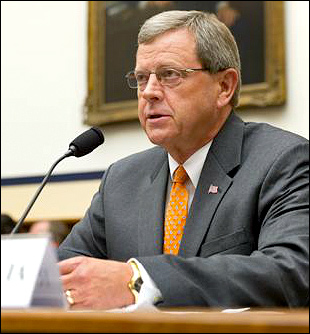
Rep. Tom Latham

Rep. Tom Latham

Rep. Tom Latham (R-IA-3) announced yesterday that he will not seek the open Iowa Senate seat next year. His decision is not particularly surprising. Iowa insiders had been indicating for more than a week that the 10-term congressman was leaning against launching a statewide bid.

In publicizing his decision, Latham indicated that he had just been re-elected to the House in a much different post-redistricting CD — in fact, 83 percent of the constituents are new to him — and a two-year statewide campaign would take him away from properly fulfilling his current responsibilities.

Politically, though he was commonly seen as the best general election candidate the Republicans could field, he faced a major obstacle in the GOP primary. Rep. Steve King (R-IA-4), fresh from his own convincing re-election victory over a strong and well-known Democratic opponent, commands the inside track to the Senate nomination. King is backed with vigorous Tea Party support and enjoys strong grassroots presence for his Republican nomination campaign, which are major factors.

Late January and early February polling provided us a quick glimpse into how the  Continue reading >

First Georgia Senate Polls

Max Cleland

Max Cleland

Two different pollsters tested the Georgia electorate about their new open Senate race (Sen. Saxby Chambliss retiring) and came away finding that one party’s strongest candidate is someone who shows no interest in running.

Both Harper Polling (Feb. 11-12; 939 registered Georgia voters; 375 Republican primary voters; 338 Democratic primary voters) and Public Policy Polling (Feb. 15-18; 602 registered Georgia voters; 366 Republican primary voters) found that Democratic former Sen. Max Cleland, who served one term from 1997 to 2003 (he lost his 2002 re-election to Sen. Chambliss 46-53 percent), would defeat all potential Republican nominees if he were to run in 2014. The former senator, now 70 years old, has given no indication that he is contemplating a political comeback, however.

Tested against the four Republican US representatives who have either entered the race or are considering such, Harper projects that Cleland would place ahead of  Continue reading >

New Iowa Data

Public Policy Polling went to Iowa to test the potential Senate candidates and confirmed what Harper Polling had previously concluded: the Democrats are generally in better position statewide; Rep. Steve King (R-IA-4) is the stronger Republican primary candidate; and Rep. Tom Latham (R-IA-3) fares better than King against all Democratic potential contenders.

PPP’s poll (Feb. 1-3; 846 registered Iowa voters; 326 self-identified “usual” Republican primary voters) shows similar levels of strength when comparing Democrats Tom Vilsack, the former governor and current US Agriculture Secretary, with Rep. Bruce Braley (D-IA-1).

Vilsack would defeat King 49-39 percent, and Braley outpaces his Republican congressional colleague by a similar 49-38 percent. But against Rep. Latham, the margins tighten. Vilsack tops the Des Moines area Congressman 46-42 percent, and Braley only has a 44-41 percent lead.

A third Democrat, defeated one-term Gov. Chet Culver, who is publicly considering seeking a re-match with five-term Gov. Terry Branstad (R), is weaker in the statewide Senate contest. He leads King 48-41 percent, but trails Latham 41-45 percent.

In the Republican primary, King would place first in a four-way race at 41 percent, followed by Latham with 22 percent. If Lt. Gov. Kim Reynolds and ex-gubernatorial  Continue reading >

The First Iowa Poll

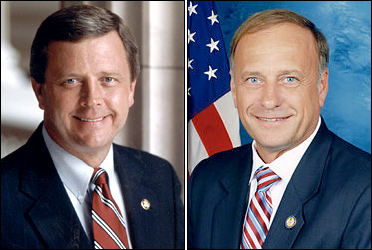
Rep. Tom Latham | Rep. Steve King

Rep. Tom Latham                                  Rep. Steve King

Harper Polling surveyed the field in Iowa, and found that early suppositions pertaining to next year’s open Senate race may already be proving true. Many believe, that on the Republican side, Rep. Steve King (R-IA-4) has an advantage for the nomination but Rep. Tom Latham (R-IA-3) is a better general election candidate. The Harper numbers show such a conclusion.

According to their Jan. 29 poll of 523 registered Iowa voters, Democratic Rep. Bruce Braley (D-IA-1) leads King 39-33 percent, but trails Latham 33-36 percent. In the statewide Republican primary, though understanding that the sample size is a very low 200 registered Republicans, King has a 46-29 percent advantage over Latham if the two were to face each other in a stand-alone battle.

Adding two other potential Republican candidates, former gubernatorial contender Bob Vander Plaats and state senator and former congressional candidate Brad Zaun, King also places first. He would lead this field 35-22-20-3 percent over Latham,  Continue reading >