Tag Archives: California

Feinstein Still Weak; Gas Tax Polling

By Jim Ellis

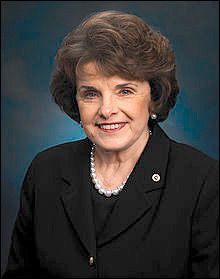
California Sen. Dianne Feinstein (D)

California Sen. Dianne Feinstein (D)

Oct. 18, 2018 — Survey USA released a poll of the California electorate, one more political study that finds Sen. Dianne Feinstein (D) failing to establish command in her race against fellow Democrat Kevin de Leon, a Los Angeles state senator.

The S-USA data (Oct. 12-14; 1,200 California adults; 964 registered California voters; 762 likely California voters) sees Feinstein again locked at 40 percent support versus 26 percent for de Leon. This is the sixth survey from four different pollsters that finds the Senator in the mid to low 40s since the June 5th jungle primary. But de Leon fares much worse, failing to break 30 percent in any of the half-dozen ballot test questions.

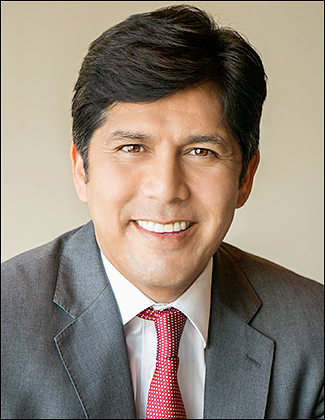
While all of the research suggests that Sen. Feinstein is politically weak, she will not lose this race. Though she brought in only $982,000 for the third quarter — a low number when campaigning in a state the size of California and understanding that many Democratic House candidates have brought in millions during the same period — de Leon raised just $254,000 and has a mere $309,000 cash-on-hand for the period ending Sept. 30. This is a low figure for a congressional race, let alone for a place that’s 53 times as large as a single CD.

California Senate President Kevin de Leon (D-Los Angeles)

California Senate President Kevin de Leon (D-Los Angeles)

The other feature potentially making the California Senate race a wild-card contest is the vote drop-off that we will see when comparing turnout for this office to the rest of the statewide ballot.

In 2016, when two Democrats were competing for an open Senate seat — the now-Sen. Kamala Harris vs. then-Rep. Loretta Sanchez (D-Garden Grove) — fewer votes were cast for that contest than in any other statewide election, including all of the ballot propositions. In fact, over 1.9 million more people voted in the presidential race than in the Senate race, and 1.3 million more chose to decide the last ballot initiative that banned single-use plastic bottles.

What occurred was a plethora of Republican voters simply skipping the Senate race rather than supporting one of the two Democrats. With de Leon running to the ideological left of Feinstein the Republican vote will likely drop even further, which becomes an interesting factor.

Continue reading

Forecasting the Results – Part II

By Jim Ellis

2018-democrat-house-majority-breakdown-text-graphicOct. 8, 2018 — The Democrats need to convert a net 24 seats to secure a one-seat majority in the US House on Election Day, Nov. 6. Many reports quote the number 23 as what is necessary to win control, but the new Pennsylvania map will yield one seat coming back to the Republicans — the new open 14th District — thus pushing the total up to 24.

As stated Friday, our forecasts listed below are based upon a series of factors, including current polling numbers, voter history, candidate personal and job approval favorability, fundraising, other races on the state ballot that could drive turnout, and outside issues such as the confirmation vote to for Judge Brett Kavanaugh to become a Supreme Court Justice, which could change the turnout model, etc.

According to our new analysis, the Democrats are on the cusp of converting the requisite number of Republican seats to take a bare majority and seeing their caucus become significantly larger. At this point, the Democratic gain range appears to reach 23 on the low side and 35 at the apex.

Looking at the country by state and region, it appears the Democrats will do well in the Midwest, in particular. The Great Lakes region that delivered President Trump his surprise victory appears to be snapping back to the Democrats in the midterm House races. Michigan looks particularly good for them at both the statewide and district levels.

Continue reading

VA-10: Momentum Change;
Dems: Eye-Popping Dollars

By Jim Ellis

Virginia state Sen. Jennifer Wexton, D-Loudoun County (left) | Rep. Barbara Comstock, R-McLean (right)

Virginia state Sen. Jennifer Wexton, D-Loudoun County (left) | Rep. Barbara Comstock, R-McLean (right)

Oct. 4, 2018 — Recently, signals were developing that Virginia Rep. Barbara Comstock’s (R-McLean) campaign status against state Sen. Jennifer Wexton (D-Loudoun County) was trending poorly to the point that she was becoming one of the most endangered incumbents in the nation. Now, the political winds appear to be changing.

In June, Monmouth University released a survey that found the congresswoman dropping behind her Democratic opponent by a substantial margin, 50-41 percent, under a standard midterm turnout model; President Trump’s approval rating was severely upside down; and rumors were circulating that the National Republican Congressional Committee (NRCC) was looking to cancel its multi-million dollar media air time reservation.

Now, things have picked up for Comstock. Yesterday, Monmouth released their new survey for this district (Sept. 26-30; 374 likely VA-10 voters), and it shows her gaining strength when compared to their June data. Still, Wexton leads in all three of their projected turnout models, but it is clear that the momentum is moving in Comstock’s direction.

Under the standard midterm participation model, the Wexton lead is 50-44 percent. If the turnout is low, her margin dips to 50-46 percent. And, if a “Democratic surge” actually takes hold of the electorate, the margin increases to 53-42 percent.

Though Rep. Comstock is behind under all turnout models, her standing has improved in each since June, and reports from inside her campaign suggest the numbers might be even better. Under the standard turnout model forecast in June, the Comstock gain is a net three percentage points. Within the low turnout model, she gains a net five points, and even her standing vis-a-vis the “Democratic surge” is better, by a net two percent.

Continue reading

The Healthcare Air Wars

By Jim Ellis

Oct. 2, 2018 — With the economy performing well, most recent polling finds jobs and taxes often dropping to third place as an answer to the most important issue question. Depending upon the geographic region, immigration ranks as the second most mentioned topic, but almost all now cite healthcare as number one.

(NY-24, Democrat Dana Balter’s healthcare ad)

Therefore, it is not surprising to see campaigns on both sides driving very different healthcare messages.

Democrats are consistently hitting Republicans over their vote to repeal the Affordable Care Act, as the Dems call it, or Obamacare, as is the GOP reference. The Democrat attacks claim that, because of this vote, the Republican House members wanted to rescind insurance coverage for those with pre-existing medical conditions. Lately, they’re adding an attack that Republicans attempted to invoke an “age tax”, claiming that the vote to repeal would have increased insurance costs five-fold for people over 50 years of age.

Republicans are countering that the “Medicare for all” plan that some Democrats advocate will cost $32 trillion dollars and result in a “doubling of the income tax.”

Continue reading

Will He Stay Or Will He Go?
New Duncan Hunter Poll Released

By Jim Ellis

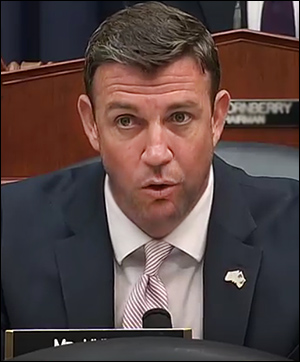
California Rep. Duncan Hunter (R-Alpine)

California Rep. Duncan Hunter (R-Alpine)

Oct. 1, 2018 — One of the more interesting asides for the coming election is whether the two indicted congressmen, California’s Duncan Hunter and New York’s Chris Collins, can still win re-election. Since the House partisan division may be close, every seat is of critical importance particularly to Republicans who are attempting to hold their tenuous majority and risk both of these seats.

Monmouth University just released their new poll in California’s 50th Congressional District, testing Rep. Duncan Hunter’s political strength. As you may remember, Hunter is under federal indictment for campaign finance violations.

According to the Monmouth data (Sept. 22-26; 401 potential CA-50 voters who have cast a ballot in at least one of the last four primary or general elections or have newly registered to vote since January 2016), Hunter still has majority support in a district that President Trump carried, 55-40 percent.

Monmouth has been testing different turnout models in all of their latest polls. They look at all registered voters, a standard midterm model, and one that features a “Democratic surge.” In this poll, as in many other Monmouth surveys around the country, the tested Democratic candidate performs better under the registered, or “all voters” model, than under a Democratic surge, so it’s unclear as to the value of the latter test framework.

Continue reading

Senate Recap – Part I

By Jim Ellis

US Senate makeup

Current US Senate makeup

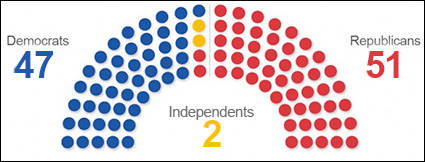
Sept. 21, 2018 — From the 35 US Senate in-cycle races it is clear that the major contests are narrowing to 16 competitive political battles. A 17th campaign, the one in California between Sen. Dianne Feinstein (D) and state Sen. Kevin de Leon (D-Los Angeles), is also competitive, at least to a degree, but since both candidates are Democrats the outcome will not alter the partisan composition. Therefore, the Golden State does not factor into the battle for the Senate majority.

Today, we look at eight of the races and provide a quick update on the latest developments. Concentrating on the 16, if Republicans win any four they will hold at least a bare majority.


ARIZONA

The race between Reps. Kyrsten Sinema (D-Phoenix) and Martha McSally (R-Tucson) has been flip flopping in the polls. Seven polls have been released in September. Rep. Sinema has led in five by an average of 3.4 percentage points. Rep. McSally took the lead in two surveys, with a mean of two percentage points.

A new independent group entitled Defend Arizona has launched a series of ads attacking Sinema that highlight previous statements advocating leniency for men who engage in child prostitution when the latter individual looks older than her age. How this line of attack will affect the race remains to be seen.


FLORIDA

Sen. Bill Nelson (D) is facing the strongest challenge of his career from Gov. Rick Scott (R). This race has been frequently polled, and no September study gives either man a lead of more than two points. Three polls project a Scott lead of one or two points. One survey gives Sen. Nelson a one-point edge, and a fifth study finds the two candidates deadlocked in a flat tie at 49 percent apiece.

Some believe that Tallahassee Mayor Andrew Gillum’s presence on the statewide ticket as the Democratic gubernatorial nominee will help Sen. Nelson, others believe it will hurt. Those arguing that Gillum helps say that he will increase minority turnout, and that Nelson will tangentially benefit because such voters would likely vote straight Democratic. Those believing Gillum is a negative indicate that he will be portrayed as being too far left, which could be an impetus to spur more conservatives to vote.


INDIANA

Sen. Joe Donnelly (D) faces former state representative and international businessman Mike Braun (R). Fox News conducted the only September poll in this race. Among likely voters, Braun had a two-point lead. But the registered voter universe tipped the scale toward Sen. Donnelly by a margin of just one point.

This is one more race that is a pure toss-up as we approach the last month of campaigning.


Continue reading

Sen. Feinstein Slips Below 40 Percent

California Sen. Dianne Feinstein (D)

California Sen. Dianne Feinstein (D)

By Jim Ellis

Sept. 10, 2018Sen. Dianne Feinstein (D) was first elected a California senator back in 1992 when she won a special election to fill Pete Wilson’s unexpired term. Wilson left the Senate when he was elected governor in 1990, ironically, defeating Feinstein to win the post. He then appointed state Sen. John Seymour as his replacement, who then lost the special election challenge to Feinstein. She won a close re-election in 1994, and then won easily in 2000, 2006, and 2012. Despite being 85 years of age, the senator currently is running for a fifth full, six-year term.

However, this 2018 campaign is a much different one for the veteran senator. Pitted against another Democrat in the general election thanks to California’s top two (regardless of political party affiliation) primary nomination system, this contest appears to be the most difficult one she has faced since losing to Wilson in the governor’s campaign, and then barely winning Senate re-election four years later against then-Congressman Michael Huffington (R).

While the senator has led in every poll and finished first in the jungle primary, she has yet to top 50 percent. The new survey released late last week from Probolsky Research (Aug. 29-Sept. 2; 900 registered California voters), actually places her not only below 50 percent, but well under 40 percent. According to the Probolsky, Sen. Feinstein leads state senator and former state Senate President Kevin de Leon (D-Los Angeles) by only a 37-29 percent margin.

Continue reading