Category Archives: Governor

President or Senator?

By Jim Ellis — Tuesday, March 11, 2025

Governor

Georgia Gov. Brian Kemp (R)

A sitting Governor and a recently retired ex-state chief executive have key political decisions to make soon.

Both Gov. Brian Kemp (R-GA) and former Gov. Roy Cooper (D-NC) are reportedly weighing running for the Senate in 2026 and/or organizing a 2028 presidential campaign. Each says he is not yet ready to announce any future political plans.

A third Governor, Michigan’s Gretchen Whitmer (D), is in a similar position but she is more definitive about running for President in 2028, so it is highly doubtful that she will enter her state’s open 2026 Senate race.

Former North Carolina Gov. Roy Cooper (D)

The two men are under intense pressure from party leaders to run for the Senate next year. Polling shows both Gov. Kemp, term-limited in 2026, and ex-Gov. Cooper, who was ineligible to seek a third term in 2024 because of North Carolina’s term limit law, leading their respective incumbent Senator of the opposite party, Jon Ossoff (D-GA) and Thom Tillis (R-NC).

The latest Georgia poll (WPA Intelligence; Jan. 14-15; 500 likely Georgia voters; live interview) projects Gov. Kemp topping Sen. Ossoff, 46-40 percent, while the other tested potential challengers, i.e., Reps. Buddy Carter (R-Pooler/Savannah), Rich McCormick (R-Suwanee), and Mike Collins (R-Jackson), all trail.

A new Public Policy Polling survey of North Carolina general election voters (March 4-5; 662 registered North Carolina voters) sees two-term Sen. Thom Tillis (R) beginning his re-election effort four points behind Cooper, 47-43 percent.

While it is typical to see a Republican trailing in a North Carolina poll – there is usually a two-point under-poll factor for GOP candidates in the state – a poor Tillis job approval ratio of 25:46 percent favorable to unfavorable according to the PPP data should be of obvious concern. Some of the disapproval is coming from Republican voters, however, who don’t believe Sen. Tillis has been sufficiently loyal to President Donald Trump.

Gov. Kemp says he understands the need to make a decision in the near future but will not do so until the Georgia state legislative session adjourns shortly after the beginning of next month. Kemp is also chairman of the Republican Governors’ Association, which he says significantly adds to his time commitments for the 2026 election cycle.

For his part, Cooper says he will make a decision about running for the Senate “in the next couple of months.”

For North Carolina’s Cooper, running for President may be an easier decision than for Gov. Kemp. In what will be an open 2028 presidential campaign for both parties, the Democratic field will be in free-for-all status because they do not have an incumbent Vice President. With the paucity of Democratic elected officials coming from the south, Cooper could reasonably build a southern strategy in the Democratic primaries that would make him a major factor with a large number of committed delegates.

For Gov. Kemp, the presidential road to the Republican nomination would be rockier since incumbent VP J.D. Vance should have the inside track to the 2028 party nomination. While sitting Vice Presidents have often not fared well in general elections, they have been near perfect in securing party nominations. With Vance already knowing the 2028 presidential campaign will be open, he would begin such a campaign with a major advantage.

At this point, however, since we usually don’t see recent Governors running for Senate because they often find the transition from an executive to being one of 100 in a legislative body difficult, it would not be shocking to see both men decline the Senate opportunity.

If so, the Georgia Republicans are ready with a political bench. Already the aforementioned three Representatives: Carter, McCormick, and Collins, are waiting in the wings to run for the Senate, and there are seven additional GOP statewide officers each with a winning electoral record.

In North Carolina, the Democrats have five sitting statewide officials, although two are unlikely to run for the Senate. Gov. Josh Stein (D) was just elected in November and probably would not give up his current position so quickly to run for the Senate.

Secretary of State Elaine Marshall, who was elected in 1996 when defeating NASCAR champion Richard Petty (R) and will turn 80 years old shortly after the November 2026 election, is another who will not run for the Senate.

The other office holders, including Lt. Gov. Rachel Hunt, the daughter of former Gov. Jim Hunt and an ex-Charlotte area state Senator, could become Senate candidates. The other statewide Democratic officials who were elected in 2024 and would have a 2026 free ride, are Attorney General and former Congressman Jeff Jackson and Superintendent of Public Instruction Mo Green.

In the US House delegation, Reps. Don Davis (D-Snow Hill/Rocky Mount), Deborah Ross (D-Raleigh), and Valerie Foushee (D-Hillsborough/Chapel Hill) could conceivably enter a US Senate race. Therefore, even without MCooper, the Democrats will have credible options with whom to challenge Sen. Tillis.

Regardless of who challenges the incumbent Senators in Georgia and North Carolina, both states will be on the 2026 political front burner.

Is Sherrod Brown Tipping His Hand?

By Jim Ellis — Thursday, March 6, 2025

Senate/Governor

Former Ohio Sen. Sherrod Brown (D)

Former Ohio Sen. Sherrod Brown (D) just published a long 4,000-plus word essay in the New Republic magazine in which he tries to chart for the Democratic Party a new path forward. (Read article here: New Republic magazine article)

The article also may signal Brown’s willingness to make an electoral comeback attempt in either the 2026 Ohio Senate or Governor’s race.

In the article, Brown says, “… Democrats must reckon with how far our party has strayed from our New Deal roots.” And, “How we see ourselves — the party of the people, the party of the working class and the middle class — no longer matches up with what most voters think.”

He further explains, “… our party’s problem with workers isn’t a two or a four-year problem. It goes back at least to the North American Free Trade Agreement.” And, “People … expected Republicans to sell them out to multinational corporations. But we were supposed to be the party that looked out for these workers — to be on their side, to stand up to corporate interests. And as a national party, we failed.”

One of his situational remedies is that, “Democrats must become the workers’ party again.” And, he says, “To become the workers’ party, we need to better understand workers and their lives, and we need to have ordinary workers more actively involved in the party and its decisions.”

While former Sen. Brown’s message toward the working class may have political attractiveness, this same theme landed on deaf ears throughout the very areas of Ohio that his revised message targets. In the 2024 Senate race, which he lost to newly elected Sen. Bernie Moreno (R), 50.1 – 46.5 percent, the incumbent Democrat could only manage to carry eight of the state’s 88 counties.

Seven of those eight domains — all in Ohio’s metropolitan counties and containing the cities of Akron, Cincinnati, Cleveland, Columbus, Dayton, and Toledo — also voted for Kamala Harris. In fact, the only rural, coal country county that both Harris and Brown carried was Athens County, found along the West Virginia border.

The lone county that Brown won where Harris lost was Lorain County, a western suburban Cleveland entity that Brown represented during his seven-term tenure in the US House. All of Ohio’s other 80 counties voted for both Donald Trump and Moreno.

In Ohio’s 2026 political situation, Gov. Mike DeWine (R) is term-limited, meaning there will be an open Governor’s race. The GOP nominee will likely be either businessman and former presidential candidate Vivek Ramaswamy, who already carries an endorsement from President Trump, or two-term Attorney General Dave Yost.

In the Senate, appointed incumbent Sen. Jon Husted (R), the state’s former two-term Lieutenant Governor and previous two-term Secretary of State, will be defending his seat on the ballot for the first time.

Therefore, if former Sen. Brown is planning to make a run for either office, this article may be laying the groundwork as to how he will deliver his pitch during the 2026 campaign to an electorate that just rejected him.

His long record of winning, however, through campaigns for the Ohio House of Representatives, Secretary of State, US House, and US Senate, and losing only one time since originally being elected in 1974, suggests he will be a formidable candidate able to develop a unique message should he decide to run for either of the statewide offices.

It will be interesting to see what Brown decides, since he is clearly the strongest potential candidate in the Ohio Democratic stable despite his 2024 loss. The Governor’s race might make the most sense for a political comeback instead of attempting to regain a seat that he lost.

To begin with, the Governor’s race is open, and the term will be four years. The Senate race would be against an appointed, but well-known, incumbent and decided upon federal issues that clearly cut against the Democrats in the last election.

Additionally, even if Brown were to defeat Sen. Husted in the 2026 special election, he would then have to immediately turn around and face another campaign in the 2028 election cycle for the full six-year term.

The Ohio situation is worth monitoring because as Sen. Brown points out in his article, change must happen if the Democratic Party is to quickly rebound from their 2024 losses.

Recruiting Governors for the Senate

By Jim Ellis — Wednesday, Feb. 26, 2024

Governor

Georgia Gov. Brian Kemp (R)

Over the weekend, Georgia Gov. Brian Kemp (R), who now serves as chairman of the Republican Governors Association, was again asked in an interview if he will challenge first-term Sen. Jon Ossoff (D) next year. As has been his practice, the Governor’s response was non-committal.

Looking at the national Senate picture for the 2026 election cycle, we see many sitting or recently term-limited Governors in a similar position to that of Gov. Kemp. In fact, there are a total of seven term-limited state chief executives who could challenge a Senator of the opposite party next year. Presidential aspirations could also play a significant role in determining which Governors might run for the Senate versus those who would want to concentrate on entering what will be an open 2028 presidential race for both parties.

In addition to Gov. Kemp, the four Governors attracting the most Senate attention are also the most prominent ones said to be weighing their national prospects.

Virginia Gov. Glenn Youngkin (R), whose term ends at the beginning of 2026, is in position to challenge Sen. Mark Warner (D). Gov. Youngkin was discussed as a possible Vice Presidential candidate and appears to have the desire to run for President. What he may decide is unclear right now. For the Senate, though he is the best possible candidate for the GOP, Gov. Youngkin would still be at least a slight underdog to Sen. Warner.

Kentucky Gov. Andy Beshear (D) won’t leave office until the beginning of 2028, but he would be the best Democratic candidate to enter the now open 2026 Senate race. He has previously said he wouldn’t run for the Senate but has not ruled out running for President. Still, he will be under strong pressure from national Democrats to run for the Senate since he is realistically the only Kentuckian who may be able to deny the Republicans from hanging on to retiring Mitch McConnell’s seat.

Sen. Thom Tillis (R-NC) is standing for a third term in North Carolina, a state that always features close races, and the 2026 campaign appears as no exception to that electoral pattern. Former North Carolina Gov. Roy Cooper (D) was term-limited in 2024 and has been actively looking at both a Senate and presidential run. Like Gov. Youngkin, Gov. Cooper was also considered as a Vice Presidential running mate.

Cooper, of the four Governors with presidential hopes, appears most open to launching a Senate bid. He has said several times that he will make a decision “within a few months.”

Michigan Gov. Gretchen Whitmer (D) has been commonly associated with a 2028 presidential run. With Sen. Gary Peters (D) retiring, the Michigan Senate race will become one of the hottest 2026 campaigns. Since Sen. Peters has surprisingly left the Senate seat open, party leaders will certainly attempt to persuade Gov. Whitmer to jump into the race.

The party hierarchy’s argument to her should be bolstered since early 2026 Senate campaign polls find Republican former Congressman and close 2024 Senate finisher Mike Rogers leading ex-US Transportation Secretary Pete Buttigieg. Buttigieg tops a potential Democratic primary by a spread beyond the polling margin of error.

Kansas Gov. Laura Kelly (D) cannot seek re-election, but she will draw attention from the national Democratic leaders who are desperately looking to find a credible candidate against first-term Sen. Roger Marshall (R). Though Gov. Kelly has not indicated any interest in the Senate race, nor talked about running for President, it will not escape the party strategists that she would make a race against Sen. Marshall very competitive.

Maine Gov. Janet Mills (D), her public rift with President Trump notwithstanding, is also term-limited and could challenge Sen. Susan Collins (R). Gov. Mills would be 79 years old should she try to begin a Senate career by running in 2026. Previously, she has deflected questions about challenging Sen. Collins, but after going to war with President Trump over transgenders in school sports, her desire about entering the federal political ring may be changing.

In 2020, Democratic nominee Sara Gideon spent more than $64 million to try to defeat Sen. Collins — not counting millions more in outside spending — and led in almost all polling; however, she failed to even make the final result close, as Sen. Collins was re-elected with a 50-42 percent victory margin. Though Gov. Mills would be a stronger candidate, upending Sen. Collins still would be a difficult task.

Many 2026 questions remain to be answered, but it is possible that we could see an abnormally high number of seriously challenged Senate races soon unfolding.

Ohio: Ramaswamy In, Trump Endorses

By Jim Ellis — Tuesday, Feb. 25, 2025

Governor

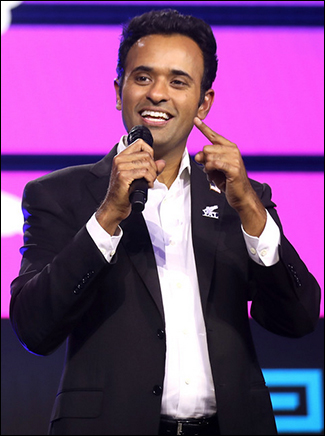
Republican Vivek Ramaswamy / Photo by Gage Skidmore

Businessman and former presidential candidate Vivek Ramaswamy (R) released his official Ohio Governor’s campaign website at the end of last week, thus kicking off the contest to succeed term-limited Gov. Mike DeWine (R) and yesterday he received a big boost.

The Republican primary race already appears to be evolving into a two-way battle between Ramaswamy, leading in all early nomination campaign polling, and two-term Attorney General Dave Yost.

A newly released Yost campaign survey, however, suggests the race could eventually tighten, and that an endorsement from President Donald Trump for one of the candidates could prove determinative. Yesterday, the President gave Ramaswamy his “complete and total endorsement.”

The National Public Affairs polling organization conducted an early February Ohio survey for the Yost campaign (Feb. 2-5; 602 likely Ohio Republican primary voters; live interview and text) and, like other research studies, found Ramaswamy posting a major lead, 46-18 percent.

Earlier, WPA Intelligence (Jan. 28-30; 600 likely Ohio Republican primary voters) saw Ramaswamy holding a 57-28 percent advantage over Yost. The Fabrizio Lee & Associates firm also tested the state in late January (Jan. 26-27; 600 likely Ohio Republican primary voters) and projected the Ohio entrepreneur topping AG Yost with a 52-18 percent margin while the since withdrawn State Treasurer Robert Sprague posted two percent preference. (Mr. Sprague, term-limited in the coming election as Ohio’s Treasurer, quickly dropped out of the Governor’s race and instead entered the open Secretary of State’s contest endorsing Ramaswamy as he exited.)

While all of the released public polls basically arrive at the same conclusion, NPA provided further information in their survey analysis that attempts to cast the largely uniform results in a different political light.

According to NPA partner Justin Clark, “our findings indicate that this early advantage is a ‘sugar high’ driven by a pre-inauguration media saturation that led to high name ID and perceived association with President Trump. That said, even at this high point of public opinion, polling support for Ramaswamy is incredibly soft. Beyond the temporal component of his losing the “sugar high” after quitting the Trump administration before it even started, the survey is clear that voters align closest to the candidate that receives the backing of President Trump … whoever that candidate is.”

We now know who Trump will endorse and it’s Ramaswamy. The Yost pollsters clearly understand the impact of presidential support in the Republican primary as their polling analysis explains.

After a series of unreleased push questions that constituted what NPA described as the “informed ballot” brought Yost within one point of Ramaswamy, the horse race question was then asked to determine what effect Trump endorsing the Attorney General would have on the primary election. If such were the case, Yost would pull ahead of Ramaswamy, 42-22 percent; hence, the power of an early Trump endorsement.

In terms of the favorability index, President Trump maintains an 82-16 percent positive to negative ratio and Vice President and former Ohio Sen. J.D. Vance scores an almost identical 81:16 percent. Ramaswamy posts a 64:15 percent score, which is better than newly elected Sen. Bernie Moreno (65:22 percent), and Attorney General Yost (53:14 percent), though all the sampled Republican primary voters viewed each tested figure very favorably.

Clearly, Ramaswamy wants to deliver an early knockout blow, and it appears he has the assets to make that happen. With a big lead in early polling and, as of yesterday, Trump’s endorsement, it appears the former presidential candidate has the package he needs to secure the Republican nomination. With that, he will have the inside track for the general election in a state that is trending more Republican.

The only Democrat to so far announce for Governor is former Ohio Health Department director Amy Acton. Other, and likely stronger, potential candidates are waiting in the wings. It is unclear if any or all of the following would make a gubernatorial run, but some from this group are likely to try.

Those Democrats mentioned as considering a bid for Governor are: former Senator Sherrod Brown, Cincinnati Mayor Aftab Pureval, Cleveland Mayor Justin Bibb, Columbus Mayor Andy Ginther, state Supreme Court Justice and former Secretary of State Jennifer Brunner, and former Congressman, 2016 presidential candidate, and 2022 US Senate nominee Tim Ryan.

Ex-Ohio State Football Coach Appointed Lieutenant Governor

By Jim Ellis — Thursday, Feb. 13, 2024

Governor

Jim Tressel

Ohio Gov. Mike DeWine (R) announced at a news conference that he has appointed former Ohio State head football coach and ex-Youngstown State University president Jim Tressel to fill the state’s vacant Lieutenant Governor’s position.

The office came open when the Governor appointed Jon Husted (R) to the US Senate to replace Vice President J.D. Vance. Immediately, reporters pummeled Tressel with questions regarding whether he would run for Governor next year, queries that both he and DeWine avoided answering.

In Ohio, the Lieutenant Governor runs on a ticket with the Governor. In 2018, during the open Republican primary, Husted, then Secretary of State, was competing against DeWine in the Republican gubernatorial primary along with then-Lt. Gov. Mary Taylor. Because it appeared that DeWine and Husted could split the center-right vote, which could reasonably have allowed Taylor to win after consolidating the political right, a deal was cut.

Husted offered then-Attorney General DeWine a proposition where he would exit the Governor’s race and run as the latter’s Lieutenant Governor running mate. DeWine accepted the arrangement and the two went onto victories in both the 2018 Republican primary and general elections. In 2022, the DeWine-Husted ticket won re-election with just over 62 percent of the vote.

Their teamwork plan included DeWine then supporting Husted for Governor in 2026, something that the Governor was prepared to do until the state’s junior Senator, J.D. Vance, was elected Vice President. At first, the Lieutenant Governor indicated he wanted to stay in the Governor’s race and battle Attorney General Dave Yost for the party nomination. It always appeared, however, that Husted was the obvious choice to take the Senate seat and was eventually prevailed upon to take that role.

Now businessman and former presidential candidate Vivek Ramaswamy is, with great fanfare, about to enter the Republican gubernatorial primary and polling suggests he begins with an overwhelming lead. State Treasurer Robert Sprague, who was briefly a gubernatorial candidate, exited the Governor’s race and endorsed Ramaswamy who is not yet even an official contender. Term-limited Secretary of State Frank LaRose, who ran unsuccessfully for Senate in 2022 and was considered a potential entry into the Governor’s race, late last week announced instead a bid for state Auditor.

Therefore, DeWine’s move to Tressel could be a plan to at least make the Republican gubernatorial campaign more competitive should the latter man, popular with high name ID due to his championship run as an Ohio State football coach, decide to run for Governor.

Tressel coached at Ohio State for 10 years and won a national championship. He resigned under a cloud, however, as the university was cited for recruitment violations under his domain. Prior to his coaching tenure with the state’s premier college football program, he coached for 14 seasons at Youngstown State. Regardless of the details concerning his exit from Ohio State, Tressel still enjoys a generally positive personal image.

At the apex of his coaching career, it was speculated upon that Tressel might mount challenges to then-Sen. Sherrod Brown (D). In both of those election years, however, Tressel chose not to run. Therefore, it is far from certain that he will enter the current Governor’s race.

For his part, Ramaswamy says he will make “a big announcement” in late February. All expect him to announce his gubernatorial candidacy at that time. Certainly, his involvement, and now possibly Tressel’s, is making the open Ohio Governor’s campaign possibly the premier 2026 political contest in terms of attracting national media attention. Expect this pattern to continue for quite some time.

New Jersey Free-For-All

By Jim Ellis — Tuesday, Feb. 11, 2025

Governor

New Jersey Rep. Mikie Sherrill

Two late January political surveys post Rep. Mikie Sherrill (D-Montclair) holding small leads in the crowded 2025 New Jersey Democratic gubernatorial primary, but all six candidates remain very much in the running.

Public Policy Polling (Jan. 22-23; 615 likely New Jersey Democratic primary voters) finds Rep. Sherrill clinging to a 16-11-9-9-9-5 percent edge over New Jersey Education Association President Sean Spiller, while the next three contenders, Newark Mayor Ras Baraka, Jersey City Mayor Steve Fulop, and former state Senate President Steve Sweeney, are all tied and slightly ahead of Rep. Josh Gottheimer (D-Wycoff).

A day earlier, Emerson College finished their statewide poll (Jan. 18-21; 437 likely New Jersey Democratic primary voters; 334 likely Republican primary voters; multiple sampling techniques) which also saw a jumbled Democratic field with most voters responding that they have yet to make a determinative decision.

According to the Emerson data, Rep. Sherrill also records a small lead but with a spread even tighter than PPP’s finding. The Emerson ballot test projects a 10-8-8-7-7-4 percent posting with Sherrill leading followed by Spiller, Mayor Baraka, Rep. Gottheimer, Sweeney, and Mayor Fulop. Again, this data suggests that the Democratic primary race is wide open, and all six contenders could still develop momentum to win the June 10 plurality primary.

The eventual Democratic nominee, according to the Emerson poll, is likely to face 2021 GOP nominee Jack Ciattarelli, a former state Assemblyman who lost to Gov. Phil Murphy (D) in a 51-48 percent finish that was much closer than expected.

The Emerson poll also forecasts Ciattarelli with a large but not insurmountable Republican primary lead. According to the ballot test results, the 2021 gubernatorial nominee would lead radio talk show host Bill Spadea, 26-13 percent, with state Sen. Jon Bramnick (R-Plainfield) posting four percent, while five other minor candidates poll support figures of three percent or less.

Political party registration in New Jersey, according to the NJ Division of Elections latest data (Feb. 1, 2025, report), finds Democrats holding a 37.4 – 24.4 percent edge in partisan affiliation. A total of 37.0 percent are unaffiliated, with slightly less than one percent of the electorate being registered in a minor political party.

Republicans, however, have gained a half-percentage point in relation to the Democrats in the three-plus months since the 2024 election. This translates into a net Republican gain of 23,061 voters. In this period, Republican registration has grown 22,686 while the Democrats have dropped 375 registered voters. In January alone, the GOP net gain factor was 10,480 individuals. Should this trend continue through the 2025 election period, the November contest could turn into a highly competitive political affair.

Resources will, of course, be a major factor in the candidates moving forward. One would believe that both Reps. Sherril and Gottheimer would be dominant on the fundraising front, yet the state rules are different. Both Representatives have become two of the most prolific fundraisers in the US House, but they face a major obstacle in their respective gubernatorial bids.

Under current New Jersey financial disclosure reports, both Reps. Sherrill and Gottheimer are on the low end of the spectrum (each raising under $1.7 million – Fulop leads all candidates with just over $2.8 million raised), but that doesn’t include the transfers the federal candidates can execute. Here is where the state law penalizes the two House members. Under the state’s campaign finance law, only $17,300 can be transferred from a candidate’s committee to another committee.

According to the year-end Federal Election Commission reports, Rep. Gottheimer had just over $20 million in his congressional account, meaning he can only transfer less than one percent of his available funds. Rep. Sherrill posted just over $183,000 cash-on-hand, which means $166,000 is nontransferable.

Featuring such a crowded and unclear Democratic primary with all candidates basically on even footing, the New Jersey Governor’s race promises to be one of the more interesting statewide contests slated for this year.

Rep. Donalds Atop New Gov Poll

By Jim Ellis — Monday, Feb. 10, 2025

Governor

Florida Rep. Byron Donalds (R-Naples) / Photo by Gage Skidmore

A new Florida Republican primary poll suggests that three-term Rep. Byron Donalds (R-Naples) holds an early commanding lead over selected potential 2026 candidates who will compete for the right to succeed term-limited Gov. Ron DeSantis (R).

Though no major candidate has formally announced for Governor, Rep. Donalds appears to be a definitive bet to run. The Victory Insights research firm commissioned a late January Republican voters’ poll (Jan. 26-27; 850 likely Florida 2026 Republican primary voters; interactive voice response system and text) and found Rep. Donalds holding a substantial 33-4-3-1 percent advantage over Lt. Gov. Jeanette Nunez, state Agriculture Commissioner Wilton Simpson, and Miami Mayor Francis Suarez. Not included was former Rep. Matt Gaetz who, from time to time, has indicated he would run for Governor in 2026.

It has now become unlikely that Lt. Gov. Nunez will become a gubernatorial candidate. This week it was announced that she will resign her position to become the interim President of Florida International University.

Obviously, this survey provides good news for Rep. Donalds who, despite being a relatively junior House member in terms of seniority, is a frequent guest on a variety of Fox News programs. Therefore, he has become well known to his state’s conservative voter base.

Gov. DeSantis may not view Rep. Donalds’ current standing in the 2026 Governor’s campaign as entirely positive. Donalds is very close to President Trump and endorsed him over his own Governor in the 2024 presidential primaries. Therefore, DeSantis’ opportunity to recast the statewide elected officials via appointment could be his way of preparing a more favored candidate for entering the political battle that will determine his own successor.

The Florida political scene will soon change because Gov. DeSantis has the unusual opportunity of appointing an entire new slate of statewide officials.

With Marco Rubio being confirmed as President Trump’s Secretary of State, Gov. DeSantis appointed state Attorney General Ashley Moody to replace him in the Senate. This allowed Gov. DeSantis to appoint his own chief of staff, James Uthmeier, as Florida’s new Attorney General.

With Nunez resigning, the Governor will now appoint a new Lieutenant Governor, and this could be the key person to watch in the unfolding open Governor’s race.

Furthermore, the state’s Chief Financial Officer, Jimmy Patronis (R), won the special congressional primary election to replace resigned Rep. Matt Gaetz in the Panhandle’s 1st District, and he is a lock to clinch the April 1 special election. Since he was running for a different office, Florida election law dictates that an individual must resign his or her current elective position. Patronis has indicated his resignation will occur on March 31. At that point, Gov. DeSantis will appoint a new state CFO.

The Secretary of State is already a gubernatorial appointed position, and Gov. DeSantis chose then-state Rep. Cord Byrd in 2022.

Once the Governor completes the appointment process, he will have chosen every statewide official. This will certainly affect the 2026 statewide elections since all of the incumbents will be DeSantis appointees as opposed to having elected status.

Since Florida has evolved into a strong Republican state in the past few elections, the next GOP gubernatorial nominee will now be rated as a strong favorite as opposed to being cast in a toss-up race.

Florida voter registration largely tells the story. At the time of the 2020 election, Democrats had a partisan voter registration edge over Republicans of 106,986 individuals according to the Florida Secretary of State’s official voter registration statistical report. The most current figures, released Jan. 10, 2025, finds not only Republicans having more party members, but they hold an astonishing 1,156,082 individual advantage over the Florida Democrats. Thus, we have seen a net Republican registration gain of 1,263,068 persons in just the preceding four years.

While Gov. DeSantis will leave his position at the beginning of 2027, his influence over who will take his place could now become even greater thanks to all of the statewide public officials coming via his appointments.