Category Archives: 2022

Texas 2022 Candidate Filing Closes

By Jim Ellis

Dec. 17, 2021 — Texas became the first state to see candidate filing close for the 2022 elections, so the campaign season has officially been launched.

In the Lone Star State, candidates file with their respective state party organizations, or county parties if their race is fully contained within one entity, and not the Secretary of State. Therefore, the filings might not yet be fully recorded and approved. The statewide primary is scheduled for March 1. If no candidate for whatever office does not receive majority support in the first election, a runoff between the top two finishers will occur on May 24.

What we know so far is that Gov. Greg Abbott (R) will face a significant Republican primary challenge from former Florida congressman and ex-Texas Republican Party chairman Allen West and former Dallas state Sen. Don Huffines. The latter man, who was defeated for re-election in 2018, has the ability to self-fund a statewide primary campaign. Former congressman and 2020 presidential candidate Beto O’Rourke will be the Democratic nominee as he faces only minor opposition in the party primary.

Regardless of the level of competition, Gov. Abbott, though his approval ratings are at a low ebb in his seven-year career as the state’s chief executive, is a heavy favorite in both the Republican primary and the 2022 general election.

The main constitutional office of interest is the attorney general’s race. Here, embattled incumbent Ken Paxton (R), who has for years been under a federal SEC indictment that has yet to move forward, and who has been publicly accused of having an ongoing extra-marital affair, faces three strong candidates for re-nomination: State Land Commissioner George P. Bush, US Rep. Louie Gohmert (R-Tyler), and state Supreme Court Justice Eva Guzman.

Though Paxton has personal and legal problems, his favorability ratings among Republican primary voters is still surprisingly high. Forcing the two-term attorney general into a runoff election, however, is a clear possibility.

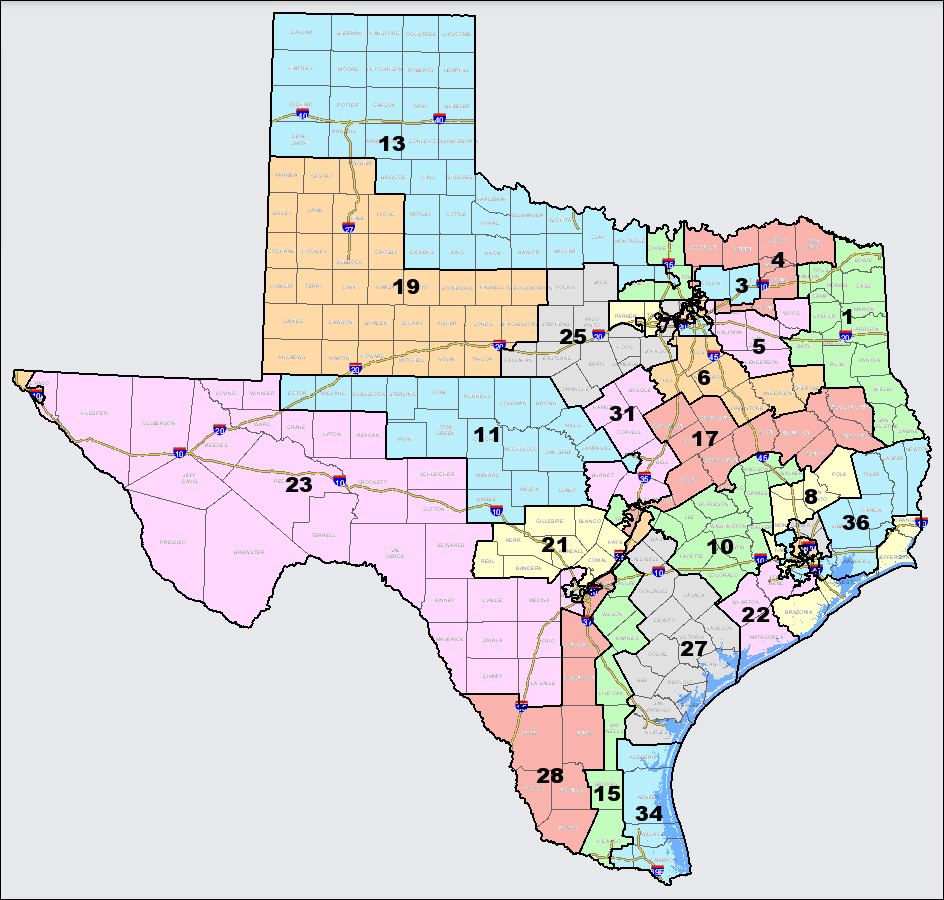
With the state having no Senate race in 2022, the federal focus turns to the new 38-member US House delegation. Texas gained two seats in national reapportionment, thus increasing their delegation size from 36 to 38 seats. The state will wield 40 electoral votes in the next presidential election, second only to California’s reduced 54.

Continue reading

New Mexico Lines Completed

By Jim Ellis

Dec. 15, 2021 — Though only a three-congressional district state, New Mexico is playing an important role in the 2021 redistricting cycle. The state is one of only four where Democrats fully control the redistricting process and can make gains.

The map that passed the legislature Monday and which was immediately sent to Gov. Michelle Lujan Grisham (D) for her signature appears to clinch the one-seat gain that national Democrats need from the state. On the other hand, it is likely that at least one of their current seats becomes more vulnerable.

Though Democrats have 15 legislative trifectas — that is where they hold the offices of governor, state Senate, and state House of Representatives — they effectively have only four for redistricting. In five of their trifecta states, redistricting has been sent to a citizens or politician (New Jersey) commission. In another six, they are maxed, meaning the Democrats already have all the seats that they can possibly win in each domain.

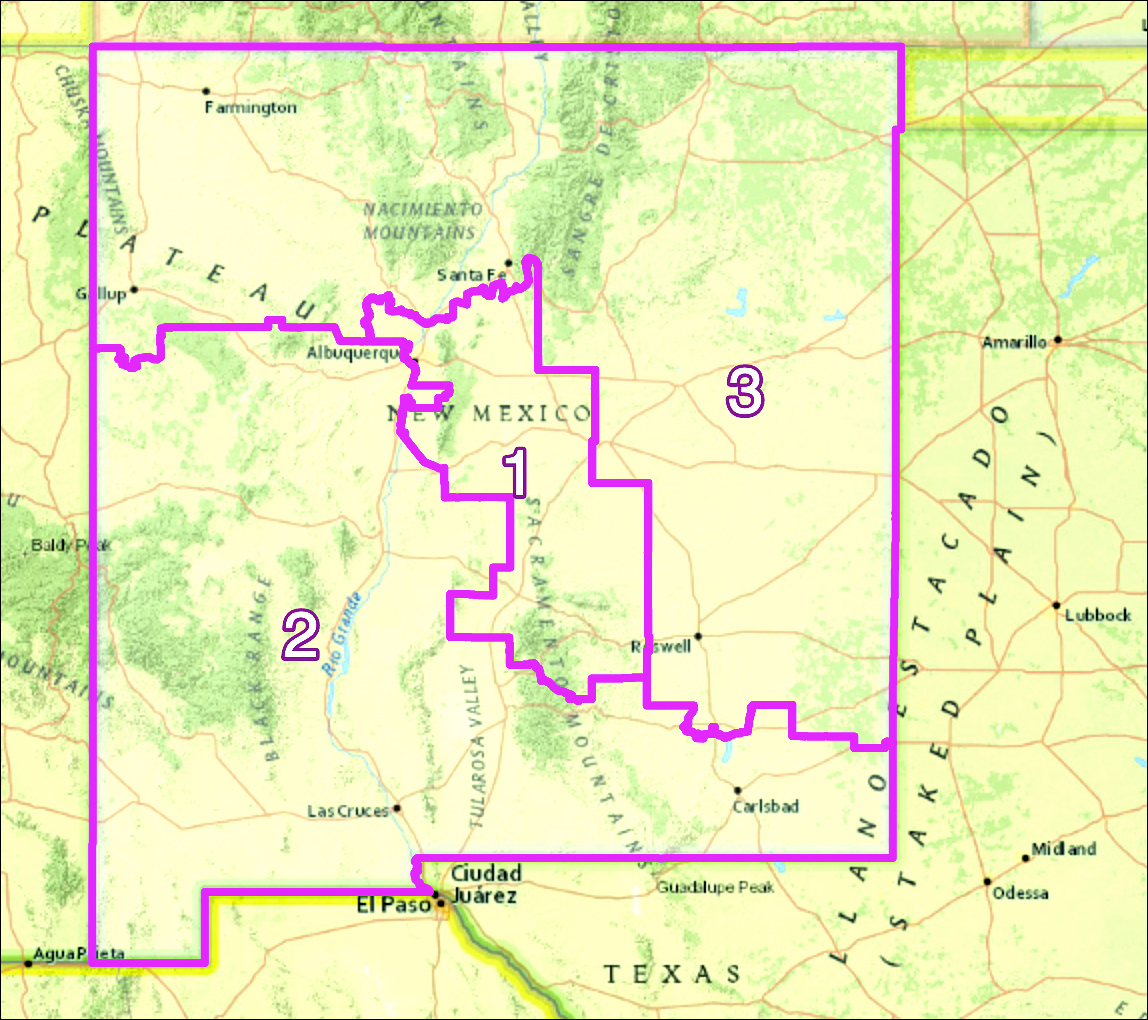
Ironically, the current Land of Enchantment map needed only minor adjustments to bring the redistricting plan into legal population compliance. The state’s per district resident quota is 705,841 individuals, and the three current districts were only between 3,082 and 11,290 people away from being in full compliance. Districts 2 and 3 needed to shed a combined 11,290 individuals to District 1, and the map would have balanced.

Instead, the Democratic leadership made major changes all centered around transforming freshman Rep. Yvette Herrell’s (R-Alamogordo) 2nd CD into a Democratic advantage. The US Department of Justice just filed suit against the Texas redistricting map under a partisan gerrymander argument, so it is curious to see whether they follow the same course and bring forth a similar partisan gerrymander lawsuit in New Mexico and Illinois, places where Democrats control the redistricting pen.

New Mexico is also interesting in that all three of the state’s delegation members, Reps. Melanie Stansbury, (D-Albuquerque) and Teresa Leger Fernandez (D-Santa Fe), as well as Herrell, are freshmen. In fact, Stansbury is even behind the other two in seniority since she won her seat in a June 1 special election to replace resigned Rep. Deb Haaland (D), who left the House to become US Interior Secretary in the Biden Administration.

For the first time, the redesigned New Mexico congressional map splits the state’s dominant city of Albuquerque. Drawing the southern 2nd District into the Albuquerque metropolitan area provides the Democrats the ability to enhance the party’s chances of flipping the seat. Throughout New Mexico’s history, the city has been fully contained within the 1st Congressional District.
Continue reading

Post Redistricting:
Competitive Seats, Part II

Nevada redistricting map

By Jim Ellis

Dec. 10, 2021 — Continuing our redistricting report about the 20 multi-congressional district states that have completed the re-drawing process, today, we look at the domains from Montana through West Virginia.


Montana:

The Montana Districting and Apportionment Commission for the first time had a congressional map to draw. The state rose from at-large status to gaining a new district in reapportionment due to strong population growth. Montana is the first multi-district state to ever fall into at-large status, as it did in the 1990 census, and then regain a second district.

Though more Democratic maps were filed for commission consideration, the main Republican offered map was adopted. One of the Democratic commissioners voted for the plan, which allowed the GOP version to prevail. Still, all of the maps created an east and west seat, with the new western seat, labeled District 1, being the more competitive.

At-large Rep. Matt Rosendale (R-Glendive) will run in the safely Republican eastern District 2, while former congressman and ex-US Interior Secretary Ryan Zinke appears to be the early leader in the western district both in the Republican primary and general election. While relatively competitive, the 1st District will clearly nominate a Republican who will be the general election favorite.


Nebraska:

The unicameral legislature and Gov. Pete Ricketts (R) enacted a new congressional map that should again deliver a 3R-0D delegation. Rep. Don Bacon’s (R-Papillion/Omaha) marginal 2nd District – Joe Biden carried the district by more than 22,000 votes – is strengthened for the incumbent, but it still remains a competitive congressional domain.


Nevada:

The Democratic legislature and Gov. Steve Sisolak (D) enacted a map that is designed to produce a 3D-1R map but, in attempting to maximize the Democratic stake, possibly all three of the party’s intended seats now fall into the potentially competitive realm.

In 2020, Clark County hosted two of the 53 districts nationally where the winning candidate scored less than 52 percent. In 3rd District Rep. Susie Lee’s (D-Las Vegas) case, her victory percentage was less than 49 percent. Fourth District incumbent Steven Horsford (D-Las Vegas) fared only slightly better at 50.7 percent. In order to strengthen these two districts, a large number of Democrats had to be taken from the previously safe seat of 1st District Rep. Dina Titus (D-Las Vegas).

The end result is three Democratic seats in the lower 50s. In a Republican year, and considering the GOP is beginning to score better with Hispanics who comprise more than 31 percent of the Clark County population, all three seats could conceivably host competitive challenge campaigns. Rep. Mark Amodei (R-Carson City), the lone Republican incumbent in the Nevada delegation, gets a safe northern state seat.


North Carolina:

The courts have been playing ping pong with the North Carolina map this week. A three-judge panel first issued a stay order on the Tar Heel State’s Dec. 17 candidate filing deadline pertaining to a redistricting lawsuit before the court. A day later, the full 15-member state Appellate Court overturned the panel’s ruling, and restored the original filing deadline. Just this week, the state Supreme Court quickly reinstated the candidate filing stay and ordered the March 8 primary postponed until May 17.

The North Carolina map is the national Republicans’ best to date. If it survives the legal challenge, the GOP could net as many as three seats in the delegation. It appears that five seats will be open, with Reps. G.K. Butterfield (D-Wilson) and David Price (D-Chapel Hill) retiring, Rep. Ted Budd (R-Advance) running for Senate, and with two more seats beign created through reapportionment and the map-drawing process.

Under the enacted map, Rep. Kathy Manning (D-Greensboro) and Virginia Foxx (R-Banner Elk) are paired in a new 11th District, which would heavily favor the GOP nominee.


Ohio:

The legislature and Gov. Mike DeWine (R) recently approved a new congressional map that may net the Republicans a one-seat gain, or could conceivably yield the Democrats a similar outcome. Three of the state’s 15 new districts are highly competitive — Ohio lost one seat in reapportionment — with two currently in Democratic hands and one under GOP control.

Reps. Steve Chabot (R-Cincinnati), Marcy Kaptur (D-Toledo), and the open 13th District seat of Rep. Tim Ryan (D-Warren), now located on the west side of Cleveland, are all tightly constructed partisan districts. In the remaining seats, Republicans hold a significant 10-2 advantage. Retiring Rep. Anthony Gonzalez’s (R-Rocky River) 16th District has effectively been collapsed.


Continue reading

Perdue to Challenge Kemp in Georgia

By Jim Ellis

Former US Sen. David Perdue (R-GA)

Dec. 7, 2021 — Something that has been rumored about and speculated upon for weeks has finally come to fruition. Defeated Sen. David Perdue has formally announced that he will challenge Gov. Brian Kemp in next year’s Republican primary.

The serious primary challenge is part of the aftermath from the 2020 election controversy where Gov. Kemp’s perceived handling of the voter fraud complaints and challenges left a significant portion of the Republican base expressing discontent. Former President Donald Trump has many times attacked Kemp on the subject and is one of the key people behind Perdue’s fledgling gubernatorial candidacy. Trump is expected to play a large role in the primary.

Georgia Gov Brian Kemp

Sen. Perdue lost his seat in the 2020 post-general runoff to Jon Ossoff (D) by a 50.6 – 49.4 percent count (54,944 votes of a total turnout of 4.48 million) after placing first in the general election by almost two full percentage points. Georgia has a majority victory rule, however, that requires all candidates to win their elections with more than 50 percent. In the November vote, Sen. Perdue fell just one-quarter percent short of securing outright victory.

One of the reasons he lost is the state’s strongest Republican counties didn’t perform in the runoff as strongly as did the best Democratic counties. Many Republicans, it is believed, did not return for the runoff because they listened to some of the key Trump leaders, including the former president himself, argue that the Georgia election system is “rigged.”

Gov. Kemp was elected in 2018, winning the primary largely because he positioned himself far to the right, thus successfully appealing to the ardent Trump Republican voter. After moderating for the general election campaign, Kemp defeated former state House Minority Leader Stacey Abrams (D) by just 54,723 votes, an almost identical number to the difference between the Ossoff-Perdue election two years later. She, like Trump, challenged the election results.

The relationship between Gov. Kemp and Trump first became strained when the former disregarded the latter’s endorsed candidate for the US Senate appointment: then-Rep. Doug Collins who was in the running to replace resigned Sen. Johnny Isakson. The three-term senator, former House member and state legislative leader, was forced to leave office for health reasons, thus allowing the governor to appoint an interim successor.

Instead of Collins, Gov. Kemp chose billionaire businesswoman Kelly Loeffler, who would go onto lose her special election runoff campaign to current Sen. Raphael Warnock (D).

Continue reading

Sans Sununu, New Hampshire Republican Candidates Still in Favorable Position

By Jim Ellis

US Senate candidate Corky Messner (R) | Photo by Amanda Blundo, Corky for Senate Campaign

Dec. 6, 2021 — A new Tarrance Group poll of the New Hampshire general electorate conducted for potential US Senate candidate Corky Messner (R) shows the Republicans in a favorable position to challenge Sen. Maggie Hassan (D) even without Gov. Chris Sununu (R) as her opponent.

The survey (Nov. 14-17; 500 likely 2022 New Hampshire general election voters, live interview) finds Messner lagging only two points behind the first-term senator, 47-45 percent. This type of ballot test result shows a weaker standing for the Republican nominee than when Gov. Sununu was paired with Hassan — in virtually every poll during the past year, the governor was leading — but a lesser known candidate’s support figure lying within the polling margin of error is certainly a positive sign for Republican chances.

Digging deeper into the poll, we find positives for both candidates. Sen. Hassan’s job approval rating is in positive territory at 50:45 percent, with a personal favorability index of 48:44 percent. Though her numbers are not stellar, considering the generic question (would you vote for a Republican or Democrat for US Senate) actually favored the GOP by a 45-42 percent count, her standing is at least stable within the context of what, for her, is an adverse political climate. Typically, the Democrats almost always lead on the generic question.

Perhaps the biggest positive for Messner from this data revolves around a ballot test within the cell group of respondents who are familiar with both candidates. This is a particularly large cell, since 74 percent of the sample participants expressed knowledge of both contenders. In looking at the ballot test figures within just this group, Messner forges into the lead, 50-43 percent.

Assuming the electorate at large would also behave in such a manner upon gaining adequate familiarity with both candidates, such a finding would be highly significant and reinforces the analysis that New Hampshire remains the Republicans’ strongest conversion opportunity.

Messner has not yet announced for the Senate, only saying he is considering becoming a candidate. He was the party’s 2020 Senate nominee, losing to Sen. Jeanne Shaheen (D), 57-41 percent, with the senator outspending Messner, $17 million to $7 million.

Continue reading

The Open and Collapsed Seats

By Jim Ellis

A look at how things might play out in key states in the redistricting tug of wars

Dec. 2, 2021 — In a redistricting year, tracking the open seats can be a bit confusing. Not only do we record retiring members and those seeking other offices, as we do in every election cycle, but in a redistricting year we also see new seats awarded to states in reapportionment, new districts created through map drawing, and collapsed seats. This, in addition to members being paired and certain incumbents choosing to run in districts other than the one they currently represent.

The open seat numbers have grown significantly during the past month. As a result, we see 24 members leaving their current districts either for retirement or to run for another office. Sixteen are from the majority Democratic conference, with eight coming from their Republican counterparts.

One seat, FL-20, remains in special election cycle and will be filled on Jan. 11. At that point, the House will have its full compliment of 435 members for the first time in this Congress.

Reapportionment changed locations within states for seven congressional seats, and map drawing has added an additional four new seats to date for a total of 11 nationally. The new seats also lead to a commensurate number of incumbent pairings or collapsed districts.

Adding the numbers from all of these categories tells us that 43 House seats have been affected in addition to four members who have declared for seats they don’t currently represent.

The collapsed seats tell their own story. In this category, certain members have nowhere to run, typically in states that lost a seat in reapportionment. In many instances, the member without a place to run is one who had previously indicated that he or she is leaving the House.

In California, the first draft redistricting map shows that Rep. Karen Bass’ (D-Los Angeles) seat would be the one collapsed, because the state is, for the first time in history, losing a district. Bass, however, previously announced that she is running for mayor of Los Angeles, so seeing her seat as the one forfeited was not a surprise.

Illinois Rep. Adam Kinzinger (R-Channahon) was geographically in a difficult position because the map drawers needed the leftward voters in his district to enhance two adjoining Democratic seats. Therefore, he became the odd man out.

Continue reading

Rep. Suozzi Announces for
New York Governor

Long Island US Rep. Tom Suozzi (D-Glen Cove)

By Jim Ellis

Dec. 1, 2021 — Turning down NYC Mayor-Elect Eric Adams’ offer of becoming one of the city’s deputy mayors, Long Island US Rep. Tom Suozzi (D-Glen Cove) instead announced Monday that he is joining the fast-growing Democratic primary for governor.

Already in the statewide race is the new incumbent, Gov. Kathy Hochul, Attorney General Tish James, and NYC Public Advocate Jumaane Williams. On the Republican side, Long Island Rep. Lee Zeldin (R-Shirley) is clearly the leading candidate for his party’s gubernatorial nomination, having already clinched the official New York Republican Party endorsement.

This is not the first time Suozzi has run for governor. In the 2006 Democratic primary, ill-fated, then-Attorney General Eliot Spitzer crushed Suozzi, 82-18 percent.

The Suozzi strategy is to take advantage of a crowded Democratic field where the other participants are all campaigning to the left. Therefore, he is calling himself the “moderate, common sense Democrat.” In a plurality election, his strategy has a chance of being successful, but the bigger question may revolve around whether he will have adequate resources to effectively communicate his message to a statewide electorate in order to develop such a fractured winning coalition.

With Rep. Suozzi foregoing re-election, it creates an additional open Democratic US House seat, a number that has grown significantly in the past two weeks, and also potentially alters the New York redistricting process.

Suozzi was first elected to the House in 2016 and twice re-elected, but failed to reach 60 percent in any of his congressional campaigns. Prior to his service in Congress, Suozzi held the Nassau County Executive position for two terms but was defeated when trying for a third. Four years later, in 2013, trying to regain his lost position, Suozzi was again defeated, this time by a strong 59-41 percent margin. Before winning his countywide position, Suozzi was twice elected as mayor of his hometown of Glen Cove, NY.

Suozzi’s 3rd Congressional District sits in Long Island’s center-west sector, hugging the north shore. The four districts that are self-contained on Long Island are a combined 148,780 people short of meeting the per-district population quota of 776,971 individuals in each of the state’s 26 congressional districts.

Continue reading