Tag Archives: Rep. Gary Peters

Three States, Three Potentially Challenging Races for Incumbents

Sen. Lindsey Graham

Sen. Lindsey Graham

South Carolina

The long-expected Republican primary challenge to Sen. Lindsey Graham is now coming to fruition. A candidate emerged yesterday who has an interesting background. It remains to be seen if she has the political wherewithal to compete with the veteran senator, however.

Nancy Mace is the first female graduate of The Citadel. Born into a military family, her father is a retired Army general. She announced her challenge to the senator late this week, joining Greenville area businessman and former 3rd District congressional candidate Richard Cash in the nomination race. State Sen. Lee Bright, coming from the Ron and Rand Paul wing of the Republican Party, says he will soon follow suit.

Can any of the three beat Lindsey Graham? While it’s clearly a long shot, the senator does have some obvious vulnerabilities. First and foremost, as any casual political observer understands, Graham is to the left of the South Carolina Republican electorate and has taken some unpopular stands in the state, such as his leadership efforts in the area of immigration reform.

Secondly, though a crowded field usually helps an embattled incumbent, South Carolina does have a run-off law, meaning it could become harder to capture a majority in a split vote primary situation. If someone is strong enough to deny the senator an outright primary victory, the scenario would then be drawn to upset him in the secondary election.

Third, while none of his opponents has significant name ID, they are all substantial individuals, and if one or more can prove they possess fundraising ability, outside conservative groups are ready to come to their aid if Graham begins to falter.
 Continue reading >

Four New Senate Polls

Four pollsters released new data in four different Senate states, each giving us some previously unknown information. Most of the results show an undefined electorate, but the one covering the upcoming Bay State special election shows a widening chasm between the two candidates.

Massachusetts

With the special senatorial election now four weeks away on June 25, New England College (June 1-2; 786 registered Massachusetts voters via automated interviews) released the findings of their latest poll. Their results show Rep. Ed Markey (D-MA-5) increasing his lead over Republican businessman Gabriel Gomez. According to the automated results, Markey now enjoys a 53-40 percent advantage, up from the single-digit spreads that previous surveys had projected.

The two candidates are vying for the right to succeed veteran Sen. John Kerry (D), who was appointed US Secretary of State earlier in the year. The winner serves the remaining segment of the current term, which ends when the 113th Congress adjourns. The new senator can then stand for a full six-year term in November of 2014.

Michigan

Public Policy Polling (May 30-June 2; 697 registered Michigan voters; 334 Republican primary voters) tested the open Senate race and found good news and bad news for Rep. Gary Peters (D-MI-14). The good news is that he leads all Republican potential candidates. The bad news is that he is unknown to two-thirds of the polling respondents.

Earlier this week, former Secretary of State Terri Lynn Land (R) announced her senatorial candidacy and she fares best against the Detroit congressman. According to PPP, Peters sports a 41-36 percent advantage over Land. He leads representatives Dave Camp (R-MI-4) 43-31 percent; Mike Rogers (R-MI-8) 42-32 percent; and Justin Amash (R-MI-3) 42-30 percent. In the Republican primary, Land finishes behind the three Congressmen (Camp 21 percent; Rogers 18 percent; Amash 16 percent; Land 15 percent), but it  Continue reading >

In Michigan, Peters Is In

Rep. Gary Peters' (D-MI-14)

Rep. Gary Peters (D-MI-14)

Rep. Gary Peters’ (D-MI-14) anticipated run for the Senate became reality yesterday as the Detroit congressman officially unveiled his statewide campaign. It has been a foregone conclusion that Peters would run since early March when veteran Sen. Carl Levin (D) publicly indicated that he would not seek re-election in 2014.

Peters is serving his third term in the House, originally winning in 2008 when he defeated Joe Knollenberg in an Oakland County seat. Prior to that, he served as the Michigan lottery commissioner, and as a state senator. Now that Debbie Dingell, wife of Rep. John Dingell (D-MI-12), will not become a candidate Peters has a strong chance of quickly evolving into the consensus Democratic nominee long before voters go to the polls in the August 2014 Democratic primary.

The congressman is a strong behind-the-scenes politician. Drawing the short straw in 2011 redistricting, as his seat was collapsed into veteran Rep. Sander Levin’s (D-MI-9) because the reapportionment formula reduced the size of the Michigan congressional delegation, Peters decided to attempt a run at the majority minority African-American seat in Detroit rather than take on a member of the Levin family. Sander Levin is the senator’s older brother. It was long believed that the trio made a political deal: Peters would refrain from  Continue reading >

Rogers, Peters Considering Michigan Senate Run; Miller Out

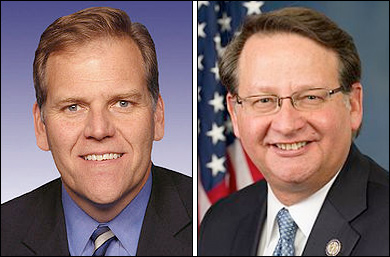
Mike Rogers (R-MI-8) | Rep. Gary Peters (D-MI-14)

Rep. Mike Rogers (R-MI-8) | Rep. Gary Peters (D-MI-14)

Sen. Carl Levin’s (D-MI) retirement announcement has already set the Wolverine State’s political wheels in motion, and the succession picture is much clearer today than at the end of last week.

Maybe In – House Permanent Select Committee on Intelligence chairman Mike Rogers (R-MI-8) and three-term Democratic Rep. Gary Peters (D-MI-14) top the lists of both parties who say they are “seriously considering” entering the Senate race. Should these two meet in a general election, we can expect a tough, hard-fought contest between a pair of strong, veteran campaigners who have both won tough races.

Potential candidates who won’t yet rule out running are Democratic National Committeewoman Debbie Dingell, the wife of Rep. John Dingell (MI-12) who is the Dean of Congress, and second-term Republican Rep. Justin Amash (MI-3). Terri Lynn Land (R), a former secretary of state, also is a possible entrant.

Definitely Out – Republican Congresswoman Candice Miller (R-MI-10), a former two-term Secretary of State who many believe would be the party’s strongest contender, is among a surprisingly large number of potential candidates who have ruled themselves out of joining the open seat contest. In a statement to the Detroit  Continue reading >

Sen. Levin to Retire

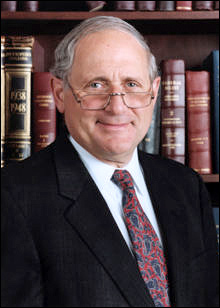
Sen. Carl Levin

Sen. Carl Levin

Michigan Sen. Carl Levin (D), chairman of the Senate Armed Services Committee, announced yesterday afternoon that he will not seek a seventh term next year.

Originally elected in 1978, Levin will conclude 36 years of service at the end of the 113th Congress and becomes the eighth senator since the November election to either leave the body, or plan a defined departure; six incumbents have announced retirement plans for 2014, Sen. John Kerry (D-MA) was appointed US Secretary of State, and Sen. Daniel Inouye (D-HI) passed away in late December.

An open Michigan seat is potentially competitive, but the state’s voting history suggests that the eventual Democratic nominee will begin the general election as the early favorite. Though, as we saw in 2010 when Republicans swept the state, Michigan voting patterns can vary widely in low turnout mid-term elections.

For the Democrats, the two potential candidates who will garner the most attention are former Gov. Jennifer Granholm and Detroit Rep. Gary Peters (D-MI-14). Granholm served two full terms as the state’s chief executive, leaving office at the beginning of the 2011. Her tenure was  Continue reading >

Michigan Gov. Snyder Looks Vulnerable Early

Public Policy Polling just released its new survey of the Michigan electorate (March 2-4; 702 registered Michigan voters) and, after showing Gov. Rick Snyder (R) with poor job approval ratings (a 37:54 percent favorable to unfavorable ratio), the survey shows Detroit Congressman Gary Peters (D-MI-14) to be the Democrat with the best potential to unseat the one-term incumbent. According to their data, Peters would lead Snyder 44-37 percent in a hypothetical ballot test question. At the current time, no challenger from either party has announced an official campaign for governor.

When paired with the man he beat 58-40 percent in 2010, Gov. Snyder trails Lansing Mayor Virg Bernero 38-43 percent. Finally, against former Rep. Mark Schauer (D-MI-7), who was defeated in 2010 after serving one term in office, the potential challenger leads this ballot test, too, but by a smaller 40-36 percent.

Though these numbers clearly show that Snyder has political weakness, he is far from moribund status for next year’s re-election contest. Single-digit leads change frequently, and polling more than 19 months from the election doesn’t mean a great deal. Still — and even more so when considering Michigan’s voting history — the numbers do yield trends and they reasonably tell us to expect a competitive statewide campaign in 2014.

Though Snyder’s job approval is poor, such a conclusion must also be qualified. PPP tends to poll this question in a way that typically registers negative job approval responses for almost every public official. Even here, the very Democratic potential candidates who lead Snyder in their latest poll, also produce upside down favorability ratings about themselves.

Bernero scores a 20:26 percent ratio when asked if the respondents have a favorable or unfavorable opinion of him. This result is actually a bit worse than the spread  Continue reading >

Halvorson Strategy Working Early

Debbie Halvorson

Debbie Halvorson

The first two election surveys have been released for the Feb. 26 special Democratic primary race in Illinois’ 2nd Congressional District, and the polling leader in both instances isn’t who one would expect. Former Rep. Debbie Halvorson (D-IL-11), hoping to split the 60 percent-plus, majority African-American voter contingent among at least six well-known black candidates and win with a small plurality coalition of white voters, appears to be in early position to achieve her strategic objective.

The Normington-Petts Democratic survey research firm just completed an internal poll (Jan. 8-10; 400 likely Democratic primary voters) for candidate Toi Hutchinson, who Continue reading >

Schwartz, Peters Likely to Stay

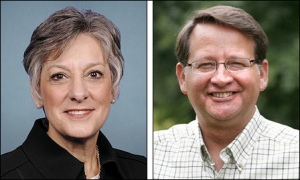
Rep. Schwartz (D-PA-13), Rep. Peters (D-MI-14)

Rep. Schwartz (D-PA-13), Rep. Peters (D-MI-14)

There has been some political speculation of late that Pennsylvania Rep. Allyson Schwartz (D-PA-13) and Michigan Rep. Gary Peters (D-MI-14) will forgo their 2014 re-election campaigns in order to challenge their respective Republican governors.

The new Democratic Congressional Campaign Committee (DCCC) assignments suggest that both of the aforementioned members of Congress will remain in their current positions, however. Schwartz has agreed to become the committee’s National Finance Chair and Peters will serve as the Candidate Recruitment Committee’s Vice-Chairman.

Their willingness to accept high-level House campaign-oriented positions sends the clear signal that both believe their future, at least for the short term, remains in the House and not in running for a state-based office.

Rep. Jesse Jackson Jr. Resignation is Official

Rep. Jesse Jackson Jr. (D-IL-2)

Former Rep. Jesse Jackson Jr.’s (D-IL-2) resignation from the House became official on Nov. 21, thus starting the special election clock. Illinois Gov. Pat Quinn (D) will make an announcement today setting the election calendar, but local officials in the three-county region that comprises the 2nd District have already asked for a waiver from the scheduling law. Should Quinn agree to bypass the special election timing requirement, judicial approval will be required.

Illinois election law states that the governor has five days to call a special election in the event of a vacancy in Congress or for state office. The vacancy is supposed to be filled within 115 days after the date of resignation, but the county officials are asking that the election be postponed to coincide with their municipal and local elections already scheduled for April 9. The special election law would require that both the nominating and special general elections occur before March 16. Quinn has already indicated that his election calendar plan will be both “… fair to the electorate and as economical as possible for taxpayers,” according to his original statement. It is expected that he will make the election concurrent with the regular municipal election date since the two dates are only three weeks apart.

The election officials have also requested that the governor place the nominating election on the same date as their regularly scheduled municipal and local primary, which is Feb. 26. Since the 2nd District is heavily Democratic, it is this party’s primary vote that will be determinative, as the general election will merely be pro forma. Therefore, it is the February date that becomes critical for this replacement process.

Jackson’s resignation is due to health reasons and an ongoing federal investigation into whether he illegally used campaign funds to cover personal expenses, as outlined in his official letter to Speaker John Boehner.

Expect a large Democratic field to compete in the special primary. Already, former Rep. Debbie Halvorson (D-IL-11), originally elected in the old 11th District but defeated in 2010 after one term, has officially announced her candidacy. She opposed Jackson in the 2012 Democratic primary but secured only 23.6 percent of the vote.

Since Illinois has no run-off, Halvorson is hoping to unify the smaller white vote, which may be enough to secure victory if the African-Americans split among many candidates. IL-2 has a black population of 62.4 percent. Two other majority African-American districts, Tennessee’s 9th CD (Rep. Steve Cohen) and Michigan’s 14th (Rep. Gary Peters), currently send white males to Washington, winning under similar circumstances to what Halvorson hopes will occur in this upcoming special election.

Other individuals said to be considering running to replace Jackson are the former congressman’s brother Jonathan Jackson, prominent local Chicago pastor Corey Brooks, attorney Sam Adam Jr., state senators Toi Hutchison and Donne Trotter, Chicago Aldermen Anthony Beale and Will Burns, and former state Reps. David Miller and Robin Kelly. All are Democrats.

The 2nd District encompasses the south Chicago area in Cook County and includes part of Will County and all of Kankakee.