Tag Archives: Redistricting

Redistricting:
California & New Jersey Maps

Click on map of California above for detailed view

By Jim Ellis

Jan. 3, 2022 — The California and New Jersey redistricting commissions are completing the last steps of passing what look to be the final congressional plans for each state. The cursory analysis suggests that Democrats may gain a seat in California with Republicans doing likewise in the Garden State.


California

The California Citizens Redistricting Commission members approved and sent toward final adoption a new 52-district congressional map that could give the Democrats even more seats in the delegation, though we will see several more competitive districts come into play. California lost one seat in reapportionment and Democrats are taking the loss of one of their Los Angeles County seats, but look to be replacing it, and then some, in other parts of the Golden State.

The 47th and 40th Districts of retiring members Alan Lowenthal (D-Long Beach) and Lucille Roybal-Allard (D-Downey) were combined to construct a new 42nd CD, which is heavily Democratic. Rep. Karen Bass (D-Los Angeles), who is leaving the House to enter the campaign for mayor of Los Angeles, sees her 37th District, which was on the chopping block in the first draft map, restored almost intact.

Major change is occurring in the Central Valley. Rep. Josh Harder (D-Turlock) sees his 10th District going from an R1 rating according to the FiveThirtyEight statistical analysis organization to R17. Therefore, it is unlikely he will run in his new designated 5th District.

Rep. Jim Costa (D-Fresno) may leave what is a new 13th District at D7 and move to the downtown Fresno seat, now labeled District 21. This seat has much of resigning Rep. Devin Nunes’ (R-Tulare) territory but is rated a D16. Rep. Costa choosing the 21st might allow Rep. Harder to drop down into new District 13, which would be a much more favorable partisan situation but takes him away from his geographical base.

Rep. Mike Garcia (R-Santa Clarita), who won his 2020 election by just a 333-vote margin, sees his designated district, now numbered 27, become at least three points more Democratic. This endangers even further his re-election chances. The 538 organization rated his current 25th CD as a D5. The new 27th becomes a D8.

Several Republicans have proven they can win these D-plus single digit type seats, however. In addition to Rep. Garcia’s two victories in current CD-25, Rep. David Valadao’s (R-Hanford/Bakersfield) 21st district is rated a D9. His new seat, designated District 22, goes to a D10. Another option for him would be to also run in District 13 (D7), which contains some of his current territory. Rep. Young Kim (R-La Habra) won a 39th District that FiveThirtyEight rated as a D6. Her new 45th CD is calculated at D5.

We could possibly see a district swap operation between Reps. Zoe Lofgren (D-San Jose) and Jimmy Panetta (D-Carmel Valley) due to geography, and between Reps. Michelle Steel (R-Orange County) and Katie Porter (D-Irvine) for partisan reasons.

Rep. Steel’s district moves from a R2 to a D6, while Rep. Porter’s adjacent CD shifts in the opposite direction, going from a D6 all the way to a R4. The problem can be solved for both members by them simply switching districts. This would mean Rep. Porter would run in the new coastal 47th with Rep. Steel going to the inland new 40th.

Rep. John Garamendi (D-Walnut Grove) gets a solid Democratic district, but its new positioning is unfavorable to him from a geographic perspective. Garamendi’s new 8th District moves closer to the San Francisco Bay Area making him vulnerable to a challenge from a Bay Area Democratic state or local official. It is likely this new Vallejo-anchored CD would produce a double Democratic general election under the state’s top two jungle primary system.

Several members see their districts downgraded from a partisan perspective. Rep. Tom McClintock (R-Elk Grove/Sacramento) goes from R15 to R8 in a new 3rd District that stretches into southern California along the Nevada border.

Rep. Jerry McNerney’s (D-Stockton) 9th CD goes from D14 to D8, again according to the 538 analysis. Rep. Ken Calvert’s (R-Corona) designated CD, numbered 41, drops from his current R13 to R7. Rep. Mike Levin’s (D-San Juan Capistrano) 49th CD recedes two points from D7 to D5.


New Jersey
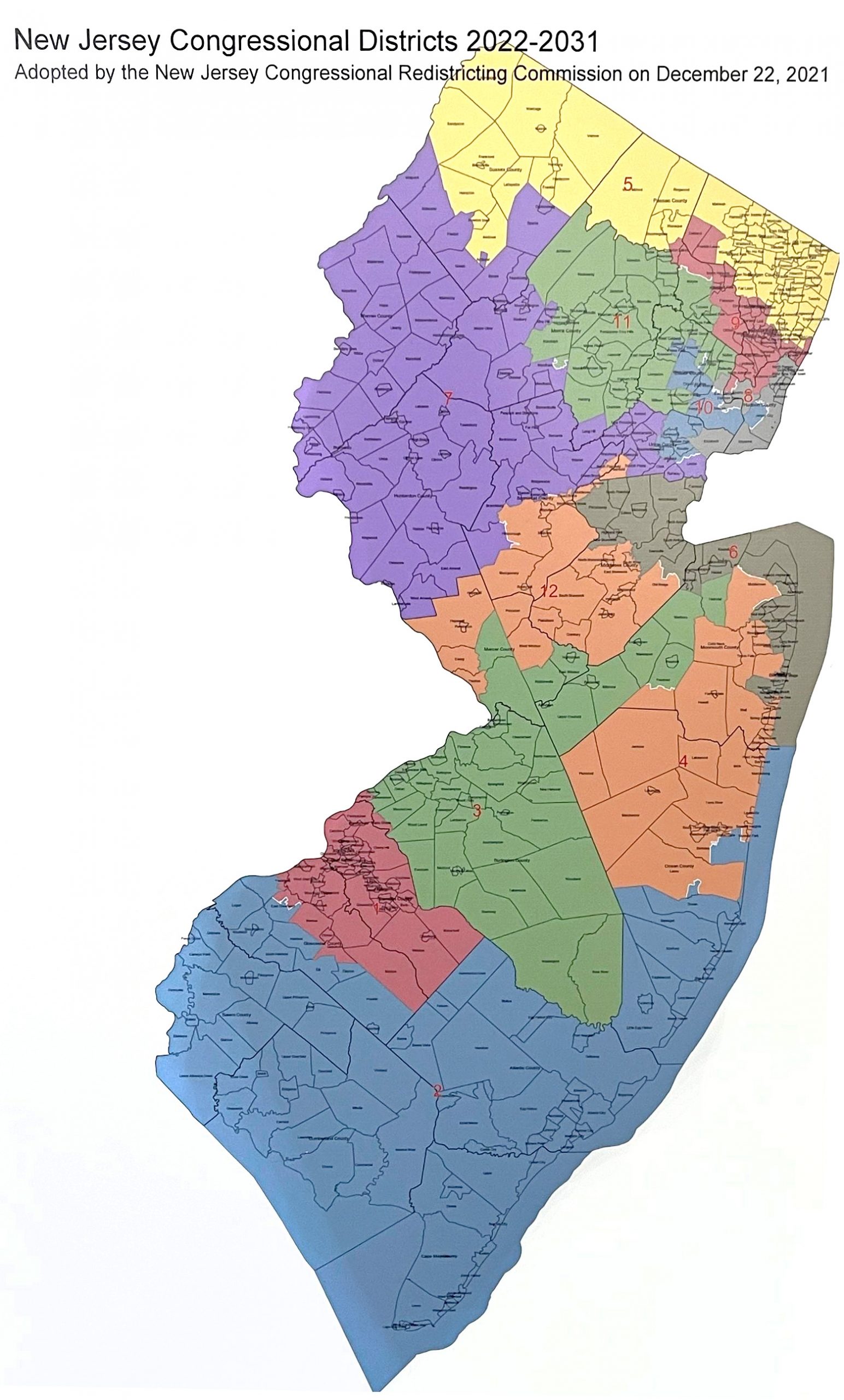
Click on map of New Jersey above to see detailed view

It appears that the New Jersey Redistricting Commission comprised of six Democratic elected officials, six similar Republicans, and a state Supreme Court selected tie-breaking member, have also agreed upon a new congressional map. New Jersey’s representation level remained constant with 12 seats, so it was a matter of adjusting the current districts.

It is evident that the rumor suggesting the commission would adopt a map that drastically weakened Rep. Tom Malinowski’s (D-Rocky Hill) seat in order to strengthen three other Democratic districts, those of Reps. Andy Kim (D-Bordentown), Josh Gottheimer (D-Wyckoff), and Mikie Sherrill (D-Montclair/Morristown) proved true.

It further appears that Rep. Albio Sires’ (D-West New York) retirement did not change the commissioners’ outlook as to which district to weaken. Sires’ 8th District returns virtually intact, another indication that Sen. Bob Menendez’s son, Robert J. Menendez (D), will likely be the retiring congressman’s successor. The latter Menendez currently serves on the NY/NJ Port Commission.

While the NJ Democrats are securing three of their more politically marginal districts, Districts 3, 5, and 11, Republicans appeared poised, probably in the person of state Senate Minority Leader Tom Kean Jr. (R-Edison) who held Malinowski to a 51-49 percent win in 2020, to convert the new 7th CD.

More research will be done on the likely-to-be-adopted California and New Jersey congressional maps when detailed district descriptions become available. It looks like several incumbent members will have decisions before them about where to run in California, while the focus of the New Jersey competitive action will center around the District 7 Malinowski-Kean re-match.
Florida Rep. Stephanie Murphy &
New Jersey Rep. Albio Sires to Retire

By Jim Ellis

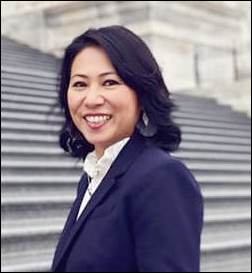
Florida Rep. Stephanie Murphy (D-Winter Park)

Dec. 22, 2021 — In a surprising move, three-term Florida US Rep. Stephanie Murphy (D-Winter Park) announced that she won’t run for re-election next year, becoming the third member of the Florida delegation to leave the House at the beginning of 2023 in addition to the state gaining a new seat in national reapportionment. Not included in the total is the special election to fill the late Rep. Alcee Hastings’ (D-Delray Beach) South Florida 20th District that will conclude on Jan. 11.

The Murphy move means the Sunshine State will host four open congressional elections next year, three of which lie in the Orlando metro area. In addition to Congresswoman Murphy, Rep. Val Demings (D-Orlando) in an adjacent district is also leaving the House. She is challenging Sen. Marco Rubio (R). Furthermore, the state’s new 28th District will likely be placed in the Orlando metroplex. The lone non-Orlando area open seat is in the Tampa Bay area as Rep. Charlie Crist (D-St. Petersburg) is foregoing re-election to again run for governor.

Rep. Murphy was elected in 2016, defeating then-Rep. John Mica (R) in a 51-49 percent result after the Florida state Supreme Court made the 7th District more Democratic during a mid-decade redistricting order. She averaged 56.5 percent of the vote in her two subsequent re-election campaigns and holds a seat on the powerful Ways & Means Committee.

New Jersey Rep. Albio Sires (D-West New York)

Also, New Jersey Rep. Albio Sires (D-West New York) announced Monday that he will not seek a ninth full term in the House. The congressman was first elected in a concurrent 2006 special and general election replacing then-Rep. Bob Menendez (D) who had been appointed to the Senate. At the time, the eastern New Jersey district that borders the Hudson River across from New York City was numbered CD-13. It was changed to number 8 in the 2011 redistricting plan.

Prior to his election to Congress, Sires served in the New Jersey General Assembly and was the body’s speaker from 2002-06. During the 1995-2006 period, he was the mayor of West New York, and concurrently served in the legislature for most of that time. Prior to a 2006 law banning the practice, it was commonplace for New Jersey mayors to simultaneously hold both their municipal position and serve in the legislature.

Continue reading

New Mexico Lines Completed

By Jim Ellis

Dec. 15, 2021 — Though only a three-congressional district state, New Mexico is playing an important role in the 2021 redistricting cycle. The state is one of only four where Democrats fully control the redistricting process and can make gains.

The map that passed the legislature Monday and which was immediately sent to Gov. Michelle Lujan Grisham (D) for her signature appears to clinch the one-seat gain that national Democrats need from the state. On the other hand, it is likely that at least one of their current seats becomes more vulnerable.

Though Democrats have 15 legislative trifectas — that is where they hold the offices of governor, state Senate, and state House of Representatives — they effectively have only four for redistricting. In five of their trifecta states, redistricting has been sent to a citizens or politician (New Jersey) commission. In another six, they are maxed, meaning the Democrats already have all the seats that they can possibly win in each domain.

Ironically, the current Land of Enchantment map needed only minor adjustments to bring the redistricting plan into legal population compliance. The state’s per district resident quota is 705,841 individuals, and the three current districts were only between 3,082 and 11,290 people away from being in full compliance. Districts 2 and 3 needed to shed a combined 11,290 individuals to District 1, and the map would have balanced.

Instead, the Democratic leadership made major changes all centered around transforming freshman Rep. Yvette Herrell’s (R-Alamogordo) 2nd CD into a Democratic advantage. The US Department of Justice just filed suit against the Texas redistricting map under a partisan gerrymander argument, so it is curious to see whether they follow the same course and bring forth a similar partisan gerrymander lawsuit in New Mexico and Illinois, places where Democrats control the redistricting pen.

New Mexico is also interesting in that all three of the state’s delegation members, Reps. Melanie Stansbury, (D-Albuquerque) and Teresa Leger Fernandez (D-Santa Fe), as well as Herrell, are freshmen. In fact, Stansbury is even behind the other two in seniority since she won her seat in a June 1 special election to replace resigned Rep. Deb Haaland (D), who left the House to become US Interior Secretary in the Biden Administration.

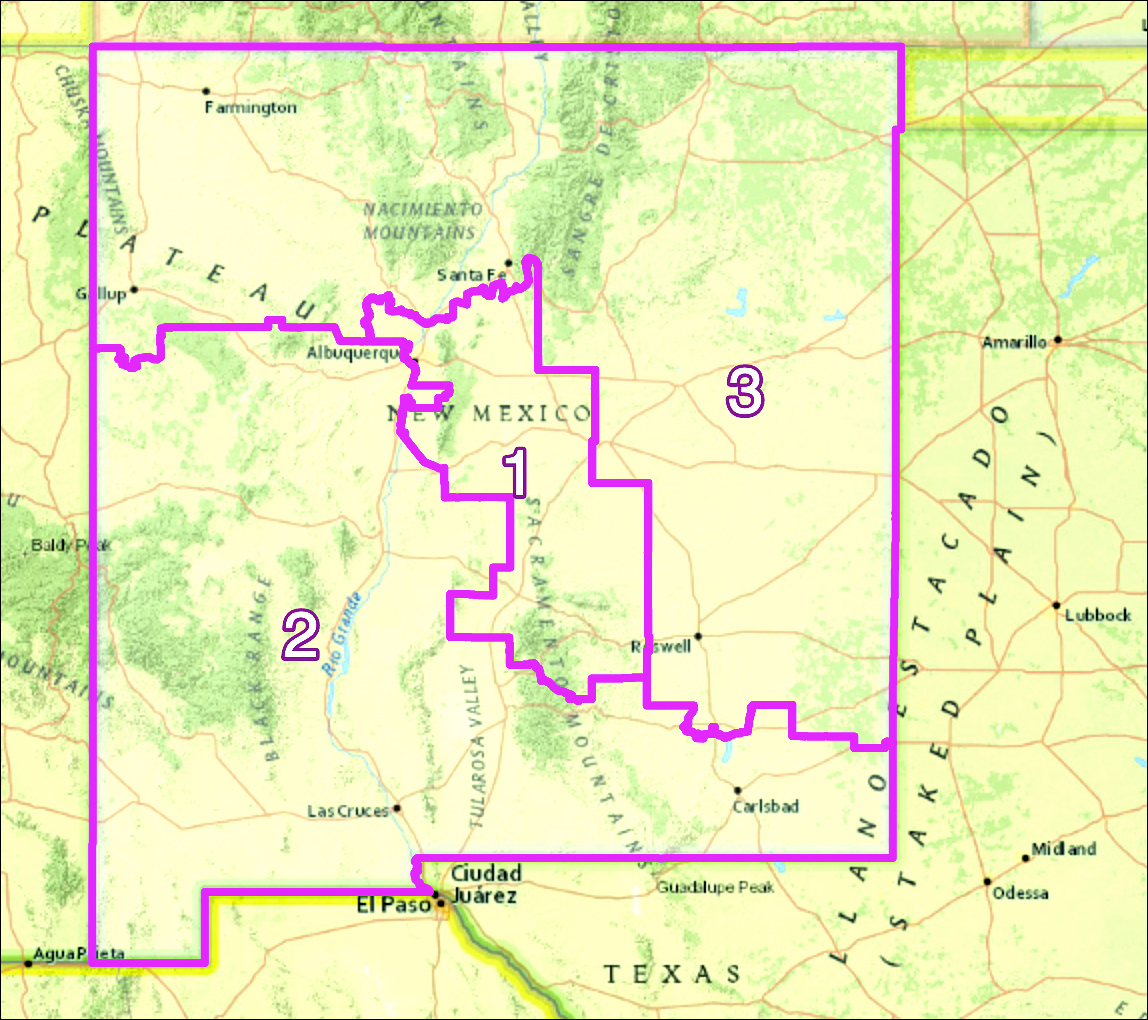
For the first time, the redesigned New Mexico congressional map splits the state’s dominant city of Albuquerque. Drawing the southern 2nd District into the Albuquerque metropolitan area provides the Democrats the ability to enhance the party’s chances of flipping the seat. Throughout New Mexico’s history, the city has been fully contained within the 1st Congressional District.
Continue reading

Rep. Devin Nunes to Resign

By Jim Ellis

Ten-term US Rep. Devin Nunes (R-CA)

Dec. 8, 2021 — Ten-term US Rep. Devin Nunes (R-CA) will leave Congress at the end of this year according to an announcement made late Monday.

Rep. Nunes, the ranking Republican on the House Intelligence Committee and the man who appeared to have the inside track to become chairman of the House Ways & Means Committee if the Republicans re-gain the chamber majority next year, will become CEO of the Trump Media & Technology Group that former President Donald Trump is launching.

While the congressman, who was first elected in 2002 to his Central Valley California seat, will leave the legislative scene, he certainly will still be very active in politics as he attempts to position a new social media platform that will give right of center individuals a greater voice in the public issues discussion arena.

“The time has come to reopen the Internet and allow for the free flow of ideas and expression without censorship,” Nunes was quoted as reported in the New York Post. “The United States of America made the dream of the Internet a reality and it will be an American company that restores the dream. I’m humbled and honored President Trump has asked me to lead the mission and the world-class team that will deliver on this promise,” Nunes concluded.

Rep. Nunes’ departure creates major change in the Central Valley’s politics. His current 22nd District is one of the just seven California districts that Trump carried in the 2020 presidential election campaign.

One would think that a special election would be called with a year remaining on the term, but in a similarly timed situation in 2020, when then-Rep. Duncan Hunter (R) resigned in January, such was not the case. Gov. Gavin Newsom (D), taking advantage of a quirk in California election law, was able to leave Hunter’s 50th District – like the Nunes seat, a safe Republican domain – vacant for the balance of the entire year.

Considering that the likely special election winner in the Nunes Fresno County-anchored district would be a Republican, and cognizant of the ongoing redistricting process, it is entirely possible that Newsom will again let the seat remain vacant for all of 2022.

Continue reading

The Incumbent Pairings

By Jim Ellis

Nov. 30, 2021 — At this point in the national redistricting process, six sets of incumbents have been paired together, mostly in nomination battles, while an additional five incumbent combinations have been averted.

Over half the states have either completed the district re-drawing process or are well down the road to finishing. Illinois leads the nation with two sets of incumbent pairings, one set for each party. An additional four states have single pairings. A total of three Republican primary pairings are on the board, two feature Democratic incumbents, and one, in North Carolina, is a potential pairing with a member from each party.

Retirements have largely averted several more pairings. Reps. Karen Bass (D-CA), Tom Reed (R-NY), Tim Ryan (D-OH) and Anthony Gonzalez (R-OH), and Conor Lamb (D-PA) and Mike Doyle (D-PA), not seeking re-election have likely prevented obvious pairings in their states.

Iowa Rep. Mariannette Miller-Meeks (R-Ottumwa), deciding to seek re-election in the new 1st Congressional District, has avoided a Republican primary pairing with her freshman GOP colleague, Rep. Ashley Hinson (R-Marion/Cedar Rapids).

Below, we review the individual pairings.


GA-7:

• Rep. Carolyn Bourdeaux (D) vs. Rep. Lucy McBath (D)
Candidate Filing: March 11
Primary: May 24
Runoff: July 26

The surprise pairing of the early cycle occurs in the Atlanta suburbs. The Republican map drawers changed Rep. McBath’s 6th District back into a seat that favors the GOP, and instead of running an uphill campaign in a general election, McBath immediately announced that she would launch a primary challenge to freshman Rep. Carolyn Bourdeaux in a politically marginal district that was made safely Democratic.

This will be one of the more interesting pairings. Rep. Bourdeaux represents most of the new 7th’s constituency, but Rep. McBath will likely be viewed as the stronger Democratic base candidate. Bourdeaux starts with an early edge, and with each candidate already approaching $2 million in their respective campaign accounts, this primary campaign will be an old fashioned political shoot out. The winner earns a virtual free ride in the general election.


IL-6:

• Rep. Sean Casten (D) vs. Rep. Marie Newman (D)
Candidate Filing: March 14
Primary: June 28

The second Democratic pairing is the result of the party’s map drawers creating a second Chicago Hispanic district. This led to freshman Rep. Marie Newman standing without her own district. Instead of challenging Rep. Jesus “Chuy” Garcia (D-Chicago) in the original urban Hispanic seat, the district in which her La Grange residence was placed, she decided to instead oppose Rep. Sean Casten in the safely Democratic suburban 6th CD.

Though the seat carries Rep. Casten’s 6th, a bit more of the constituency belongs to Rep. Newman. The early resources favor Casten, as his $1 million in the bank is more than double Rep. Newman’s Sept. 30th filing deadline cash-on-hand total. This race will be one that turns sharply left, as both members identify with the party’s leftward faction. Rep. Casten is likely to attract more Chicago establishment support whereas Rep. Newman will get the bulk of leftward social issues coalition backing.

On paper, it appears that Rep. Casten would have at least a slight edge, but we can count on seeing a major campaign contest all the way to the June 28 primary.


IL-12:

• Rep. Mike Bost (R) vs. Rep. Mary Miller (R)
Candidate Filing: March 14
Primary: June 28

The second Land of Lincoln pairing features two Republican incumbents in the state’s southern sector. Typically, in a gerrymandered state the minority party inherits several very safe districts. Such is the case for the GOP in the new IL-12.

Most of Rep. Bost’s current 12th District constituency is in the new 12th, but the eastern part of a district that now encompasses all of the southern Illinois territory currently belongs to freshman Rep. Miller. The early financial edge also goes to Rep. Bost, but the two begin this race separated only by approximately $200,000.

Continue reading

Ohio Redistricting Set to Pass

WBNS TV – Channel 10 – Columbus

By Jim Ellis

Nov. 19, 2021 — The Ohio legislature has sent the new congressional and state legislative maps to Gov. Mike DeWine (R) for his approval. Ohio loses one seat in reapportionment.

As expected, the new map radically changes the seats that outgoing members Tim Ryan (D-Warren/Youngstown) and Anthony Gonzalez (R-Rocky River) currently hold. Rep. Ryan, running for the Senate, sees his eastern Ohio 13th District collapsed, with a sizable chunk of Akron remaining in the seat and the remainder going to Rep. Bob Gibbs’ (R-Lakeville) 7th District.

Instead of moving east, as under the current map, the new 13th moves to the west, annexing Medina County and the western part of the Cleveland metro area in Cuyahoga County. Much of this territory comes from the retiring Rep. Gonzalez’s current 16th District, a seat whose territory gets absorbed in several neighboring CDs.

At first glance, the map looks to break 12R-3D, meaning Democrats would take the seat loss in typical election years. Three of the districts, however, two of which Democrats now hold, would become highly competitive.

The members with the most competitive districts would again be Reps. Steve Chabot (R-Cincinnati) in the 1st District, in addition to Marcy Kaptur’s (D-Toledo) 9th CD, and the open 13th District.

The safest members are Reps. Brad Wenstrup (R-Cincinnati), though he loses a significant part of his anchor city, Joyce Beatty (D-Columbus), Jim Jordan (R-Urbana), Bob Latta (R-Bowling Green), Bill Johnson (R-Marietta), Bob Gibbs (R-Lakeville), Warren Davidson (R-Troy), Shontel Brown (D-Cleveland), and Troy Balderson (R-Zanesville).

Reps. Mike Turner (R-Dayton), David Joyce (R-Russell Township, and Mike Carey (R-Columbus) all would get reliable Republican districts, but not overwhelmingly so. Turner’s composite improves his marginal district a net three points in his party’s favor. Rep. Joyce sees his partisan complexion remaining at about a 10-point positive district for him when comparing the composite average to the 2020 presidential results.

Continue reading