Tag Archives: Ohio

House Re-Match Recap – Part II

By Jim Ellis — Friday, Feb. 28, 2025

House

We have been witnessing recent 2026 campaign action in some of the closest 2024 US House races. Several re-matches are on the political horizon.

Yesterday, we published Part I; today, we continue our update of potential re-match House campaigns in states stretching from Maine to Wisconsin.


ME-2:

  • ME-2: Rep. Jared Golden (D) over St. Rep. Austin Theriault (R)
  • 50.3 – 49.6%; Vote Difference: 2,706

The main impediment to seeing a re-match of this tight 2024 campaign is whether Rep. Golden will run again. Persistent rumors are present that he will enter the open race for Governor since incumbent Janet Mills (D) is ineligible to seek a third term.

Should the Congressman eschew the Governor’s race and seek re-election to a fifth term, he is virtually assured of again facing Theriault, a former NASCAR driver, who is almost a sure bet to run again in 2026.


MI-7:

  • Ex-Sen. Tom Barrett (R) defeated ex-Sen. Curtis Hertel (D)
  • 50.3 – 46.6%; Vote Difference: 16,763

After losing the 2022 congressional race to then-incumbent Elissa Slotkin (D), Republican Barrett returned two years later for an open-seat race and defeated former state Senator and gubernatorial chief of staff Hertel. There is no indication that Hertel will run again, and eyes are pointing to state Sen. Sarah Anthony (D-Lansing) as a potential opponent for Rep. Barrett.


MI-10:

  • Rep. John James (R) defeated ex-Judge Carl Marlinga (D)
  • 51.1 – 45.0%; Vote Difference: 26,074

Though challenger Marlinga is saying he plans to run again, he may not face Rep. James. It is becoming clearer that the Congressman will enter the open Governor’s race where he enjoys huge polling leads for the Republican nomination and a potentially favorable three-way setup in the general election that features Detroit Mayor Mike Duggan running as an Independent.

Marlinga will be challenged in the Democratic primary, regardless of the circumstances since the party leadership views him as an under-performing candidate. Without Rep. James in the field, the 10th District becomes a major national Democratic conversion opportunity.


NE-2:

  • Rep. Don Bacon (R) outpaced state Sen. Tony Vargas (D)
  • 50.9 – 49.1%; Vote Difference: 5,829

State Sen. Vargas challenged Rep. Bacon for the second time and again fell short in a district that both Joe Biden and Kamala Harris carried in the presidential race. It is likely that Vargas will not be back for a third run against Congressman Bacon. The Democratic leadership is expressing a desire for a different nominee in a continued desire to unseat the five-term Representative who specializes in winning close elections.


NC-1:

  • Rep. Don Davis (D) overcame retired Col. Laurie Buckhout (R)
  • 49.5 – 47.8%; Vote Difference: 6,307

The 2024 North Carolina redistricting plan made the 1st District much more competitive, thus explaining Rep. Davis’ close re-election result. First-time candidate Buckhout performed well and is said to be considering making another attempt in 2026. The district is obviously more competitive, but it is also possible that the close ’24 finish is the best the Republicans can expect.


OH-9:

  • Rep. Marcy Kaptur (D) nipped state Rep. Derek Merrin (R)
  • 49.5 – 47.8%; Vote Difference: 2,382

Rep. Kaptur, who is the second-most senior current House Democratic member with now 22 terms in office, had one of her closest calls in 2024. This is largely due to the 2021 Ohio redistricting plan that made the Toledo-anchored seat a largely Republican domain (FiveThirtyEight rating: R+6).

State Rep. Merrin made the race close and may return for another attempt. If he doesn’t run, count on Republicans to again heavily target this seat with a strong challenger because GOP conversion opportunities around the country will not be overly plentiful.


OH-13:

  • Rep. Emilia Sykes (D) defeated ex-Sen. Kevin Coughlin (R)
  • 51.1 – 48.9%; Vote Difference: 8,542

The Akron-anchored 13th District is another politically marginal seat that leans Democratic. Rep. Sykes, re-elected for the first time, has won two close elections and can expect to face another tough race in 2026.

Kevin Coughlin, out of campaign politics since last elected to the legislature in 2006, returned to run a strong race. It is possible he returns for a re-match. If not, Republicans are again expected to heavily target the district with a new candidate.


PA-7:

  • State Rep. Ryan Mackenzie (R) unseated Rep. Susan Wild (D)
  • 50.5 – 49.5%; Vote Difference: 4,062

The Allentown-Bethlehem-Easton district is another seat designed as politically marginal, and it has lived up to its billing. After winning two close re-election battles against the same Republican opponent, Rep. Wild fell short against Mackenzie.

Though she has discussed a comeback attempt, that is now less likely with the Northampton County Executive, Lamont McClure (D), entering the ’26 congressional race. We can expect another very tight election coming next year, but the candidates will be different than seen in the immediate past.


PA-8:

  • Rob Bresnahan (R) unseated Rep. Matt Cartwright (D)
  • 50.8 – 49.2%; Vote Difference: 6,272

Though 2021 redistricting made the 8th District decidedly Republican, veteran Rep. Matt Cartwright (D) was able to hold a conservative district despite a liberal voting record. His congressional tenure ended in November, however, when businessman Bresnahan unseated him.

Cartwright has discussed mounting a comeback, but his intentions have not yet been definitive. Realistically, having the former Congressman back as the party nominee is probably the only way the Democrats would have a chance of regaining the seat. Otherwise, Rep. Bresnahan would be favored for re-election in a district the FiveThirtyEight data group rates as R+8.

Before the election, the Down Ballot political blog statisticians rated PA-8 as the fourth-most vulnerable seat that any Democrat held.


PA-10:

  • Rep. Scott Perry (R) defeated Janelle Stelson (D)
  • 50.6 – 49.4%; Vote Difference: 5,133

Veteran Rep. Perry was not a beneficiary of the 2021 redistricting plan as the addition of the Harrisburg area to the 10th District made his seat more competitive. Though the FiveThirtyEight data organization rates the seat R+9, it has played much closer in recent down ballot elections.

Rep. Perry has now won three consecutive close elections, but former news anchor Stelson proved to be his toughest opponent. At this point, there has been no mention of Stelson returning to run in 2026.


VA-2:

  • Rep. Jen Kiggans (R) topped Missy Cotter Smasal (D)
  • 50.7 – 46.9%; Vote Difference: 15,702

Virginia’s 2nd District is another one that has bounced between the parties, but GOP Rep. Jen Kiggans, a retired Naval officer, is proving a good fit for the constituency. After unseating then-Rep. Elaine Luria (D) in 2022, Rep. Kiggans won re-election defeating businesswoman and former state Senate candidate Smasal.

Though the Congresswoman never appeared in danger of losing, the closeness of the race reveals that District 2 has a loyal Democratic partisan base. No talk yet of a re-match here, and it is likely the Democratic leadership would prefer a candidate with a stronger resume than that of Smasal.


VA-7:

  • Col. Eugene Vindman (D) edged Derrick Anderson (R)
  • 50.7 – 46.9%; Vote Difference: 10,489

The northern Virginia 7th District was drawn as a lean Democratic district, and it has performed as planned. The seat was open because then-Rep. Abigail Spanberger (D) retired from Congress in order to concentrate on a 2025 run for Governor. This opened the door for retired Army Col. Eugene Vindman, known as a staunch opponent of President Donald Trump, vis-à-vis the Russia-Ukraine War, to run for Congress.

Vindman became one of the nation’s top congressional fundraisers and used his strong 6:1 spending advantage over Republican Anderson to secure his tight victory. Talk of a re-match has not surfaced, and it is doubtful that Anderson will return to run again. It is likely that this seat will trend more Democratic as the northern Virginia demographic and voting pattern continues to solidify.


WI-3:

  • Rep. Derrick Van Orden (R) defeated Rebecca Cooke (D)
  • 51.3 – 48.6%; Vote Difference: 11,258

Despite some negative publicity relating to certain controversial comments and actions of Rep. Van Orden, the party faithful closed ranks behind him and delivered a close re-election victory.

The southwestern 3rd District’s electorate appears more Republican on paper (FiveThirtyEight: R+9) largely because of its performance in presidential elections, but votes in down ballot races often produce Democratic results. This is illustrated through Van Orden’s predecessor, Rep. Ron Kind (D), who represented the seat for 26 years before retiring in 2022.

Cooke is one of the past Democratic candidates discussing making another run, as is the 2022 Democratic nominee and sitting state Sen. Brad Pfaff (D-La Crosse). It is possible that Rep. Van Orden will see one of his previous opponents again in 2026, but at this point it is hard to see whether Sen. Pfaff, Cooke, or another individual emerges from the Democratic fold.
Ohio: Ramaswamy In, Trump Endorses

By Jim Ellis — Tuesday, Feb. 25, 2025

Governor

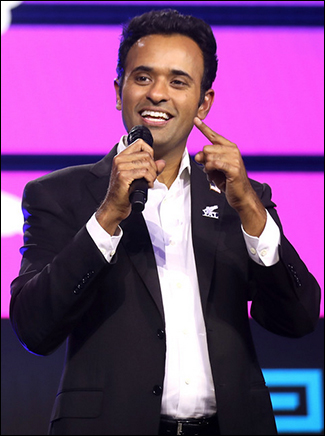
Republican Vivek Ramaswamy / Photo by Gage Skidmore

Businessman and former presidential candidate Vivek Ramaswamy (R) released his official Ohio Governor’s campaign website at the end of last week, thus kicking off the contest to succeed term-limited Gov. Mike DeWine (R) and yesterday he received a big boost.

The Republican primary race already appears to be evolving into a two-way battle between Ramaswamy, leading in all early nomination campaign polling, and two-term Attorney General Dave Yost.

A newly released Yost campaign survey, however, suggests the race could eventually tighten, and that an endorsement from President Donald Trump for one of the candidates could prove determinative. Yesterday, the President gave Ramaswamy his “complete and total endorsement.”

The National Public Affairs polling organization conducted an early February Ohio survey for the Yost campaign (Feb. 2-5; 602 likely Ohio Republican primary voters; live interview and text) and, like other research studies, found Ramaswamy posting a major lead, 46-18 percent.

Earlier, WPA Intelligence (Jan. 28-30; 600 likely Ohio Republican primary voters) saw Ramaswamy holding a 57-28 percent advantage over Yost. The Fabrizio Lee & Associates firm also tested the state in late January (Jan. 26-27; 600 likely Ohio Republican primary voters) and projected the Ohio entrepreneur topping AG Yost with a 52-18 percent margin while the since withdrawn State Treasurer Robert Sprague posted two percent preference. (Mr. Sprague, term-limited in the coming election as Ohio’s Treasurer, quickly dropped out of the Governor’s race and instead entered the open Secretary of State’s contest endorsing Ramaswamy as he exited.)

While all of the released public polls basically arrive at the same conclusion, NPA provided further information in their survey analysis that attempts to cast the largely uniform results in a different political light.

According to NPA partner Justin Clark, “our findings indicate that this early advantage is a ‘sugar high’ driven by a pre-inauguration media saturation that led to high name ID and perceived association with President Trump. That said, even at this high point of public opinion, polling support for Ramaswamy is incredibly soft. Beyond the temporal component of his losing the “sugar high” after quitting the Trump administration before it even started, the survey is clear that voters align closest to the candidate that receives the backing of President Trump … whoever that candidate is.”

We now know who Trump will endorse and it’s Ramaswamy. The Yost pollsters clearly understand the impact of presidential support in the Republican primary as their polling analysis explains.

After a series of unreleased push questions that constituted what NPA described as the “informed ballot” brought Yost within one point of Ramaswamy, the horse race question was then asked to determine what effect Trump endorsing the Attorney General would have on the primary election. If such were the case, Yost would pull ahead of Ramaswamy, 42-22 percent; hence, the power of an early Trump endorsement.

In terms of the favorability index, President Trump maintains an 82-16 percent positive to negative ratio and Vice President and former Ohio Sen. J.D. Vance scores an almost identical 81:16 percent. Ramaswamy posts a 64:15 percent score, which is better than newly elected Sen. Bernie Moreno (65:22 percent), and Attorney General Yost (53:14 percent), though all the sampled Republican primary voters viewed each tested figure very favorably.

Clearly, Ramaswamy wants to deliver an early knockout blow, and it appears he has the assets to make that happen. With a big lead in early polling and, as of yesterday, Trump’s endorsement, it appears the former presidential candidate has the package he needs to secure the Republican nomination. With that, he will have the inside track for the general election in a state that is trending more Republican.

The only Democrat to so far announce for Governor is former Ohio Health Department director Amy Acton. Other, and likely stronger, potential candidates are waiting in the wings. It is unclear if any or all of the following would make a gubernatorial run, but some from this group are likely to try.

Those Democrats mentioned as considering a bid for Governor are: former Senator Sherrod Brown, Cincinnati Mayor Aftab Pureval, Cleveland Mayor Justin Bibb, Columbus Mayor Andy Ginther, state Supreme Court Justice and former Secretary of State Jennifer Brunner, and former Congressman, 2016 presidential candidate, and 2022 US Senate nominee Tim Ryan.

Ex-Ohio State Football Coach Appointed Lieutenant Governor

By Jim Ellis — Thursday, Feb. 13, 2024

Governor

Jim Tressel

Ohio Gov. Mike DeWine (R) announced at a news conference that he has appointed former Ohio State head football coach and ex-Youngstown State University president Jim Tressel to fill the state’s vacant Lieutenant Governor’s position.

The office came open when the Governor appointed Jon Husted (R) to the US Senate to replace Vice President J.D. Vance. Immediately, reporters pummeled Tressel with questions regarding whether he would run for Governor next year, queries that both he and DeWine avoided answering.

In Ohio, the Lieutenant Governor runs on a ticket with the Governor. In 2018, during the open Republican primary, Husted, then Secretary of State, was competing against DeWine in the Republican gubernatorial primary along with then-Lt. Gov. Mary Taylor. Because it appeared that DeWine and Husted could split the center-right vote, which could reasonably have allowed Taylor to win after consolidating the political right, a deal was cut.

Husted offered then-Attorney General DeWine a proposition where he would exit the Governor’s race and run as the latter’s Lieutenant Governor running mate. DeWine accepted the arrangement and the two went onto victories in both the 2018 Republican primary and general elections. In 2022, the DeWine-Husted ticket won re-election with just over 62 percent of the vote.

Their teamwork plan included DeWine then supporting Husted for Governor in 2026, something that the Governor was prepared to do until the state’s junior Senator, J.D. Vance, was elected Vice President. At first, the Lieutenant Governor indicated he wanted to stay in the Governor’s race and battle Attorney General Dave Yost for the party nomination. It always appeared, however, that Husted was the obvious choice to take the Senate seat and was eventually prevailed upon to take that role.

Now businessman and former presidential candidate Vivek Ramaswamy is, with great fanfare, about to enter the Republican gubernatorial primary and polling suggests he begins with an overwhelming lead. State Treasurer Robert Sprague, who was briefly a gubernatorial candidate, exited the Governor’s race and endorsed Ramaswamy who is not yet even an official contender. Term-limited Secretary of State Frank LaRose, who ran unsuccessfully for Senate in 2022 and was considered a potential entry into the Governor’s race, late last week announced instead a bid for state Auditor.

Therefore, DeWine’s move to Tressel could be a plan to at least make the Republican gubernatorial campaign more competitive should the latter man, popular with high name ID due to his championship run as an Ohio State football coach, decide to run for Governor.

Tressel coached at Ohio State for 10 years and won a national championship. He resigned under a cloud, however, as the university was cited for recruitment violations under his domain. Prior to his coaching tenure with the state’s premier college football program, he coached for 14 seasons at Youngstown State. Regardless of the details concerning his exit from Ohio State, Tressel still enjoys a generally positive personal image.

At the apex of his coaching career, it was speculated upon that Tressel might mount challenges to then-Sen. Sherrod Brown (D). In both of those election years, however, Tressel chose not to run. Therefore, it is far from certain that he will enter the current Governor’s race.

For his part, Ramaswamy says he will make “a big announcement” in late February. All expect him to announce his gubernatorial candidacy at that time. Certainly, his involvement, and now possibly Tressel’s, is making the open Ohio Governor’s campaign possibly the premier 2026 political contest in terms of attracting national media attention. Expect this pattern to continue for quite some time.

Ramaswamy Up Big in Ohio

By Jim Ellis — Friday, Jan. 31, 2025

Governor

Republican Vivek Ramaswamy / Photo by Gage Skidmore

Surprising new data was just released regarding the open Ohio Governor’s race, thus giving more credibility to Vivek Ramaswamy’s proposed campaign.

A late January Fabrizio Lee & Associates survey of the Ohio Republican electorate (Jan. 26-27; 600 likely Ohio 2026 Republican primary voters; live interview & text) sees businessman and former presidential candidate Ramaswamy jumping out to a huge Republican primary lead.

Ramaswamy just resigned from President Trump’s Department of Government Efficiency (DOGE), where he was serving as co-chair with Elon Musk, in order to return to Ohio with the reported intent of embarking on a gubernatorial campaign.

In the race for what will be an open Governor’s position, Ramaswamy tops Attorney General Dave Yost and state Treasurer Robert Sprague by a 52-18-2 percent margin, respectively, according to the Fabrizio Lee results.

The Governor’s race has been at the heart of the Ohio political spectrum and figured prominently in the selection of a Senator to replace Vice President J.D. Vance.

Gov. Mike DeWine chose Lt. Gov. Jon Husted (R) for the Senate seat, though it apparently took some convincing before he accepted the position. Husted had been planning for years to run for Governor when DeWine’s final term comes to an end. Therefore, the 2026 election looked to begin with a Republican primary battle between Husted and Yost, which was expected to be hard fought and potentially divisive.

The open Senate seat drastically changed the picture. With Sen. Husted having to run to fill the balance of the current term in 2026, and then for a full term in 2028, he is out of the Governor’s race. This gave AG Yost and State Treasurer Robert Sprague the opportunity of battling in the GOP primary for the right to succeed Gov. DeWine as the party nominee.

The Ramaswamy potential entry changes the political outlook yet again, especially with this new data posting him to a very large and surprising lead. Independently wealthy, Ramaswamy will have as much money as he needs to run a strong campaign. Therefore, we can expect an intense GOP primary battle.

At this point, the only Democrat to so far announce her gubernatorial candidacy is former Ohio Health Department director and physician Amy Acton.

It is likely others will soon follow. Those Democrats mentioned as potential statewide contenders are the mayors of Ohio’s three largest cities: Andy Ginther in Columbus, Cleveland’s Justin Bibb, and Cincinnati chief executive Aftab Pureval. State Supreme Court Justice and ex-Secretary of State Jennifer Brunner, and ex-Congressman and 2022 US Senate candidate Tim Ryan are also frequently mentioned as possible gubernatorial candidates.

Though Ohio is voting more Republican in recent elections – President Trump carried the state three times with an average win margin of 9.1 percent and Ohio has now elected two Republican Senators, for example; the Democrats are still expected to make a maximum effort to convert this office in 2026.

The Senate race will obviously also factor into the statewide political picture. The major question surrounds the status of former Sen. Sherrod Brown (D) who was defeated for re-election in November. While he has been more closely associated with running again for the Senate since there will now be a special election to fill the balance of the Husted term, there is also some speculation that he could run for Governor.

Sen. Brown had always been viewed as someone who could attract Republican votes even though he is unabashedly liberal. That aura was certainly punctured when he lost to now-Senator Bernie Moreno in November by just over 3.6 percentage points after spending $103 million just through his individual campaign committee. Despite his loss, it is clear that Brown would be the Democrats’ strongest candidate either for the Senate or Governor.

Ohio will again be a major political battleground, and we can expect to see a great deal of activity coming from the Buckeye State throughout the 2026 election cycle.

An Activity-Laden Gubernatorial Week Across the Country

By Jim Ellis — Monday, Jan. 27, 2025

Governor

With South Dakota Gov. Kristi Noem officially being confirmed for her federal position as Secretary of the Department of Homeland Security, Lt. Gov. Larry Rhoden (R) ascends to the Governorship. / Photo by Gage Skidmore

While political activity is largely quiet in the early 2026 Senate and House races, the same is not true for budding Governors’ campaigns.

First, in South Dakota, with Gov. Kristi Noem officially being confirmed for her federal position as Secretary of the Department of Homeland Security, Lt. Gov. Larry Rhoden (R) ascends to the Governorship and is expected to seek a full term in 2026. Noem was term-limited for the coming election, so a GOP nomination fight has been expected for months.

With Rhoden now the sitting Governor, a major multi-candidate Republican primary may be avoided. At this time, however, it is too early to tell exactly how the state’s politics may unfold. For his part, Rhoden served as Lieutenant Governor for the entirety of Noem’s tenure as Governor, beginning in 2019. Prior to assuming his statewide office, Rhoden served for 16 years in the state legislature.

Late last week in Michigan, Secretary of State Jocelyn Benson (D) announced that she will seek the Democratic gubernatorial nomination to succeed term-limited Gov. Gretchen Whitmer (D). This race will be complicated with the presence of Detroit Mayor Mike Duggan running as an Independent. He was elected to his present position three times as a Democrat.

The possibility of splitting the Democratic vote between Duggan and the eventual party nominee could give the eventual Republican nominee the opportunity of winning the statewide vote with just plurality support. Crowded primaries in both major parties are expected to form.

Turning to New Mexico, Sen. Martin Heinrich (D), who had been considering making a bid for Governor on the heels of his re-election to a third term, announced last week that he will not enter the race. This likely makes former US Interior Secretary and ex-Congresswoman Deb Haaland the Democrats’ leading candidate to succeed term-limited Gov. Michelle Lujan Grisham (D).

In Ohio, Attorney General David Yost (R) formalized his gubernatorial campaign with a specific announcement late last week, though for months it has been no secret that he would run. With Lt. Gov. Jon Husted, who was thought to be Yost’s main opponent, now an appointed US Senator, the Attorney General’s top GOP competitor may well be former presidential candidate Vivek Ramaswamy who is expected to make a formal announcement this week. State Treasurer Robert Sprague (R) also announced his candidacy earlier this month.

The state’s health care director during COVID, Dr. Amy Acton, has already announced for the Democratic gubernatorial nomination, but we can expect additional individuals to ultimately declare their candidacies. Gov. Mike DeWine (R) is ineligible to seek a third term.

In South Carolina, Rep. Nancy Mace (R-Charleston) confirmed last week that she is seriously considering a run for Governor since incumbent Henry McMaster (R) is ineligible to succeed himself. Lt. Gov. Pamela Evette and Attorney General Alan Wilson, son of Rep. Joe Wilson (R-Springdale), are also potential Republican gubernatorial candidates. Rep. Ralph Norman (R-Rock Hill) is also mentioned as a possible contender, but if he is to launch a statewide Republican primary bid it would more likely be against Sen. Lindsey Graham.

As mentioned in our column late last week, Tennessee Sen. Marsha Blackburn (R) is now running “thank you” ads for her Senate victory, which is an apparent move to solidify support for the open 2026 Governor’s race. It was clear that several GOP members of the Tennessee congressional delegation were preparing to run, specifically Rep. John Rose (R-Clarksville) who was scheduled to announce soon after the November election, but such may not materialize.

Sen. Blackburn’s presence in the race, with polls showing she would easily win a gubernatorial primary is suggesting that the twice-elected Senator won’t even draw major opposition. Should she choose to run to succeed term-limited Gov. Bill Lee (R), it appears she would be a lock to win both the Republican primary and general elections.

DeSantis Appoints Ashley Moody

By Jim Ellis — Friday, Jan. 17, 2025

Senate

Florida Attorney General Ashley Moody

With Sen. Marco Rubio’s (R) confirmation as US Secretary of State virtually assured, Florida Gov. Ron DeSantis made his announcement yesterday as to who will succeed the Senator when he officially resigns.

As expected, based upon recent predictions, Gov. DeSantis selected state Attorney General Ashley Moody (R) to assume the Senate seat once the position officially becomes vacant. President-Elect Donald Trump will nominate his cabinet choices once he is sworn into office; when certain confirmation hearings are completed, we can expect the Senate to take swift action regarding key confirmation votes.

Sen. Rubio is expected to sail through the process, since he is a well known figure to all Senators. Once he is officially confirmed, the new Secretary of State will resign the Senate seat and Moody will likely be on hand to take the oath of office for her new position. This would mean no lapse in Florida Senate representation.

The same cannot be said for the similar situation in Ohio. Vice President-Elect J.D. Vance resigned from the Senate on Jan. 10, but Gov. Mike DeWine has yet to name a replacement.

It’s possible that the Governor is having trouble filling the seat. Lt. Gov. Jon Husted appears to be his first choice, but stories continue to surface indicating that Husted wants to remain in Ohio to fight in a tough open 2026 Republican gubernatorial primary.

A story appeared midweek that former presidential candidate Vivek Ramaswamy met with the Governor last weekend to discuss the Senate position. This is a surprising development, since Ramaswamy, citing his position as co-director of President-Elect Trump’s Department of Government Efficiency (DOGE), withdrew his name from Senate consideration weeks ago.

Though the chosen individual will literally be handed a Senate seat, the long-term path is not without challenges. Former Sen. Sherrod Brown (D), who new Sen. Bernie Moreno (R) unseated in November, says he is not done with public service and is viewed as a possible 2026 contender vying for the right to serve the balance of the current term.

Brown raised a whopping $103 million for his losing 2024 effort. Considering his long record in Ohio politics, any appointed Senator would be forced to conduct an expensive major campaign versus a very formidable opponent.

Even if successful in 2026, the new Senator would again face the voters in 2028 when this particular seat next comes in-cycle. Therefore, whomever is chosen can expect to be in full campaign mode for a four-year period.

Attorney General Moody is close to Gov. DeSantis and has twice proven she can win a Florida statewide election. In 2018, Moody, a former circuit judge, was elected Attorney General with 52.1 percent of the general election vote. In 2022, she increased her vote share to 60.6 percent. As was explained regarding the eventual new Ohio Senator, Moody will run to fill the balance of her new term in 2026, and then have the opportunity of campaigning for a full six-year term in 2028.

Additionally, Moody will apparently face significant opposition in the next Republican primary. Rep. Cory Mills (R-New Smyrna Beach) said earlier in the week that he will enter the Senate primary regardless of whomever Gov. DeSantis appoints.

The current spate of Florida political musical chairs is allowing Gov. DeSantis, who cannot seek a third term in 2026, to continue shaping a large segment of his state’s future government. Not only did he pick Moody for the Senate, but he will now be able to choose a replacement Attorney General.

Furthermore, with former Rep. Matt Gaetz (R) leaving his 1st District seat, current Florida CFO Jimmy Petronis (R) entered the special election field and is widely viewed as the favorite. Under Florida state law, any officeholder running for a different position must resign his current post.

Since the 1st District special election is scheduled for April 1, Petronis announced that he will leave his current position on March 31. Regardless if Petronis wins or loses the congressional seat, the statewide CFO position will be open at the beginning of April, and Gov. DeSantis will then have the opportunity of filling that position, as well.

Looking ahead, the state of Florida will experience a period of significant political change over the course of the next two years, and Gov. DeSantis will have the power to choose his allies to lead the state long after he leaves office.

Cooper’s Challenge; Texas Senate Battle; Democrat’s Election Battle; PA-8, WA-4 House News; Governor Races Maneuvering

By Jim Ellis — Tuesday, Jan. 14, 2025

Senate

Former North Carolina Gov. Roy Cooper (R)

North Carolina — Former North Carolina Gov. Roy Cooper (D), who would be the national Democrats’ first choice to challenge Sen. Thom Tillis (R), said this week that he will make a decision about running “in the next few months.” Cooper is also apparently testing the waters for a presidential run in the open 2028 election. Former Congressman Wiley Nickel (D), who did not seek re-election to a second term in 2024 because of an adverse redistricting map, has already declared his intention to challenge Sen. Tillis.

Texas — A new Victory Insights poll of the Texas Republican electorate (Jan. 4-6; number of respondents not released; interactive voice response system and text) finds Sen. John Cornyn (R) trailing state Attorney General Ken Paxton (R) in an early 2026 Republican primary pairing. It has long been rumored that Paxton is going to launch a primary challenge to Sen. Cornyn, a move that Paxton does not deny.

According to the ballot test, Paxton would lead the Senator 42-34 percent, which is a very low support performance for any long-time incumbent. AG Paxton does best with the conservative base, leading Cornyn 55-23 percent among the self-described MAGA segment, and 50-24 percent from the group that describes themselves as constitutional conservatives. Sen. Cornyn rebounds to a 50-15 percent spread among traditional Republicans, and 59-18 percent within the self-described moderate Republican segment. Clearly, this early data suggests the 2026 Texas Republican primary will attract a great deal of coming national political attention.

DSCC — New York Sen. Kirsten Gillibrand has officially been chosen to head the Democratic Senatorial Campaign Committee for the 2026 election cycle. She replaces Sen. Gary Peters (D-MI) who cannot succeed himself since he is in-cycle for the coming campaign. Sen. Gillibrand will be tasked with quarterbacking the Democrats’ efforts to reclaim the majority they lost in 2024.

While the map forces the Republicans to risk what will be 22 seats in the 35 Senate races, which includes two special elections, the odds of Democrats re-electing all 13 of their in-cycle Senators and converting four GOP seats to reach a 51-seat Democratic majority appear long.

House

PA-8 — Former Pennsylvania Rep. Matt Cartwright (D), who just lost his Scranton-anchored congressional seat to freshman Rep. Rob Bresnahan (R-Dallas Township), indicated that he is considering returning in 2026 to seek a re-match. Bresnahan unseated then-Rep. Cartwright with a 50.8 – 49.2 percent majority, a margin of 4,062 votes of 403,314 cast ballots. Cartwright said he will make a decision about running in the next few months.

The FiveThirtyEight data organization rates PA-8 as R+8, so the Bresnahan victory was not a huge upset considering the region’s voter history and that Cartwright’s last two election victories in 2020 and 2022 were close.

WA-4 — Ex-congressional candidate Jerrod Sessler (R) says he will return to challenge Rep. Dan Newhouse (R-Sunnyside) for a third time in 2026. Despite placing first in the 2024 jungle primary, Sessler lost to the Congressman by a 52-46 percent margin even with President-Elect Donald Trump’s endorsement. Rep. Newhouse is one of two remaining House Republicans who voted for the second Trump impeachment.

In 2022, Sessler failed to qualify for the general election, placing fourth in a field of eight candidates with 12.3 percent of the vote. Beginning an early 2026 campaign, Congressman Newhouse will again be favored to win re-election.

Governor

New Jersey — In a 2025 gubernatorial campaign that is already featuring a very competitive Democratic primary to succeed term-limited Gov. Phil Murphy (D), a new election date has been scheduled. Due to a conflict with a Jewish holiday, Gov. Murphy announced he was moving the state primary from June 3, 2025, to June 10.

Already in the Democratic race are two current Representatives, Josh Gottheimer (D-Wycoff) and Mikie Sherrill (D-Montclair), and three Mayors, Sean Spiller (Montclair), Ras Baraka (Newark), and Steve Fulop (Jersey City), along with former state Senate President Steve Sweeney. For the Republicans, 2021 gubernatorial nominee and ex-state Assemblyman Jack Ciattarelli, state Sen. Jon Bramnick (D-Plainfield), and radio talk show host Bill Spadea are the major candidates.

Ohio — This week, Dr. Amy Acton (D), who became a regular media figure in 2020 as Ohio’s Covid chief, announced that she will run to succeed term-limited Gov. Mike DeWine (R). Competitive primaries are expected in both parties with the eventual GOP nominee becoming the favorite for the general election considering Ohio’s recent voting history.

Gov. DeWine’s choice to replace Sen. J.D. Vance (R) when he resigns to become Vice President could affect the Republican gubernatorial lineup. Expect a great deal of action in the Governor’s race once the Senate pick is announced.