Tag Archives: Florida

Is Tierney Done in Mass.?

While a highly publicized scandal appears to be undoing Florida Republican David Rivera’s re-election campaign, a Massachusetts Democrat is apparently feeling similar heat. Early this year, Rep. John Tierney’s (D-MA-6) wife, Patrice, was sentenced to 30 days in prison and another five months of house arrest for her role in falsifying her brother’s tax returns to hide profits from an illegal gambling operation. Though Rep. Tierney himself was not accused of any wrongdoing, he may be coming to the end of his congressional career, nonetheless.

Yesterday, following the Democratic Congressional Campaign Committee’s (DCCC) decision to cancel a $650,000 media buy on his behalf, Tierney’s campaign cancelled $370,000 of television advertising in the Boston market they had previously reserved. This means the congressman’s campaign will have no television airing from Oct. 23rd to the election, unless they purchase new time segments. But, if they were planning such a media re-allocation move as the campaign manager suggests, then why cancel the original purchase carrying lower rates?

The Tierney action follows Republican Richard Tisei releasing a new McLaughlin & Associates poll showing him with a 50-33 percent lead. The Boston Globe, in late September, found Tisei to be holding a 37-31 percent advantage. These moves, plus Tierney’s current ad talking about his wife’s legal woes (and saying he had nothing to do with her admitted illegal actions) suggests that the congressman is effectively conceding the race. Converting a heavily Democratic Massachusetts congressional district such as MA-6 will be a boon to Republican hopes of expanding the size of their current House majority.

The VP Debate and a Changing Map

The vice presidential candidates took center stage for one night last evening, and at least the in the CNN poll (conducted by Opinion Research Council of 381 debate watchers via post-event telephone interviews), results suggested that Paul Ryan fared better than Vice President Joe Biden.

A 48-44 percent pro-Ryan division relating to winner perception was recorded, though a slight over-sampling of Republicans was present in the CNN respondent universe. Ryan scored more favorably on two critical perception points, being more likable (53-43 percent) and better expressing himself (50-41 percent). Of those sampled, 28 percent said they are now more likely to vote for Mitt Romney because of this debate, versus 21 percent who made similar comments in relation to Pres. Barack Obama.

Thus, the debate ended with neither candidate scoring a knock-out blow or inflicting serious damage upon their own campaign effort. It is likely the after-effects from this forum will be short-lived, which likely helps Romney because he has the current momentum.

Last night, Real Clear Politics also released their version of the new electoral map. According to them, based upon all polling data to which they have access, the president has a safe/likely/lean count of 201 electoral votes from 16 states and the District of Columbia, while Romney’s commensurate total is 181 from 22 states. Curiously, RCP lists Missouri in the Undecided/Uncommitted column. Based upon complete voting history since 2000, inclusive, and the fact that Romney has led in virtually every Show Me State poll, it is more than plausible to add their 10 Electoral Votes to the Romney column. If so, the challenger would pull within 10 votes of the president, leaving 146 votes in 11 states as uncommitted.

Among the states moving into the Undecided/Uncommitted category are two places with a clear Democratic history in presidential elections, Michigan and Pennsylvania. Once the votes are completely counted, it is more than likely that both of these domains will remain in the president’s column but the fact that he is having to fight so hard to keep them is indicative of his weakening national standing.

The remaining nine states: Florida, North Carolina, Virginia, Ohio, New Hampshire, Wisconsin, Iowa, Colorado and Nevada are the ones we have been analyzing for some time. It is clear that some combination of these states will make the final electoral determination in early November.

Assuming the moving of Missouri to Romney and Michigan and Pennsylvania to Obama prove correct, then the Republican would need 79 Electoral Votes to win the Presidency and Obama 33. Of the Undecided/Uncommitted states on the current board, the Republican’s easiest path to victory would include Florida, North Carolina, Virginia, Wisconsin, Iowa, and Nevada. This would give Romney a bare 270-268 victory and send him to the White House.

While originally it was thought that a challenger would have to carry Florida, Ohio, and Virginia to defeat Obama, it is now possible to win with taking Florida and only one of the latter two. With more states firmly in play, the Romney campaign now has several options to possibly cobble together a winning coalition of states in order to reach the magic 270 electoral vote plateau.

Getting through last night’s VP debate with both sides intact, means the stakes for the remaining two debates grows even higher. Pressure will continue to mount upon both candidates and what remains true is that the final defining events for this particular presidential election have yet to occur.

Pollster Projects Romney Win in Fla., N.C., & Va.

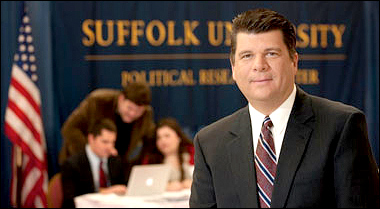
Suffolk University’s David Paleologos

On Bill O’Reilly’s Fox News program, “The O’Reilly Factor,” Suffolk University polling director David Paleologos rather surprisingly announced that his institution would no longer conduct presidential surveys in the core swing states of Florida, North Carolina and Virginia. He says that Republican challenger Mitt Romney will carry the trio, representing a combined 57 Electoral Votes. If true, this would have a stunning effect on the national election.

Paleologos has several reasons supporting his decision to project the three states, all of which voted for President Obama in 2008. First, he says, in Florida, 12 candidates are on the ballot. When questioning the respondents who say they are supporting someone other than Obama or Romney, the overwhelming majority cited the Republican nominee as their second choice. He reasons that most people pledging for a minor candidate will move to one of the two major party contenders when they actually cast their ballots instead of wasting their vote on someone who cannot win.

Paleologos also cited the absentee ballot request forms in Florida as another fundamental reason that Romney will win the Sunshine State. He argues that of those people officially requesting ballots, 43.4 percent are registered Republicans versus 39 percent who identify as Democrats. Of those already returning their voting envelope, 45.5 percent are Republican as compared to 38 percent Democratic. In North Carolina, 52 percent of the absentee ballot requests are from Republicans with just 27 percent coming from Democrats. He is less specific about his reasoning for including Virginia in this group of states.

Though some of the support points for Suffolk’s decision are sound, it is way too early, and the margins too close, to begin projecting such states for either candidate. Just look at the major swings occurring within the last two weeks, yielding trends that no one predicted. Much will continue to happen in the next month to determine the actual winner. Suffolk’s polling withdrawal decision is quite premature.

Romney Strikes Back

Just before the Oct. 3 presidential debate, conventional wisdom held that the national race had effectively ended and President Obama was on the threshold of clinching re-election. He was consistently ahead in all nationwide polls, and in every key swing state. Oh, what a difference a week makes.

With his debate performance as the catalyst propelling Republican nominee Mitt Romney back into contention, a series of new polls now shows a complete race reversal.

Eight national surveys were released yesterday and, for the first time, it is Romney who leads or is tied in the preponderance of them. Gallup, the American Research Group (ARG), Public Policy Polling, and the Investors Business Daily’s TIPP poll all post Romney to a lead of one or two points. Two studies, Ipsos/Reuters and Rasmussen Reports, project a tie between the two candidates, while UPI/CVoter and Zogby Research for The Washington Times still find the President leading by a lone percentage point.

But the national data tells only part of the story. In the most important core and secondary states of North Carolina, Ohio, Colorado and Nevada, Romney has gained strong momentum and leads in several polls.

North Carolina, by all accounts a critical core conversion state, yields to a Gravis Marketing study (Oct. 6-8; 1,325 likely North Carolina voters) that projects Romney to a major 50-41 percent lead, obviously his biggest margin of the campaign in the Tar Heel State. Along with Florida, Ohio and Virginia, North Carolina is in virtual must-win status for the Romney campaign.

Ohio, another of the four core states, features trends that are mixed in declaring a leader, but all polls show significant movement for Romney. The American Research Group (Oct. 5-8; 600 likely Ohio voters) gives the challenger a one-point 48-47 percent edge. Survey USA (Oct. 5-8; 808 likely and actual Ohio voters) also finds a one point difference between the candidates, but their data still has the President in front, by a scant 45-44 percent margin. Finally, in better news for Obama, the CNN/ORC survey (Oct. 5-8; 888 likely voters) gives the president a 51-47 percent lead.

In the secondary states, the places Romney would need to win should he fail to carry all four of the core states, are also turning in favorable numbers for the GOP challenger. Colorado, a state trending blue in 2008 and electing a Democratic senator in the Republican landslide year of 2010, has been showing signs of returning to the GOP column. The latest ARG poll (Oct. 5-8; 600 likely Colorado voters) gives Romney his first Centennial State lead, 50-46 percent, after following closely behind Obama even in the days when the president was beginning to break away in other places.

Staying out west in Nevada, another state showing signs of returning to the Republican fold after four years of relatively consistent Democratic voting patterns, Rasmussen Reports (Oct. 8; 500 likely Nevada voters) projects the two candidates being tied at 47 percent.

The latest swing toward Romney is actually quite consistent with voter behavior throughout this election cycle. The electorate has often moved both quickly and wildly in responding to late-breaking events. Such is the case with the Romney debate performance. It remains to be seen if this direction holds or if voters will soon snap back toward the president.

The next two presidential debates have now assumed an aura of much greater importance in determining the final outcome of this hotly contested race. Will Romney again be dominant? Will the president rebound? Is the swing toward Romney the beginning of a trend, or a mere blip? Time will soon bring us the answers.

Romney Gaining in Key States

Based upon the media coverage of the first presidential debate, it’s not surprising to witness at least a short-term tightening of the national campaign. Fortunately for Republican nominee Mitt Romney, his standing is also improving in the most important swing states.

In Florida, two polling firms now are projecting Romney to be leading President Obama. The Sunshine State is the Republican’s most important conversion entity because there is simply no way to compensate for losing its 29 Electoral Votes. According to Rasmussen Reports (RR) on the day after the presidential debate (Oct. 4; 500 likely Florida voters), the GOP challenger has taken a two-point, 49-47 percent lead. We Ask America (WAA), which ran approximately 1,200 sample automated polls in the three most important swing states also on Oct. 4, finds Romney now leading in Florida, as well. Their margin is 49-46 percent.

Similar results are found in Virginia, another of the critical four core states. Romney’s easiest path to victory is to convert each of the cores (Florida, North Carolina, Virginia and Ohio), and then take at least one more Obama state that is larger than Vermont or Delaware. The President wins re-election, for all intents and purposes, if he takes Florida or any two of the core states.

Rasmussen Reports, testing 500 Old Dominion state likely voters on Oct. 4, found a 49-48 percent Romney lead in Virginia. We Ask America, also on the same date, detected a 48-45 percent GOP challenger advantage.

In Ohio, RR still forecasts the President to be leading, but by just one point, 50-49 percent. WAA, however, sees Romney forging ahead in this critical state, up by the same one-point spread, 47-46 percent.

Regardless of whether these small margins are completely accurate, they do tell us that Romney did receive, at the very least, a quick momentum surge that penetrated into the states that will have the largest say in determining the final outcome of this presidential election.

It remains to be seen if the Romney debate bump sustains itself for more than a few days. The electorate, throughout the 2012 election cycle, seems all too willing to shift on a dime and the challenger’s improved standing could be yet one more example of this phenomenon. If so, then the vast majority of polling between now and the last week of October won’t tell us too much because we know things can quickly change based upon external events. If Romney’s improved standing holds through the next week, though, then a new, firmer Republican base may well be formulating.

What we can confidently determine is that 39 states and the District of Columbia have made their decision about this presidential contest. Among the decided states, the President enjoys a 201-176 advantage. This means Pres. Obama needs to convert 69 of the remaining 161 Electoral Votes, or 43 percent of them. Romney, on the other hand, needs 57 percent — or 94 of the remainder.

    The 11 undecided states are, from west to east:

  • Nevada (tilting Obama, but approaching toss-up status)
  • Colorado (tilting Obama, but approaching toss-up status)
  • Iowa (pure toss-up)
  • Wisconsin (tilting Obama, but approaching toss-up status)
  • Michigan (leaning Obama)
  • Ohio (leaning Obama)
  • Pennsylvania (leaning Obama)
  • New Hampshire (leaning Obama)
  • Virginia (tilting Obama, but approaching toss-up status)
  • North Carolina (leaning Romney)
  • Florida (tilting Romney, but again approaching toss-up status)

Understanding where the states currently stand, and even giving Iowa to Romney, the president would win re-election with 297 Electoral Votes. But, make no mistake, his political position is precarious. For an incumbent to be this close to losing a month away from Election Day is a bad sign for him because the majority of voters are not yet positively convinced after four years of performance from which to judge. This race remains undecided.

The Stretch Drive Begins for Senate, House Races

October is here and the political stretch drive is beginning, so it is appropriate to examine where the Senate and House campaigns stand from an aggregate party division perspective.

For most of the election cycle, Republicans appeared to be on the precipice of capturing the Senate majority, taking it away from Harry Reid and the Democrats. But, new swings in momentum show a more Democratic trend.

Recently, Democratic incumbents in Florida and Ohio have gained strength and open seat contender Tammy Baldwin has seized the initiative in the open Wisconsin campaign. Sunshine State polls have been erratic, but Sen. Bill Nelson now seems to have built a consistent and sustained advantage. First-term Sen. Sherrod Brown has also seen the polls ebb and flow, but his mid to high single digit edge over GOP state Treasurer Josh Mandel is stabilizing, at least for the short term. Baldwin’s ad offensive and Republican former governor Tommy Thompson’s recent comments about dismantling entitlements has posted the Democratic nominee to a slight lead.

After some flirtation with breaking toward the Democrats, the pure toss-up campaigns in Massachusetts (Sen. Scott Brown vs. Elizabeth Warren), Montana (Sen. Jon Tester opposing Rep. Denny Rehberg), and Virginia (ex-senator George Allen and former governor Tim Kaine) have re-established themselves as dead heat campaigns. All three of these races will likely go down to the wire.

Additionally, there is movement toward Republicans in at least two long shot states, Connecticut and Pennsylvania, while Democrats are making Arizona a race. By most polls, Rep. Chris Murphy (D-CT-5) still leads Republican Linda McMahon, but the gap is closing and the latter has gained the offensive.

The sleepy Pennsylvania Senate race has finally arisen, and Republican Tom Smith’s recent ad blast appears to be bringing him to within a single-digit deficit of first-term incumbent Bob Casey Jr. Democrats are still likely to prevail here and in Connecticut, but there is no question that Republican candidates in both places have created some current positive momentum.

Democrat Richard Carmona, the former US Surgeon General, is pulling much closer to Arizona Rep. Jeff Flake (R-AZ-6) in their open seat battle according to most polls. As in Connecticut and Pennsylvania for the Democratic candidates, Flake still must be considered the favorite to prevail.

The Missouri campaign between Sen. Claire McCaskill who, at the beginning of the cycle appeared to be the most vulnerable Democratic incumbent standing for re-election, and the mistake-ridden Rep. Todd Akin (R-MO-2) is still in toss-up territory. Most believe, however, that activity in the final stretch will favor the Democratic Senator.

Republicans were thought early to be clear favorites in North Dakota and Indiana, but polling is still indicating that both of these campaigns remain close. The GOP appears to be a lock to convert Sen. Ben Nelson’s (D) open Nebraska seat, and Independent Angus King continues to maintain the inside track in retiring Republican Sen. Olympia Snowe’s seat in Maine, though the numbers are closing.

Today, Democrats look to be ahead in enough states to give them a 49-47 aggregate lead in the Senate, with four races in the toss-up column; three of which are currently Democratically held. Hence, the majority remains in abeyance.

The House has been the most stable of the federal political entities in the 2012 cycle. Post-census redistricting will prove to be the determining factor here and that favors the Republicans. It appears the partisan swing will deviate between a +/- three seat margin in terms of aggregate gains and losses for the two parties, but Republican control seems secure.

Democrats could be gaining as many as three seats in Florida and potentially the same or more in Illinois. Republicans are positioned to score similarly in North Carolina. New York and California remain as wild cards.

While the GOP appeared to be in position to gain seats up until the last two weeks, Democrats are enjoying a swing in some House races, too. The best estimate indicates Republicans will comfortably retain control, but Democrats could make an aggregate gain in the low single digits.

Today, it appears that 233 seats are safely or trending Republican as compared to 186 headed to the Democrats. Sixteen seats are considered too close to call, with 11 of the 16 being in GOP currently held districts.

A Quintet of Close New House Polls

Rep. Mary Bono Mack

Now that we’ve passed Labor Day, congressional polls are going to be released at a fast and furious pace. Yesterday several surveys came into the public domain, each revealing close races for the tested subjects. Some of the new data appears surprising, but considering the redistricting or political situation surrounding the incumbent such results should have been expected.

Around the horn, close races are confirmed for Reps. Mary Bono Mack (R-CA-36), Mike Coffman (R-CO-6), Bill Johnson (R-OH-6), David Rivera (R-FL-26) and the open WA-1 campaign between Republican John Koster and Democrat Suzan DelBene.

Polling for the liberal advocacy group Democracy for America, Public Policy Polling (Sept. 12-13; 1,281 likely CA-36 voters via automated interviews) gives California Rep. Bono Mack only a 47-44 percent lead over physician Raul Ruiz (D). The Riverside County district favors Republicans in registration by a 40.3 to 38.6 percent margin and the PPP sampling universe showed a 41-40 percent Republican to Democrat ratio. Therefore, the poll accurately reflects the desert district’s political division. This is the second poll that has projected the campaign to be within the margin of error. Such is not a surprise because this district can be competitive and Dr. Ruiz is proving to be a formidable opponent.

In Colorado, when the court re-drew the 2011 congressional map, the incumbent receiving the most adverse district was sophomore Rep. Mike Coffman. His 6th District went from 53-46 percent McCain to a 54-45 percent Obama, a net swing of 16 points toward the Democrats. So, it’s no surprise that he would be in a tough 2012 campaign. The Democratic Congressional Campaign Committee released another of their methodologically questionable interactive voice response polls, this one of only 350 people. The results show Coffman leading 42-39 percent, which on this type of survey, and being unaware of the types of questions asked, may not be a bad result for the Republican incumbent. The new confines of the district will yield a close race, but it is reasonable to conclude that the DCCC three-point Republican advantage conclusion most likely understates Rep. Coffman’s true support.

The 6th District in Ohio is a Democratic-leaning district at the very least. Freshman Rep. Bill Johnson’s upset of two-term Rep. Charlie Wilson (D) was one of the biggest surprises of the 2010 cycle. Therefore, it was expected that the re-match would be close. According to an Anzalone-Liszt survey for the Wilson campaign (Sept. 9-12; 500 likely OH-6 voters), the results confirm such a prediction. The Democratic internal data projects the race to be a 46-46 percent tie. Both candidates are accusing the other of voting to cut Medicare. The 6th, Ohio’s largest coal-producing district, could well vote based upon energy policy. The Cap & Trade issue was a major reason for Johnson’s 2010 win, even though Wilson had opposed the bill when he was in the House. This race appears to be a pure toss-up.

In Florida, Public Policy Polling, again for Democracy for America (dates and sample size not released) fielded a survey that was basically in the push-poll category as it asked several questions regarding the FBI investigating freshman Rep. David Rivera (R-FL-26). The pre-push result showed two-time former congressional nominee Joe Garcia (D) leading the first-term representative 46-39 percent. After the push questions were asked and recorded, the secondary ballot test gave Garcia a 49-36 percent lead. There is no doubt that Rivera has political problems, and since the new 26th CD is politically marginal the six point Democratic lead is certainly within the realm of possibility.

Finally, in Washington state, a Survey USA poll (Sept. 13-15; 593 likely WA-1 voters) gives Republican John Koster a 46-42 percent lead over Democrat Suzan DelBene. Both individuals are former congressional nominees. The new 1st is much different from the current CD-1 that Democratic gubernatorial nominee Jay Inslee formerly represented. Fifty-two percent of the territory is new to the 1st District, but it’s an area largely comprised of places Koster represented during his tenure in the legislature and on the Snohomish County Commission. While 56 percent of the CD-1 voters supported President Obama in 2008, such a number represents a swing of 12 points toward the Republicans from WA-1’s former configuration. The S-USA poll shows Koster trailing DelBene by just one point among female voters, which is likely to expand in DelBene’s favor as the campaign continues toward Election Day. This race is expected to be close, but in a presidential year, the Democrats should command at least a slight edge.