Tag Archives: favorability

Will He Stay Or Will He Go?
New Duncan Hunter Poll Released

By Jim Ellis

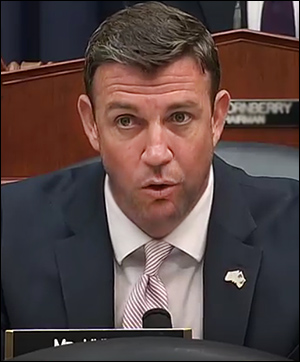
California Rep. Duncan Hunter (R-Alpine)

California Rep. Duncan Hunter (R-Alpine)

Oct. 1, 2018 — One of the more interesting asides for the coming election is whether the two indicted congressmen, California’s Duncan Hunter and New York’s Chris Collins, can still win re-election. Since the House partisan division may be close, every seat is of critical importance particularly to Republicans who are attempting to hold their tenuous majority and risk both of these seats.

Monmouth University just released their new poll in California’s 50th Congressional District, testing Rep. Duncan Hunter’s political strength. As you may remember, Hunter is under federal indictment for campaign finance violations.

According to the Monmouth data (Sept. 22-26; 401 potential CA-50 voters who have cast a ballot in at least one of the last four primary or general elections or have newly registered to vote since January 2016), Hunter still has majority support in a district that President Trump carried, 55-40 percent.

Monmouth has been testing different turnout models in all of their latest polls. They look at all registered voters, a standard midterm model, and one that features a “Democratic surge.” In this poll, as in many other Monmouth surveys around the country, the tested Democratic candidate performs better under the registered, or “all voters” model, than under a Democratic surge, so it’s unclear as to the value of the latter test framework.

Continue reading

Senate Recap – Part II

By Jim Ellis

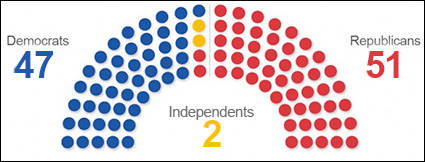
US Senate makeup

US Senate makeup

Sept. 24, 2018 — Today we continue our look at the most competitive 17 US Senate contests with our second and final installment. To take a look at our Part I recap, please see our writeup this past Friday at: Senate Recap – Part I.


NEVADA

Sen. Dean Heller (R) is embroiled in an intense re-election battle with freshman Rep. Jacky Rosen (D-Henderson) as the two compete for a toss-up Senate seat. Heller won here in 2012 by a single percentage point over then-Rep. Shelley Berkley (D-Las Vegas), but that was in the election when President Obama carried Nevada, 52-46 percent.

Polls go back and forth between the senator and congresswoman, but neither leads beyond the margin of polling error. Since the beginning of September three polls have been released, and the average spread between the contenders is just two points. This is a pure toss-up election and, as a Republican defense seat, one of the most important campaigns in the nation.


NEW JERSEY

The Garden State is often a teaser for Republicans, meaning polls routinely suggest their candidates will fare better than actual results portend. The Senate race between incumbent Bob Menendez (D) and pharmaceutical CEO Bob Hugin (R) is likely no exception. Though several polls have indicated the race is competitive, it is probable that Sen. Menendez will pull away and score a comfortable win.

Polling has been scarce. The most recent survey was released in mid-August from Quinnipiac University (Aug. 15-20; 908 registered New Jersey voters) and projects the senator to be leading Hugin, 43-37 percent. Obviously, Menendez corruption trial that ended in the case against him falling apart and being dropped has taken a toll on his favorability index, but it is doubtful that even a 29:47 percent positive to negative personal approval rating (aforementioned Q-Poll) would cost him the election.


NORTH DAKOTA

If polling were the only factor in determining race outlook, then North Dakota would be the Republicans’ best conversion opportunity. Though polls have been anything but plentiful, those that have been published find at-large Rep. Kevin Cramer (R-Bismarck) leading incumbent Sen. Heidi Heitkamp (D).

The most recent study came in early September from Fox News (Sept. 8-11; 701 likely North Dakota voters) and finds Rep. Cramer holding a 48-44 percent advantage. This is the first survey release since the beginning of July.

The North Dakota race is a strong Republican conversion opportunity, but though Cramer appears to have a discernible edge right now, this contest is far from over.


Continue reading

Texas Sen. Ted Cruz Rebounds

By Jim Ellis

Sen. Ted Cruz (R-TX)

Sen. Ted Cruz (R-TX)

Sept. 20, 2018 — A new Quinnipiac University poll (Sept. 11-17; 807 likely Texas voters) finds that Sen. Ted Cruz (R), after languishing in a rather prolonged syndrome where he was only posting small single-digit leads over US Rep. Beto O’Rourke (D-El Paso), has opened a much larger advantage in his campaign for re-election.

The latest Q-Poll finds Sen. Cruz now topping Rep. O’Rourke, 54-45 percent, his strongest advantage since two polls (Gravis Marketing and YouGov) put him nine and 10 points ahead in early July.

It remains to be seen whether this Quinnipiac poll proves to be an outlier. Up until this release, seven Texas statewide polls had been conducted since early July, all with a mean average of 3.4 percentage points separating Cruz and O’Rourke, but always in the senator’s favor.

This poll suggests that Texas is one of the most polarized states in the country. Both parties produce almost unanimous support for their individual nominee. Sen. Cruz, by a whopping margin of 94-6 percent, commands Republican support. By the same token, Rep. O’Rourke sees virtually the same split forming behind him among Democrats, 94-4 percent. The Independents are leaning toward O’Rourke, 51-47 percent, but the larger number of Lone Star State Republican voters catapults Cruz into a comfortable lead.

Continue reading

MA-3: A Sleeper?

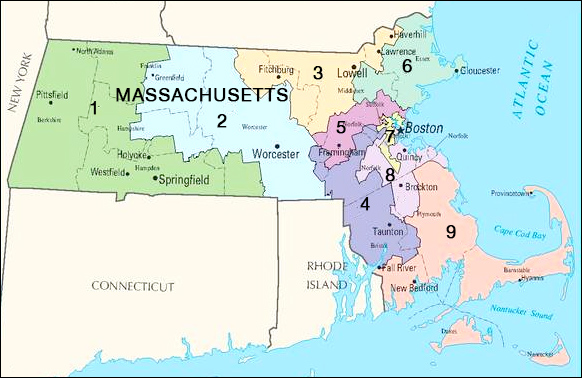
Massachusetts congressional districts

Massachusetts congressional districts


By Jim Ellis

Aug. 27, 2018 — One of the few interesting remaining primaries in this 2018 election cycle is the open northern Massachusetts congressional race a week from tomorrow featuring 10 Democratic candidates all attempting to succeed retiring Rep. Niki Tsongas (D-Lowell).

A new University of Massachusetts at Lowell and Boston Globe survey of the impending MA-3 Democratic primary (Aug. 14-21; 849 MA-3 registered voters, 553 MA-3 likely Democratic primary voters) finds ex-Boston mayoral chief of staff Dan Koh forging into the lead, but with only a 19-13-13 percent edge over former ambassador to Denmark, Rufus Gifford, and state Sen. Barbara L’Italien (D-Andover) as the state’s Sept. 4 partisan primary draws near.

But other candidates could possibly make a run, too. Business consultant Lori Trahan posts eight percent in the poll, and while state Rep. Juana Matias (D-Lawrence) has just six percent, she is dominant within the district’s Hispanic community. In such a crowded campaign with a low voter turnout, any candidate with a major support base must be taken seriously. The other five candidates each register four percent and below.

But there could be more to this campaign than the winner of a crowded primary going on to easily take the general election in what should be a safe seat for the dominant party in the district, in this case the Democrats.

Continue reading

New Nevada Poll Numbers Are Mixed

By Jim Ellis

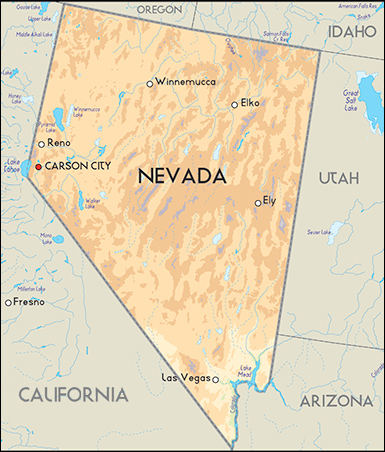
Nevada-mapJuly 3, 2018 — Gravis Marketing released their latest Nevada statewide poll (June 23-26; 630 likely Nevada voters “using an online panel of cell phone users and interactive voice responses”), and the findings provide some uptakes for both political parties.

According to the Gravis results, Rep. Jacky Rosen (D-Henderson) assumes a 45-41 percent lead over Sen. Dean Heller (R) in the critical US Senate race, while Republican Attorney General Adam Laxalt edges Democratic Clark County Commissioner Steve Sisolak, 43-41 percent in the open governor’s race.

We see mixed results throughout the poll on the underlying questions, thus leading one to believe that the two key Nevada campaigns are pure toss-ups.

Gov. Brian Sandoval (R) continues to post approval ratings that make him the most popular public official in the state. The Gravis favorability index posts the governor at 62:29 percent positive to negative. President Trump, not surprisingly from a state that he lost 48-45 percent, has a 43:53 percent upside-down job approval ratio. Interestingly, however, his approval numbers among Hispanics are dead even, with 46favorability approving of his job performance and an additional 46favorability disapproving. His numbers among White/Caucasian respondents are similar to what is found among Hispanics, 49:50favorability.

Continue reading

Critical NJ Race in Toss-Up Mode

By Jim Ellis

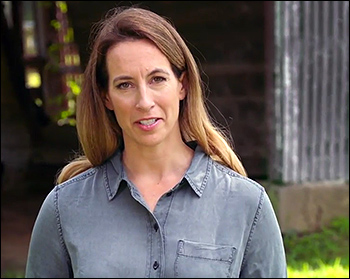
Navy veteran and attorney, Mikie Sherrill

Navy veteran and attorney, Mikie Sherrill (D) | Photo from campaign ad

June 28, 2018 — Democrats have high hopes of converting a northern New Jersey seat that has only elected Republicans during the past 34 years, and a new Monmouth University poll (June 22-25; 406 NJ-11 registered voters) projects a toss-up 11th District contest. The two major party nominees, chosen in early June, are state Assemblyman Jay Webber (R-Morristown) and attorney and Navy veteran Mikie Sherrill (D).

Monmouth polling is experimenting with new sampling methods that involve three different turnout projection models. Their full sample, or “potential” voter model is one that tests only people who have voted in at least one election since 2010 or who are newly registered voters. The second model is what they term a “standard midterm” sample, and the third is in place to monitor a “Democratic surge,” if such were to develop.

The latter phrase has been used frequently in polling and in political commentaries, but there is little evidence of a substantial increase in Democratic primary voting from most states. At this point, national turnout models based solely upon 2018 primary voter turnout suggest a pattern that is closely aligned with a typical midterm performance. So far, more Democrats have been voting in states that normally vote Democratic, and more Republicans are participating in places where GOP candidates dominate.

New Jersey state Assemblyman Jay Webber (R) | Photo from campaign ad

New Jersey state Assemblyman Jay Webber (R) | Photo from campaign ad

According to the full sample model, Democrat Sherrill leads Republican Webber by a scant 40-38 percent. Under the typical midterm model, the Democratic advantage increases to four points, 44-40 percent, but is still within the polling margin of error. Under their potential “Democratic surge” model, which may well prove illusionary when actual votes are counted, Sherrill increases her advantage to 45-39 percent.

The sample is weighted, but the draw does include more Independent voters (plus-three percent) than the raw percentage district total, and is four points less Democratic. But, the weighting formula is supposed to neutralize such discrepancies.

Continue reading

Wisconsin Gerrymandering Ruling;
Greitens Still Lingering

By Jim Ellis

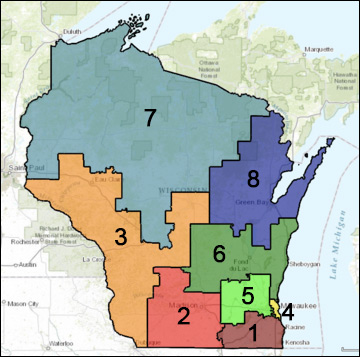
Wisconsin Congressional Districts

Wisconsin Congressional Districts

June 20, 2018 — The United States Supreme Court issued their long-awaited ruling on the Wisconsin political gerrymandering case on Monday, and it basically sends the parties back to the drawing board. At one time it was thought that Wisconsin was the vehicle for the high court to issue a definitive ruling regarding political gerrymandering, which continues to be the subject of many live redistricting lawsuits. Instead, on a rare 9-0 vote, the Supreme Court ruled that the plaintiffs did not have the necessary standing to bring the action.

The plaintiffs came from four Wisconsin Assembly districts who claimed they were personally harmed by the state legislative boundaries the legislature and governor adopted back in 2011. The court ruled that such plaintiffs did not have adequate standing to bring a statewide lawsuit.

The court did issue some orders, however, that will make later political gerrymandering suits more difficult to bring because certain technical standards must now be met in future action. As part of the plaintiffs’ standing ruling, the justices vacated the lower court ruling that ordered the state assembly districts re-drawn. It is now likely that political boundaries around the country are finally set for the 2018 election.

Continue reading

Poll: New Jersey Closing

By Jim Ellis

new-jersey-mapMay 31, 2018 — A new curious poll was released right before the Memorial Day break that suggests the New Jersey Senate race is already closing.

Since presumed Republican nominee Bob Hugin, the former chairman and CEO of the Celgene pharmaceutical corporation, has already spent $3.7 million on his campaign in conjunction with the June 5 primary, it is not particularly surprising that the margin between he and Sen. Bob Menendez (D) is getting tighter.

What appears unusual are the raw numbers from the recent Fairleigh Dickinson University survey, however. The poll (May 16-21; 856 registered New Jersey voters) looks to be sound methodologically, and the numbers reported for various approval ratings and other data points seem consistent with previously released research. The ballot test, however, raises questions because the incumbent’s support figure is so low and the undecideds high (46 percent). According to the F-D study, Sen. Menendez leads Hugin only 28-24 percent.

Despite the veteran senator seeing the federal bribery case against him fall apart and charges dismissed, his reputation has still suffered. The F-D report finds the senator’s favorability index at 33:39 percent favorable to unfavorable with only 51 percent of Democrats answering with a positive response. In comparison, the state’s junior senator, Cory Booker (D), posts a 55:27 percent ratio and a positive rating among Democratic respondents of 79 percent.

Demographically, the senator’s numbers are weak across the board. Even while leading Hugin in every category, his margins are tight and overall support figures poor. Sen. Menendez gets 27 percent among men, 29 percent from women, 27 percent with white voters, and just 30 percent from non-white voters. Even the college-educated voters, usually a strength segment for Democratic candidates, favor him only 32-24 percent.

This May poll is drastically different from published university polls in April and March. But Hugin’s strong early campaign provides at least a partial explanation. The former corporate leader is so far self-funding to the tune of $7.5 million and had raised almost $700,000 from individuals as listed in the May 16 pre-primary disclosure report.

Continue reading

Two New Senate Polls
From Indiana and Rhode Island

By Jim Ellis

gravis-marketing-Anzalone-Liszt-Grove-ResearchMay 21, 2018 — Gravis Marketing went into the field two days after the Indiana primary ended to test the new general election pairing between Sen. Joe Donnelly (D) and former state representative and businessman Mike Braun (R). According to the poll (May 10-15; 400 likely Indiana voters), the race has already lapsed into a dead heat.

Forecast as a toss-up all the way to November, Gravis finds Braun, who scored a 41-30-29 percent Republican primary plurality victory over Reps. Todd Rokita (R-Brownsburg/ Lafayette) and Luke Messer (R-Greensburg/Muncie), respectively, edging Sen. Donnelly by a single point on the first ballot test, 45-44 percent.

When respondents leaning to both candidates are added, Gravis reports that Braun is up 47-46 percent. The pollsters pushed the undecideds to make a choice, but the secondary responses reportedly break 19-13 percent for Sen. Donnelly, while the remaining 69 percent maintain they are still undecided. Adding these totals into the decided ballot test appear to produce a 46-46 percent split, but the Gravis analysis gives Braun the one-point lead. Regardless of the mathematical fine-tuning, these results conclude that the Indiana Senate race is already in pure toss-up mode.

Sen. Donnelly posts a 41:40 percent favorable to unfavorable job approval score. This includes 11 percent who say they strongly approve and 18 percent who strongly disapprove. In comparison, President Trump posts a 47:47 percent score, with 24 percent strongly approving and 35 percent strongly disapproving. Indiana’s junior senator, Todd Young (R-IN), was also comparatively tested and recorded a 36:34 percent favorability index (ine percent strongly favorable; 15 percent strongly unfavorable). Hoosier State Gov. Eric Holcomb (R) fared best in the Gravis poll, however. His job approval index is 54:30 percent, with 16 percent and seven percent strongly approving and disapproving, respectively.

Continue reading

New Arizona Senate Data

By Jim Ellis

Sen. John McCain (R) -- Negative approval rating and pressure to retire

Sen. John McCain (R) — Negative approval rating and pressure to retire

April 19, 2018 — Magellan Strategies independently surveyed the Arizona Republican electorate (April 11-12 and 15; 755 likely Arizona Republican primary voters) to test the state’s upcoming Senate race, along with Sen. John McCain’s (R) status and that of other key elected GOP leaders.

According to Magellan’s results, US Rep. Martha McSally (R-Tucson) outpaces former Maricopa County Sheriff Joe Arpaio and ex-state senator and 2016 US Senate candidate Kelli Ward, 36-26-25 percent, an improvement for the congresswoman when compared to previously published polls.

In January, Phoenix-based OH Predictive Insights released their poll that found McSally leading 31-22-19 percent over Arpaio and Ward, while another Arizona-based survey research firm, Data Orbital, found a much tighter three-way split, 31-29-25, again with McSally topping Arpaio and Ward, consecutively.

Much speculation still surrounds Arpaio’s candidacy. Some believe that he will drop his Senate campaign prior to the state’s May 30 candidate filing deadline, instead using the race as basically a vehicle to raise money to cover legal fees from battling charges filed against him during the past two years. President Trump pardoned Arpaio after he was found guilty of criminal contempt in relation to refusing to follow a judge’s immigration order while in his position as sheriff.

Continue reading