Tag Archives: Arkansas

Ross, Wu to Retire

Two more Democratic House members announced they will not seek re-election in 2012, but for very different reasons.

Arkansas Rep. Mike Ross (D-AR-4), first elected in 2000 and whose eyes are set on a gubernatorial run in 2014, announced yesterday that he will end his congressional career when the current term concludes. The 4th district was made more competitive in redistricting, so not seeking re-election and possibly risking a closer result than in 2010 (Ross’ margin over Republican Beth Anne Rankin was 57-40 percent) will not weaken his standing in the gubernatorial contest. Already, several Democratic and Republican state and local office holders are expressing interest in running for the new open seat. The succeeding campaign will likely be highly competitive.

In Oregon, Rep. David Wu (D-OR-1) who had been the subject of news stories questioning his mental health and now facing an ethics probe of sexual harassment accusations says he won’t seek re-election in 2012. It was clear that Mr. Wu is in a weakened political state, but the large number of Democrats publicly contemplating filing against him could have allowed him to slip through with a small plurality of support since the anti-Wu voters would be split. Expect many Democratic candidates to file in this new open seat.

The Democrats will retain the district as it is unlikely to become competitive even in an incumbent-less race.
___________________________________________________
For further detailed insights, to sign up for my daily email updates, or to sign up to track specific issues or industries, please contact me at PR***@*******************ts.com.

Trump’s Exit: What Effect?

Real estate magnate Donald Trump announced yesterday that he will not seek the presidency next year, but says he could have won. Indicating that his true passion is still business and not politics, Trump decided to take a pass on joining the Republican field of candidates.

His exit is not likely to alter the race all that much since his support, though appearing to be relatively wide, would have proven to be quite shallow. Despite his own favorable analysis about his prospects, Trump had little chance to win the Republican nomination. His polling status was mostly built on name identification from his high-profile business and television exploits over a long period of years. Once the other candidates and news media began attacking his past public positions and business record, particularly as it relates to owning gambling casinos, along with his flamboyant personal life, one can quickly determine that Mr. Trump was not compatible with the Republican primary electorate in most states. Obviously, the departure of former Arkansas Gov. Mike Huckabee will considerably change the GOP presidential picture, but the never-to-be Trump for President campaign was little more than a blip on the political radar screen.
___________________________________________________
For further detailed insights, to sign up for my daily email updates, or to sign up to track specific issues or industries, please contact me at PR***@*******************ts.com.

Huckabee, McCotter Say ‘No’; Succeeding Sen. Kohl; W.Va. Gov. Results

Former Arkansas Gov. Mike Huckabee officially took himself out of the 2012 presidential race Saturday night, announcing his decision on the Fox News television program that he hosts. Despite performing very well in preliminary presidential polling, Mr. Huckabee simply stated that his heart was not in another run. Instead, he will devote his time to the “Huckabee” television program and will continue with radio commentaries, speeches, and public appearances. Mr. Huckabee further committed to actively supporting conservative and pro-life candidates for public office.

The decision was not particularly surprising. Though included in virtually every national and early state primary poll, Huckabee had done nothing to operationally construct a campaign apparatus, a sure sign that a candidate is not serious about running. The effect on the rest of the field is unknown, but his sizable base of support will likely disperse to some of the more conservative candidates.

Michigan Senate

As quickly as speculation was beginning to surface suggesting that Rep. Thaddeus McCotter (R-MI-11) might challenge Sen. Debbie Stabenow (D-MI) next year, the five-term congressman made public his quick and definitive decision. In a statement over the weekend, Mr. McCotter said he will not run for the Senate in 2012. All nine GOP members of the Michigan congressional delegation have now taken themselves out of competition against Stabenow. Though appearing vulnerable, the Republicans have yet to field a strong candidate.

Wisconsin Senate

Turning to Wisconsin, on Friday afternoon Sen. Herb Kohl (D) made public his intention not to seek a fourth term next year. This sets up what could be a very competitive Badger State open seat political campaign. Kohl is the ninth in-cycle senator to announce a return to private life. Eight of these particular seats will be open in 2012. Nevada Sen. John Ensign (R) has already resigned with Dean Heller (R) replacing him for the remainder of the current term. Hence, Sen. Heller’s new status for his 2012 political run will be that of an appointed incumbent.

There is likely to be a great deal of speculation surrounding potential candidates for the Wisconsin Senate seat. On the Democratic side, defeated Sen. Russ Feingold will be the person most discussed. Feingold, before Sen. Kohl opted out of another campaign, said he had no intention of running in 2012, even if the seat came open. Now that it has, Feingold will quickly be pressed for a decision. He served three six-year terms, originally being elected in 1992. He was defeated in 2010 by now-Sen. Ron Johnson (R) 47-52 percent.

Should Mr. Feingold not return to elective politics, Rep. Ron Kind (D-WI-3) will be a person who attracts noticeable attention as a potential Senatorial candidate. Second District Rep. Tammy Baldwin (D) is saying she will consider running statewide, too. Likewise for defeated Democratic gubernatorial nominee Tom Barrett. Prior to his run for governor, Mr. Barrett was mayor of Milwaukee and a former congressman.

On the Republican side, all eyes will preliminarily be on House Budget Committee chairman, Rep. Paul Ryan (R-WI-1), who also is not ruling out a Senatorial bid. The author of the Ryan budget, which the Democrats are excoriating as the vehicle that destroys Medicare, will be a huge political target no matter what office he chooses to seek. Ryan has more than $3 million in his campaign account, so he starts any campaign in very strong financial shape.

West Virginia Governor

The special West Virginia gubernatorial primary was held on Saturday. As expected, Acting Gov. Earl Ray Tomblin easily won the Democratic nomination. He tallied 40 percent of the vote over state House Speaker Rick Thompson who was strongly backed by organized labor and placed a surprising second (24 percent). Secretary of State Natalie Tennant who, early in the race was believed to be Tomblin’s strongest challenger, finished a disappointing third with 17 percent.

An upset occurred on the Republican side, proving again that virtually unknown candidates are still performing better in GOP primaries than more familiar politicians. Businessman Bill Maloney, who polling showed was gaining momentum toward the end of the race, took advantage of the political wind at his back and claimed an easy 45-31 percent win over former Secretary of State Betty Ireland. Total voter turnout was only 16 percent of the statewide registered voters pool. Tomblin and Maloney will now square-off in a special general election scheduled for Oct. 4. The nomination of Maloney now turns this contest into a potentially interesting campaign.
___________________________________________________
For further detailed insights, to sign up for my daily email updates, or to sign up to track specific issues or industries, please contact me at PR***@*******************ts.com.

Fayetteville Finger Falls

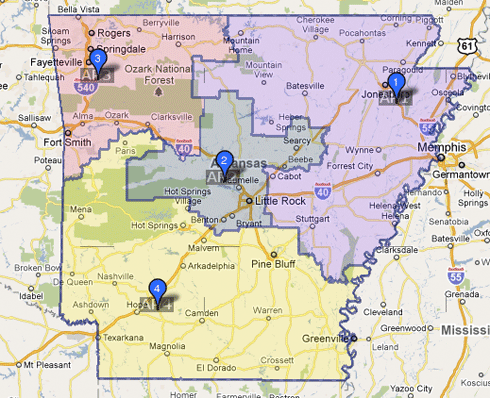
The current layout of Arkansas' congressional districts. (govtrack.us)

The Arkansas legislature officially sent Gov. Mike Beebe (D) a new congressional district map, but the attempt to annex the city of Fayetteville to Democratic Rep. Mike Ross’ 4th district failed. This is a victory for the northwest Arkansas-area legislators who insisted that the city stay as the anchor of the 3rd district. The controversy surrounding Fayetteville erupted because of a proposal that featured a jutting protrusion, dubbed the “finger,” beginning in the southern part of Arkansas and stretching all the way to Fayetteville in the northwest. This was done to put more liberal voters into Rep. Ross’ 4th district to better secure the seat for future Democrats. Ross is expected to run for governor in 2014, thus creating a potentially competitive open seat three years from now. The Fayetteville “finger” would have cemented the seat for the Ds.

The new map secures AR-3 for Republican Steve Womack, but the 4th could now become competitive after Ross departs. The 2nd district remains relatively intact, which is good news for freshman Rep. Tim Griffin (R). The GOP could take a hit, however, in the 1st district that will now cover the entire eastern portion of the state. The inclusion of more Democratic votes in Arkansas’ southeastern delta region will likely make freshman Rep. Rick Crawford’s seat highly competitive. Liberal activists are generally upset with the map, believing that the Democratic legislature and governor should have drawn a plan to return to a 3D-1R advantage, instead of the current split that features the exact opposite 3R-1D division. To summarize, the new Arkansas congressional map has two marginal seats and two that will likely remain Republican, thus the source of angst for the Democratic partisans.
___________________________________________________
For further detailed insights, to sign up for my daily email updates, or to sign up to track specific issues or industries, please contact me at PR***@*******************ts.com.

Redistricting in Iowa, Indiana, Arkansas & Maryland

The Census Bureau is sending four more states their block data this week and soon Iowa, Indiana, Arkansas, and Maryland will begin their redistricting processes.

Iowa: The Hawkeye State — which draws its lines through a special legislative committee and does not add the incumbents’ home addresses to their data pull, thereby ensuring that districts are built only around population figures and not politics — will be the most interesting of this bunch. Iowa will lose a seat, and it’s still unclear which two members will be paired. Prior to the actual census data being released, it was estimated that Iowa had two of the 20 lowest populated districts. The current delegation stands at three Democrats and two Republicans, so statistically the Democrats have a greater chance of having at least one of their districts in a pairing. On the Republican side, Rep. Tom Latham’s 4th district, the more interior seat, has a greater chance of being paired than the western-most 5th district of Rep. Steve King. The final four-seat plan could assume one of many diverse variations, but it’s simply too soon to tell what may happen here. We do know for sure, however, that at least one current sitting incumbent will not return in the next Congress.

Indiana: The new Indiana Republican delegation approaches redistricting in strong position. The delegation is divided 6R-3D, after the GOP gained two seats in the 2010 election. All six Republicans can expect to gain safe seats from the GOP-controlled state legislature and Gov. Mitch Daniels (R). Expect the southern Indiana seats, districts 8 and 9, to be strengthened with more Republicans, thus reconfiguring to some extent the safe 4th (Rep. Todd Rokita) and 6th districts (Rep. Mike Pence; likely an open seat). The aforementioned central state seats will all remain heavily Republican, including the 5th district of Rep. Dan Burton, but they will likely contain some different territory. The big Indiana question is whether the Republicans will try to weaken Rep. Joe Donnelly’s (D) 2nd district. He barely secured a third term last November with a very tight 48-47% victory over state Rep. Jackie Walorski (R).

Arkansas: The Republicans gained two seats in the Arkansas delegation, flipping the 3D-1R advantage into a 3:1 split in the GOP’s favor. With Democrats in control of the redistricting pen, will they draw a map that protects all incumbents to the detriment of their own party? Today, that’s difficult to say. The wild card in the picture is Rep. Mike Ross’ (D-AR-4) open desire to run for governor in 2014, since Democratic Gov. Mike Beebe will be term-limited. Ross wants to ensure the safest congressional seat possible for himself to build a strong base for the statewide contest. The more Democratic Ross’ district becomes, the greater the chance all three Republicans survive.

Maryland: This is a state where the Democrats must be concerned about over-reaching. Currently ensconced with a solid 6D-2R delegation split, some Ds want to see the Eastern Shore seat strengthened to give a legitimate shot a unseating freshman Rep. Andy Harris (R-MD-1). Geography favors Harris, as the Eastern Shore is unlikely to be split. If the region has grown, this will help Harris, too. The Congressman hails from the mainland of the state, and his strength on the Eastern Shore may be weaker than most incumbents, but he has a full term in which to personalize his seat. The only Maryland question to resolve is how far will the Democrats go? Will they secure a strong 6D-2R map, or stretch to 7D-1R?
__________________________________________________
For further detailed insights, to sign up for my daily email updates, or to sign up to track specific issues or industries, please contact me at PR***@*******************ts.com.

The Redistricting Bell Sounds

The Census Bureau delivered the individual block data to four states at the end of last week, and scheduled an additional quartet for this week, thus officially opening the deci-annual national redistricting process. Since New Jersey, Mississippi, Louisiana and Virginia all have odd-numbered year elections and operate within the tightest timeline to complete their state and local redistricting processes, it has become traditional for them to receive their vital population statistics ahead of all others. The four states scheduled for this week are Iowa, Indiana, Arkansas, and Maryland. Expect Illinois and Texas to be done soon, too, as both states have early March 2012 primary elections and each has a different number of congressional districts in the new national apportionment.

New Jersey: In the first group of four states now equipped to begin the re-mapping process, each has some hurdles to clear before a final congressional map can be completed. New Jersey, which draws their districts via special commission, loses a seat, and will be reduced from 13 to 12. All 13 current districts are under-populated, hence the underlying reason for reducing the Garden State’s level of representation. The population shift trends reveal the most significant inhabitant drain in the middle of the state. Actually, the majority minority seat in northern New Jersey, CD 10 in Newark, must gain about 100,000 new residents but will not be collapsed. It will be reconstructed for purposes of protecting the large African-American voting base.

Districts 8 (Rep. Bill Pascrell; Paterson, West Orange) and 9 (Rep. Steve Rothman; Hackensack, Ft. Lee) have to gain more than 70,000 people apiece, suggesting that it might be easiest to eliminate one of these two. Districts 5 (Rep. Scott Garrett; Paramus, part of Bergen County) and 6 (Rep. Frank Pallone; Plainfield, New Brunswick) each must gain more than 60,000, so these too could be candidates for removal. Rep. Rob Andrews’ 1st district (Camden) also must gain more than 60,000 people, but the geography and political characteristics affecting this seat point to preservation.

Mississippi: With a split state government and the Obama Justice Department holding map pre-clearance power over Mississippi, the Republicans will be very fortunate to protect their 3R-1D split in the Magnolia State congressional delegation. The Voting Rights Act-protected 2nd district (Rep. Bennie Thompson) needs to gain over 73,000 people, presenting the Democrats with a substantial stumbling block to fulfill their goal of creating two districts of their own. Their most likely target, Rep. Gregg Harper’s 3rd district (Jackson/Pearl; Starkville) has to shed 15,000 people, which makes it more difficult to make drastic changes.

Louisiana: Though the Republicans are now in total control of the Louisiana redistricting apparatus thanks to a party switch in the state Senate, their new status won’t force the Democrats to absorb the loss of a congressional seat. Largely because of post-Katrina population drain, Louisiana is one district down in reapportionment. The only Democratic position in the delegation, the New Orleans’ based 2nd district (Rep. Cedric Richmond), also is a VRA district and cannot be retrogressed. With the 2nd needing to gain an incredible 272,000 people and the 3rd district (Rep. Jeff Landry) directly to its south requiring an additional 118,000 inhabitants, it is very likely the 3rd will be eliminated and its people spread to neighboring districts.

Currently hosting a 6R-1D split in the congressional delegation, Louisiana will almost assuredly send five Republicans and one Democrat to Washington for the balance of the new decade.

Virginia: The Virginia map, which currently yields eight congressional Republicans and three Democrats, has significant areas of population loss and gain. Holding steady with eleven districts for the coming political decade, means that substantially re-shifting the seats’ population centers becomes a necessity. The Virginia Beach-Norfolk area is low, as both Reps. Scott Rigell and Bobby Scott must each gain significant population. The northern Virginia seat of Rep. Frank Wolf, CD 10, is over-populated to the tune of 142,000+ people. Thus, the overflow will have to be dispersed to other seats in the region, but the effect of such a population roll will change the complexion of the other seats, as well.

Since legislative elections will be conducted this year in Virginia, don’t expect the congressional map to be drawn until early 2012. With both parties striving to gain full control of the legislature, the power to re-construct the congressional map becomes a spoils for the victor in the 2011 election cycle. At the end of the process, Republicans will find themselves in very strong position if they are simply able to maintain the status quo 8R-3D split. Whether or not this occurs is yet to be decided.
__________________________________________________
For further detailed insights, to sign up for my daily email updates, or to sign up to track specific issues or industries, please contact me at PR***@*******************ts.com.

The Senate is Finally Final … Almost

Washington Sen. Patty Murray (D) was declared the winner of the 2010 Senate contest with still more than 17% of the vote remaining to be counted. The 46,000+ vote margin made it impossible for challenger Dino Rossi (R) to close the gap. Rossi released a statement conceding the election. Campaign Manager Pat Shortridge indicated that the turnout in the Democratic stronghold of King County (Seattle) was greater than 70%, a huge number for a mid-term election and an obstacle that Rossi could not overcome.

The Murray victory ends all of the Senate races from a partisan perspective. It is still unclear if Sen. Lisa Murkowski (R-AK) will retain her seat via the write-in process, but it is a foregone conclusion that the eventual winner will either be she or the Republican nominee Joe Miller. You will remember that Miller defeated Murkowski in the GOP primary. Though it will be two weeks or more before this election is finally determined, it does appear that Murkowski is well positioned to eventually declare victory.

The final count will show 53 Democrats in the new Senate versus 47 Republicans; a net gain of six seats for the GOP. Republicans won 24 of the 37 Senate elections, but needed 28 to claim the majority. They converted six Democratic states, but only defeated two incumbents – Blanche Lincoln in Arkansas and Russ Feingold of Wisconsin. Democrats won zero Republican states, as the GOP was successful in holding all of the seats they previously controlled.

On the gubernatorial side, several more races were called yesterday. Former Gov. John Kitzhaber (D) was declared the winner in Oregon, defeating ex-NBA basketball player Chris Dudley (R). Illinois Gov. Pat Quinn (D) eked out a very close win over state Sen. Bill Brady (R) in a race that polling suggested was headed for a different conclusion. In Vermont, Democrats successfully converted the open Republican seat back to their column as state Senate President Peter Shumlin won a razor-thin victory over GOP Lt. Governor Brian Dubie.

Two states are still outstanding: Connecticut and Minnesota. Confusion reins in Connecticut as election officials and media outlets attempt to determine the actual vote count. Democrat Dan Malloy claims to be ahead in the race as most of the uncounted ballots come from the city of Bridgeport, which is a Democratic fortress area. Former Sen. Mark Dayton’s (D-MN) 8,000+ vote margin will likely stand, but the Minnesota election appears headed for a recount.

Should the Democrats win the final two races, the count will end with 29 Republican governors, 20 Democrats and 1 Independent (former Sen. Lincoln Chafee in Rhode Island); a gain of five seats for the Republicans. Like in the Senate, only two incumbents were defeated, Govs. Ted Strickland (D-OH) and Chet Culver (D-IA). Republicans won a total of 23 gubernatorial elections this past Tuesday night as compared to the Democrats’ 13, assuming the last two campaigns finally break their way.

Looking at some House stats from Tuesday, 51 incumbents were defeated (49 Democrats; 2 Republicans), not counting any of the remaining outstanding campaigns; 35 of the ousted incumbents are either in their freshman or sophomore term, and 16 are veteran members. The House Blue Dog Coalition was decimated on Tuesday, as 28 of its 52 members will not return to the 112th Congress. Twenty-two BD’s were defeated on Election Day and six more either retired or ran for a different office.