Tag Archives: Alaska

Trump Endorses Alaska Lt. Gov. Dahlstrom for House Seat; Ciscomani Leads in Arizona; Rare Poll in IL-17; Five-Term Rep. Graves Won’t Run in LA-6

By Jim Ellis — Friday, June 21, 2024

House

Alaska Lt. Gov. Nancy Dahlstrom (R)

AK-AL: Trump Endorses Lt. Governor — The Alaska at-large district is the most Republican seat that a House Democrat holds. Rep. Mary Peltola (D-Bethel) has won three congressional elections, largely through the state’s Ranked Choice Voting system. This year, the stage may be set for a similar conclusion. Businessman Nick Begich III (R), nephew of former Democratic US Sen. Mark Begich (D), ran against former Gov. Sarah Palin (R) in the special election when veteran Rep. Don Young (R) passed away, and for both succeeding regular terms. This year, while Palin is not running, Lt. Gov. Nancy Dahlstrom has joined the Republican congressional field.

Under the Alaska system, all candidates appear on the jungle primary ballot, and the top four primary finishers advance into the general election irrespective of political party affiliation. Former President Donald Trump announced his endorsement for Dahlstrom, the candidate who enjoys the national and state Republican Party leadership backing. With two strong candidates battling for the Republican vote, it is likely that Rep. Peltola will again finish first among the top four general election finalists. The question to be answered is whether she can reach the 50 percent mark. If not, Ranked Choice Voting then takes effect.

Begich says he will withdraw if Dahlstrom places ahead of him in the initial qualifying election on Aug. 20. Dahlstrom has yet to make a similar promise.

In the latest available published poll, though dated, from Data for Progress (Feb. 23-3/2; 1,120 likely AK-AL voters; online), Begich had a large 41-12 percent lead over Dahlstrom. In a head to head pairing against Rep. Peltola, the congresswoman and Begich tied at 50-50 percent. Once again, the Alaska at-large campaign is a race to watch.

AZ-6: Rep. Ciscomani Holds Comfortable Lead — An internal Public Opinion Strategies poll (May 28-30; 300 likely AZ-6 general election voters; live interview) for the Juan Ciscomani re-election campaign finds the freshman Arizona congressman holding a 50-39 percent advantage over former state senator and 2022 Democratic congressional nominee Kirsten Engel as the two prepare for a rematch from the campaign of two years ago.

The 6th District, which sits in Arizona’s southeastern corner, is politically marginal in nature but made more Republican in the 2021 redistricting plan. In the previous election, Ciscomani defeated Engel, 50.7 – 49.2 percent, a margin of 5,232 votes. The same survey finds former President Donald Trump leading President Joe Biden, but with a smaller margin than Rep. Ciscomani’s advantage, 49-45 percent. In 2020, Biden carried this region with the slightest 49.3 – 49.2 percent edge.

IL-17: Rare Poll is Published — If there is a competitive seat in the Illinois delegation, it is the far western 17th District, anchored in the Quad Cities, which freshman Rep. Eric Sorensen (D-Moline) now represents. Republicans nominated retired circuit judge Joe McGraw back in March. The 1892 survey research organization just released their polling data (released June 19; 400 likely IL-17 voters; live interview) and the results find Rep. Sorensen holding a 44-35 percent lead over McGraw.

The 17th was highly competitive prior to the last redistricting, but the legislative Democrats who drew the plan configured the 17th in a much different manner. The district configuration now resembles the form of a letter “C” beginning in the city of Rockford, then coming west to pick up the Illinois section of the Quad Cities, meaning the cities of Rock Island and Moline, and then turns east to include Galesburg, downtown Peoria, and the territory all the way to Bloomington. The FiveThirtyEight data organization calculates a D+4 rating for the post-redistricting 17th, but that number should realistically increase because of a new Democratic incumbent seeking re-election.

LA-6: Rep. Graves Won’t Run –– This year’s final chapter in the Louisiana redistricting saga perhaps has now been written. Earlier in this election cycle, a court struck down the Louisiana congressional map as a racial gerrymander because a second majority minority seat could be drawn and was not. Then the map was redrawn to transform the current 6th CD into such a district, but it stretched from Baton Rouge to Shreveport. Activists sued to get the map disqualified since it was similar to a draw the courts rejected in 1994 because the Constitution forbids race being a determining factor in drawing districts. Subsequently, the US Supreme Court issued a stay on that ruling, thus reviving the original redraw that created the state’s second majority minority seat.

Though there is likely to be a future challenge to the map, it appears evident that this will be the Louisiana congressional plan that prevails at least for the 2024 election. As a result, the odd man out on this draw is five-term Rep. Garret Graves (R-Baton Rouge) who was left with the choice of running in a decidedly Democratic new 6th CD (Biden ’20: 59-39 percent) or challenging either Republican incumbents Julia Letlow (R-Start) or Clay Higgins (R-Lafayette).

Graves has now decided not to challenge either member, saying he does not wish to upset the Republican political apple cart for what could only be a short-term map. The litigation in this redistricting case is far from over, so Graves’ congressional career may not be ending, but only suspended.

With Rep. Graves leaving the House and state Sen. Michael Rulli (R) winning the OH-6 special election on June 11, it means there are now 50 open congressional seats, 25 from the Democratic column, and 24 from the Republican side, along with the newly created Alabama district through that state’s redraw. The open seat number will reduce to 49 when the vacant Colorado District 4 is filled in a special election on June 25.

Nebraska Moves to Change Electoral Vote Apportionment; Curious GOP Targeting in Alaska House Race; A Tie in CA-16?; Braun’s Lead in Indiana

Click on above map to go to interactive version. | 270towin.com

By Jim Ellis — Friday, April 5, 2024

President

Nebraska: Move to Change Electoral Vote Apportionment — With the support of Gov. Jim Pillen (R), a bill in the Nebraska unicameral legislature would change Nebraska’s electoral vote apportionment system, which allows each of the state’s three congressional districts to carry their own electoral vote and change the system to the more common winner-take-all option.

Nebraska and Maine are the two states where presidential candidates win two electoral votes for clinching the statewide vote and one each for every carried congressional district.

The move would help former President Donald Trump in this year’s presidential race, because he is a lock to carry the statewide vote but is the underdog in the Omaha-anchored 2nd Congressional District.

Though Republicans have a large majority in the ostensibly non-partisan state Senate, there is no guarantee the votes will be present to change the system. Doing so, however, would likely deliver an important electoral vote to the Trump candidacy.

House

AK-AL: CLF’s Curious Targeting — The Congressional Leadership Fund, the Republicans’ top House Super PAC, unveiled their first 20 targets for the upcoming general election. Nineteen of the supported candidates are not particularly surprising, but their choice in Alaska’s at-large CD does raise eyebrows. The CLF is supporting Lt. Gov. Nancy Dahlstrom (R) in the top-four contest, even though published research finds that Republican attorney and former candidate Nick Begich fares better against incumbent Mary Peltola (D-Bethel).

In a recently released poll (Data for Progress; Feb. 29-March 2; 1,120 AK-AL likely voters), Lt. Gov. Dahlstrom trailed Begich by 25 points and was 34 points down to Rep. Peltola on the initial multi-candidate ballot test. Once the hypothetical Ranked Choice Voting rounds were simulated, Begich finished at parity with Pelota with each garnering an equal 50 percent share. Therefore, it is curious that the CLF is bypassing Begich to support a weaker candidate.

CA-16: An Apparent Tie — It appears that all votes have finally been counted in California’s open 16th Congressional District and the long anticipated result for the second general election qualifying position has apparently ended in a flat tie. Both San Mateo County Supervisor and former state Sen. Joe Simitian (D) and Assemblyman Evan Low (D-Campbell) each have an unofficial 30,249-vote tally.

If this result becomes final both men will advance into the general election against former San Jose Mayor Sam Liccardo (D) who long ago secured the first qualifying position. This would lead to a three-way general election among a trio of Democrats, a rarity in a top two jungle primary system. The eventual winner of this race succeeds retiring Rep. Anna Eshoo (D-Atherton).

Governor

Indiana: Sen. Braun Continues with Significant Lead — Crossroads Public Affairs, polling for the Indy Politics campaign blog, released a new survey for the upcoming open Hoosier State Republican gubernatorial primary scheduled for May 7. The survey (March 24-25; 500 likely Indiana Republican primary voters) sees US Sen. Mike Braun leading the primary field with a 33-11-11-10 percent margin over Lt. Gov. Suzanne Crouch, businessman Eric Doden, and former Indiana Commerce Secretary Brad Chambers.

While still holding a strong lead, Sen. Braun’s advantage has decreased since the last published poll from Emerson College, which found him posting a 34-7-7-5 percent lead. Therefore, while the opponents have shown some collective gain in the past three weeks, the fact that the challengers are all so closely bunched will allow Sen. Braun to capture the gubernatorial nomination even if he only attains plurality support.

Conflicting Polls in Ohio; Boebert Won’t Run in Special; Ranked Choice Toss-up Result in Alaska; California General Election Becoming Clearer

By Jim Ellis — Monday, March 18, 2024

Senate

Ohio businessman Bernie Moreno (R)

Ohio: Conflicting Polls — Late last week, we reported on an Emerson College poll of the Ohio Senate Republican primary that posted state Sen. Matt Dolan (R-Chagrin Falls) to a 26-23-16 percent edge over businessman Bernie Moreno and Secretary of State Frank LaRose, respectively. Now we see a Survey USA study (March 6-11; 1,241 registered Ohio voters; 533 likely Republican primary voters; online) that projects Moreno holding a 22-18-16 percent lead over Sen. Dolan and Secretary LaRose. The closeness of both polls suggests any of the three still has a chance to win this coming Tuesday.

House

CO-4: Boebert Won’t Run in Special — Colorado US Rep. Lauren Boebert (R-Silt) announced late last week that she will not compete in the special election to replace resigning Rep. Ken Buck (R-Windsor) but will remain in the race for the full term. Colorado Republican Party chairman Dave Williams, who is himself a congressional candidate in open District 5, announced that he will be assembling a committee of party leaders and elected officials to choose a 4th District special election nominee within “the next several weeks.” Gov. Jared Polis (D) has already said he will schedule the special election concurrently with the state’s June 25 primary election. The Democrats have a selection committee of more than 200 members, and the party leadership says a special vote to choose their nominee will occur on April 1.

The move not to enter the special makes sense for Boebert. It is highly unlikely that she would be chosen as the committee’s nominee, since she currently represents another district. Therefore, if the congresswoman wins the regular primary election it is irrelevant as to who would hold the seat for the remainder of this term. Unless the special election winner also wins the regular primary on the same day, then said person will not compete in the general election.

AK-AL: New Poll Shows Ranked Choice Toss-up Result — A new Data for Progress survey (Feb. 23-March 2; 1,120 likely Alaska general election voters; web to text) finds a very tight impending at-large congressional race with no clear leader after several hypothetical rounds of Ranked Choice Voting. Rep. Mary Peltola (D-Bethel) leads the original field of businessman and former congressional candidate Nick Begich III (R), Lt. Gov. Nancy Dahlstrom (R), and Libertarian Chris Bye by a 44-35-10-2 percent break. In Ranked Choice Voting, the primary sends four candidates to the general election and the pollsters project these individuals would be the eventual finalists.

Since no one receives majority support in the initial round, RCV begins, and Bye is eliminated. In the second round, Rep. Peltola would lead 48-41-12 percent over Begich and Dahlstrom. This result would lead to Dahlstrom’s elimination. The third round finds Peltola and Begich in a dead heat at 50-50 percent. Though Rep. Peltola has a 10-point personal favorability spread, the best of all the tested politicians, it appears the electoral system makes this race a toss-up.

California: General Election Becoming Clearer — More vote totals are being released from the long California ballot counting process, and congressional general election matchups are now becoming cemented. In preparation for Tuesday’s special election to replace resigned House Speaker Kevin McCarthy, it is now likely that we will see a double-Republican regular general election between Assemblyman Vince Fong (R-Bakersfield) and Tulare County Sheriff Mike Bourdeaux.

To the Democrats’ benefit in open Districts 30 and 31, Democratic-Republican general elections appear to be the final result. Such pairings would almost assuredly elect state Assemblywoman Laura Friedman (D-Burbank) to replace Rep. Adam Schiff (D-Burbank), and former Congressman Gil Cisneros (D) returning to the House to succeed retiring Rep. Grace Napolitano (D-Norwalk) also appears to be a certainty.

The closest race is occurring in open District 16 where Rep. Anna Eshoo (D-Atherton) is retiring. Former San Jose Mayor Sam Riccardo (D) has secured the first general election position, but the battle for second place is still undecided. San Mateo County Supervisor and former state Sen. Joe Simitian (D) has yielded second place to Assemblyman Evan Low (D-Campbell). The razor-thin margin is only 59 votes between the two according to the secretary of state’s official count. An unspecified number of ballots remain uncounted. District 16 will definitely send two Democrats to the general election, but the second finalist position is still undecided.

New Hampshire Primary Today; Close Race in Delaware; Gov. Burgum to Retire; Opponents Look to Change Alaska’s Ranked-Choice Voting

By Jim Ellis — Tuesday, Jan. 23, 2024

President

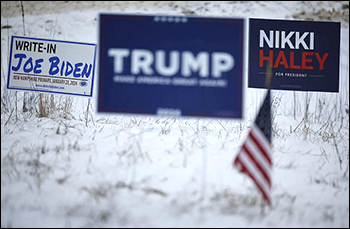
Candidate signs along the road in New Hampshire.

New Hampshire: Primary Election Today — At one point it appeared that former UN Ambassador Nikki Haley was well positioned against former President Donald Trump in the New Hampshire primary, but a plethora of late polls find the former president expanding his advantage well into double digits.

Also on the ballot tonight is the Democratic presidential primary, though sans President Joe Biden. He is bypassing this event because the state refused to accept the Democratic National Committee recommended primary schedule change that would have deprived New Hampshire of its cherished first-in-the-nation primary status.

Ten polls have been released since Saturday from as many different pollsters, and except for the American Research Group, all show Trump holding leads between 10 and a whopping 27 percentage points. The ARG survey finds Trump holding only a 33-29 percent edge.

The Democratic race is much more difficult to forecast because of the write-in campaign underway for the president. The three polls, from the American Research Group, the University of New Hampshire for CNN, and Emerson College for WHDH-TV in Boston, see the Phillips support line falling between 10 and 18 percentage points.

The New Hampshire primary could effectively spell the end to competitive challenges.

First, for Haley: it’s hard to see a path going forward should she lose by the amounts suggested in most polls. The candidates’ next stop is Nevada. The legislature and former governor forced a primary law upon the state, but Republicans still wanted to have their caucus as in years past. Thus, the Nevada GOP is holding both a primary and a caucus, with the caucus being the delegate apportionment body, not the primary.

The candidates could only participate in one of the contests, and curiously Haley entered the primary. The other candidates, when they were in the race, chose the caucus. Therefore, regardless of how many primary votes Haley attracts in the primary, Trump is going to sweep the Nevada delegation because he is the only active candidate who will be receiving pledged delegates.

The South Carolina primary — Haley’s home state — will hold their primary on Feb. 24, and it will be interesting to see whether her candidacy will even remain alive at that time. Polling already shows Trump holding strong leads in the Palmetto State.

For the Democrats, US Rep. Dean Phillips (D-MN) may well be a “one and done” candidate. He will have little in the way of an argument moving forward against President Biden if he fails to overtake him in New Hampshire where the incumbent’s name was not even on the ballot.

With data showing the respective party leaders expanding their leads, it will be an even bigger upset tonight if either President Biden or Donald Trump fail to meet their enhanced expectations.

Governor

Delaware: First Dem Primary Poll Suggests Close Race — With Gov. John Carney (D) being ineligible to run for a third term, lieutenant governor and gubernatorial candidate Bethany Hall-Long (D) released the results of her internal Public Policy Polling Democratic primary survey (Jan. 10-11; 643 likely Delaware voters; live interview & text).

The study finds the lieutenant governor posting an early 30-23 percent lead over New Castle County Executive Matt Meyer. National Wildlife Federation CEO Collin O’Mara, also an announced candidate, was not included on the Democratic primary ballot test.

The Delaware primary is one of the latest in the cycle, scheduled for Sept. 10, so much time remains for this race to develop. The eventual Democratic nominee will be in commanding position to win the open race in November.

North Dakota: Gov. Doug Burgum to Retire — Former presidential candidate Doug Burgum (R) announced yesterday that he will not seek a third term as North Dakota’s governor despite high approval ratings. With his endorsement of former President Trump, and the ex-chief executive indicating that Gov. Burgum would be primed for a position in a new Trump Administration should the 2024 election go the Republicans’ way, Gov. Burgum’s time in politics may not be coming to an end.

The decision to leave the governorship when his current term ends will open a highly competitive race for the Republican nomination through the state party convention and potentially a June 11 open primary. The eventual Republican nominee becomes a prohibitive favorite to succeed Gov. Burgum.

States

Alaska: Ranked Choice Voting Opponents File Petition Signatures — The proponents of a ballot proposition to repeal the state’s Top Four and Ranked Choice Voting systems have presented 55 percent more than the required number of signatures to reach the ballot, but they may be short on another qualifying requirement. While the group will likely have the proper aggregate number of valid signatures, there are questions as to whether they have met the requirement that certain numbers of the signatures must come from all the required districts. Therefore, it remains to be seen if this repeal measure will qualify for the 2024 election ballot.

The Ranked Choice system could have a wide-ranging effect on the coming presidential race, just as it has in the last two Alaska congressional campaigns.

Ohio’s Moreno Endorsed by Trump;
NJ Polling Battles; Alaska’s Peltola Could Again Get Boost From RCV; Census Projections for 2030

By Jim Ellis — Thursday, Dec. 21, 2023

Senate

Ohio Senate candidate Bernie Moreno (R) gets Trump’s endorsement.

Ohio: Trump Makes an Endorsement — As has been expected for several months, former President Donald Trump, the leader for the 2024 GOP presidential nomination, signaled his official support to one of the three major Republican US Senate contenders Monday. While a Survey USA poll earlier in the week (Dec. 8-12; 573 likely Ohio Republican primary voters; online) found businessman Bernie Moreno trailing both Secretary of State Frank LaRose and state Sen. Matt Dolan (R-Chagrin Falls) by a 33-18-12 percent margin, Moreno man did finish in first place for the Trump endorsement. Previously, two other surveys found Moreno holding a slight lead in the primary race.

The Ohio primary is scheduled for March 19, and promises to be a highly competitive nomination campaign. The eventual winner of the plurality election will face three-term Sen. Sherrod Brown (D) in the general election.

New Jersey: Competing Poll Places Rep. Kim First — Though indicted Sen. Bob Menendez (D) for now remains in the 2024 Senate race, the Democratic primary battle appears to be a contest between US Rep. Andy Kim (D-Moorestown) and the state’s First Lady, Tammy Murphy. Approximately a month ago, Public Policy Polling released a survey favoring Murphy for the party nomination by a large 40-21 percent spread.

Rep. Kim released his internal Breakthrough Campaigns survey Monday (Dec. 7-14; 1,004 NJ likely Democratic primary voters; live interview & text) that produced a virtual mirror-like result. This study found Rep. Kim leading Ms. Murphy, 45-22 percent. Sen. Menendez, as was the case in the PPP survey, languishes in single digits. The dueling wide discrepancy polls suggest the statewide Democratic primary will be an interesting one to chart. The New Jersey primary is scheduled for June 4.

House

AK-AL: New Polling Favorable for Rep. Peltola — Once again, Alaska’s Ranked Choice Voting system may re-elect at-large Democratic US Rep. Mary Peltola (D-Bethel) even though more voters select a Republican candidate. Under the state’s primary system, four candidates advance into the general election. If no candidate receives majority support in the November vote, Ranked Choice Voting takes effect.

The Remington Research Group conducted a new poll for Republican candidate Nick Begich III (Dec. 11-14; 672 likely Alaska primary voters; live interview) and the ballot test finds Rep. Peltola attracting 42 percent support. Begich follows in second place with 28 percent. Lt. Gov. Nancy Dahlstrom (R) is third with nine percent, while Libertarian Chris Bye, running on the No Labels ballot line, would secure the fourth position with seven percent of the prospective vote. If this were the actual vote totals, RCV would begin with Bye being eliminated and his second choice votes added to the aggregate.

Rep. Peltola has been successful in the Ranked Choice process in both of her elections. In this case, the RCV process would begin because no candidate reached the majority support level.

Census Estimates: Early Reapportionment Projections for 2030 — The Census Bureau released its 2023 population estimates and from that data, extrapolated congressional seat gain and loss estimates for the next census, which is seven years away. Obviously, much can change over that time period, but the projections suggest serious population movement. California appears headed to lose a whopping four seats, while Texas would gain four. The other prospective multi-seat gainer would be Florida at plus-3. Arizona, Georgia, Idaho, North Carolina, South Carolina, Tennessee, and Utah would each gain one seat.

In addition to California, the losing states would include New York (minus-3) and Illinois (minus-2) with Michigan, Minnesota, Oregon, and Pennsylvania losing one seat apiece. Oregon is the biggest surprise in the loser column because they gained a seat in the 2020 reapportionment.

Since these numbers are all long-range projections, the gainers and losers are not equal, which will correct itself once the final apportionment is completed after the next census many years from now.

The Kennedy Factor in Alaska; Maryland Gov. Moore Endorses Senate Candidate; Malinowski’s Response; Candidate Search in PA-10

By Jim Ellis — Thursday, Oct. 26, 2023

President

Alaska: First Poll with Kennedy — The Alaska Survey Research firm tested the 2024 general election with, for the first time, Robert F. Kennedy Jr. on the questionnaire as an Independent candidate. Some have been saying that Kennedy on the ballot could force former President Donald Trump below 50 percent, which would jump-start a Ranked Choice Voting round. This could open the door to President Joe Biden winning Alaska even though he would be nowhere close to victory in the initial vote.

According to the ASR data (Oct. 13-18; 1,375 likely Alaska general election voters; online) Trump is leading the field but with just 37 percent support. President Biden follows with 29 percent, while Kennedy draws 17 percent. In an initial test without Kennedy, Trump would lead President Biden 45-37 percent. Therefore, both candidates would yield 8 percent support to Kennedy. The key here for Trump is making sure he does not fall below the 50 percent threshold, and this poll suggests he would be in danger of doing so if Kennedy continues to remain relatively strong.

Senate

Maryland Gov. Wes Moore (D)

Maryland: Gov. Moore Endorses Senate Candidate — Maryland Gov. Wes Moore (D) involved himself in what promises to be a hotly contested open Democratic primary to replace retiring Sen. Ben Cardin (D). Maryland’s voting history suggests that Sen. Cardin’s successor will be found in the Democratic primary, as Republicans will have little chance to win a Maryland statewide race in a presidential election year.

Gov. Moore announced that he is supporting Prince Georges County Executive Angela Alsobrooks for the party nomination. Her chief opponent is US representative and Total Beverage chain founder, Rep. David Trone (D-Potomac). The Moore endorsement is a signal to the African American community, the base of the state’s Democratic Party, that they should unite behind Alsobrooks.

Maryland’s black population accounts for just under 32 percent of the state’s residents. In a Democratic primary, however, their size is significantly larger.

Rep. Trone has already put just under $10 million of his own money into his campaign account and is currently advertising in targeted markets. According to Trone’s latest campaign finance report, 98 percent of his money comes from him.

House

NJ-7: Ex-Rep. Malinowski Responds — Former two-term US Rep. Tom Malinowski (D) responded to a statewide op-ed piece asking him to challenge the man who unseated him in 2022, freshman US Rep. Tom Kean Jr. (R-Westfield).

While Malinowski has not publicly ruled out running again, his response to the piece suggests that he will not become a candidate. His quote: “I am very happy in my life right now and looking forward to the next challenge, not backward.” Currently in the Democratic primary are former State Department official Jason Blazakis and progressive left activist Sue Altman.

PA-10: New Democratic Leader — According to a new Public Policy Polling Democratic primary survey of Pennsylvania’s competitive 10th District (Oct. 16-17; 547 PA-10 likely Democratic primary voters; live interview & text), the respondents are looking for a new nominee to challenge US Rep. Scott Perry (R-Dillsburg/Harrisburg).

The poll suggests that retired news anchor Janelle Stelson holds an early 33-20 percent edge over 2022 Democratic nominee and Harrisburg City Councilwoman Shamaine Daniels. In November, Daniels held Rep. Perry to a 54-46 percent victory. Her 27 years on the air in south-central Pennsylvania provides her with a substantial district-wide name identification advantage.

Expect this race to again be competitive, but Rep. Perry begins as the favorite for re-election. The FiveThirtyEight data organization rates PA-10 as R+9. The Daily Kos Elections site ranks the seat as the 37th most vulnerable seat in the Republican Conference.

The Kennedy Factor

By Jim Ellis — Thursday, Oct. 19, 2023

President

Robert F. Kennedy Jr.

RFK Jr.: Independent Impact — Since Robert F. Kennedy Jr. announced that his presidential candidacy would move to the Independent line and away from the Democratic primary, it has been an exercise to predict which states his candidacy might detract from either President Joe Biden or former President Donald Trump.

Though Kennedy is stating he will try to win the race as an Independent, the chances of him doing so are slim. Ross Perot, on the Reform Party ballot line in 1992, was the last minor party candidate who was significant in a modern-era presidential race. Perot received 18.9 percent of the national popular vote but won no states, meaning zero electoral votes. Bill Clinton won the 1992 election with 43.0 percent nationally and 370 electoral votes.

The last minor party candidate to secure electoral votes was at the time former Alabama Gov. George Wallace running on the American Independent Party line, back in 1968. He carried five states (Alabama, Arkansas, Georgia, Louisiana, and Mississippi) for a total of 46 electoral votes. Richard Nixon won the ‘68 election with 43.4 percent of the popular vote and 301 electoral votes.

Assuming Kennedy also fails to win a state, there are certain places where his candidacy could still affect the outcome. This means capturing enough votes to tip a state from one of the major party candidates to the other. Using the 1992 race as a model for 2024 because of the minor candidate factor, overlaid with current voting trends, it appears that six states could be in the “Kennedy tip” category.

Such includes four from Biden to Trump; one from Trump to Biden; and one Trump “gettable” state to Biden. Thus, the Kennedy influence could be enough to slightly tip the national general election to Trump or into the House of Representatives to break a tie.

The four states that could flip to Trump are Arizona, Georgia, Nevada, and New Hampshire. In 1992, former President George H.W. Bush carried Arizona, and to win this election Trump is virtually forced to also reverse his fortune from 2020 and carry the Grand Canyon State. In ’92, Bush won the state with a two-point margin over Clinton, while Perot attracted 23.8 percent. While the ’92 race occurred decades ago, the in-play states still exhibit the potential to provide a large number of votes to a minor party or Independent candidate, especially one with universal name identification.

Georgia is a state that must go to Trump if he is to have any chance of winning the general election. In 1992, Clinton carried the Peach State by less than one percentage point, while Perot garnered 13.3 percent of the vote.

Clinton carried the Silver State of Nevada with a three-point margin while Perot’s vote total was 26.2 percent. Should Kennedy also finish within the Perot vote total realm, it is reasonable to believe that more than a net three percentage point margin would come from President Biden’s total, which would likely be enough for Trump to win Nevada and add six electoral votes to his total.

New Hampshire, rated as one of the nation’s states with the greatest swing potential, also falls into the Kennedy tip category. Clinton defeated President Bush here by 1.3 percentage points in ’92, with a 22.6 percent vote factor for Perot. Again, if Kennedy were able obtain well over 20 percent in New Hampshire, a New England state with a strong history of supporting his family, that could tip the state’s four electoral votes to Trump. Only two points more from Kennedy’s aggregate would have to come from Biden’s total for Trump to win the state.

Alaska, however, with its Ranked Choice Voting system, could be a state that Kennedy’s presence could tip to Biden. The Ranked Choice Voting system has played to the Democrats’ favor here, and it may so again should the Kennedy factor be high enough to force the race leader below the 50 percent mark in order to jump-start the ranking procedure.

Finally, Wisconsin will be a major state in the ’24 election. In 1992, it also demonstrated a higher than average vote for Perot (21.5 percent). Clinton carried Wisconsin with a 4.3 v percentictory margin. These totals suggest that if Kennedy finished in the same realm as Perot in the Badger State, that would likely help President Biden.

The above scenario, assuming all other states voted as they did in the 2020 presidential race, would actually create an electoral college tie. Adding Arizona, Georgia, Nevada, and New Hampshire and giving up Alaska would give both candidates 269 electoral votes, meaning the election would be decided in the House of Representatives.

Kennedy’s performance in these and several other states could well change the trajectory of the entire presidential race and becomes just one more unique factor in this so far unpredictable campaign.