Category Archives: TEXAS

Rep. Taylor Withdraws From Race

Former Texas Collin County Judge (Executive) Keith Self is now the new 3rd District Republican nominee after north Texas area Congressman Van Taylor (R-Plano) decided to withdraw from the runoff election resulting from Tuesday’s primary.

By Jim Ellis

March 4, 2022 — It was on a somewhat surprising note that north Texas area Congressman Van Taylor (R-Plano) was forced into a runoff from Tuesday’s primary election, but Wednesday’s related events proved astonishing.

Rep. Taylor has announced that he is withdrawing from the runoff, making public an extra-marital affair in which he engaged. Apparently, affair rumors began to surface late in the primary contest. Clearly knowing the story would become public, he admitted the indiscretion and immediately departed the race.

Under Texas election procedure, a candidate qualifying for a runoff election can decline to participate. The concession means the opponent automatically wins the party nomination. Thus, former Collin County Judge (Executive) Keith Self is the new 3rd District Republican nominee with an accompanying ticket to Washington, DC after the Nov. 8 election.

Taylor only secured 48.7 percent of the vote in Tuesday’s primary, meaning that a majority of Republican primary voters chose another candidate. This is never a good sign for any incumbent and the chief reason that most incumbents fail when forced to the secondary election. Adding the personal baggage obviously told Rep. Taylor that his re-election chances were irreparably diminished.

Self is a retired career West Point Academy Army officer who placed second in the primary with 27.1 percent, outlasting third-place finisher Suzanne Harp, a hard-charging businesswoman who proved to be surprisingly strong. The new congressional nominee presided over Collin County, an entity with now more than 1 million people, for three terms and chose to retire in 2018. In the congressional primary, he campaigned to Rep. Taylor’s right.

Continue reading

Redistricting After-Effects

Click the map above or this link to go to an interactive version: Dave’s Redistricting App

By Jim Ellis

Feb. 24, 2022 — As more states complete their redistricting process and additional data becomes available, we are beginning to catch a glimpse of each party’s path to either keeping or re-claiming the House majority in the coming midterm election.

The FiveThirtyEight statistical organization along with the Dave’s Redistricting App operation are the two data groups that are charting each district as the states complete their decennial task of drawing new congressional district boundaries.

At this point, we have usable projection data from the two organizations in 350 of the nation’s 435 congressional districts, meaning newly completed maps in all but eight states. (FiveThirtyEight has not yet analyzed the new North Carolina map because the court has not yet given final approval, but Dave’s App has calculated based upon the version now before the judicial panel.) As an aside, several of the outstanding states are large, including Florida (28 congressional districts), Ohio (15 CDs: map was complete but rejected before the state Supreme Court), and Pennsylvania (17 CDs).

At this point we can see, after analyzing each of the 350 completed districts, that redistricting in and of itself will return only a narrow advantage to one party or the other. Considering the still incomplete outstanding states, it is unclear which political entity may earn a slight advantage once the entire process is finalized. Currently, newly created maps are complete (or pending court approval) in 42 states, including five of the six at-large domains whose single-state districts are included in the aforementioned aggregate number.

The FiveThirtyEight projections and Dave’s Redistricting App agree on party advantage in 344 of the completed districts even though they used different mathematical formulas and election complexion to arrive at their conclusions. Therefore, the assigned D or R-plus ratings from FiveThirtyEight consistently align with Dave’s numerical projections for Democratic and Republican strength in each of the 344 CDs.

Of the six districts where the two organizations disagree over party advantage, in each of the half-dozen CDs, the FiveThirtyEight data has projected a stronger Republican number. Three of the six lie in the state of Michigan.

The conflicting districts are:

STATE-DIST MEMBER FiveThirtyEight DAVE R DAVE D
CO-8 NEW SEAT            R+3 46.91% 48.24%
MI-7 SLOTKIN, ELISSA            R+4 47.75% 49.18%
MI-8 KILDEE, DAN            R+1 46.05% 50.84%
MI-10 CREATED SEAT            R+6 47.82% 49.44%
TX-15 CREATED SEAT            EVEN 46.73% 51.02%
VA-2 LURIA, ELAINE            R+6 48.35% 49.58%

(Note: a “New Seat” is one drawn in a state that was awarded an extra seat, or two in the case of Texas, through national reapportionment. A “created seat” is a new open district that came as a result of the redistricting process.)

Totaling the 344 districts where FiveThirtyEight and the Dave’s App are in agreement as to party advantage, the Democrats would gain 12 Republican, new, or created districts; while the GOP would gain 10 Democratic, new, or created seats.

Continue reading

Alabama Map Ruling Stayed; Redistricting Update

By Jim Ellis

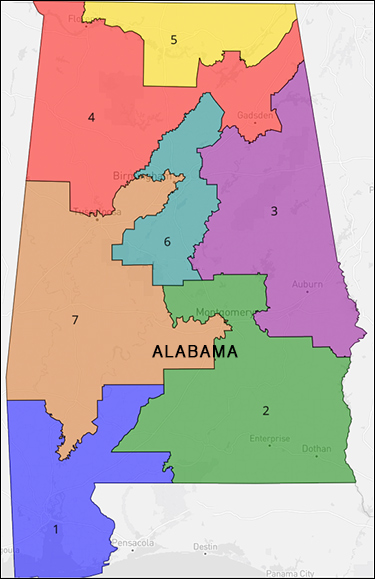
Alabama redistricting map (Click on the map above or go to DavesRedistricting.org to see interactive map)

Feb. 9, 2022 — On a 5-4 vote, the US Supreme Court voted to stay the lower court ruling that invalidated the new Alabama congressional map. A Republican three-judge panel had ruled that a second majority minority district could have been drawn among the state’s seven congressional districts, and thus disqualified the plan on Jan. 23.

Writing a concurring opinion, Justice Brett Kavanaugh stated that the lower court decision was made too close to the 2022 election, meaning that the judicial process would not have proper time to hear the appeal and make an educated ruling prior to the state’s scheduled primary election. The ruling does not mean the appeal was granted, but merely postpones hearing the case to a later date.

Analysts say the stay ensures that the original map will be in place for this year’s election. It does not mean, however, that the map won’t be altered for the 2024 election and beyond.

The new plan is virtually an extension of the current map, which elected six Republicans and one Democrat in the 2020 election. It was a curious original decision, not only because the judges that ruled against the GOP map drawers were appointed by former President Donald Trump (2) and the late President Ronald Reagan (1), but that the same map footprint stood unencumbered for the past 10 years.

The major change made from the current map to the new draw came in the 7th CD, which is the Voting Rights district. The legislature, however, had no choice but to make a substantial change. AL-7 was 53,143 people short of reaching the state’s congressional district population quota of 717,754 individuals.

The previous ruling also postponed the Jan. 28 candidate filing deadline for the Alabama US House candidates. Those running for all other offices have now already filed and been qualified for the respective party primary ballots. The congressional candidates will now file on Feb. 11.

Redistricting Notes

• Summarizing the legal action in other states, the North Carolina map has been disqualified and the legislature will now return to redraw the congressional and state legislative maps. As has been the case throughout the previous decade, the partisan Republican legislature and the partisan Democratic state Supreme Court continue to go back and forth over the issue of partisan gerrymandering.

• The lower court ruling in Michigan rejected the Detroit area Democratic current and former state legislators’ claim that the Michigan Independent Citizens Redistricting Commission members violated the Voting Rights Act in drawing the city of Detroit’s congressional and state legislative maps. Unless an appeal is granted, the new Michigan maps will stand for this year’s elections.

• The Kansas legislature adjourned without voting to override Gov. Laura Kelly’s (D) veto of the state’s congressional map. The hasty adjournment move, however, allows the legislature to reconsider the veto override. Without a successful override vote, the map will go to the courts for a redrawing of the Kansas City metro area.

Continue reading

Redistricting Challenges – Part I

By Jim Ellis

Jan. 25, 2022 — Today we begin a two-part series about incumbent US House members who could be considered redistricting “victims”, meaning those who find themselves in districts with a largely unfamiliar constituency.

A total of 27 states have completed their redistricting process, and 41 incumbents seeking re-election in these places will be in new seats where a majority of the electorate has not previously seen their names on the congressional ballot.

Interestingly, many of the changes are positive for some of the members in question, because the new constituents are favorable to the incumbent’s party. Others, however, face potentially tough re-nomination or re-election battles, and some will see challenges coming from both Republicans and Democrats.

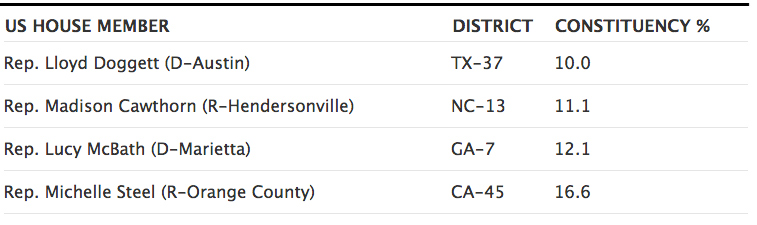
Interestingly, the four incumbents with the most new constituents, those having a district where a range from just 10 to 20 percent of their current electorates are present in the new CD, actually chose to run in the new places. Each eschewed a seat where they have a larger number of current voters.


Texas Rep. Lloyd Doggett (D-Austin) has the least carryover of any member from a redistricting completed state. Moving from his current 35th District into the new 37th CD means just 10.0 percent of his current constituents reside in the succeeding district. Placing Doggett here was not the intent of the map drawers, however, as the 37th was meant to be one of the state’s two new seats, a Democratic district fully contained within Austin’s Travis County.

Doggett’s 35th District is now the open seat, in a domain that again stretches from Austin to San Antonio. Had he stayed in the 35th, a total of 60.7 percent of his constituency would have remained constant, according to the Daily Kos Elections site statisticians who have calculated the redistribution percentages for all of the states that have completed redistricting.

Rep. Doggett faces little in the way of Democratic primary opposition, and the new 37th is a similar Austin-anchored seat to his original 10th District in which he began his US House career back in 1995.

North Carolina Rep. Madison Cawthorn (R-Hendersonville) chose to run in the 13th District, which was designed to be that state’s new seat. Despite having only 11.1 percent of his current constituency in the new district, Rep. Cawthorn likes his chances. The 13th lies closer to the Charlotte metro area in comparison to his current western North Carolina seat.

Continue reading

Texas 2022 Candidate Filing Closes

By Jim Ellis

Dec. 17, 2021 — Texas became the first state to see candidate filing close for the 2022 elections, so the campaign season has officially been launched.

In the Lone Star State, candidates file with their respective state party organizations, or county parties if their race is fully contained within one entity, and not the Secretary of State. Therefore, the filings might not yet be fully recorded and approved. The statewide primary is scheduled for March 1. If no candidate for whatever office does not receive majority support in the first election, a runoff between the top two finishers will occur on May 24.

What we know so far is that Gov. Greg Abbott (R) will face a significant Republican primary challenge from former Florida congressman and ex-Texas Republican Party chairman Allen West and former Dallas state Sen. Don Huffines. The latter man, who was defeated for re-election in 2018, has the ability to self-fund a statewide primary campaign. Former congressman and 2020 presidential candidate Beto O’Rourke will be the Democratic nominee as he faces only minor opposition in the party primary.

Regardless of the level of competition, Gov. Abbott, though his approval ratings are at a low ebb in his seven-year career as the state’s chief executive, is a heavy favorite in both the Republican primary and the 2022 general election.

The main constitutional office of interest is the attorney general’s race. Here, embattled incumbent Ken Paxton (R), who has for years been under a federal SEC indictment that has yet to move forward, and who has been publicly accused of having an ongoing extra-marital affair, faces three strong candidates for re-nomination: State Land Commissioner George P. Bush, US Rep. Louie Gohmert (R-Tyler), and state Supreme Court Justice Eva Guzman.

Though Paxton has personal and legal problems, his favorability ratings among Republican primary voters is still surprisingly high. Forcing the two-term attorney general into a runoff election, however, is a clear possibility.

With the state having no Senate race in 2022, the federal focus turns to the new 38-member US House delegation. Texas gained two seats in national reapportionment, thus increasing their delegation size from 36 to 38 seats. The state will wield 40 electoral votes in the next presidential election, second only to California’s reduced 54.

Continue reading

Post Redistricting:
Competitive Seats, Part II

Nevada redistricting map

By Jim Ellis

Dec. 10, 2021 — Continuing our redistricting report about the 20 multi-congressional district states that have completed the re-drawing process, today, we look at the domains from Montana through West Virginia.


Montana:

The Montana Districting and Apportionment Commission for the first time had a congressional map to draw. The state rose from at-large status to gaining a new district in reapportionment due to strong population growth. Montana is the first multi-district state to ever fall into at-large status, as it did in the 1990 census, and then regain a second district.

Though more Democratic maps were filed for commission consideration, the main Republican offered map was adopted. One of the Democratic commissioners voted for the plan, which allowed the GOP version to prevail. Still, all of the maps created an east and west seat, with the new western seat, labeled District 1, being the more competitive.

At-large Rep. Matt Rosendale (R-Glendive) will run in the safely Republican eastern District 2, while former congressman and ex-US Interior Secretary Ryan Zinke appears to be the early leader in the western district both in the Republican primary and general election. While relatively competitive, the 1st District will clearly nominate a Republican who will be the general election favorite.


Nebraska:

The unicameral legislature and Gov. Pete Ricketts (R) enacted a new congressional map that should again deliver a 3R-0D delegation. Rep. Don Bacon’s (R-Papillion/Omaha) marginal 2nd District – Joe Biden carried the district by more than 22,000 votes – is strengthened for the incumbent, but it still remains a competitive congressional domain.


Nevada:

The Democratic legislature and Gov. Steve Sisolak (D) enacted a map that is designed to produce a 3D-1R map but, in attempting to maximize the Democratic stake, possibly all three of the party’s intended seats now fall into the potentially competitive realm.

In 2020, Clark County hosted two of the 53 districts nationally where the winning candidate scored less than 52 percent. In 3rd District Rep. Susie Lee’s (D-Las Vegas) case, her victory percentage was less than 49 percent. Fourth District incumbent Steven Horsford (D-Las Vegas) fared only slightly better at 50.7 percent. In order to strengthen these two districts, a large number of Democrats had to be taken from the previously safe seat of 1st District Rep. Dina Titus (D-Las Vegas).

The end result is three Democratic seats in the lower 50s. In a Republican year, and considering the GOP is beginning to score better with Hispanics who comprise more than 31 percent of the Clark County population, all three seats could conceivably host competitive challenge campaigns. Rep. Mark Amodei (R-Carson City), the lone Republican incumbent in the Nevada delegation, gets a safe northern state seat.


North Carolina:

The courts have been playing ping pong with the North Carolina map this week. A three-judge panel first issued a stay order on the Tar Heel State’s Dec. 17 candidate filing deadline pertaining to a redistricting lawsuit before the court. A day later, the full 15-member state Appellate Court overturned the panel’s ruling, and restored the original filing deadline. Just this week, the state Supreme Court quickly reinstated the candidate filing stay and ordered the March 8 primary postponed until May 17.

The North Carolina map is the national Republicans’ best to date. If it survives the legal challenge, the GOP could net as many as three seats in the delegation. It appears that five seats will be open, with Reps. G.K. Butterfield (D-Wilson) and David Price (D-Chapel Hill) retiring, Rep. Ted Budd (R-Advance) running for Senate, and with two more seats beign created through reapportionment and the map-drawing process.

Under the enacted map, Rep. Kathy Manning (D-Greensboro) and Virginia Foxx (R-Banner Elk) are paired in a new 11th District, which would heavily favor the GOP nominee.


Ohio:

The legislature and Gov. Mike DeWine (R) recently approved a new congressional map that may net the Republicans a one-seat gain, or could conceivably yield the Democrats a similar outcome. Three of the state’s 15 new districts are highly competitive — Ohio lost one seat in reapportionment — with two currently in Democratic hands and one under GOP control.

Reps. Steve Chabot (R-Cincinnati), Marcy Kaptur (D-Toledo), and the open 13th District seat of Rep. Tim Ryan (D-Warren), now located on the west side of Cleveland, are all tightly constructed partisan districts. In the remaining seats, Republicans hold a significant 10-2 advantage. Retiring Rep. Anthony Gonzalez’s (R-Rocky River) 16th District has effectively been collapsed.


Continue reading

Texans Planning Moves

By Jim Ellis

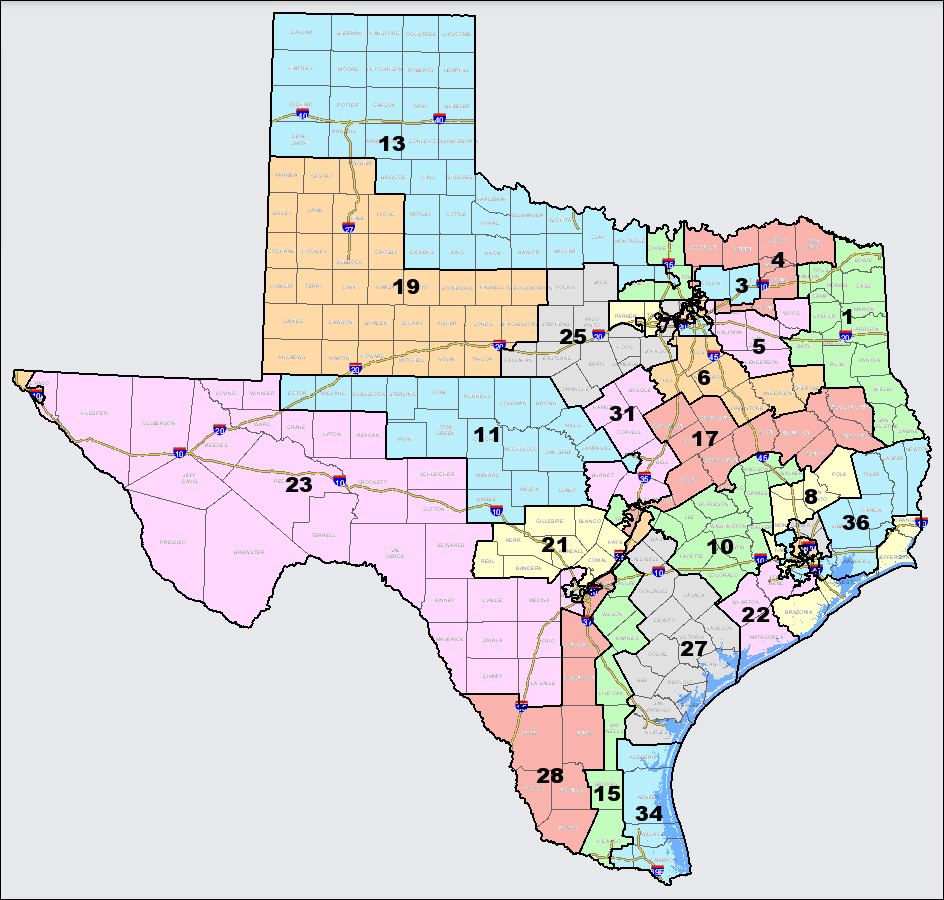
Oct. 5, 2021 — The Texas congressional map was unveiled in the state Senate last week, and already many incumbents and challengers are making or announcing political plans based upon what they are seeing … but this congressional plan is a long way from enactment.

In the past few days we have seen Rep. Vicente Gonzalez (D-McAllen) concede that he would consider moving to run in the open 34th District, which is due east of his own 15th CD and anchored in the city of Brownsville. Rep. Filemon Vela (D-Brownsville) is not seeking re-election to a sixth term, and he reportedly is favorable toward Gonzalez coming into his district.

The 34th remains solidly Democratic under the Senate introduced congressional map, but the 15th, already trending more Republican than in past elections, would actually have favored former President Trump by three percentage points under the proposed boundaries. Thus, Republicans would have a strong chance of winning here in an open seat race.

The 2020 GOP nominee, Monica de la Cruz-Hernandez, who held Rep. Gonzalez to a 50-48 percent re-election victory while spending barely over $400,000, has announced she is running again and House Republican Leader Kevin McCarthy (R-CA) has already endorsed her for the 2022 race.

Gonzalez is not the only one working on his next political move. Wesley Hunt (R), who lost 51-47 percent to Rep. Lizzie Fletcher (D-Houston) in 2020, said months ago that he would run for the House again, but was mum on exactly where he would land in hopes that one of the new seats would fall into his area. Under this proposed map, the new 38th District does encompass part of the current Fletcher district, and it is highly favorable to an eventual Republican nominee.

For her part, Rep. Fletcher gets a much stronger Democratic district in southern Harris County and now into Ft. Bend County, which is one of the fastest growing regions in the state. Reports also suggest that Hunt has over $1 million in his campaign account at the reporting period ending Sept. 30 despite not previously declaring where he would run. He announced last week that he has chosen District 38 if this new map becomes law.

Late last week, Republican businessman and retired Air Force officer Steve Fowler announced his congressional candidacy in the 28th District, Rep. Henry Cuellar’s (D-Laredo) seat that begins in San Antonio and spans to the Mexican border. Earlier this year, Jessica Cisneros, who held Cuellar to a 52-48 percent Democratic primary win in 2020, announced she is returning for a re-match.

Rep. Lloyd Doggett (D-Austin) will also have a decision to make. The new 37th District is wholly contained within Travis County and safely Democratic. He could easily run in this seat, thus leaving his 35th CD that is co-anchored in Austin and San Antonio for a Hispanic Democrat to likely win.

Continue reading