Category Archives: Reapportionment

Oregon’s New Seat

Current Oregon US Congressional Districts Map


By Jim Ellis

July 2, 2021 — Oregon earned a sixth congressional seat in the 2021 apportionment, but exactly where that district will be placed on the Beaver State’s new map is not particularly obvious.

Like most states, Oregon handles redistricting through the legislative process and Democrats have firm control of all three legs of the legislative stool. In addition to Gov. Kate Brown (D), the party has a 18-11 margin in the state Senate with one Independent. Their majority in the state House of Representatives is similarly large, 37-22, with one vacancy. Yet, the partisan breakdown of the state might make drawing a solid 5D-1R map surprisingly somewhat difficult.

Currently, the five congressional districts are not obviously gerrymandered, as the seats are drawn in block form. Naturally, all but two cluster around the Portland metropolitan area, the state’s dominant population region.

The five incumbents are all senior, with Rep. Suzanne Bonamici (D-Washington County) being the most junior with her original election coming in a special 2012 contest. The delegation dean is House Transportation & Infrastructure Committee chairman Peter DeFazio (D-Springfield) who was first elected in 1986.

As you can see from the following chart, using 2019 population numbers since the Census Bureau will not be delivering census tract data to the states until after Aug. 15, the five districts are remarkably equivalent in relation to population size.

DISTRICT INCUMBENT 2020% POPULATION REG. VOTERS
1 BONAMICI 64.6% 858,875 570,186
2 BENTZ 59.9% 841,022 598,375
3 BLUMENAUER 73.0% 853,116 588,614
4 DeFAZIO 51.5% 820,504 588,508
5 SCHRADER 51.9% 844,220 578,609

The population figures suggest that each district will have to shed between 115,000 to 155,000 people in order to create six CDs with equal population, likely a number around 710,000 individuals for this state.

Continue reading

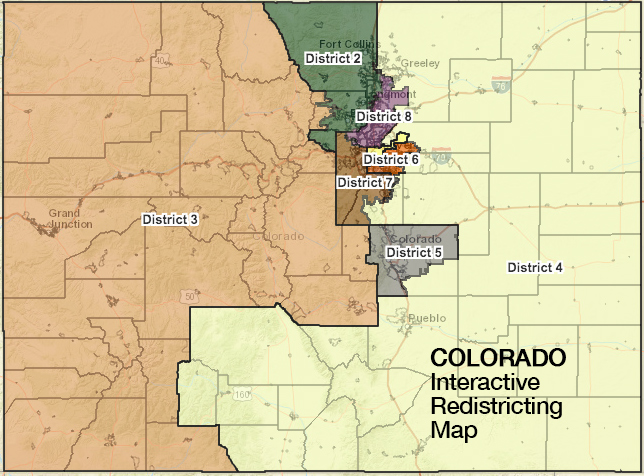
Colorado Releases First New Map


District 1 – Rep. Donna DeGette (D-Denver)
District 2 – Rep. Joe Neguse (D-Lafayette/Boulder)
District 3 – Rep. Lauren Boebert (R-Silt/Western Slope)
District 4 – Rep. Ken Buck (R-Windsor/East Colorado)
District 5 – Rep. Doug Lamborn (R-Colorado Springs)
District 6 – Rep. Jason Crow (D-Aurora)
District 7 – New Seat
District 8 – Rep. Ed Perlmutter (D-Arvada/Thornton)


By Jim Ellis

June 28, 2021 — The Colorado Independent Redistricting Commission, using only Census Bureau estimates because no state has yet received its census tract information and won’t until at least Aug. 15, released a preliminary new eight-district US House map late last week. Colorado is one of the states that gained a congressional seat under the 2020 national reapportionment.

The published commission map will not be the final version because population estimates and statistical sampling cannot be used for redistricting purposes per a 1999 US Supreme Court ruling (Department of Commerce v. US House of Representatives). Therefore, if this map is to become the basis for the actual plan, it will have to be adjusted after Colorado is presented with its census tract data.

This is the first redistricting cycle where Colorado has opted for the commission process. The new congressional map looks similar to the current seven-district design, in that the basic configurations of the seats and anchor population centers remain consistent with the notable exception of Rep. Ed Perlmutter’s (D-Arvada) current 7th District.

What appears designed as the new seat, District 8, takes a key population center from the 7th, the Arvada-Westminster-Thornton corridor, and makes it the new 8th CD anchor. This means the new 8th begins just north of Denver in Adams County and consumes about 85 percent of the local entity before moving slightly west to capture small Broomfield County and parts of Jefferson and Boulder counties. It then continues northeast to encompass a portion of Weld County.

Continue reading

Census Delays: Some Ramifications

By Jim Ellis

June 1, 2021 — As we know, the Census Bureau has delayed in meeting its public reporting deadlines, which causes ramifications in the political world. As a result, the state officials responsible for redistricting could well find themselves placed behind the proverbial eight ball as the new year approaches.

Reapportionment is the term used to explain the entire decennial process. Reapportionment, as the US Supreme Court defined it in their 1999 ruling on the US Census Bureau v. House of Representatives case, is basically divided into two parts. The first, which was finally completed and released on April 26, is the allocation of congressional seats to the states. The second is the re-drawing of congressional, state, and local district boundaries most often referred to as redistricting.

To complicate matters even further, the delayed allocation proved much different – affecting six seats to be exact – than predictions. It was believed for at least two years that Texas would gain three seats in the 2020 reapportionment and Florida two, with Arizona, Colorado, Montana, North Carolina, and Oregon adding one seat apiece. The actual numbers found Texas gaining two, Florida one, and Arizona none. The other one-seat gaining states were correctly predicted.

Conversely, Alabama, California, Illinois, Michigan, Minnesota, New York, Ohio, Pennsylvania, Rhode Island, and West Virginia were all expected to lose one seat apiece. The actual report found Alabama, Minnesota, and Rhode Island each retaining the same number of seats they held in the 2010 reapportionment, while the others did lose a single district apiece.

The Census Bureau claims that COVID is largely responsible for their delays, but the state of Alabama, in their pending lawsuit against the federal statistical entity, disagrees. Alabama claims the deadline violations occurred because of the Bureau’s attempt to impose, for the first time in history, differential privacy over the data. This means, under the argument of protecting individual privacy, data would be deliberately scrambled, and certain information not publicly released.

Differential privacy alone would make redistricting extremely difficult for state map drawers because the released census tract numbers, now by definition, wouldn’t equal the state population figures brought forth earlier in the year. The effect would cause political havoc throughout the country. A court ruling on the Alabama case is expected shortly.

Because of a successful legal challenge from Ohio, the Census Bureau has agreed to make the data necessary for redistricting available to the states by Aug. 15 instead of the Oct. 1 date indicated when allocation was announced.

Continue reading

Rep. LaHood Considering Judicial Bid

By Jim Ellis

Illinois Rep. Darin LaHood (R-Peoria)

May 25, 2021 — An interesting story is breaking in Illinois that involves four-term US Rep. Darin LaHood (R-Peoria). Reports suggest that the congressman is considering running for an open state Supreme Court position next year instead of re-election.

The move would make some sense in that winning the 3rd District Supreme Court position would appear to give Republicans a 4-3 majority on the judicial panel, the only area of power that the GOP would control in the state.

Considering the Illinois congressional map is a heavy Democratic gerrymander (13D-5R statewide) and will likely continue as such under a new 17-seat map (down one from the current 18) to be drawn when the Census Bureau reports the track data to the states, probability is high that the collapsed seat will be Republican and come from Illinois’ downstate region.

Though fewer people reside in the state of Illinois today than 10 years ago, the population loss appears greater outside the Chicago metropolitan area. Democrats, with their wide majorities in both houses of the state legislature, will assuredly capitalize upon the opportunity of collapsing two of the few remaining GOP seats into one. This means despite languishing in a severe minority, Republican congressional strength in the state will likely diminish even further.

Illinois is one of the few states that runs its Supreme Court elections by districts. Justices are initially elected in partisan elections for 10-year terms, and then must stand for a yes-no retention vote to secure succeeding terms. To win retention, a justice must receive at least a 60 percent yes vote.

Third District Justice Thomas Kilbride recorded only a 56.5 percent yes vote in the November election; therefore, he was defeated. His appointed replacement, Democratic Justice Robert Carter, has already said he will not seek a full 10-year term in 2022, meaning the position will be open for election.

Continue reading

Census Patterns

By Jim Ellis

April 30, 2021 — Monday’s Census Bureau’s congressional apportionment and state population report continues to be digested, and its many surprises will potentially lead to legal action from unanticipated sources.

First, the ongoing Alabama lawsuit against the census counting methodology, among other issues, will likely be drastically altered since the Yellowhammer State did not lose its seventh district. An in-person hearing has been scheduled for Monday, May 3, in the state capital of Montgomery.

Second, New York Gov. Andrew Cuomo (D) is already making noises that his state will sue over the apportionment formula that eliminated one of his state’s congressional districts by just 89 individuals. Others are questioning how the state, where projections forecast a loss of potentially two congressional districts, landed exactly on the national growth average and came within just a few people of not even losing one seat.

The 50-state population segmentation is interesting in that it again provides us clear growth and mobility patterns. Regionally, the immense area starting in the center of the country and moving west to the Pacific Ocean is the big population gainer. The Midwest and Northeast is the major loser, with the South and Southeast producing mixed data.

In the 17 states beginning at the eastern border of North Dakota and moving down all the way to Texas’ eastern border and then back through the entire west but not including Alaska and Hawaii, the regional population growth rate was 10.6 percent, or 3.2 points above the national growth rate of 7.4 percent.

If, however, the five states within this sector that fell below the national growth rate are removed, California (6.1 percent growth rate), Oklahoma (5.5 percent), Kansas (3.0 percent), New Mexico (2.8 percent), and Wyoming (2.3 percent), the regional average for the 12 states that exceeded the national growth rate becomes 13.4 percent, or a full six points above the US benchmark.

Therefore, the fact that this western region gained five of the seven new congressional seats is consistent with the recorded sector growth data.

The South/Southeast segment, which includes 11 states, produced inconsistent regional data. Area-wide, the average growth rate was 6.7 percent, or 0.7 percent below the national average. This is a surprising number considering the region gained two congressional seats in reapportionment.

Continue reading

Apportionment Surprises


By Jim Ellis

April 28, 2021 — In virtually every 10-year apportionment announcement at least one surprise occurs, but the census unveiling Monday contained multiple blockbusters.

For example, two states had their final number of congressional districts determined by less than 90 people. Reportedly, if New York had just had 89 more people, that would have saved an Empire State congressional seat. Minnesota becomes the beneficiary allowing the state to barely hold its eighth district.

Instead of 10 seats changing states as had been forecast, only seven, affecting 13 domains, switched. Perhaps the main reason for the lower number is the decade population growth rate. According to yesterday’s final report, the nation grew at only a 7.4 percent rate, the lowest since the 1930 census’s 7.3 percent. By contrast, the population increase from the 2010 total was 9.7 percent.

Pre-census projections, for better than a year, had been predicting that Texas would gain three seats, Florida two, and Arizona one. The analysts also estimated seat losses for Alabama, Minnesota, and Rhode Island. None of these projections proved accurate.

On the other hand, prognostications for the balance of the map were accurate. Texas, and Florida did gain, but two and one, respectively, instead of three and two seats. Colorado, Montana, North Carolina, and Oregon each added one district apiece as expected. The one-seat losers were California, for the first time in history, Illinois, Michigan, New York, Ohio, Pennsylvania, and West Virginia.

It’s a bit too soon to determine which party will benefit the most from these numbers at the congressional level, though Republicans should be up slightly in the Electoral College for the next presidential campaign. Once we see how the population is distributed within the states will better tell us whether Democrats or Republicans will take the most advantage of the apportionment. This will depend upon how the population spreads through the cities, suburbs, and rural regions.

Continue reading

Ohio Rep. Stivers to Resign

By Jim Ellis

Ohio Rep. Steve Stivers (R-Columbus)

April 21, 2021 — The growing list of US House vacancies has risen again, but this one came as a surprise. Ohio Rep. Steve Stivers (R-Columbus), who had raised close to $1.4 million in the first quarter of 2021 in testing the waters for a possible US Senate campaign, has decided to leave elective politics altogether.

Effective May 16, Stivers will resign from the 15th District in the Buckeye State’s US House delegation in order to become President/CEO of the Ohio Chamber of Commerce. His about-face from joining the open Senate race leaves former Ohio Republican Party chair Jane Timken and ex-state Treasurer Josh Mandel in the GOP field along with author and venture capitalist J.D. Vance, who appears ready to enter.

Also in the contest are businessmen Mike Gibbons, a 2018 US Senate candidate, and Bernie Moreno. North Ohio state senator and Cleveland Indians baseball club minority owner Matt Dolan is also a possible Republican candidate. Democrats appear to be coalescing around Rep. Tim Ryan (D-Warren/Youngstown), though he has yet to formally announce his Senate campaign.

The Stivers move could open the door for one or more of his congressional colleagues who have been considering the Senate race, namely Reps. Mike Turner (R-Dayton), Bill Johnson (R-Marietta), and David Joyce (R-Russell Township).

The Stivers’ seat will become the fifth vacated House district once he departs in the middle of May and the Louisiana congressional vacancy (LA-2) is filled in a special election this Saturday, April 24. Currently, in addition to Rep. Stivers, seven House members have announced they will not be standing for re-election in 2022, either retiring or seeking a different office.

Once Rep. Stivers officially resigns, Gov. Mike DeWine (R) will schedule a replacement special election for the balance of the term. It is more than likely he will follow the same calendar set for the state’s other congressional vacancy, the 11th District of former representative and now-Housing & Urban Development Secretary Marcia Fudge (D-Cleveland/Akron).

The 11th CD schedule calls for a partisan primary on Aug. 3 with the general election Nov. 2. Ohio election law allows for special elections to be called only in certain months, hence the long cycle for these vacant seats.

The 15th District sits largely in the center of the state and occupies approximately 20 percent of Franklin County, including part of the city of Columbus, and also contains all or portions of 11 other counties. The seat encompasses the rural areas west, southwest, and southeast of the Columbus metro area. It is traditionally Republican, though a version of the seat elected Democrat Mary Jo Kilroy in the 2008 election after eight-term Rep. Deborah Pryce (R) had retired. Kilroy defeated Stivers, then a state senator, in a close 46-45 percent result. He returned for a re-match in 2010 and won a convincing 13-point victory, ousting Kilroy after just her first term in office. Since his first victorious congressional election, Stivers averaged 63.1 percent of the vote over five re-election campaigns.

In presidential elections, the 15th District backed Donald Trump in both of his national elections, 56-42 percent last November, and 55-40 percent against Hillary Clinton in 2016. We can expect a crowded special Republican primary with the eventual nominee beginning the general cycle as the favorite. Democrats can be expected, however, to field a credible nominee and will likely make a concerted effort to win the special election.

Though Ohio is set to lose a congressional district in reapportionment, the 15th, which touches the main growth region of the state, in and around Columbus, will likely remain relatively intact. According to the latest available Census records, the 15th would need to gain less than 10,000 residents, while adjacent Districts 3 (Rep. Joyce Beatty-D) and 12 (Rep. Troy Balderson-R), the only two over-populated CDs in Ohio, must shed people.