Category Archives: Polling

Two Long Shot Races Turning

A pair of under-the-radar Senate races are now becoming competitive, recent polls indicate. In Arizona and Pennsylvania new publicly released surveys put a Democratic and Republican underdog in the national spotlight for the first time.

In the Grand Canyon State for the seat of retiring Sen. Jon Kyl (R), polling results from Democratic nominee Richard Carmona, the former U.S. Surgeon General under President George W. Bush, places him in a virtual tie with his favored Republican opponent, Rep. Jeff Flake (R-AZ-6). Anzalone Liszt Research, polling for the Carmona campaign, surveyed 600 likely voters over Sept. 18-23 period and projected 44-43 percent results. Other recent surveys also put the Arizona seat in play, but their margins still favor Flake beyond the margin of error. Rasmussen Reports publicized a study earlier this week giving the congressman a six-point, 47-41 percent lead, and the international research firm YouGov posted mid-September data that projected the Republican nominee to be enjoying a similar 43-37 percent margin.

Flake, a six-term congressman from Mesa, Ariz., is best known as one of the leaders of the movement to end spending earmarks. Opposed in the late August Republican primary, he easily defeated wealthy businessman Wil Cardon. Many Democratic strategists believe that Dr. Carmona, an Independent-turned-Democrat who President Obama and Senate Majority Leader Harry Reid encouraged to run, can score an upset win. While current polling is beginning to show serious competition, voting history nonetheless yields a conclusion that the seat will stay red.

In the Keystone State of Pennsylvania, we see another Senate race growing tighter as we inch closer to Election Day. Incumbent Democratic Sen. Bob Casey Jr. has maintained a sizable lead throughout the campaign, however, his challenger, a self-funding former Democrat, appears to be making a move. Recently the seat has moved from “likely” to “lean Democratic” proving that GOP nominee Tom Smith is gaining ground against the incumbent. With President Obama polling well in Pennsylvania, Smith will have to run substantially ahead of his own presidential nominee to record a surprise win, making his uphill task even more difficult.

Tom Smith is a former coal company chief executive officer who handily won the Republican primary with multi-million dollars in personal expenditures. Smith is making a strong issue of his coal background and using recent plant closings as a way to draw a contrast between himself and Casey. Smith will attempt to take advantage of Obama’s Cap & Trade legislative initiative that proved so lethal to Democrats in the 2010 elections. Pennsylvania is the nation’s fourth largest coal producer, providing over 5 percent of the nation’s aggregate total.

Recent polls do suggest positive movement for Smith, leaving the Democrats a bit uneasy. A Quinnipac University poll (1,180 likely voters, +/- 2.9% error factor) released this Wednesday showed Sen. Casey leading the Republican just 49-43 percent, a drop all the way from 55-37 percent (a net swing of 12 points) in late July. Another contemporary Susquehanna Research survey published in the Pittsburgh Review Tribune newspaper also showed a similar split with Casey only leading 46-41 percent.

It’s clear from the political metrics that Smith is making gains, but is it too little, too late? With Obama consistently leading Mitt Romney here and Sen. Casey maintaining at least a small edge over challenger Smith, the patterns still suggest the Pennsylvania Senate seat will remain in the blue column.

The Conflicting Trends

Though we spend a great deal of time writing about and analyzing polls, it is important to remember that even though individual ballot test data is helpful and allows us to gauge campaign trends, the isolated individual polls themselves can be misleading. Today’s examples coming from Nevada and Ohio are a case in point. In both states, polls conducted during the same sampling period are producing considerably different results.

In Nevada, Public Policy Polling (Sept. 18-20; 501 likely Nevada voters) and Public Opinion Strategies (Sept. 19-20; 500 likely Nevada voters) can’t even agree on which Senatorial candidate is leading the race. A similar range conflict is found in the Ohio Senate race between Gravis Marketing (Sept. 21-22; 594 likely Ohio voters) and the Washington Post (Sept. 19-23; 759 likely Ohio voters), though the incumbent, Sen. Sherrod Brown (D), leads in both studies.

Looking at the Silver State, PPP projects Democrat Shelley Berkley to have a 48-44 percent lead over appointed Sen. Dean Heller (R). But POS is posting Heller to the opposite position, as they show the Senator topping Berkley 44-39 percent. Among the Buckeye State likely voters (the Washington Post poll provides separate results for their larger sampling universe of 934 registered voters and the whittled down cell segment of 759 likely voters), the WP Poll gives Sen. Brown a substantial 51-43 percent advantage, while Gravis sees only a one-point difference (Brown over state Treasurer Josh Mandel (R) 44-43 percent) between the two candidates.

Examining the aggregate for all four polls, the net swing in Nevada is D minus 7 points from PPP to POS, while both show the same level of support for Republican Heller (44%). Interestingly, the Gravis and Washington Post Ohio polls reveal a similar effect. While Democrat Brown swings seven points between the two surveys, Republican Mandel scores the same level of support in both, 43 percent.

The presidential numbers in both states also show similar divisions. PPP gives President Obama a 52-43 percent lead over Mitt Romney in Nevada, while POS shows the two candidates tied at 46 percent. In this case, PPP is six points higher for the Democratic candidate and three points lower for the Republican for a net swing of nine points. In Ohio, the Washington Post gives Mr. Obama a 52-44 percent edge among likely voters while Gravis Marketing projects only a one-point 45-44 percent margin in the President’s favor. Again, the two polls detect the same level of support for the Republican candidate, but vary rather substantially (once more, a difference of seven points) for the Democratic contender.

All four of these polls are live interview surveys, as compared to those using the Interactive Voice Response method, so these studies are all in the “apples to apples” comparison category. All are making their own unpublished determination as to what they define as a “likely voter.” The pollsters weight the responses to mirror the state’s population and voter registration and preference history but don’t reveal their particular weighting equations. And, clearly, this distinction is key in relation to the Democratic scale because the Republican numbers among these various studies remains constant, or virtually constant (GOP presidential number in Nevada is different).

What does this tell us? Again, looking beyond the original ballot test numbers, we are seeing clear variance, particularly on the Democratic side. This is more than likely the result of the particular pollster’s sample selection, weighting equation, and likely voter determination while, of course remembering that all polls are a mere snap shot in time of a very small group of people. This is why contrasting multiple polls to obtain a picture of a particular campaign is so important, because the comparison tells a much different story than looking at any one of these polls individually.

Throughout this election cycle, pollsters have been detecting an electorate that is inconsistent and can abruptly swing. The polls we compare today certainly continue to show such characteristics. This means, to a large extent, that we are flying blind into Election Day, and that the final determining factors either haven’t yet happened or are not fully cemented.

A Senate Shift to the Left? Not Quite

Angus King, Independent

Several surveys were released this week that revealed a leftward polling shift in key Senate races, but new data publicized late yesterday returned to the previous pattern.

With only six-plus weeks left until Election Day, Democratic Senate candidates have made considerable gains, and earlier this week national trends were showing a clear shift in races that are pivotal to a Senate majority.

With 51 seats needed to maintain the Senate majority, a current combination of returning senators and candidates leading in 2012 contests would give the Democrats 48 members. One Independent candidate (Angus King), should he win the open seat three-way race in Maine, is likely to caucus with the Democrats, while another six races where neither candidate has led consistently are considered toss-ups. In three of the too-close-to-call states – Wisconsin, Massachusetts and Virginia – the Democratic candidates appear to have made gains since the national convention period, and early week polls showed a definite change in voter support. But, studies released late yesterday afternoon projected the Republican candidate to now be gaining in all three of those particular places.

In Wisconsin, the battle between former governor Tommy Thompson and Democratic Rep. Tammy Baldwin continues to make news. Polling completed after the Democratic gathering in Charlotte, N.C., ended showing a major shift in the race. A New York Times/CBS News/Quinnipiac University survey projected Rep. Baldwin to have drawn into a tie with Thompson, after trailing him by six percentage points in August. Additionally, a Marquette University poll, also released Wednesday, revealed Rep. Baldwin catapulting from a nine-point deficit all the way into a nine-point lead. The new CBS/Quinnipiac poll, however, brings the race back to an even footing.

In the Old Dominion, we see another slight shift to the left as two polls give the Democrat, former governor Tim Kaine, leads of four and seven percentage points over Republican ex-senator George Allen. The polls, including one from the Washington Post, found that Kaine has an eight percentage point lead over Allen, 51-43 percent. That’s a significant shift since May when their last poll found the two candidates – both universally known in Virginia politics – tied. The second poll, a Quinnipac University/CBS News/New York Times study released Wednesday found Kaine to hold a seven percentage point lead over Allen, 51-44 percent, but their respondent universe contained a substantial over-sampling of Democrats. Previously, the same partnering organizations’ poll conducted in late July posted Kaine to a smaller, two percentage point lead.

In New England, we see more movement. On Wednesday, a fourth consecutive poll was published putting Democrat Elizabeth Warren ahead of Sen. Scott Brown (R). The incumbent, who recently distanced himself from GOP nominee and former Massachusetts governor Mitt Romney and continues to battle for the opportunity to win a full six-year term in office, must overcome the highest hurdle of adverse political voting history of any Republican candidate in the country.

The Republicans may be coming through their down polling period because of the positive consistency associated with the numbers released yesterday. This tells us it is too soon to tell if a pro-Democratic pattern is beginning to crystallize, or whether the recent upturn was a mere blip in the ebb and flow of the election cycle.

With only 46 days until Election Day it is a certainty that each of the long-term close Senate races will continue to help define which of the two parties will claim majority status when the new Congress convenes in January.

A Quintet of Close New House Polls

Rep. Mary Bono Mack

Now that we’ve passed Labor Day, congressional polls are going to be released at a fast and furious pace. Yesterday several surveys came into the public domain, each revealing close races for the tested subjects. Some of the new data appears surprising, but considering the redistricting or political situation surrounding the incumbent such results should have been expected.

Around the horn, close races are confirmed for Reps. Mary Bono Mack (R-CA-36), Mike Coffman (R-CO-6), Bill Johnson (R-OH-6), David Rivera (R-FL-26) and the open WA-1 campaign between Republican John Koster and Democrat Suzan DelBene.

Polling for the liberal advocacy group Democracy for America, Public Policy Polling (Sept. 12-13; 1,281 likely CA-36 voters via automated interviews) gives California Rep. Bono Mack only a 47-44 percent lead over physician Raul Ruiz (D). The Riverside County district favors Republicans in registration by a 40.3 to 38.6 percent margin and the PPP sampling universe showed a 41-40 percent Republican to Democrat ratio. Therefore, the poll accurately reflects the desert district’s political division. This is the second poll that has projected the campaign to be within the margin of error. Such is not a surprise because this district can be competitive and Dr. Ruiz is proving to be a formidable opponent.

In Colorado, when the court re-drew the 2011 congressional map, the incumbent receiving the most adverse district was sophomore Rep. Mike Coffman. His 6th District went from 53-46 percent McCain to a 54-45 percent Obama, a net swing of 16 points toward the Democrats. So, it’s no surprise that he would be in a tough 2012 campaign. The Democratic Congressional Campaign Committee released another of their methodologically questionable interactive voice response polls, this one of only 350 people. The results show Coffman leading 42-39 percent, which on this type of survey, and being unaware of the types of questions asked, may not be a bad result for the Republican incumbent. The new confines of the district will yield a close race, but it is reasonable to conclude that the DCCC three-point Republican advantage conclusion most likely understates Rep. Coffman’s true support.

The 6th District in Ohio is a Democratic-leaning district at the very least. Freshman Rep. Bill Johnson’s upset of two-term Rep. Charlie Wilson (D) was one of the biggest surprises of the 2010 cycle. Therefore, it was expected that the re-match would be close. According to an Anzalone-Liszt survey for the Wilson campaign (Sept. 9-12; 500 likely OH-6 voters), the results confirm such a prediction. The Democratic internal data projects the race to be a 46-46 percent tie. Both candidates are accusing the other of voting to cut Medicare. The 6th, Ohio’s largest coal-producing district, could well vote based upon energy policy. The Cap & Trade issue was a major reason for Johnson’s 2010 win, even though Wilson had opposed the bill when he was in the House. This race appears to be a pure toss-up.

In Florida, Public Policy Polling, again for Democracy for America (dates and sample size not released) fielded a survey that was basically in the push-poll category as it asked several questions regarding the FBI investigating freshman Rep. David Rivera (R-FL-26). The pre-push result showed two-time former congressional nominee Joe Garcia (D) leading the first-term representative 46-39 percent. After the push questions were asked and recorded, the secondary ballot test gave Garcia a 49-36 percent lead. There is no doubt that Rivera has political problems, and since the new 26th CD is politically marginal the six point Democratic lead is certainly within the realm of possibility.

Finally, in Washington state, a Survey USA poll (Sept. 13-15; 593 likely WA-1 voters) gives Republican John Koster a 46-42 percent lead over Democrat Suzan DelBene. Both individuals are former congressional nominees. The new 1st is much different from the current CD-1 that Democratic gubernatorial nominee Jay Inslee formerly represented. Fifty-two percent of the territory is new to the 1st District, but it’s an area largely comprised of places Koster represented during his tenure in the legislature and on the Snohomish County Commission. While 56 percent of the CD-1 voters supported President Obama in 2008, such a number represents a swing of 12 points toward the Republicans from WA-1’s former configuration. The S-USA poll shows Koster trailing DelBene by just one point among female voters, which is likely to expand in DelBene’s favor as the campaign continues toward Election Day. This race is expected to be close, but in a presidential year, the Democrats should command at least a slight edge.

New Land of Enchantment Numbers

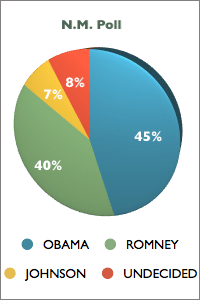
The Albuquerque Journal released the results of their Research & Polling, Inc. survey of 667 likely New Mexico voters over the Sept. 3-6 period, and it reveals an improved position for Republican presidential nominee Mitt Romney. New Mexico, along with New Hampshire and Iowa, has performed as a pure swing state in national elections since 2000, but surveys to date have consistently given President Barack Obama double-digit leads.

In this poll, Obama has only a 45-40 percent advantage over Romney, with former New Mexico governor Gary Johnson, the Libertarian nominee for President, drawing 7 percent. With just a five-point gap now, the results show substantial movement for Romney, who had been trailing by as many as 15 points in previous surveys. The poll also shows that Johnson could play spoiler for Obama and not Romney. According to the Albuquerque Journal, “Johnson gets 12 percent of the Independent vote in the state, leaving Romney with a 38-35 lead over Obama among the key group.”

The study was conducted after the Republican convention but before the President made his official acceptance speech last week in Charlotte. According to the pollsters, about half of the respondents were questioned subsequent to First Lady Michelle Obama’s address.

In another race, Rep. Martin Heinrich (D-NM-1) leads former Rep. Heather Wilson (R-NM-1) by a 49-42 percent count. This is consistent with other polls that have shown both candidates in the 40-percentile range, with Heinrich leading. The numbers break down regionally as one would expect, except that Wilson, tied with Heinrich in the southwestern corner of the state, should be performing better in the region south of Albuquerque.

This poll suggests that the “lean Democrat” rating assigned to this campaign is correct, but also shows a growth pattern available to Wilson. The fact that she leads Heinrich 53-37 percent among Independents is highly encouraging for her campaign effort.

Missouri Aside, Senate Polls Break Toward GOP

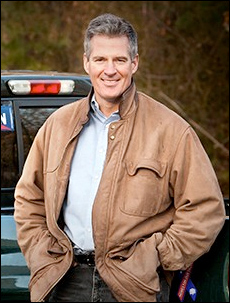
Sen. Scott Brown (R-MA)

A spate of new US Senate polls is giving Republican Party leaders some solace in the face of the Todd Akin debacle in Missouri.

Public Policy Polling (Aug. 16-19; 1,115 likely Massachusetts voters) projects Sen. Scott Brown (R) to a 49-44 percent lead over consumer advocate and Harvard law professor Elizabeth Warren (D). This is the senator’s largest lead in months. Most recent polls showed him either trailing by a point or two, or tied.

Rasmussen Reports (Aug. 20; 500 likely Montana voters) gives Republican Rep. Denny Rehberg (R-MT-AL) a 47-43 percent edge over Sen. Jon Tester (D).

Michigan-based Foster McCollum White & Associates (Aug. 16; 1,733 likely Michigan voters), for the first time, posts challenger Pete Hoekstra (R) to a 48-46 percent advantage against two-term Sen. Debbie Stabenow (D).

PPP also released data for the Wisconsin Senate race, as did Marquette University Law School. According to the former (Aug. 16-19; 1,308 likely Wisconsin voters), Republican ex-governor Tommy Thompson has the upper hand over Rep. Tammy Baldwin (D-WI-2) by a five-point, 49-44 percent, spread. The latter survey (Aug. 16-19; 706 registered Wisconsin voters) shows Thompson with an even larger lead, 50-41 percent.

And, as we reported yesterday, Foster McCollum White & Associates (Aug. 17; 1,503 likely Florida voters) gives Rep. Connie Mack IV (R-FL-14) his largest lead of the campaign, 51-43 percent, over two-term Sen. Bill Nelson (D).

If the patterns in each of these campaigns were to hold, the Republicans would surely capture the Senate majority and see their conference grow to 52 members and possibly beyond. Much will change, however, between now and Nov. 6.

Several Stunning Polls

Across the nation, some eye-opening new polls have cast several races in a different light. Except for the Missouri debacle involving Rep. Todd Akin (R-MO-2) and his quest for the US Senate seat, which has blown up on the Republicans over their candidate’s rape-related abortion comments, some other recently released data is decidedly breaking the GOP’s way.

In Florida, Foster McCollum White & Associates, in conjunction with the public affairs firm Douglas Fulmer & Associates, surveyed 1,503 registered Florida voters on Aug. 17 and found not only Mitt Romney leading President Obama by a heretofore unheard of 54-40 percent count, but Rep. Connie Mack IV (R-FL-14), fresh from his strong Aug. 14 Republican primary victory, also jumped out to a 51-43 percent advantage over his opponent, two-term Sen. Bill Nelson (D). Mack has proved to be a stronger than anticipated candidate, thus paving the way for what is becoming a highly competitive campaign. This is the Republicans’ best Florida poll to date.

From an internal campaign survey taken over a month ago (OnMessage; July 16-17; 400 registered Colorado 7th District voters) for candidate Joe Coors Jr. (R) but just released now, the Republican challenger leads veteran Rep. Ed Perlmutter (D) 45-36 percent. No data has shown anything close to this margin so far and the spread here doesn’t fit the district’s normal voting patterns. More data showing a similar trend will have to be released before such a result is confirmed as being accurate. Expect the Perlmutter campaign to shortly counter with a different set of numbers.

In Nevada’s new 4th District, another seat created via reapportionment, Public Opinion Strategies (Aug. 7-9; 400 likely NV-4 voters) polling for the American Action Network, gives GOP nominee Danny Tarkanian a 46-35 percent lead over state House Majority Leader Steven Horsford (D). Like the set of numbers mentioned above in Colorado, these numbers seem to paint a more rosy Republican picture than how the region normally votes. A Democrat candidate should have the advantage in this northern Las Vegas area CD, so more will have to be learned before such a result is fully accepted.

Finally, countering last week’s internal campaign poll from New York GOP nominee Chris Collins, which showed the Republican jumping out to a double-digit lead, Siena College (Aug. 12-14; 628 registered NY-27 voters) finds the former Erie County Executive to be leading freshman Rep. Kathy Hochul (D) 47-45 percent. Since the new 27th CD is the safest Republican seat in New York, it is plausible that the Democrat incumbent would be trailing here. This race is a hotly competitive campaign and a must-win for New York Republicans.