Category Archives: Election Analysis

North Carolina’s Rep. Cawthorn Switching Districts in 2022

By Jim Ellis

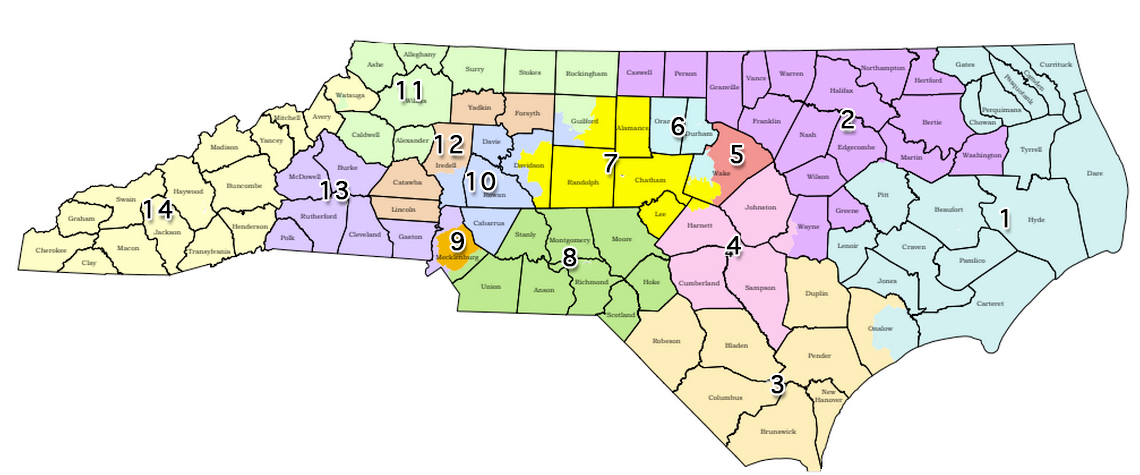
Nov. 15, 2021 — With the newly enacted North Carolina congressional map being vetted and analyzed, candidates for the various districts are beginning to come forth. One surprising move is the decision from freshman Rep. Madison Cawthorn (R-Hendersonville) to run in new District 13 instead of where his home and the majority of his current constituents reside, in new District 14.

Rep. Madison Cawthorn

Cawthorn, at at the age of 26, is the youngest member of Congress; he was elected to represent the 11th District in 2020, succeeding Mark Meadows, the former Trump chief of staff who left the US House to enter the White House. The 11th has traditionally been the number for the district that sits in the Tar Heel State’s far western corner, anchored in Asheville and nestled among the Virginia, Tennessee, Georgia, and South Carolina borders, but the newly enacted congressional map changes its number to 14.

Though the seat in its present configuration has become strongly Republican, that was not always the case. Throughout the 1980’s the district became one of the most politically marginal CDs in the country. During that entire decade, the 11th switched repeatedly back and forth between Democrat James Clarke and Republican Billy Hendon.

Once businessman and former state legislator Charles Taylor defeated Rep. Clarke in 1990, he was able to hold the district for eight consecutive terms until losing in 2006 to Democrat Heath Shuler, the former star University of Tennessee quarterback and NFL player. Shuler represented the district for three terms before retiring, leading to Meadows winning the first of his four elections. Rep. Cawthorn then recorded a 55-42 percent win in 2020 to keep the seat in the Republican column.

The new iteration of the westernmost North Carolina district returns to a more politically marginal status with a statistical history producing Republican victories in the low 50s rather than the high 50s. The adjacent new open 13th District, which annexes the western part of the Charlotte metropolitan area and moves to the Buncombe County line, becomes the region’s new safe Republican seat.

Continue reading

Nevada and Utah Maps Released

Nevada 2021 proposed Congressional redistricting map

By Jim Ellis

Nov. 12, 2021 — Two new proposed redistricting maps were released early in the week, both of which the Dave’s Redistricting App personnel, from the statistical analysis website that specializes in redistricting, call partisan gerrymanders. Democrats drew the Nevada map in anticipation of the special state legislative session beginning next week; Republicans crafted the Utah plan that has now cleared both houses of the state legislature.

In 2020, two of the Las Vegas area congressional districts turned in close re-election victories for Democratic incumbents, Rep. Susie Lee (District 3: 49-46 percent) and Rep. Steven Horsford (District 4: 51-46 percent). The Democratic controlled legislature is looking to improve their districts, from a partisan perspective, but that comes at the expense of Rep. Dina Titus’ downtown Las Vegas CD (District 1) that will become more competitive should this map be enacted as currently drawn. Titus’ 2020 victory spread was 62-33 percent.

Utah 2021 proposed Congressional redistricting map (click on map to see larger view)

The Utah Republican legislature’s redistricting team has designed a new map that would give all four Republican incumbents equivalently strong GOP districts. The big winner is freshman Rep. Burgess Owens (R-Salt Lake City), who sees his marginal district grow from one that produced only his plurality Republican victory over then-Rep. Ben McAdams (D) into the safest Republican seat in the state.

As with many of the smaller population western states with an expansive land mass and one metropolitan area that dominates the entity, the Republican map drawers chose a pie-shaped option, that is a plan where all of the state’s congressional districts share a piece of, in this case, the Salt Lake City metro area.

The Nevada map, on paper, is designed to send three Democrats and one Republican to the US House. The lone Republican, Rep. Mark Amodei (R-Carson City), will again have the northern 2nd District, a seat too far from Las Vegas to take any part of the metro area.

The geography, and the number of people in Nevada’s northern sector, makes drawing a 4D-0R map almost impossible. Therefore, in order to help craft three districts that Democrats should win in typical election years, the map drawers packed as many Republican voters as possible into the one northern district.

Dave’s Redistricting App’s analysts divided the new districts on a partisan basis, but their percentages are estimates. Almost 30 percent of the Nevada electorate registers as Nonpartisan, so dividing only into Democrat and Republican segments may not be particularly accurate.

Continue reading

Sununu Won’t Take Senate Plunge

New Hampshire Gov. Chris Sununu (R) will not run for the Senate.

By Jim Ellis

Nov. 11, 2021 — New Hampshire Gov. Chris Sununu (R) held a long awaited news conference this week to announce his political plans for 2022. The governor had been the Republicans’ top recruitment prospect to challenge vulnerable Democratic Sen. Maggie Hassan, but the three-term state chief executive has chosen to eschew a tough Senate challenge and will instead run for a fourth gubernatorial term.

Though Sununu, like his father before him, has been elected three times as governor, he is still only in his fifth year of service. New Hampshire and Vermont are the only states that have two-year gubernatorial terms. In fact, for a 146-year period, no one had served more than one term as the state’s top office holder. The only governor in New Hampshire history to serve four terms is Democrat John Lynch, who was in office from 2005-2013.

Gov. Sununu’s decision certainly changes the New Hampshire political landscape and will cause potential candidates to begin assessing their chances both in a Senate race against Hassan and as a gubernatorial contender opposite Sununu. Attention now may turn to two-term US Rep. Chris Pappas (D-Manchester).

The Republicans, with trifecta control of the New Hampshire political system in that they hold the governor’s office and have majorities in both houses of the legislature, are looking to change the marginal 1st Congressional District, the seat that has defeated more incumbents than any CD in the country since 2004, into a Republican domain. Doing so would concede the politically marginal 2nd District to incumbent Democratic Rep. Annie Kuster (D-Hopkinton/Concord).

Pappas, aware that a significant change in his district could make him an underdog for re-election, was likely headed into an open governor’s race if Sununu decided to run for Senate. Now that he would have to take on a popular incumbent, his next political move may be less clear.

Turning back to the Senate picture, incumbent Hassan still remains as the most vulnerable Democrat seeking re-election in 2022; so where do Republicans go now? Looking at the crowded 1st District race, two contenders stand out as potential statewide candidates.

Gail Huff Brown, a long time New England television news reporter, is the wife of former Massachusetts Sen. Scott Brown, and she has already announced her congressional candidacy. Former Sen. Brown, himself, would also be a possibility since he has already run for the Senate once in New Hampshire. Matt Mowers is the 2020 1st District nominee who held Rep. Pappas to a 51-46 percent re-election victory. He, too, is an announced congressional candidate but it appears possible that at least one of the aforementioned could instead enter the Senate race.

Continue reading

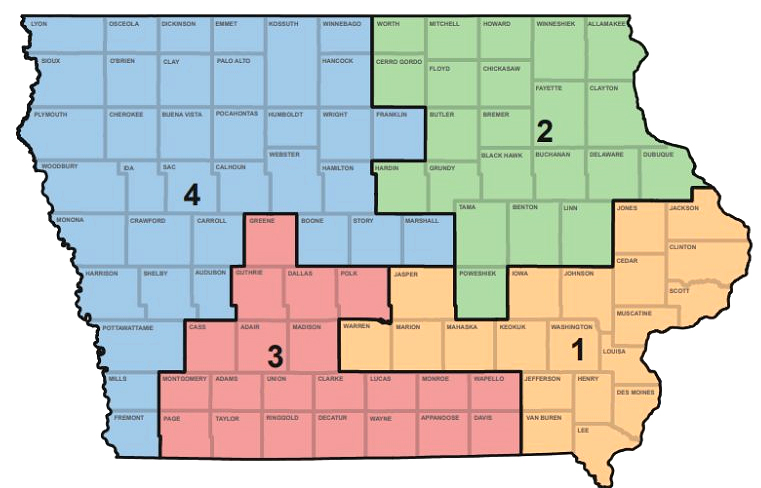
Iowa Map Enacted

By Jim Ellis

Nov. 10, 2021 — Gov. Kim Reynolds (R) signed the new Iowa redistricting map package, legislation that contained the new US House, state Senate, and state House of Representatives maps. The new congressional plan makes what appear to be minor changes to the state’s four districts, while again crafting a new quartet that would have voted in unison for former President Donald Trump. As is the case on the current map, Trump’s district victory margins featured varying percentages.

The Iowa redistricting system is unique. Some believe the state redistricts through a commission, but that is not the case. Rather, a state legislative committee is tasked with drawing the three-map plans and presenting them to the legislature for final approval. The plans must be submitted as a package, and the legislators may only vote up or down on the whole group, as no amendments to any of the maps are allowed.

The committee also employs a formulaic algorithm to create the districts without regard to political proclivities or deference to incumbents. If three map packages are rejected, the legislature then takes full control of the process.

The adopted package is the second plan iteration. The committee staff first put forth a series of maps that failed to make it through the first state Senate committee of jurisdiction. That congressional map was much different than the ultimately enacted plan. In the first draw, freshman Rep. Ashley Hinson (R-Marion/Cedar Rapids) would have been placed in a decidedly Democratic district that would have made her an underdog for re-election in 2022.

It is likely, however, that alone was not the reason for the Senate committee members rejecting the map package. The committee staff created two separate pairings of three incumbent senators apiece, thus dooming the entire package. Once returned, the congressional map plan, using a changed formula, returned to a similar configuration as under the current map.

Continue reading

Rep. Beutler Trailing in New Poll

Six-term Washington Rep. Jaime Herrera Beutler (R-Battle Ground/Vancouver)

By Jim Ellis

Nov. 9, 2021 — Another of the House Republican Trump impeachment supporters appears to be having trouble back home. A new Trafalgar Group poll (Oct. 30-Nov. 2; 682 likely WA-3 primary voters; combination live interview, interactive voice response system, and text) finds six-term Washington Rep. Jaime Herrera Beutler (R-Battle Ground/Vancouver) placing third in a field of four as a prelude to next year’s jungle primary.

According to Trafalgar, former Green Beret Joe Kent (R), who has former President Trump’s endorsement, leads the candidate field with 35 percent preference. Next is Democrat Brian Hennrich, a movie theatre technician, who records 24 percent. For this poll, Hennrich realistically serves as a placebo candidate to test Democratic support. Rep. Beutler then places third with 23 percent and another Republican, pastor and author Heidi St. John, posts 10 percent support. An additional eight percent said they would vote for “another Democrat.”

Surveys such as this will likely spur the Democrats to recruit a much stronger candidate in what plays as a marginal southwestern Evergreen State congressional district.

Washington is one of three states that employs a top-two jungle primary system. All candidates are placed on the same ballot and the top two finishers, regardless of percentage or party, advance into the general election. Therefore, this poll would suggest that Rep. Beutler, at least today, could be eliminated before the general election cycle even officially begins. Washington has a late primary, Aug. 2, 2022, so plenty of time remains for the congresswoman to right her political ship.

The Washington districts won’t likely change a great deal in redistricting. Washington redistricts by commission, and has since 1991. Because none of the state’s 10 districts need a major population influx, it is probable that most of the seats, and especially District 3 (largely because it must only shed 2,222 individuals) will remain relatively constant.

The 3rd District is nestled into the southwestern corner of the state, bordering Oregon and the Pacific Ocean. The seat needing to gain the most people is Rep. Derek Kilmer’s (D-Gig Harbor) 6th District, but the 33,730 residents it requires is still a relatively small number in comparison to some other states.

Currently, the Beutler district votes as a marginal Republican seat. Former President Trump carried WA-3 in 2020 with a 51-47 percent margin after posting a 50-42 percent showing against Hillary Clinton in 2016. Rep. Beutler, in what was billed as a competitive race at the beginning of the 2020 election cycle, scored a 56-43 percent re-election victory. She has averaged 57.6 percent of the vote in her six successful congressional elections.

Fundraising so far has been significant. The September 30 FEC reports find Rep. Beutler already raising $1.73 million for the cycle with $1.38 million cash-on-hand. Kent has also done well, especially for a challenger, raising $1.09 million with $837,000 in the bank. St. John (R) has also raised a respectable $334,000, and held just over $213,000 in her campaign account at the reporting period’s end.

Continue reading

North Carolina Map Passes

By Jim Ellis

Nov. 8, 2021 –The North Carolina legislature passed a congressional redistricting map late last week featuring a new seat that pushes the state to a 14-member delegation, but court challenges are again inevitable.

Under North Carolina law, the governor, in this case Democrat Roy Cooper, has no veto power over redistricting. Therefore, when the map cleared both legislative chambers, the plan became law.

The Tar Heel State legislature and the courts have battled over redistricting for most of the previous decade, with the judiciary changing the legislature’s maps no fewer than three times during that 10-year period.

The last court iteration, in which the Democratic controlled state Supreme Court added two Democratic seats at the GOP’s expense, created safe districts for their party in Raleigh and Greensboro. The effect transformed the delegation’s partisan division to eight Republicans and five Democrats.

Under the legislature’s new 2021 version, the members returned to the previous GOP model for the Greensboro area, while largely keeping the Democratic draw for central Raleigh. Though political data is not yet available for the 14 new districts, estimates suggest that the new plan will yield 10 Republican seats and four Democratic districts, at least for the 2022 election cycle.

With a March 8, 2022 primary and candidate filing opening in about a month on Dec. 6, it will be difficult to move quickly through the court process to stop the map before officially beginning the election cycle.

The new map displaces several members and is another example of the map drawers changing the district numbers, thus making it more difficult to make comparisons. The members most negatively affected are Reps. Kathy Manning (D-Greensboro), Virginia Foxx (R-Banner Elk), and Richard Hudson (R-Concord).

The Manning district currently covers all of Guilford County, including the cities of Greensboro and High Point, and moves west into Forsyth County to annex the city of Winston-Salem. The court’s 2020 draw was split four ways, giving Rep. Manning the choice of approximately four immediate districts in which she could run, all of which are Republican. Therefore, it appears at first glance without the aid of political data that she would have to choose among four bad options in order to attempt to continue her congressional career.

Rep. Foxx, who currently represents a western North Carolina 5th District that stretches from Virginia to South Carolina would now see her new 11th CD begin in the western mountains and stretch easterly along the Virginia border and south into the city of Greensboro. This may be a relatively Republican district, but the addition of Democratic Greensboro clearly changes the district’s complexion and takes Foxx into a region that she has not represented over her nine terms in Congress.

Continue reading

Election Day Upsets and Surprises

By Jim Ellis

Nov. 4, 2021 — Now that Tuesday’s election numbers are becoming more available and final, we can explore the contests that proved to be upsets and ones providing us with some surprises. In most instances, the Republicans performed better in these races than expected.

The first obvious upset, though a mild one as we approached election day because most people understood that Republican Glenn Youngkin had a legitimate chance to score a victory over former Gov. Terry McAuliffe, is the Virginia statewide race. The biggest surprise was New Jersey Republican Jack Ciattarelli within one percentage point of defeating Democratic Gov. Phil Murphy.

With that background, let’s begin with our upsets:

• Georgia: Former Atlanta Mayor Kasim Reed (D), attempting to regain his former position in the open seat 2021 race, has apparently failed to qualify for the runoff. Atlanta City Council President Felicia Moore (D) placed first, with City Councilman Andre Dickens (D) running 612 votes ahead of Reed for second position with all of the precincts reporting.

Mail votes and ancillary ballots could still push Reed into a runoff with Moore, but it appears that Dickens has the inside track to nose the former mayor out of this race.

• Maine:• New Jersey: State Senate President Steve Sweeney (D) has apparently lost his southern New Jersey seat to truck driver Edward Durr (R) who spent only about $5,000 on his campaign. Durr leads 52-48 percent, which should be enough for him to eventually claim victory.

• New York: Big Republican local election wins occurred in Suffolk and Nassau County on Long Island. GOP candidates won the Suffolk and Nassau County District Attorney’s offices, and defeated the Nassau County Executive. They also reclaimed the majority on the Suffolk County legislature for the first time since 2005.

• Texas: Continuing a GOP rebound among Hispanic voters in Texas, Republican John Lujan converted a 71 percent Hispanic district in southeast Bexar County (San Antonio). Lujan was a 51-49 percent winner in Texas House District 118.

• Virginia: Glenn Youngkin (R) defeated Terry McAuliffe (D), 51-48 percent. Winsome Sears (R) topped state Del. Hala Ayala (D), 51-49 percent. State Del. Jason Miyares (R) ousted Attorney General Mark Herring (D), 51-49 percent. Republicans have clinched or lead in 52 House of Delegates races, enough for them to re-claim the majority. Not only did Youngkin score an upset win, but he had obvious coattails.

There were several interesting surprises on election night, too:

• Florida: Miami area Democrats went to the polls to choose a special election nominee to replace the late Rep. Alcee Hastings (D-Delray Beach) and the result yielded a photo finish. Recounts will be ordered and a long post-election process is expected before someone advances to the January 11th special general election.

At first take with supposedly all votes counted, businesswoman Sheila Cherfilus-McCormick looks to have secured the party nomination by just 31 votes. A later count then put Broward County Commissioner Dale Holness on top by an even smaller 12-vote margin. Expect this one to be in the courts long before a Democratic nominee is finally settled upon.

Continue reading