
By Jim Ellis — Monday, June 22, 2026
Ranked Choice Voting
Ten days after Maine’s June 9th primary, the Secretary of State’s office finally released the results of the Ranked Choice Voting (RCV) tabulations, and the post‑election redistribution altered the final outcome in two major races.
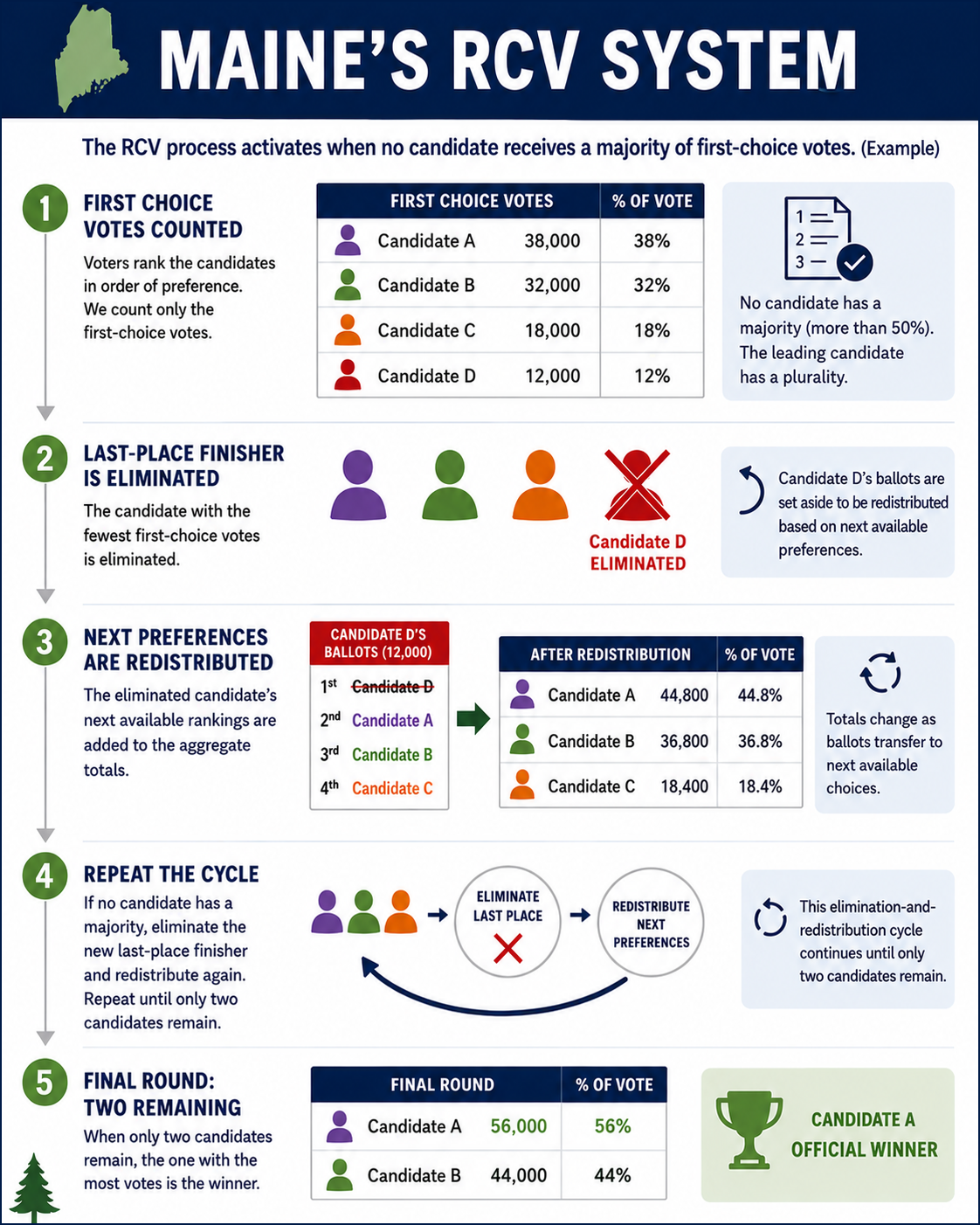
(Click on image to see example larger.)
Maine uses RCV only in primaries and federal elections. The state Supreme Court has ruled that the Maine Constitution recognizes plurality winners in state general elections, meaning RCV cannot be applied there. The court also held that it lacks jurisdiction over party‑run primaries and federal contests, so it cannot block RCV in those elections.
In the open Governor’s race, former state Health Director Nirav Shah led the Democratic primary in the initial count but ultimately lost in the RCV rounds. The official Democratic nominee is former state House Speaker Hannah Pingree, daughter of Rep. Chellie Pingree (D‑North Haven/Portland).
Although Pingree trailed Dr. Shah 27-23 percent in first‑choice votes, she gained steadily through second and third choice rankings. In the fourth and final round – after the field had narrowed to those two – she prevailed 56-44 percent.
Businessman Angus King III, son of Sen. Angus King (I‑ME), was the first candidate eliminated, and his votes were redistributed according to the voters’ alternate rankings.
Secretary of State Shenna Bellows was eliminated next, and the addition of her supporters’ ranked choices pushed Pingree ahead of Shah for the first time, by an adjusted margin of 2,990 votes. After former state Senate President Troy Jackson was eliminated, the fourth round matched Pingree against Shah, producing the final outcome.
‘
On the Republican side, RCV did not alter the standings. Former Assistant Secretary of State Bobby Charles led on election night with a 38-20-20 percent advantage over businessman Ben Midgley and attorney Jonathan Bush, nephew and cousin to Presidents George H.W. Bush and George W. Bush.
The order remained unchanged through seven RCV rounds, and Charles officially secured the nomination with a 60-40 percent final‑round margin over Midgley.
Pingree and Charles now advance to the general election, where they will also face Independent state Sen. Rick Bennett of Oxford.
Bennett, a former Maine Republican Party chairman and Republican National Committeeman, left the GOP to run as an Independent, believing he would be more competitive in a three-way race without the party designation. His presence on the ballot is expected to draw votes away from Charles, thus making Pingree a heavy favorite in November.
RCV also changed the outcome in the Democratic primary for the 2nd Congressional District. On election night, state Sen. Joe Baldacci (D‑Bangor), brother of former Governor and Congressman John Baldacci, held a narrow lead. But in the second round of RCV tabulation only 546 votes separated Baldacci, State Auditor Matt Dunlap, and former congressional aide Jordan Wood. In the third round, Dunlap overtook Baldacci and won the nomination with just over 52 percent of the adjusted vote.
Dunlap, therefore, advances to face former Gov.Paul LePage in the general election. LePage was unopposed for the Republican nomination.
Maine’s 2nd District is the most Republican‑leaning seat in the country that a Democrat currently represents: retiring Rep. Jared Golden (D‑Lewiston).
The 2026 general election is expected to be competitive. Given that LePage carried the 2nd District in all three of his gubernatorial campaigns, he enters this general election campaign as the early favorite.