Monthly Archives: May 2026

New Florida Map Adopted

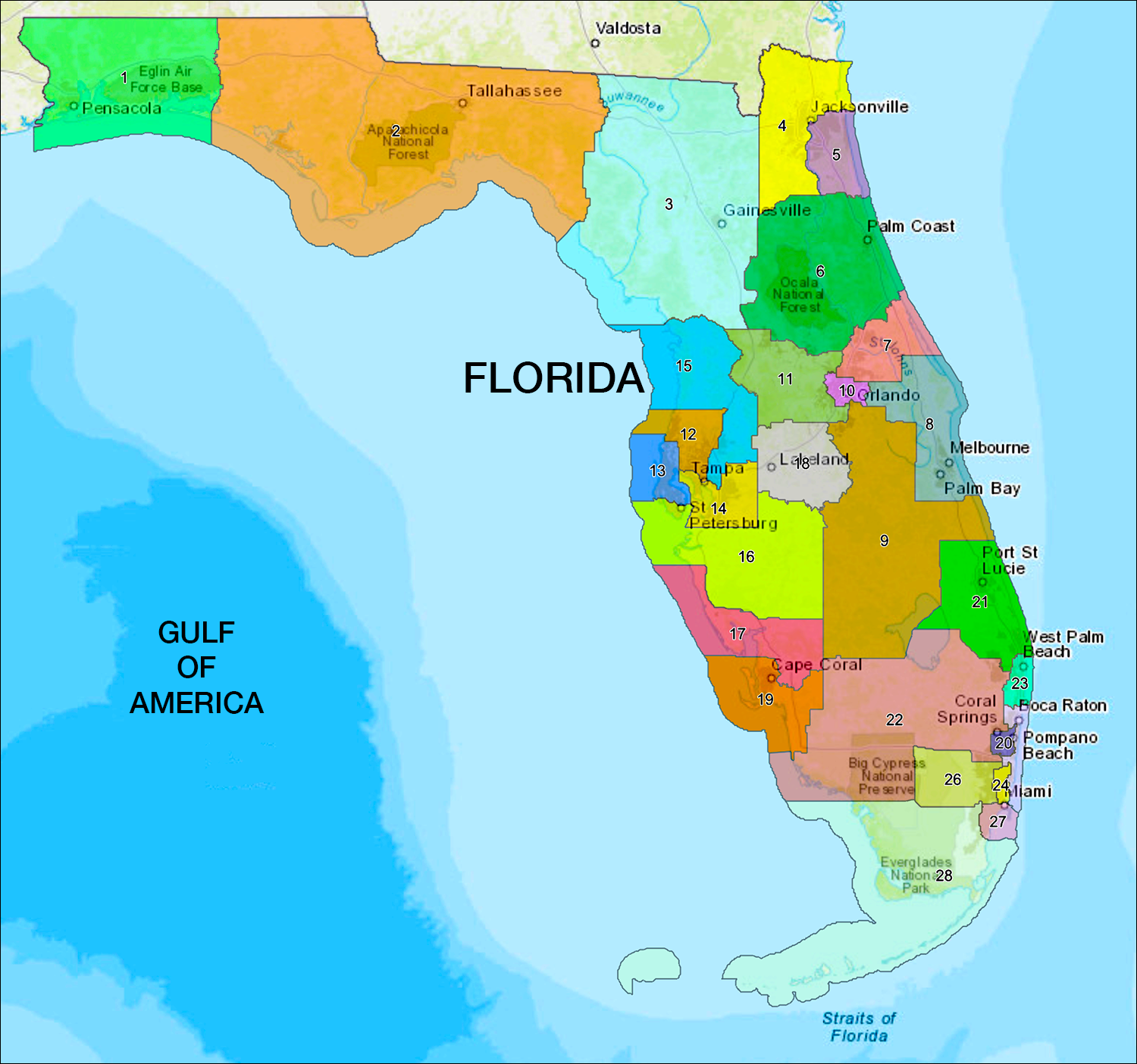
Click the map above or here to see an interactive version: Florida redistricting map.

By Jim Ellis — Tuesday, May 5, 2026

Redistricting

The proposed 2026 Florida congressional map is now law with passage in both the state House of Representatives and Senate along with Gov. Ron DeSantis’ (R) signature, but legal challenges are on the horizon.

Democrats are expected to challenge the newly enacted map in court, focusing not on racial gerrymandering but on certain partisan provision language contained in the voter‑approved redistricting criteria. Although the initiative language includes a ban on overt partisan gerrymandering, the Callais v. Louisiana decision also addressed technical issues that relate to Florida’s initiative, and this could complicate or even undermine the Democrats’ anticipated lawsuit.

Assuming the state Supreme Court upholds the new map – a majority of the justices are DeSantis appointments – the early statistical analysis points to a 24R – 4D partisan split. Such would provide Republicans four more seats compared with their current Sunshine State standing.

Yesterday, several members announced where they intend to run, and the new map creates significant challenges for multiple incumbents. The statisticians at The Down Ballot political blog have released preliminary partisan estimates based on the two most recent presidential elections.

The four Democrats facing unfavorable new districts are: Reps. Darren Soto (D-Kissimmee), Kathy Castor (D-Tampa), Jared Moskowitz (D-Parkland), and Debbie Wasserman Schultz (D-Weston). Reps. Maxwell Frost (D-Orlando), Lois Frankel (D-Ft. Lauderdale), and Frederica Wilson (D-Miami Gardens) would receive safe Democratic seats. The vacant 20th District from which former Democratic Rep. Sheila Cherfilus-McCormick recently resigned would also remain strongly Democratic.

Two of the members, Reps. Soto and Castor, announced yesterday that they will run in their newly assigned districts. Rep. Soto previously held a reliably Democratic 9th District, where Kamala Harris defeated President Biden 51.2 to 47.7 percent. President Biden ran even stronger here in 2020, carrying the district 58.2 to 40.8 percent. Under the new plan, however, the 9th District shifts sharply to the right: Donald Trump would have defeated Harris 58.2 to 40.5 percent.

Rep. Castor’s 14th District was even more strongly Democratic than Rep. Soto’s previous CD. In 2024, Kamala Harris carried the 14th CD 55.3 to 45.6 percent. Four years earlier, the Democratic margin was 59.0 to 39.8 percent. Under the new DeSantis plan, the 14th District — still anchored in Tampa but containing less of the city — would have shifted to the right, with Trump winning 54.5 to 44.0 percent.

Making early comments about where she might run, Rep. Frankel remained uncommitted about seeking re-election in the new 23rd CD that contains part of Ft. Lauderdale and the Democratic stronghold of West Palm Beach.

Rep. Moskowitz indicated that he will likely run in the new 25th District, an Atlantic coastal seat where he already represents roughly half of the constituency. The updated partisan numbers, however, show that President Trump would have carried the new 25th with a 54.0 to 44.8 percent margin.

The Democrat in the most difficult position is Rep. Wasserman Schultz. Unless she chooses to challenge another Democrat in a paired‑incumbent race, she would likely run in the new 22nd District, which begins in the Fort Lauderdale area and stretches west across the peninsula to the Gulf of America. Based on Donald Trump’s would‑be performance, the partisan split in this district is calculated at 54.6 to 44.1 percent.

Several Republicans would also find themselves in new political circumstances. Rep. Gus Bilirakis (R‑Clearwater) would still hold a strongly Republican district, but its Trump performance of 56.9 to 41.6 percent is noticeably weaker than that of his previous 12th District. The major change is drawing the 12th into Tampa to absorb some Democratic voters that Rep. Castor previously represented.

In the Tampa area, Rep. Laurel Lee (R‑Tampa) would receive a much more Republican‑leaning district, but her new territory north of Tampa could leave her vulnerable in a GOP primary. Hernando County Commissioner Steve Champion has already announced that he will challenge her.

In the Daytona area, Rep. Cory Mills (R‑New Smyrna Beach), who is facing multiple sexual‑harassment accusations, would see his 7th District remain almost entirely unchanged. His biggest obstacle to re‑election is likely to come from the Republican primary.

The new Florida map will play a major role in determining which party ultimately controls the House in the upcoming midterm elections. Attention will soon shift to the state Supreme Court and its forthcoming decision on what is expected to be a highly technical legal challenge.

Redistricting Disarray: Alabama Yes, Georgia No, Louisiana Back to Jungle

By Jim Ellis — Monday, May 4, 2026

Redistricting

The Supreme Court ruling on the Callais v. Louisiana racial gerrymandering case has thrown the House election cycle into disarray. As a result of the high court’s decision, redistricting options are again being contemplated in several states.

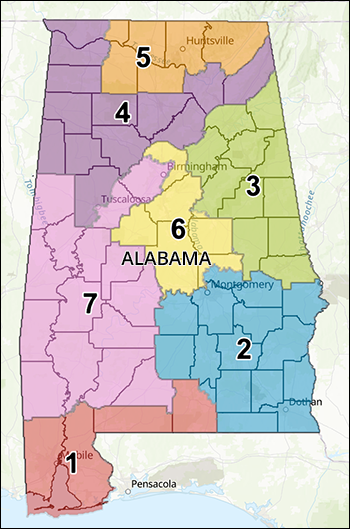
Alabama Gov. Kay Ivey (R), despite previously stating she opposed redistricting ahead of the 2026 elections, issued a proclamation on Friday calling the legislature into special session later today to redraw the state’s congressional and state Senate maps.

Alabama is in exactly the same situation now as Louisiana. Under court orders, both states were required to redraw their 2021 congressional maps to add a majority minority district. Following last week’s Supreme Court Callais ruling, those revised maps are now invalid.

It is probable that the Alabama legislature will revert to a map like the one enacted in 2021. Such a plan would collapse Rep. Shomari Figures’ (D‑Montgomery) current District 2 and shift the seat back to southeast Alabama. That change would likely return the state’s congressional delegation to a 6R–1D alignment, rather than the current 5R–2D split.

The principal beneficiary of such a map would be former Congressman Jerry Carl (R), who lost his seat in a 2024 paired‑incumbent primary. He is currently running in the reconfigured 1st District now that incumbent Rep. Barry Moore (R) is seeking a Senate seat. Carl, however, trails state Rep. Rhett Marques (R‑Enterprise) in a recently released poll.

A new map would likely restore Mobile County as the population anchor of District 1 and shift District 2 back to southeast Alabama. Such a draw would allow both Carl and Marques to run in separate districts. While each would still face primary competition under a new configuration, they would no longer be forced to run against one another.

The Alabama primary is scheduled for May 19, which means the legislature will have to act quickly. The most likely scenario is that the regular primary proceeds as planned for all offices except the US House of Representatives and state Senate. Once new maps are enacted, a separate filing period and new primary dates for those offices would be set for later in the year.

Georgia is another state that could potentially redraw its congressional map, but with candidate filing already closed and the May 19 primary fast approaching, Gov. Brian Kemp (R) is taking the opposite position of Gov. Ivey. Kemp said he does not support redistricting for 2026, though indicated he would be open to considering a new map for the 2028 election cycle.

In Louisiana, state Senate President Cameron Henry (R‑Metairie) said Friday that the 2026 election scheduling decision will likely return the state’s US House races to the jungle primary format that has been in place since the late 1970s.

Gov. Jeff Landry (R) has already suspended the May 16 primary for US House campaigns in response to the Supreme Court ruling. The other affected contests, most notably the US Senate race, will continue to proceed under the May 16 partisan primary schedule.

With other offices still operating under the jungle primary system, which runs concurrently with the November general election and employs December runoffs when no candidate wins a majority, it is likely the Governor will simply return the US House races to this previous format and election calendar. Such would be the least expensive way for the state to conduct elections under a revised schedule.

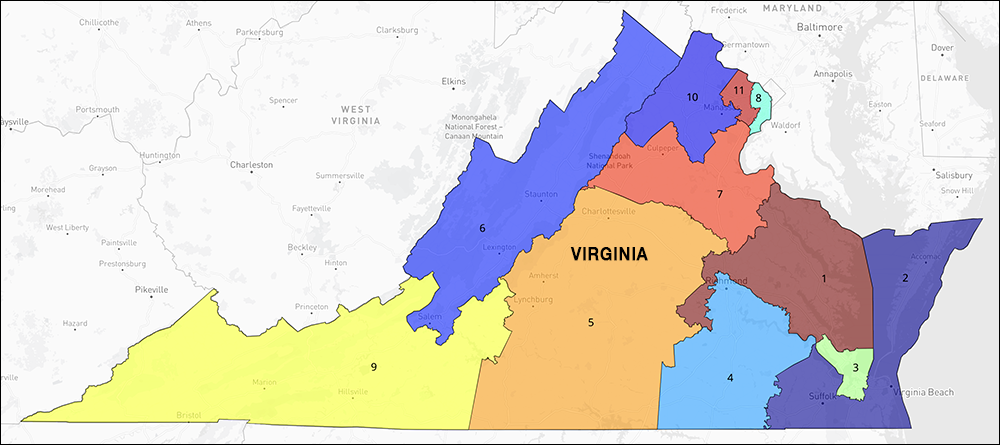
Once the Virginia state Supreme Court renders a decision upholding the April 21 redistricting referendum, and the new Florida plan wins approval from its state Supreme Court after a lawsuit is formally filed, along with Alabama and Louisiana overcoming the legal objections to moving their primaries, the national redistricting landscape will finally come into clear focus.

Assuming all of these courts rule as suggested, we can reasonably predict that the new California and Texas maps would offset one another in terms of partisan gains, as would the changes in Virginia and Florida. Republicans would probably gain one seat each in Alabama, Louisiana, Missouri, and North Carolina, with the potential for one or two additional seats in Ohio. Democrats would gain one seat in Utah under that state’s new court‑ordered map.

Therefore, if the national redistricting picture ultimately unfolds as outlined above, the 2026 changes would likely result in Republicans achieving a net gain of four to five seats nationwide.

Louisiana Suspends House Primaries

Louisiana Governor suspends US House elections (view interactive 2024 Louisiana Congressional Districts map on Dave’s Redistricting App).

By Jim Ellis — Friday, May 1, 2026

House

A day after the US Supreme Court ruled Louisiana’s congressional map an unconstitutional gerrymander, Gov. Jeff Landry (R) issued an executive order affecting the state’s May 16 primary election.

With early voting set to begin tomorrow and the state’s congressional map declared illegal by the nation’s highest court on Wednesday, Gov. Landry moved quickly to suspend the House primaries. He said the nomination election will remain in abeyance to give legislators time to redraw and approve a new congressional map and identified July 15 as the target date for rescheduling the House contests.

All other races, including the US Senate primaries in both parties, will proceed as planned on May 16.

Democrats, and even some Republicans, criticized the decision, arguing that early voting ballots have already been distributed and that postponing only the US House primaries would create confusion and likely depress turnout.

One of the Republican critics, Sen. Bill Cassidy, who faces a difficult renomination fight under the new partisan primary system, warned that running two different nomination schedules will mislead voters. For that reason, he opposes allowing the Senate primary to proceed on May 16.

What is likely a more salient reason for Sen. Cassidy’s push to postpone the primary is a new Emerson College poll released yesterday. The survey (April 24–26; 500 likely Republican primary voters; multiple sampling techniques) shows Sen. Cassidy trailing both former state Treasurer John Fleming and Rep. Julia Letlow (R‑Start), whom President Trump has already endorsed.

The ballot test produced a 28-27-21 percent split, with Fleming narrowly leading Rep. Letlow, and Sen. Cassidy following. Clearly, the race is headed toward a runoff, and it is not even certain that Sen. Cassidy will qualify for the second round.

At the end of 2024, the Louisiana legislature and the Governor overhauled the state’s preliminary election system. The new law created a partisan primary in May of the election year, followed by a June runoff in any race where no candidate secures a majority. Once nominees are chosen, they advance to a November general election, as in all other states.

Previously, Louisiana used a jungle primary system in which all candidates, regardless of party, appeared on the same ballot. Any candidate who received more than 50 percent of the vote in the first round was elected outright. If no one reaches a majority, the top two finishers, again, regardless of party affiliation, advance to the general election.

In past years, Louisiana held its initial election concurrently with the national general election. If a runoff was required, the top candidates would meet again in an early December second round. For the state legislature and many statewide offices, including the governorship, that system remains in place. The new partisan primary structure applies only to federal offices and certain designated state positions.

The act of drawing a new congressional map will almost certainly guarantee Republicans at least one additional seat in the current 4R–2D Louisiana delegation. Some observers, most notably reporters at the liberal political blog The Down Ballot, have speculated that Republican legislators might even attempt to convert both Democratic seats. Whether such an effort will materialize remains uncertain.

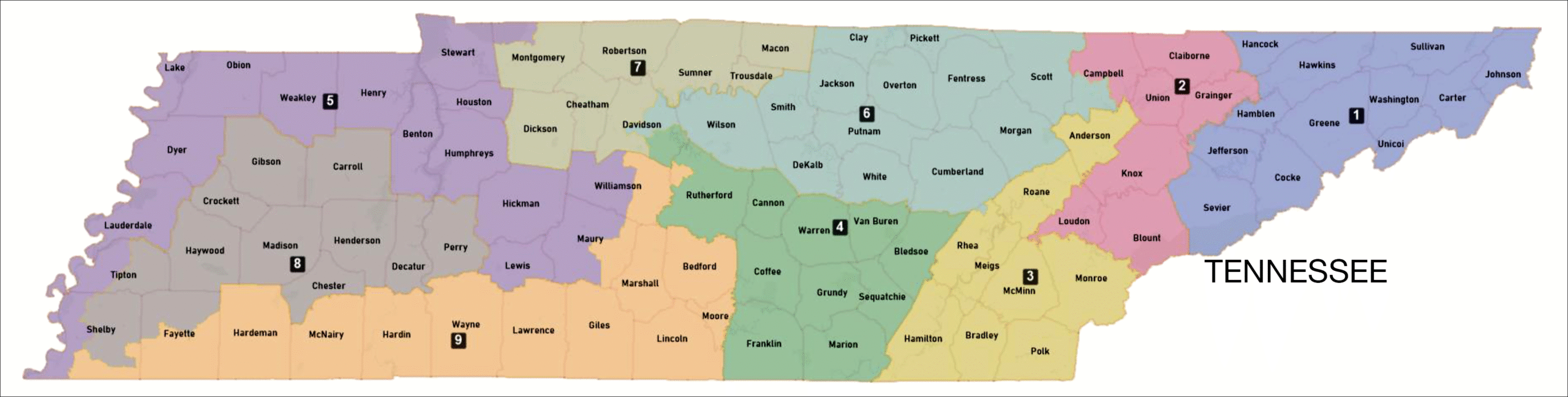
In addition to Louisiana, other states may also undertake redistricting ahead of the 2026 election. Reports indicate that President Trump has urged Tennessee Gov. Bill Lee (R) to eliminate the state’s lone Democratic‑held district; Georgia is also viewed as a potential candidate for a 2026 redraw.

Other states could be in the mix, as well. If such efforts move forward, they will almost certainly unfold on a very compressed timeline.