By Jim Ellis — Thursday, July 30, 2026
Senate
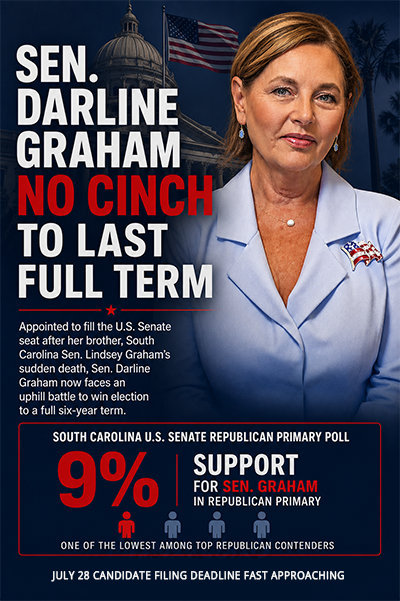
 Candidate filing closed yesterday for the South Carolina special Republican Senate primary, and no fewer than eight individuals filed to challenge appointed Sen. Darline Graham despite her carrying President Trump’s endorsement.
The death of Sen. Lindsey Graham earlier this month required state Republican leaders to schedule a quick special election to replace him on the ballot. The primary will be held Tuesday, Aug. 11. If no candidate receives a majority, the top two finishers will advance to an Aug. 25 runoff.
The headline challengers are two sitting US House members: Rep. Ralph Norman (R‑Rock Hill), who finished a distant third in June’s gubernatorial primary, and Rep. Russell Fry (R‑Murrell’s Inlet/Myrtle Beach).
Other notable entrants include former Myrtle Beach Mayor and ex‑City Councilman Mark McBride – an unwelcome development for Rep. Fry, since McBride is likely to siphon votes from the northeastern South Carolina region – and wealthy businessman Mark Lynch, who drew 29 percent in his June primary challenge to Lindsey Graham. Former Governor and Congressman Mark Sanford, who considered entering the 1st District regular primary but ultimately did not, also filed for the Senate special.
Three apparent also-ran candidates also filed: former Waterboro City Councilman Duke Buckner, businesswoman Glenda Gail Parker, and biochemical engineer Sam Shepherd.
This crowded field makes it unlikely that any candidate, including Sen. Graham, will reach the 50 percent threshold. The most probable runoff scenario involves two of the three leading contenders – Sen. Graham, Rep. Norman, and Rep. Fry. Should Graham fail to win outright, she would enter the runoff at a disadvantage, since a majority of voters would have already chosen someone else.
Historically, family members of deceased officeholders often perform well in replacement elections, though Democratic family members typically perform better than Republicans.
In terms of campaign resources, Rep. Norman is independently wealthy and capable of quickly self‑funding at a seven‑figure level. Rep. Fry has roughly $1 million in his House campaign account that can be transferred to a Senate committee. Sen. Graham must raise funds into a new federal committee, but a supportive Super PAC has indicated it is prepared to spend $1.5 million on her behalf. Lynch, who spent more than $5 million on his unsuccessful June challenge, is also well‑financed and capable of again investing heavily, this time in a short‑term race.
Turnout will be key, as is typical in special elections. In June, 464,709 voters participated in the regular Senate primary, and it is likely that considerably fewer will cast ballots in the Aug. 11 special primary.
Lindsey Graham received 264,091 votes in securing his 57 percent primary win, giving the late Senator’s sister a substantial Graham‑aligned vote base from which to begin assembling a victory coalition. In the regular Senate primary, Mark Lynch drew 134,360 votes, and in the Republican gubernatorial primary, Rep. Ralph Norman received 80,790 votes.
With at least these three candidates capable of attracting significant support, the Aug. 11 primary is poised to be highly competitive, increasing the likelihood that the nomination will not be decided until the Aug. 25 runoff.
The eventual Republican nominee will be favored in November against Democratic nominee Annie Andrews, given South Carolina’s strong Republican voting history. It remains to be seen which of the major contenders will ultimately secure the nomination.