Tag Archives: North Carolina

Senate: Early Handicapping

By Jim Ellis

Jan. 17, 2019 — The 2020 Senate election cycle features 34 races instead of 33 because of the Arizona special, and this time it is the Republicans who must defend the preponderance of seats. In 2018, Democrats held 26 of the 35 seats up for election; in this cycle, Republicans must protect 22 of the 34 Senate positions.

Republicans are first risking two open seats, those of Sen. Pat Roberts in Kansas and Lamar Alexander of Tennessee. At this point, both should remain in the GOP column. They also face a slew of competitive races in as many as eight incumbent states. Democrats, on the other hand, must defend in one highly competitive campaign, that of Sen. Doug Jones in Alabama, and a potentially viable contest in Minnesota.

But the most vulnerable Republican races will attract serious political attention. Appointed Sen. Martha McSally (AZ), Sen. Cory Gardner (CO), and North Carolina first term incumbent Thom Tillis are facing difficult election or re-election campaigns, in addition to Sen. Jones.

Martha McSally lost the 2018 Arizona Senate race to new Sen. Kyrsten Sinema (D) by 55,900 votes of more than 2.384 million ballots cast, or a margin of 2.4 percentage points. This, however, in the same election where Republican Gov. Doug Ducey scored a strong 56-42 percent re-election victory.


Continue reading

NC-9: Vacant for the Year?

By Jim Ellis

Jan. 15, 2019 — The 9th District of North Carolina, still with uncertified electoral results from November, could conceivably remain vacant until the November municipal elections as the situation continues to unfold.

The NC State Board of Elections was supposed to have met on Friday, and at that point would likely have scheduled a new election, but the panel itself is a political football. A state judge acted to dissolve the membership by refusing to issue a stay of his previous ruling.

North Carolina Republican Mark Harris has filed a court challenge to the Board of Elections not certifying his win in NC-9 and claiming his 905-vote lead should stand.

The panel became a tug of war between Gov. Roy Cooper (D) and the Republican dominated state legislature even before the NC-9 controversy arose. During the transition between the time that Cooper unseated GOP Gov. Pat McCrory (R) in the 2016 statewide election and his taking office Republican legislators changed certain laws. One of those moves concerned the Board of Elections’ composition.

A judge eventually ruled that the legislature acted unconstitutionally regarding some of the changes including the legislation regarding the Board of Elections. The board was supposed to be dissolved after the election certification period, but the NC-9 problem earned the group a stay of the original ruling. The judge, however, did not see fit to allow them to continue in the new year.

At the end of the year, with Republican legislators desiring to change the special election law that would allow an open primary system instead of the general election rerun that would have been the previous board’s only option had they ordered a new vote, a new election law was enacted.

In a deal with the Democrats, the Republican leadership passed a bill that allows the open primary in exchange for giving Gov. Cooper what he wanted in terms of Board of Elections’ personnel. The bill passed overwhelmingly in both houses, but the governor vetoed. The legislature immediately overrode his action.

Continue reading

House: Opening with a Vacancy

By Jim Ellis

North Carolina Republican Mark Harris

Jan. 7, 2019 — When the new House of Representatives convened last week, they did so with only 434 voting members, not 435, as the situation in North Carolina’s 9th District remains unresolved.

To recap, Republican Mark Harris scored an apparent 905-vote victory over Democrat Dan McCready on election night, but the results remain uncertified due to what a majority of Board of Elections panel members are citing as voting irregularities in one county. The panel is scheduled to next meet this Friday, Jan. 11th, and organizing a new election is the likely resolution.

Previously, the Board only had the power to order a rerun of the general election. Hence, the subsequent election would have included only Harris, McCready, and Libertarian Jeff Scott. Considering the media hit that Harris has received over the election irregularity controversy, his chances of winning the rerun are slim. (He hired the Red Dome Consulting firm, which contracted with the individual accused of orchestrating the ballot harvesting operation, McCrae Dowless, the vice chairman of the Bladen County Soil and Water Conservation Board.)

Therefore, with Republicans controlling the legislature, they quickly constructed a legislative package that would give Democratic Gov. Roy Cooper largely what he wanted in naming a new Board of Elections panel, while changing the post-election law to allow open primaries. This would give the GOP the opportunity of replacing Harris in the general election.

The legislature quickly passed the reform package at the end of the year with an overwhelming margin, because most Democrats voted for the bill as it included their much-wanted Board of Elections changes. The legislation was sent to Gov. Cooper with veto-proof majorities in both houses.

Continue reading

Apportionment Projections:
Who is Gaining, Who is Losing

By Jim Ellis

Jan. 3, 2019 — Late last year, we covered the new Census Bureau report for the states gaining and losing population during the past 12-month period. Now, we see the agency’s latest just-released numbers for the decade through this past July. Armed with the new data, outside mathematicians have made apportionment projections to provide a more defined picture as to which states will be gaining or losing US House seats in the 2020 post-census reapportionment.

With two years remaining in the present decade, trends can still change and we must remember that the reapportionment formula is complex, but the new projections give us a strong idea as to just how many seats, give or take a small variance, will transfer. At this point, according to the Washington, DC-based Election Data Services, it appears that as many as 22 seats could change location affecting 17 states.

Texas, having gained 3.55 million people since the 2010 census, looks to be adding as many as three seats for the 2022 elections and beyond. This will give the Lone Star State 39 seats during the next decade, and 41 electoral votes in the succeeding presidential elections.

Florida was the second largest gainer with just under 2.5 million new residents, meaning the Sunshine State will likely gain two seats, going from 27 to 29. In terms of raw numbers, California gained more than 2.3 million people, but it actually dropped a tenth of a point below the national growth average of 6.3 percent for the past eight years. This means the Golden State is currently on the hook to actually lose a district for the first time in history.

Continue reading

Potential Specials in North Carolina

By Jim Ellis

Dec. 12, 2018 — Rep. Mark Meadows (R-Skyland/Asheville) being mentioned as a possible successor to outgoing White House chief of staff John Kelly means that a special election would be called for western North Carolina if the congressman were to vacate his district. Should this come to pass, the state may be forced to host two congressional special elections but possibly under different rules.

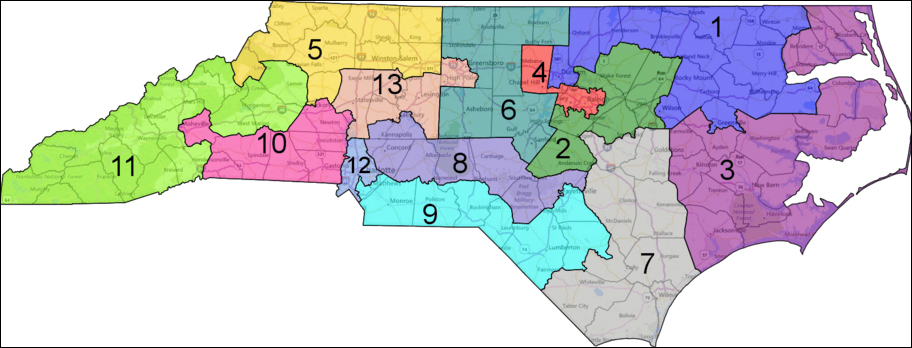
North Carolina Congressional Districts

The 9th District, which stretches from Charlotte to Fayetteville along the South Carolina border, is likely headed to a new vote since the state Board of Elections refuses to certify Republican Mark Harris’ 905-vote lead over Democrat Dan McCready due to election irregularities in one county.

Though the two potential elections could reasonably be held under the same schedule, the process parameters surrounding each are likely to be different.

If Rep. Meadows’ district opens, the special election will be run under traditional rules, meaning open partisan primaries and a general election once nominees are chosen. But, not so in the 9th District.

Under North Carolina law, should the Board of Elections declare the original election null and void after their investigation into the alleged irregularities concludes, a new special election would be a rerun of the 2018 general election, meaning the candidates would be Harris, McCready, and Libertarian nominee Jeff Scott.

Continue reading

Two House Races Still Not Decided

By Jim Ellis

Dec. 6, 2018 — Two House races are still not finalized, with one possibly headed for a new election. In California, action is still not complete now almost a month after Election Day. Democrat T.J. Cox leads Rep. David Valadao (R-Hanford/Bakersfield) by 843 votes in the 21st District with an undetermined number of ballots remaining to be counted. It does appear that Cox will be declared the winner, but the election officials actually doing finalizing the race still have not done so.

In North Carolina, the state Board of Elections has blocked certifying Republican Mark Harris’ victory over Democratic businessman Dan McCready in the state’s open 9th District. The seat went to open status after the North Carolina primary in May when Harris, formerly a Baptist pastor, upset Rep. Bob Pittenger (R-Charlotte) in the Republican primary.

Ironically, a practice referred to as “ballot harvesting” appears to be at the heart of the California political overtime races and this one suspended result in North Carolina. Ballot harvesting is the act of an individual gathering absentee ballots from voters, bundling them together, and turning them over to election officers for counting purposes. In California, ballot harvesting is now legal. In North Carolina, it is not.

In the Golden State, the Valadao district is the last to turn. In five other seats, all Republican held, the GOP candidate led through Election Day and mail counting, only to see the tables turn when provisional ballots were added. Statewide, almost 2 million votes were in this category, so an average of approximately 35,000 such votes were present in most congressional districts.

Continue reading

NC-9: Certification Problems

By Jim Ellis

North Carolina Republican Mark Harris

Nov. 30, 2018 — The North Carolina Board of Elections has failed to certify Republican Mark Harris’ victory in the open 9th Congressional District, action that may initiate a long legal battle.

Board Vice Chairman Joshua Malcolm (D) objected to certifying Harris’ 905-vote victory over businessman Dan McCready (D) from 282,717 total votes cast. The seat was open after Harris, a Baptist former pastor and ex-US Senate and congressional candidate, defeated Rep. Bob Pittenger (R-Charlotte) in the May Republican primary.

Malcolm cited “irregularities” in Republican Bladen County, an entity that Harris carried by 1,557 votes, obviously more than his district-wide margin, as his reasoning to the other board members as to why the result should be at least temporarily suspended.

The 9th District begins in Mecklenburg County and then travels down the South Carolina border to the Fayetteville area. It includes five complete counties and parts of three others including Mecklenburg and Bladen. Harris carried only Union County and Bladen’s 9th District section, but his margins were large enough in these two places to overcome McCready’s advantage in the other six local entities.

The North Carolina Board of Elections (BoE) is a nine-member panel that has been at the center of controversy between Gov. Roy Cooper (D) and the Republican legislature. After Cooper defeated then-Gov. Pat McCrory (R), the legislators passed a series of bills that limited some of the governor’s power. One of the measures involved changing how the Board of Elections’ membership was appointed.

Continue reading