Tag Archives: Mitt Romney

Hunter Reeling

California Rep. Duncan Hunter (R-Alpine)

By Jim Ellis

Oct. 7, 2019 — In addition to his legal woes, indicted California Rep. Duncan Hunter (R-Alpine) now appears to have severe political problems according to a new just-released CA-50 district study.

A Survey USA poll conducted for the San Diego Union-Tribune (Sept. 27-Oct. 2; 592 likely CA-50 voters; 671 respondents were asked favorability questions about the top four candidates, but the electoral questions were asked only of those who described themselves as likely voters) tested the seven announced candidates for the March 3 California jungle primary.

The S-USA results find Democrat Ammar Campa-Najjar, the 2018 party nominee who held Rep. Hunter to a four-point win, holding 31 percent support. Former San Diego City councilman and mayoral and congressional candidate Carl DeMaio (R) follows with 20 percent, ex-Rep. Darrell Issa, who recently announced his candidacy records 16 percent, while Rep. Hunter posts only an 11 percent preference factor.

Rather surprisingly, state Sen. Brian Jones (R-Santee), also a recent candidate but a public official who represents almost 90 percent of the 50th District, records a very low four percent. The two independent candidates have three percent combined.

It is no surprise that Campa-Najjar is leading. In a crowded field with only one candidate from a particular party, it becomes a simple strategy to coalesce the party members behind the lone contender. While Campa-Najjar will almost certainly advance to the general election in this type of jungle format with so many candidates splitting his opposition party vote, we also must see that 52 percent of the poll respondents chose a Republican candidate. This obviously bodes poorly for the sole Democrat in the general election.

The setup here is similar to last year’s open 49th District, the adjacent seat from which Rep. Issa retired. In the June 2018 election, Republican Diane Harkey finished first by an eight-point margin in a field of 16 candidates but, in the general with only two contenders, it was Democrat Mike Levin who recorded a 56-44 percent victory.

Continue reading

Collins Resigns; Thornberry to Retire

By Jim Ellis

Rep. Chris Collins (R-NY)

Oct. 2, 2019 — Reportedly planning to plead guilty to an insider trading charge after being indicted last year, Rep. Chris Collins (R-NY) resigned his seat in the House, officially informing Speaker Nancy Pelosi (D-CA) and New York Gov. Andrew Cuomo (D) Monday of his intentions.

Despite having an indictment hanging over his head, Rep. Collins won a close re-election in NY-27 — normally a safe Republican upstate district that occupies all or parts of eight counties in the region’s rural area east of Buffalo and south of Rochester.

The congressman defeated Democrat Nate McMurray, a Grand Island town supervisor, by a razor-thin 49.1 – 48.8 percent spread, a margin of just 1,087 votes. Clearly the indictment played a major role in the outcome being so close, as Collins’ re-election percentages were an identical 67.2 percent in 2014 and 2016 after unseating then-Rep. Kathy Hochul (D) in the 2012 general election.

Anticipating an open seat or a weakened Collins seeking re-nomination, several Republicans had already announced their intentions to run. Two state senators, Chris Jacobs (R-Buffalo) and Rob Ortt (R-Lockport), are already in the race as is attorney and former town judge Beth Parlato. The 2018 Democratic nominee, McMurray, is also a declared candidate.

It is likely that other Republicans will jump into either the special election, if it is called, or the regular election now that it is an open seat race. It is also likely that Democratic leaders will make sure that McMurray has a clean shot for re-nomination in order to make him as strong as possible against a different GOP nominee.

The New York state primary is scheduled for June 23. The eventual GOP nominee should begin as a favorite to hold the seat.
Continue reading

Rep. Shimkus to Retire

Illinois Rep. John Shimkus (R-Collinsville)

By Jim Ellis

Sept. 4, 2019 — Twelve-term Illinois Rep. John Shimkus (R-Collinsville), a key member of the House Energy & Commerce Committee, announced over the Labor Day weekend that he will not seek re-election next year, becoming the latest GOP House member to join the increasing line of incumbents voluntarily not returning for the next Congress.

Rep. Shimkus’ retirement makes his IL-15 the 18th open House seat for the next election, including the two September 10th North Carolina special elections. Of this group, Republicans currently hold 14 of the 18 seats, with the vacant NC-9 — one of those currently in special election and the district that featured a disputed 2018 electoral result — previously in the GOP column as well.

Shimkus, in his written statement, said, “[A]s Illinois candidates begin to circulate petitions next week, now is the time for me to announce that I will not be seeking re-election.

“It has been the honor of my lifetime to be asked by the people of Illinois to represent them in our nation’s capital. Each day I have tried to do this as best as I possibly could, and my success lies squarely at the feet of my incredible staff in Illinois and Washington, DC.”

IL-15 is a safe Republican district. President Trump carried the seat, 71-24 percent, in 2016. Four years earlier, Mitt Romney’s margin was 64-34 percent, and John McCain won here 55-43 percent in 2008. Therefore, over the course of time, the 15th has become more Republican. In his four elections in this district configuration, Shimkus has averaged 78.6 percent of the general election vote.

The district is predominantly located in the eastern sector of the state, hugging the Indiana border and traveling due south all the way to Kentucky. It then stretches west to almost the other side of the state in order to annex the Collinsville area, an outer St. Louis metro area community where Shimkus resides.

Continue reading

Ex-Rep. Issa Forms Exploratory Committee For Crowded CA-50

Ex-California US Rep. Darrell Issa

By Jim Ellis

Sept. 3, 2019 — Ex-California US Rep. Darrell Issa, who represented the state’s 49th CD for 18 years, just filed a new congressional exploratory committee with the Federal Election Commission. But he is not looking to run in his former seat. Rather, the exploratory committee is organized to survey his chances of winning the adjacent 50th CD, the district that indicted Rep. Duncan D. Hunter (R-Alpine) currently represents.

This congressional district’s political soap opera continues to unfold. Hunter is facing a trial after the first of next year to defend himself against campaign finance charges, certain ones for which his estranged wife and former campaign manager have already negotiated a plea agreement with the government. And, with the early March 3 state primary scheduled concurrently with the presidential Super Tuesday vote, candidates are already announcing their intentions.

Anticipating that the court case will go against the congressman, five Republicans have announced their candidacies. And, with the trial now postponed until after the first of the year (it was originally scheduled for mid-September) there is a strong chance that Rep. Hunter will file for re-election before the state’s Dec. 6 candidate filing deadline. Should Issa decide to enter the race, then at least seven Republicans will be competing.

So many are coming forward because the 50th is one of the safest Republican seats in California, a state that now has a congressional delegation of 46 Democrats and just seven Republicans. However, quite possibly, and largely due to the state’s jungle primary law, the seat could fall into Democratic hands under a very realistic scenario.

Under California law, similar to the system in Louisiana and Washington, all candidates appear on the primary ballot regardless of political party affiliation. In the California process, the top two finishers in the first election, which is in reality a qualifying election as opposed to a partisan primary, advance to the general election.

Because there will be seven Republicans or more on the ballot and, at this point, just one Democrat — 2018 nominee Ammar Campa-Najjar, who posted 48.3 percent of the vote against Hunter — Campa-Najjar’s chances of advancing to the general election are quite favorable.

Continue reading

Wisconsin Rep. Sean Duffy to Resign

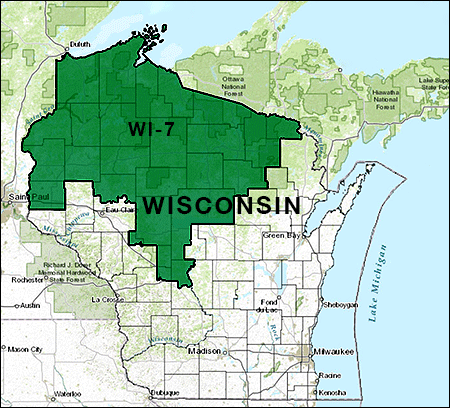
Wisconsin’s US 7th Congressional District

By Jim Ellis

Aug. 28, 2019 — Five-term Wisconsin Rep. Sean Duffy (R-Wausau) announced Monday that he is resigning from Congress effective Sept. 23. Rep. Duffy indicated his reason for leaving mid-term is that his wife and his expectant child, their ninth, has already been diagnosed with challenging health issues.

Therefore, his 7th Congressional District will go to special election once Gov. Tony Evers (D) sets the schedule. The congressional vote will likely coincide with the state’s spring election, where statewide and district judges are on the ballot and many localities use the dates to hold their own elections. The Wisconsin calendar pinpoints the Spring Primary for Feb. 18, 2020, while the Spring General election will run concurrently with the Wisconsin presidential primary on April 7.

The Badger State’s 7th CD occupies a full quarter of the state’s land area, beginning on the shores of Lake Superior and stretching to Buckhorn State Park close to Wisconsin’s center. The district covers a large land mass and is populated with small towns spread throughout the 26 counties that it covers or touches. WI-7 contains 21 whole counties and parts of five others. Its largest city, Wausau, which is Congressman Duffy’s hometown, has just under 40,000 people.

The district’s electorate now votes solidly Republican but, before Rep. Duffy was elected in 2010, this seat remained in Democratic hands for 41 consecutive years in the person of former Rep. David Obey (D) who first won in a 1969 special election and retired in the 2010 cycle. The district’s pre-Obey history, however, was solidly Republican. A member of the GOP had represented the seat for 82 of its first 96 years of existence.

Since the Duffy resignation was unexpected, no potential successors are being discussed, but that situation will quickly change.

Continue reading

Now, Texas Rep. Marchant Bows Out

By Jim Ellis

Texas Rep. Kenny Marchant (R-Coppell/DFW area)

Aug. 7 2019 — The string of House retirements continues this week as eight-term Texas Rep. Kenny Marchant (R-Coppell/DFW area) announced that he, too, will leave the House at the end of the current term. Combined with his time in the Texas legislature, Marchant will have served 34 consecutive years in elective office.

The 24th District has been a focal point of the Texas congressional scene since Democrats position the seat high on their conversion opportunity list because of its close 2018 result. Despite Democratic nominee Jan McDowell spending less than $100,000 on her campaign, she came within a 51-48 percent margin of upsetting the veteran congressman, a difference of approximately 8,100 votes.

The vote drop-off from the 2016 presidential year, as it relates to turnout, was only four percent in 2018 compared to 42 percent when contrasting the 2014 midterm to the 2012 presidential election year, thus partially explaining why the latest results are so different.

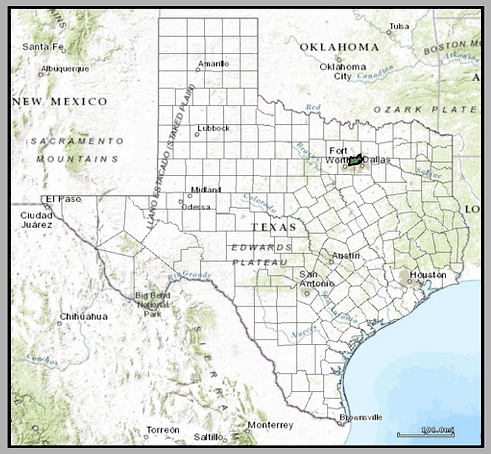
Texas Congressional District 24, currently represented in the US House by Kenny Marchant.

The 24th District is the region surrounding DFW Airport, and contains parts of Dallas, Tarrant, and Denton Counties. President Trump carried the seat with a 51-44 percent margin, down from Mitt Romney’s 60-38 percent, and the 58-41 percent margin that John McCain recorded back in 2008. Then-Rep. Beto O’Rourke slipped past Sen. Ted Cruz (R) in the November election by the same margin that Rep. Marchant won re-election, 51-48 percent, however.

Over his eight elections, Marchant averaged 61.8 percent of the vote, but 58.2 percent since the district was drawn in its present fashion from as part of the 2011 redistricting process.

Continue reading

Yet Another Texas Rep. to Retire

By Jim Ellis

Aug. 5, 2019 — The House Republican retirements keep coming. Now, three-term Rep. Will Hurd (R-San Antonio) announced late last week that he will not seek re-election, risking the truest swing seat in the Texas delegation. Hurd, a former CIA officer, says he wants to leave the House “to pursue opportunities outside the halls of Congress to solve problems at the nexus between technology and national security.”

Texas Rep. Will Hurd (R-San Antonio)

The Lone Star State’s 23rd District stretches from San Antonio all the way to El Paso, a distance of some 550 miles, making this one of the largest CDs in the United States that does not encompass an entire state. The 23rd also shares approximately 800 miles of the US-Mexico border, the largest of any congressional district.

TX-23 contains 26 counties and parts of three others, but just about 50 percent of the people live either in Bexar (San Antonio) or El Paso Counties. The seat’s voting history is as politically tight as its area is expansive. Hillary Clinton carried the district over President Trump, 50-46%, but Mitt Romney slipped past President Obama, 51-48 percent.

Rep. Hurd has represented the district for three terms but has never reached 50 percent in his trio of victories. Though he has won three times, his average vote percentage is 49.1 percent. In 2018, against Democratic nominee Gina Ortiz Jones, Rep. Hurd won the second closest raw vote victory of any Republican in the House, a 926-vote win. This seat will now likely become the top Democratic conversion target in the 2020 election cycle.

Prior to Rep. Hurd winning here in 2014, the district had flipped between the two parties since Democrat Ciro Rodriguez defeated seven-term veteran Republican Congressman Henry Bonilla in 2006. A subsequent court order after the state legislature drew new districts in 2003 changed significant parts of this seat, making it more Democratic.

After being re-elected in 2008, Rep. Rodriguez then lost in 2010 to Republican Quico Conseco, who then lost to Democrat Pete Gallego in 2012, who then lost to Hurd in 2014. From 2010-2018, the top winning percentage was Gallego’s 50.3 percent in 2012. Therefore, the 23rd has performed as the most evenly split district in the country during the current decade.

The citizen voting age population breaks into two racial demographic sectors, Hispanic (62.0 percent) and non-Hispanic white (31.8 percent). It is the most Hispanic district in the US that consistently elects a Republican candidate.

Continue reading

Another One Bites the Dust:
Rep. Martha Roby to Retire

By Jim Ellis

Alabama Rep. Martha Roby (R-Montgomery)

July 30, 2019 — In the past week, three Republican House members made public their intention not to seek re-election including one this weekend. The action brings the grand total of open seats to 13, still a low number but one that is beginning to grow exponentially.

Now joining Reps. Paul Mitchell (R-MI) and Pete Olson (R-TX) in the recent retirement category is Alabama Rep. Martha Roby (R-Montgomery). The congresswoman released an electronic message indicating that she will not seek a sixth term and thanked her family and the people of her state’s 2nd District for the opportunity of serving in the US House for what will be a full decade.

Unlike in 2018, Roby looked to have a clear path to re-election. In the last campaign cycle, she drew a significant primary challenge because of negative comments she made about President Trump during the 2016 electoral contest. But the president endorsed her in the ’18 GOP nomination campaign and she scored a solid 68-32 percent win opposite former Democratic Congressman Bobby Bright in the Republican run-off.

Against four primary opponents, however, Rep. Roby only managed 39 percent of the vote, thus forcing the run-off. She rebounded nicely in the secondary election, and then went onto post a 61 percent victory in the general election. So far, no one from either party has come forward to challenge her, thus, Roby announces her retirement devoid of political pressure.

Alabama’s US Congressional Districts

Alabama’s 2nd District occupies the southeastern corner of the state, from the capital city of Montgomery to the Florida border on the south and Georgia to the east. It contains 14 whole counties and almost two-thirds of Montgomery County.

The seat is solidly Republican. President Trump posted a whopping 65-33 percent win here against Hillary Clinton, even topping Mitt Romney’s 63-36 percent margin over President Obama in 2012. In her five congressional general elections, Roby averaged 58.4 percent of the vote, but that figure is a bit misleading. She unseated then-Rep. Bright in 2010 with 51.1 percent and then survived a surprisingly close call in 2016 when she defeated a relatively unknown Democrat with only a 48.8 – 40.5 percent point spread. In her other three generals, she recorded victory percentages of 64, 67, and 61.

While the open seat figure is creeping upward, the majority of what will be incumbent-less campaigns are still non-competitive for next year’s election season. The overwhelming number of the 13 opens are Republican-held (10R-3D), and it appears at this early point in the election cycle that five of the districts will feature seriously contested general election contests, including four currently in GOP hands.

Continue reading

Rep. Pete Olson to Retire

Texas Congressional District 22, currently represented in the US House by Pete Olson (R-Sugar Land), who just announced his retirement.

By Jim Ellis

Texas Rep. Pete Olson (R-Sugar Land)

July 29, 2019 — Six-term Texas Rep. Pete Olson (R-Sugar Land) announced late last week that he will not seek re-election next year, bringing the House open seat total to an even dozen and leaving what appears to be a competitive race in his wake.

Over the years, the 22nd District has had a colorful history. Originally crafted as a swing district in the 70s, Ron Paul first won it in a 1976 special election before losing it in the regular election later that year. He would return to win the district back in 1978 and then hold it for three terms before running unsuccessfully for the Senate.

Succeeding Dr. Paul was then-state Rep. Tom DeLay (R), who would win 11 elections in the congressional district and rise through leadership to become Majority Whip and Majority Leader.

Leaving mid-term in 2006, the Republicans were barred from replacing DeLay on the ballot, which led to then-Houston City Councilwoman Shelley Sekula-Gibbs (R) running as a write-in candidate and losing to a Democrat, former Rep. Nick Lampson. Two years earlier, Lampson had lost his Beaumont-anchored district. Republicans re-claimed the seat two years later in the person of the current incumbent, Pete Olson.

Rep. Olson issued the following statement explaining his decision: “as someone who has long advocated for policies that put our families first, it’s time for me to take my own advice and be a more consistent presence to help our family. To that end, while I will complete my term in the 116th Congress, I will not be seeking reelection.”

Continue reading

Michigan Rep. Paul Mitchell to Retire:
“Rhetoric Overwhelms Policy …”

Michigan Rep. Paul Mitchell (R-Dryden)

By Jim Ellis

July 26, 2019 — Michigan Rep. Paul Mitchell (R-Dryden) who represents the eastern part of the state known as “the thumb of Michigan”, announced Tuesday that he will not seek a third term in the US House.

His reason for departing after what will be only four years in office and spending over $7 million of this own money to win election to Congress over three campaigns is to spend more time with his family because of his special needs son. Rep. Mitchell also expresses displeasure and frustration with Washington because, he says, “rhetoric overwhelms policy, and politics consumes much of the oxygen in this city.”

Rep. Mitchell was originally elected in 2016, replacing Rep. Candice Miller (R) when she retired after 14 years in the House. He won a five-way Republican primary that year with 38 percent support, or more than 8,000 votes beyond he and his closest competitor, state Sen. Phil Pavlov (R-Port Huron). Mitchell won the ’16 general election with a 63-32 percent margin and was re-elected last year, 60-35 percent.

In his first venture into elective politics, Mitchell ran in the vacant 4th District when former Ways & Means Committee chairman Dave Camp (R-Midland) retired in 2014 after his time leading the panel had reached its term limit. In the three-way Republican primary, Mitchell lost 52-36 percent to current Rep. John Moolenaar (R-Midland). After the defeat, he moved across the state to Lapeer County, an area where Mitchell had business interests.

Continue reading