By Jim Ellis
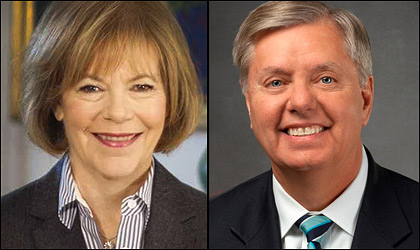
Are incumbents Sen. Tina Smith (D-MN), left, and Sen. Lindsey Graham (R-SC) in re-election trouble?
Polling is now consistently showing close races in the two states, and Sen. Smith’s recent comments about the police have seemingly moved her re-election campaign closer to the toss-up category according to a just-released Harper Polling survey.
Looking at the HP data (Aug. 30-Sept. 1; 50 likely Minnesota voters via live interview), Sen. Smith’s ballot test edge has dropped to just 43-41 percent over former US Rep. Jason Lewis (R).
In May, Harper found Sen. Smith posting a 46-35 percent advantage over Lewis. After this release, Public Policy Polling forecast a 48-39 percent split toward the end of July. Lastly, Emerson College published what appears to be precursor data to the latest Harper findings. The Boston-based university poll (Aug. 8-10; 73 likely Minnesota voters) found a three-point split between the two contenders, 48-45 percent, again in Sen. Smith’s favor.
To the southeast of liberal Minnesota, in conservative South Carolina, veteran Sen. Lindsey Graham (R) has also fallen into a competitive contest with former state Democratic Party chairman Jaime Harrison, who had raised an incredible $29 million for his smaller state race through the end of June.
The most recent poll we have seen from the Palmetto State was released at the beginning of August. Quinnipiac University (July 30-Aug. 3; 91 registered South Carolina voters) detected a 44-44 percent tie between Sen. Graham and Harrison. From mid-July through the beginning of August, six surveys were conducted, including the Quinnipiac study, and Sen. Graham’s average lead was only 2.8 percentage points.
 April 20, 2020 — Within a 10-day period, two statewide polls producing radically different results were conducted of the North Carolina electorate. Rather unsurprisingly, the Republican polling firm turned in better results for the GOP candidates than did the Democratic company.
  In the two North Carolina special elections that were decided on Tuesday night, the winning Republican candidates exceeded the published polling projections. The same pattern also occurred in Pennsylvania back in late May when Rep. Fred Keller (R-Middleburg), while predicted to win comfortably, garnered a considerably larger vote percentage than projected when he scored a 68 percent special election victory.