Tag Archives: Ellis Insight

Biden’s Good and Bad News

By Jim Ellis

Former Vice President Joe Biden

Feb. 19, 2020 — Despite former Vice President Joe Biden’s poor performance in Iowa and New Hampshire, the latest available data suggests his presidential campaign status is not as dire as some in the media are prognosticating.

There have only been five Nevada Caucus polls released since the first of the year and the most recent one appears potentially unreliable. Point Blank Associates actually finds Tom Steyer leading the poll conducted over the Feb. 13-15 period, in a 19-16-14-13-13 percent count over Sen. Amy Klobuchar, Biden, Sen. Bernie Sanders, and former mayor, Pete Buttigieg. This poll has a sample size of only 256 respondents, thus making the error factor unacceptably high.

On the other hand, WPA Intelligence went into the field over the Feb. 11-13 period with a more reasonable sample size of 413 individuals who are described as likely voters. In contrast with the Point Blank result, WPAi finds Sen. Sanders leading the field, a conclusion more consistent with previously released polls. According to WPA, the split is 25-18-13-11-10-10 percent, with Biden in second place followed consecutively by Warren, Steyer, Buttigieg, and Klobuchar.

Therefore, while Biden is not leading either of these Nevada polls, he looks to be in range for potential delegate allocation. Obtaining delegate votes in Nevada will put him in better position to rebound for Super Tuesday, and particularly so if he can hold on to win in South Carolina.

The new East Carolina University survey still finds Biden leading the field in the Palmetto State as he has in every poll conducted in January, early February, and all of last year. East Carolina (Feb. 12-13; 703 likely South Carolina Democratic primary voters) projects Biden to a 28-20-14 percent lead over Sanders and Steyer, respectively. All others fall below 10 percent support.
Continue reading

Granger Goes Negative

(Granger Attack Ad)

By Jim Ellis

Feb. 17, 2020 — Veteran Texas Congresswoman Kay Granger (R-Ft. Worth) faces a serious Republican primary challenge that will be decided on March 3. With no public polling available, outside signs suggest the race is getting close. Otherwise, a 12-term incumbent would not be launching negative ads against her low name ID opponent.

Once the political domain of former US House Majority Leader Jim Wright (D), Texas’ 12th Congressional District has seen Granger dominate this area’s politics now for almost three decades. She became the first female mayor of Ft. Worth before winning her congressional seat in 1996, and now stands for a 13th term in the 2020 election.

The congresswoman’s GOP challenger is former Colleyville City Councilman Chris Putnam, who made himself wealthy in private business before running for political office. Putnam’s rise into politics is a familiar story. The local city council was blocking one of his business moves, so he decided to run himself and won. In the following election, he and his allies converted every seat on the panel. Putnam didn’t seek a second four-year term on the council, saying he had accomplished his original set of goals.

Now he is challenging Rep. Granger, even though his locality of Colleyville is not in the 12th District. Putnam raised significant money through the end of the year and has the wherewithal to add some more of his own should the situation call for such action. Of the $535,000-plus that he raised through the end of 2019, $250,000 was self-loaned.

For her part, Granger is taking this campaign seriously. She spent more than $1.1 million even before 2019 ended, and figures to spend whatever she needs to in 2020 to saturate her messages.

Continue reading

Sessions in Trouble

By Jim Ellis

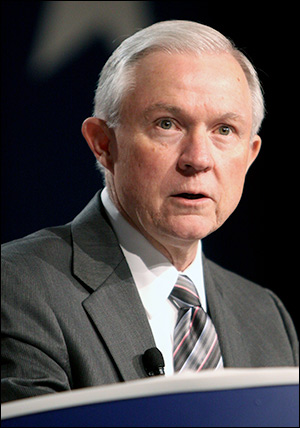
Former US attorney general and Alabama senator, Jeff Sessions (R)

Feb. 13, 2020 — Mason-Dixon Polling & Strategy conducted a new poll (Feb. 4-6; 400 likely Alabama Republican primary voters) of the Alabama Senate race and though former US attorney general and ex-Alabama senator, Jeff Sessions, still leads in what is a tightening Republican primary, peeling away the underlying data suggests that he could find rough going in an inevitable run-off election.

The M-D results find Sessions leading only 31-29 percent over former Auburn University head football coach Tommy Tuberville. Rep. Bradley Byrne (R-Mobile) trails with 17 percent, but well ahead of former Alabama Supreme Court chief judge and 2017 special election Senate nominee Roy Moore who posts just five percent support.

Sessions’ numbers have declined significantly since he entered the race, obviously suggesting a downward trend pointing to a more serious situation when further seeing that his name identification is universal.

With a significant double-digit margin between the top two poll finishers and Rep. Byrne, it becomes highly likely that both Sessions and Tuberville would advance to a run-off election. Neither is positioned to win the nomination outright, however. With Sessions nowhere close to a majority and, after considering his long political history in the state and 100% name identification among Republican primary voters and his current tepid ballot test numbers, it would not be surprising to see Tuberville overtake him in a one-on-one battle.

Another clue that Sessions has political problems is his favorability index as detected in the Mason-Dixon poll. According to their cell responses, Sessions carries a 49:18 percent favorable to unfavorable ratio among Republican primary voters, which looks positive on the surface, but after overlaying the pervasive name ID percentage it becomes clear that half of the respondents fail to have a positive impression.

Continue reading

Iowa Drags On

By Jim Ellis

South Bend Mayor Pete Buttigieg

Feb. 5, 2020 — Almost a full day after voting ended, the Iowa Democratic Party released what now accounts for almost three-quarters of the state’s precinct totals, and we may be headed for a split decision.

While South Bend Mayor Pete Buttigieg is being credited as the leader and potential victor, the complicated Iowa system suggests that two candidates can claim a victory of sorts.

Buttigieg leads among the state delegate count, as caucus attenders choose individuals to serve as delegates to the state party convention in order to determine how Iowa’s 41 first-ballot delegates will vote at the Democratic National Convention in mid-July. At this writing, Buttigieg has 26.8 percent of the state delegate contingent, ahead of Sen. Bernie Sanders’ 25.2 percent.

In actuality, however, it is Sanders who has more raw votes. At this point, the Vermont senator maintains an approximate 1,300-vote lead over Buttigieg, and 7,000 more than Sen. Elizabeth Warren. Former Vice President Joe Biden performed poorly, attracting only half the total number of votes that Sanders has so far recorded.

Each caucus awards a certain number of delegates regardless of how many people attend the precinct meeting. Like the electoral college in the general election, the bigger entities receive more delegate votes. Therefore, even though Buttigieg received fewer popular votes he did better in the largest areas, thus awarding him a few more state delegates.

In terms of the published projections for the national convention delegate slate it appears that Buttigieg would have 12 votes, Sanders 10, Warren 6, and Biden 3 with ten more to be decided once all of the votes are finally tabulated. It’s possible that while Sen. Amy Klobuchar (D-MN) failed to reach the 15 percent threshold she might earn a delegate or two based upon the individual congressional district vote.

Biden, who is currently at just 15.4 percent of the state delegate vote is just barely qualifying for apportionment. If the final outstanding votes cut against him, it’s possible that he could fail to reach the final 15 percent, which would prevent him from earning any at-large national convention delegate votes.

The Iowa Debacle

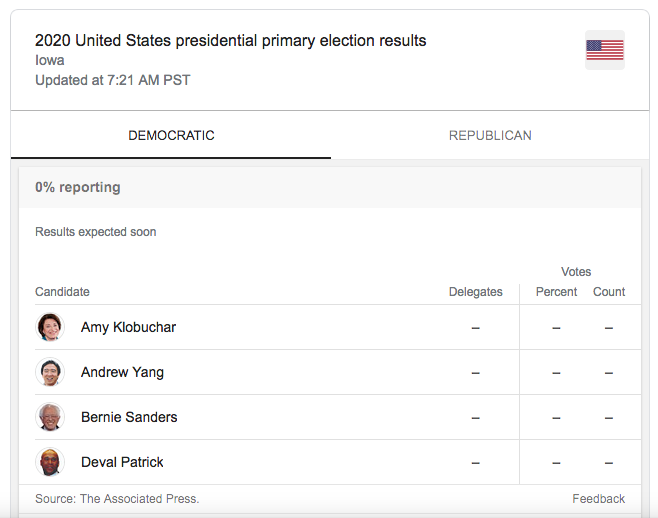
Iowa Caucus results as of 10:21 am Eastern, 7:21 am Pacific time, Tuesday, Feb. 4, 2020.

By Jim Ellis

Feb. 4, 2020 — The reporting problem that arose in the Iowa Democratic Caucuses last night have left us with no results for what could be as long as a full day or more after votes were cast, but it still appears as if a clear winner and loser have emerged. The winner and loser terms have a different meaning in the Iowa Caucus context, however.

Voters attended meetings in 1,679 precincts and the party organizers were supposed to submit their first ballot and final alignment numbers through a specially designed application. The app failed, and so did the party’s back-up plan. Therefore, while voting occurred in all of the precincts, less than one-third of the totals have been received at the Iowa Democratic Party headquarters at the end of the night. The party spokespeople say they will not release any numbers until the entire state reports, and the 1st and 2nd round totals have been verified.

Meeting attenders cast their first ballot and the candidates failing to attain 15 percent support in the precinct were eliminated. In the final alignment round, those voting for a non-qualifying candidate were then lobbied to vote for a candidate who did surpass the 15 percent threshold and would thus qualify for delegates to advance to the state convention on June 13. The state delegates will then vote to assign Iowa’s 41 first-ballot delegates to the Democratic National Convention, but the eventual official apportionment will closely follow the Caucus votes.

What we began seeing from the fastest reporting precincts that were released, and that was less than two percent of the statewide vote, was a bunching at the top among Sens. Bernie Sanders (I-VT) and Elizabeth Warren (D-MA), and South Bend Mayor Pete Buttigieg. Former Vice President Joe Biden and Sen. Amy Klobuchar (D-MN) were in need of further support from around the state to reach the 15 percent mark, but both are close. Therefore, it does appear possible that all five of these contenders could qualify for a share of the state’s delegates.

The unfolding situation seems to favor one person in particular, while disfavoring another. On the short end is Sen. Sanders, even though he looks to clinch first place. The glitch cost him the opportunity to declare outright victory in a timely fashion before a national television audience. The most fortunate candidate looks to be Biden, whose early performance suggests he might not even qualify for delegates in a substantial number of precincts. The reporting problem prevented headline stories claiming that he was Iowa’s under-performer.

Continue reading

Iowa Caucus Voting Tonight

By Jim Ellis

Feb. 3, 2020 — The final Iowa Caucus research surveys are providing very different results, while what is traditionally the state’s most reliable poll, from the Des Moines Register through Selzer & Company, is being held back.

The DMR and Selzer have decided not to release their latest data because of potential methodology errors in that a particular candidate’s name was omitted from an unknown number of survey questionnaires. This means the results could be compromised. Therefore, this particular poll will not be made publicly available.

The American Research Group (Jan. 27-30; 400 likely Iowa Democratic caucus meeting attenders) and Park Street Strategies’ (Jan. 24-28; 600 likely Iowa Democratic caucus meeting attenders) studies find different leaders but have a key new point in common.

The ARG findings post Sen. Bernie Sanders (I-VT) atop the field, as most recent polls have shown, with former Vice President Joe Biden in second place with 17 percent. Park Street, however, sees Biden pulling first place support with 20 percent as compared to Sen. Sanders’ 18 percent.

But the biggest change, as both of these pollsters detect, is a late surge coming from Minnesota Sen. Amy Klobuchar. ARG places her third with 16 percent, just ahead of Sen. Elizabeth Warren (D-MA) who posts 15 percent. Former South Bend Mayor Pete Buttigieg drops to just nine percent backing.

Park Street also sees Klobuchar jumping into double digits, but not as high as ARG forecasts. PSS projects the Minnesotan to a 12 percent level behind Buttigieg and Warren who both have 17 percent support.

Continue reading

Georgia Developments Unfolding

By Jim Ellis

Rev. Raphael Warnock

Feb. 3, 2020 — Several things became clearer late last week about the Georgia Senate special election.

As expected, Rev. Raphael Warnock, pastor of the historic Ebenezer Baptist Church in Atlanta where Dr. Martin Luther King Jr. worshipped, co-pastored with his father, and where his funeral service was conducted, announced his US Senate candidacy.

Rev. Warnock becomes the second major declared Democratic candidate, joining Atlanta businessman Matt Lieberman, the son of 2000 Democratic Vice Presidential nominee and ex-Connecticut senator, Joe Lieberman. Additionally, former US Attorney and ex-state senator, Ed Tarver, also confirmed that he will enter the race within the next few weeks.

A few days ago, as we previously covered, north Georgia Rep. Doug Collins (R-Gainesville) officially became a candidate, ostensibly challenging appointed Sen. Kelly Loeffler (R).

Also, as we reported, a move is underway within the Georgia legislature to change the scheduled primary date in order to add the Senate special to the regular 2020 election calendar. Gov. Brian Kemp (R) scheduled the special as a jungle primary to occur concurrently with the general election on Nov. 3. All candidates will be on the same ballot with the top two advancing to a Jan. 5, 2021 run-off should no one receive majority support.

Late last week, proponents of the legislation, which most believe would help both Rep. Collins and the Democrats, were confronted with a roadblock that looks to derail their efforts. After the bill passed through the initial policy committee with only one opposition vote, the legislation was returned to the panel for technical reasons.

Continue reading