
Tag Archives: coronavirus

Montana Shock Poll

By Jim Ellis

(Left) Montana Sen. Steve Daines (R); Gov. Steve Bullock (D)

May 7, 2020 — Montana State University at Bozeman’s research arm just completed a survey of their state’s electorate (April 10-27; 738 Montana adults, 458 likely Montana voters) and produced a surprising tally in the Senate race.

According to MSU Bozeman, Gov. Steve Bullock (D) has jumped out to a 46-39 percent lead over first-term Sen. Steve Daines (R) even with President Trump posting a 5.6 percentage point advantage over former vice president Joe Biden (46.3 – 39.7 percent) within the same sampling group.

Though Montana is viewed as a Republican state, and it generally performs as such in most federal races, the margins usually aren’t particularly lopsided, and Democrats have done well in statewide contests up until 2016. Except for Gov. Bullock’s 50-46 percent re-election victory that year, Republicans running in the wake of Trump’s 20-point landslide win over Hillary Clinton, swept the other races.

Several notes about this poll: first, the questioning period lasted 18 days, a very long time for a likely voter sample size of 458 individuals. Typically, such surveys are conducted over a three-day period. Such an implementation interval substantially increases the error rate.

Second, though the error factor is stated as 4.6 percent, the chairman of the university’s political science department, Dr. David Parker, stated in a local Helena KTVH television news story, that the Senate race is within the margin of error and in reality too close to call. While his conclusion may well be accurate, the ballot test shows a margin between Bullock and Daines of seven percentage points, meaning that the result is well beyond the polling margin of error. Therefore, Dr. Parker’s comments suggest the methodology actually yields an error factor larger than stated, which is more consistent with the elongated sampling time feature.
Continue reading

Wisconsin: A Precursor?

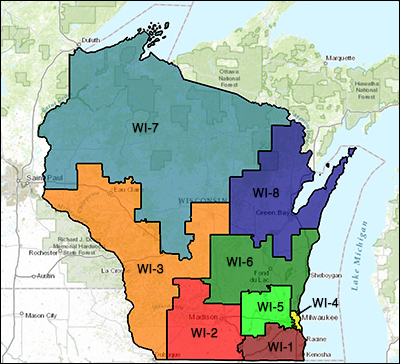
Wisconsin Congressional Districts

By Jim Ellis

April 16, 2020 — The April 7th Badger State primary election results were announced this Monday, and former vice president Joe Biden easily defeated Sen. Bernie Sanders (I-VT), 63-32 percent, but that’s not the real story behind the final statewide totals.

The bigger race was an ostensibly nonpartisan state Supreme Court judicial election between appointed incumbent Daniel Kelly and Dane County Circuit Court judge Jill Karofsky. Though the Republican and Democratic labels did not appear on the ballot, both parties were heavily invested. And, with much money being spent and both sides “all-in”, many believed it to be a precursor to this year’s presidential campaign in a state that could well become the deciding factor nationally.

Wisconsin Republicans needed the seat to maintain their 5-2 majority on the court, and Democrats wanted to narrow the margin to 4-3 in order to position themselves to take the majority in the next election; hence, this contest’s importance.

Controversy surrounded whether to even hold the election. Democratic insiders and activists were lobbying Gov. Tony Evers (D) to petition the legislature to delay the vote because of the Coronavirus situation. Evers delayed taking action, but finally went to the legislature a week before the vote. The Republican legislative leaders turned Evers down, and subsequent court decisions backed the decision to hold the election on schedule, virtually the only state that was moving forward with an in-person voting mode.

The announced results gave Judge Karofsky a big 55-45 percent upset win, and whether or not this is a precursor to the presidential result remains to be seen. Some believe the fact that the Republican leadership was insisting on moving forward with the election – with people believing they wanted the election as scheduled because they felt the quicker vote favored them – resulted in a voter backlash; hence, Karofsky’s large margin in what was projected to be a much closer electoral contest.

Democrats fought hard to postpone the election and increase the mail-in facet – and most believe they wanted such because they perceived it favored them – but clearly won the election even under the voting structure that the Republicans desired.

Continue reading

Will Michigan & Wisconsin Voters Determine 2020 Presidential Election?

By Jim Ellis

April 6, 2020 — Polls were just released in both Michigan and Wisconsin, obviously two critically important states that will weigh heavily in determining the final outcome of the next presidential election. While it’s too early to take any general election poll as a true projection of what may happen in November, particularly in light of the current unique situation, the survey did reveal some interesting points.

Progress Michigan’s Lake Effect newsletter: “The governors’ approval ratings pertaining to the [coronavirus] crisis are better than those of the president.”

Public Policy Polling tested the Michigan electorate for the Progress Michigan progressive left organization (March 31-April 1; 1,01 registered Michigan voters) and Marquette Law School just completed their quarterly survey of Wisconsin voters (March 24-29; 81 registered Wisconsin voters). Both made public their results.

We won’t pay too much attention to the ballot tests because it is so far away from the actual vote and the political situation is obviously going to change during the coming months, but the two pollsters found President Trump and former vice president Joe Biden within the margin of error in each state. In both cases, it was Biden who enjoyed a three-point lead.

Within this prism, it is important to recall the 2016 race in which polling badly underestimated Trump’s strength against Hillary Clinton in these two places. According to the 270 To Win organization, which tracked polling throughout that election year, the final averages going into the final weekend found Trump trailing by six points in Michigan and seven in Wisconsin. He won each state by approximately one percentage point, thus proving a large error factor in virtually all of the late polling.

A post-election analysis in which the Pew Research Center and CNN participated, among other firms and media outlets, concluded that a major reason for the flawed projections were the much larger number of Democrats willing to respond to the polling questions than Republicans. Even understanding this was the case at the time, the pollsters’ weighting formulas and algorithms still badly missed the mark throughout the crucial Great Lakes region.

Continue reading