Category Archives: Senate

Dems Take Mississippi

(Click above to play or watch on YouTube: “Pick another protein“)

By Jim Ellis — Thursday, November 12, 2026

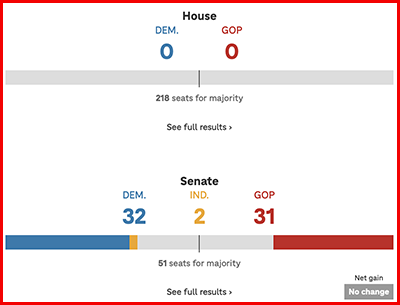
Last night, Lowndes County District Attorney Scott Colom (D) was declared the winner of Mississippi’s US Senate election over Republican Sen. Cindy Hyde-Smith, bringing the Democrats’ total to 55 seats for the 120th Congress. Once Alaska completes its vote count and Ranked Choice Voting tabulations, Democrats could add a 56th seat.

Since election night, when Colom was leading with a tiny 43-vote edge, his margin has steadily expanded. With only a limited number of ballots remaining to be counted, Colom now leads by 4,669 votes, a deficit Hyde-Smith can no longer overcome.

This result, along with the Republican loss in South Carolina, appears to be less a product of the national Democratic wave than of weak Republican campaigns. Colom spent approximately $4.5 million on his Senate bid, compared to roughly $6 million for Hyde-Smith. In today’s political environment, those are relatively modest sums for a US Senate race.

Clearly, Republican spending proved insufficient as political trends in the state moved against the party’s nominee.

Cindy Hyde-Smith was appointed to the Senate in 2018 after Sen. Thad Cochran resigned due to health reasons. She then won a special election to fill the balance of the term later that year, but in unimpressive fashion. She scored just 41.2 percent in the jungle primary, just barely ahead of former US Agriculture Secretary and ex-Mississippi Congressman Mike Espy (D) who posted 40.9 percent support. She would defeat Espy in the runoff election, but again with a lackluster 53.6 – 46.4 percent margin, which is below the Mississippi Republican statewide average.

She returned to the ballot in 2020 seeking a full term and again faced Espy. While Hyde-Smith improved her margin, winning 54%-44 percent, her showing still lagged behind that of Mississippi’s senior Republican Senator, Roger Wicker, who has averaged 59.5 percent of the vote across his three successful re-election campaigns.

Further evidence that the election was a loss for Sen. Hyde-Smith rather than the Republican Party can be found in the state’s four congressional races.

Reps. Trent Kelly (R-Saltillo/Tupelo), Michael Guest (R-Brandon/Jackson), and Mike Ezell (R-Pascagoula) won with 58.3, 57.4, and 61.0 percent of the vote, respectively. When Republican Ron Eller’s total in the 2nd District race against Rep. Bennie Thompson (D-Brandon) is added to the aggregate total, Republican congressional candidates collectively received 492,140 votes compared to Hyde-Smith’s 468,667, a difference of 23,473 votes.

Considering that Hyde-Smith is likely to lose statewide by fewer than 10,000 votes, her substantial underperformance relative to the congressional vote underscores the weakness of her campaign.

The Colom campaign very adroitly turned a Hyde-Smith interview gaffe into a campaign theme that went viral and paved the way for the candidate’s upset victory. In answering a question about the high price of beef, Sen. Hyde-Smith responded that people have other protein choices. The Colom campaign then cut a series of successful ads that referenced her comment about choosing a different protein with the rejoinder that “I’d like to choose a different Senator.” (See video at top)

A similar dynamic unfolded in South Carolina. Sen. Darline Graham was originally appointed to serve in a caretaker capacity before President Trump publicly encouraged her to seek a full term. She ultimately proved to be an unprepared and ineffective candidate, struggling in public appearances and failing to build a strong campaign operation. Fundraising lagged throughout the cycle, and Democrats, sensing an opportunity, poured resources into the race. By Election Day, Dr. Annie Andrews held a 12-to-1 spending advantage over Graham.

As in Mississippi, other Republican candidates outperformed the Senate nominee. The results suggest that the South Carolina outcome was less an anti-Republican vote than an anti-Graham vote. Attorney General Alan Wilson, who was elected Governor in the same election, carried the state with 1,051,334 votes, while the seven Republican House candidates, five of whom won their races, combined for 1,031,274 votes. Sen. Graham, by contrast, received only 952,151 votes.

Major miscues on the Republican side are responsible for the party giving away two Senate seats, and in January they become six-year mistakes.
Uncalled Races Update

By Jim Ellis — Tuesday, November 10, 2026

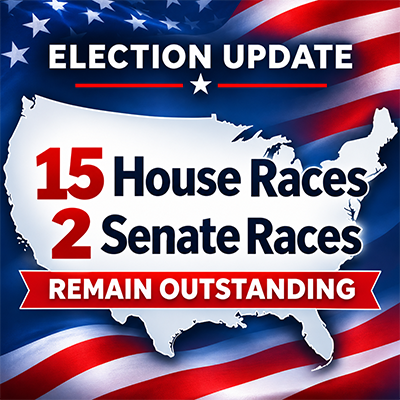
Several more races have been projected as 15 races in the House and two in the Senate remain outstanding:

Alaska

In the Senate race, former Rep. Mary Peltola (D) leads GOP Sen. Dan Sullivan 48.6 – 47.5 percent with approximately 75,000 votes to count according to NBC News. Since both could finish under 50 percent the race would then go into the Ranked Choice Voting rounds once the count is finally finished. Expect this race to be decided closer to Thanksgiving.

In the Governor’s race, the Democratic nominee, former state Rep. Jonathan Kreiss-Tomkins, is at 49.6 percent with a big lead over a large ballot. He has a chance to win the race outright. If not, he will very likely win in the first RCV round.

At-large Rep. Nick Begich (R-Chugiak) currently has 49.2 percent of the vote and is also in position to top 50 percent before going to RCV. He, too, is expected to win the race either in the outright vote or RCV.

Arizona

District 2 Rep. Eli Crane (R-Oro Valley) has been projected the winner with 49.6 percent of the vote. The Arizona delegation is now complete and the Democrats netted a gain of two congressional seats.

California

The state’s elongated vote counting process likely means we won’t see final results until Thanksgiving week. The state has 36 days after the election to count and certify the final results.

Rep. Mike Thompson (D-St. Helena/Napa) continues to trail Democratic challenger Eric Jones. The latest vote count finds the challenger leading Rep. Thompson by 7,940 votes, but an estimated 89,000 ballots remain uncounted.

In District 7, Rep. Doris Matsui (D-Sacramento) leads her Democratic opponent, Sacramento City Councilwoman Mai Vang, with a 21,772-vote spread with approximately 81,000 votes remaining uncounted.

In District 23, Rep. Jay Obernolte (R-Big Bear Lake) leads his Democratic opponent, Clinical Social Worker Tessa Lynn Hodge, with a margin of 3,384 votes and only an estimated 16,000 votes remaining outstanding.

Colorado

The lone outstanding race is in the Centennial State’s 4th District where incumbent Lauren Boebert (R-Silt) continues to trail her Democratic opponent, retired Navy Admiral Eileen Laubacher. At this point, with approximately 8,000 votes remaining, Rep. Boebert trails by 3,352 votes. Though this race has not been officially called, it appears the Democratic challenger will unseat the Congresswoman.

Florida

Rep. Mario Diaz-Balart (R-Miami) has been projected the winner of the 26th District campaign with a vote percentage of 49.9.

The open 7th District, with Republican Ryan Elijah and the 9th District with Rep. Darren Soto (D-Kissimmee) ahead, are also uncalled. Elijah leads by 1,631 votes. Rep. Soto holds a 1,506 vote lead. It is unlikely that either of these races drastically change, meaning Elijah and Rep. Soto should soon be declared the winner.

In Rep. Maria Elvira Salazar’s 27th CD, the latest analysis makes little sense. She leads her Democratic opponent, former news anchor Eliott Rodriguez (D) by 1,090 votes, yet they claim only approximately 700 votes remain outstanding. It is likely they are waiting to see if the race falls within the automatic recount range of .5 percent between the two leading candidates. In the end, Rep. Salazar will win re-election.

Louisiana

The state’s two outstanding congressional elections are headed to Dec. 12 runoff elections because no candidate in Districts 5 and 6 reached 50 percent. In both places, the aggregate Republican vote exceeded the aggregate Democratic numbers in seats that are designed to elect Republicans.

In District 5, Republican candidates received an aggregate 63.1 percent of the cast ballots. Two state Representatives, Patricia Moore (D-Monroe) and Gabe Firment (R-Pollock) advance to the runoff.

In CD-6, the six Republican candidates garnered an aggregate 57.4 percent of the vote. The two advancing candidates are former East Baton Rouge Councilwoman Chauna Banks (D) and state Sen. Blake Miguez (R-New Iberia).

Minnesota

Rep. Brad Finstad (R-New Ulm) trails educator Jake Johnson (D) by 679 votes with an approximate reported 4,100 votes outstanding. It is always better to be leading in these types of situations, and NBC News estimates that Rep. Finstad would need to capture just under 54 percent of the remaining votes, which is likely a tall order.

Mississippi

The Senate race remains uncalled but is virtually over. Sen. Cindy Hyde-Smith, after being behind by just 43 votes on election night, now trails local District Attorney Scott Colom by 2,536 votes. An estimated 26,000 votes remain outstanding, but NBC News estimates that Sen. Hyde-Smith would have to garner almost 54 percent of the outstanding universe.

North Carolina

Two races appear headed to recounts with one Republican incumbent barely leading and another barely trailing.

In NC-3, Rep. Greg Murphy (R-Greenville) leads former state Rep. Raymond Smith by just 233 votes with an approximate 3,100 votes, likely provisional ballots, remaining uncounted. The District 5 result is almost as close. Here, veteran Rep. Virginia Foxx (R-Banner Elk) trails retired newspaper reporter Chuck Hubbard (D) by only 99 votes with approximately 2,600 votes remaining in the process. Both of these contests could go either way once the final votes are counted and then recounted. Expect both of these situations to take weeks to determine.

Washington

In District 5, Rep. Michael Baumgartner (R-Spokane) has been declared the winner with 51.7 percent of the vote.

Democrats Score Huge Victory

Up-to-the-minute interactive 2026 election results: FOX News

By Jim Ellis — Wednesday, November 4, 2026

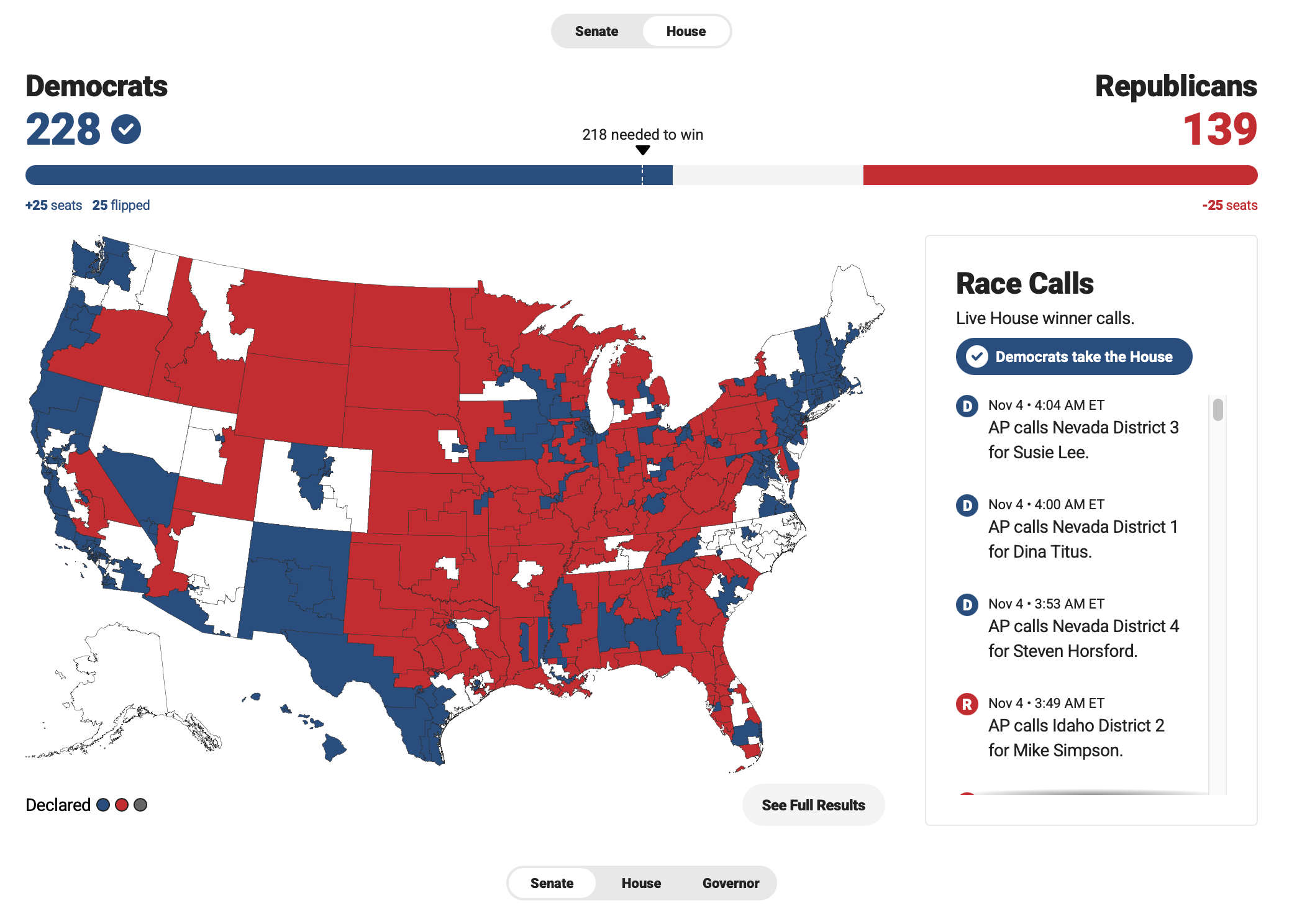
The Democrats scored a wave victory in the 2026 midterm elections last night, capturing both houses of Congress with large margins and likely paralyzing the final two years of the Trump Administration.

The Senate results were the biggest surprise of the evening as all of the battleground states went Democratic. Once again, the Senate races performed in virtually uniform fashion, as they have in every recent wave election.

The party is now assured of 54 seats in the new Senate, and the number could climb to as high as 56 depending upon the outcome of uncalled races in Alaska and Mississippi.

At this point, we see as many as 43 uncalled House races. Democrats are assured of gaining 27 Republicans seats, with at this point, Republicans defeating no Democratic incumbent. Redistricting, which was supposed to give the GOP a chance to mitigate the size of the new majority was a resounding failure as only two of the 13 seats Republicans had hoped to gain in redistricting actually came through. The biggest redistricting failures came in Florida and Texas. The party was expected to gain four in Florida – they gained zero – and five in Texas – they gained one, with one uncalled.

Among the 43 uncalled races, the Democratic candidate leads in 11, and an additional dozen are too close to call. If the Democrats successfully hold their leads in the 11 where they have a clear advantage and at least break even among the remaining toss-up uncalled seats, the majority figure would reach to 258 and could well approach or go beyond 260. Such a large majority will give them the opportunity of holding House control for many successive elections.

Once the results become final, we will be able to judge the actual turnout figures, which will go a long way toward explaining why the electorate fell as it did. We can already see that the polling industry revived itself after going through a difficult series of elections since President Trump was initially elected.

Expect more indepth analysis to be soon forthcoming when races and results become final.

The Point Races

By Jim Ellis — Tuesday, November 3, 2026

Election Day

You can watch Election Day results in a number of locations; NPR is just one of dozens, if not hundreds of spots you can track in real time as election results unfold: NPR Election Results.

Today is Election Day, and there are a number of races we should watch for clues about the developing national trend. Outlined below are key contests that may provide some early answers.

In the Senate, Republicans have a 53-47 majority and are likely to return with a smaller conference if not in the minority. The Democrats need a net gain of four seats to reach the 51 majority threshold. Republicans, as we know, will retain the Senate at 50-50.

The first race to monitor is Michigan, while conceding that the Republican seat in North Carolina will easily go to Democratic former Gov. Roy Cooper. If former Republican Congressman Mike Rogers flips Michigan’s open Senate seat by defeating former Wayne County health director Abdul El-Sayed, Republicans would have a strong chance of preserving their majority.

Democrats can reach 51 seats with a Cooper victory in North Carolina, a hold in Michigan, and wins in three of the following four states: Maine (defeating Sen. Susan Collins), Ohio (defeating Sen. Jon Husted), Texas (capturing the open seat being vacated by Sen. John Cornyn), and Alaska (defeating Sen. Dan Sullivan). If Republicans win any of these contests in addition to Michigan, their majority would likely be secure.

At this point, the Iowa race featuring Rep. Ashley Hinson (R-Marion/Cedar Rapids) and the Nebraska contest involving Sen. Pete Ricketts are both trending Republican. Kansas remains a wild card. Though the polling trajectory resembles both 2014 and 2020, when late surveys showed close races before Republicans ultimately won by 10 and 11 points, respectively, the contest between Sen. Roger Marshall and Democrat Adam Hamilton continues to remain tight.

The final Senate race to watch in the early time zones is Minnesota. The Republican nominee is former national sports media figure Michele Tafoya, who has an outside chance at scoring an upset. As in Michigan, a Tafoya victory would likely ensure continued Republican control of the Senate.

The House appears poised to shift Democratic, but the size of the emerging majority remains uncertain. Among the most important early House races is New York’s 17th District, where two-term Rep. Mike Lawler (R-Pearl River) faces former National Security Council official Cait Conley. Rep. Lawler holds one of three districts that voted for Kamala Harris but sends a Republican to the House. He is a strong campaigner with a proven track record. A Lawler defeat would suggest that Democrats have a realistic opportunity to approach 240 seats in the new House.

The same is true in Pennsylvania’s 1st District. Rep. Brian Fitzpatrick (R-Levittown) also represents a suburban Philadelphia seat that Harris won but sends a Republican to the House. If Bucks County Commissioner Bob Harvie (D) defeats Fitzpatrick, Democrats would be well on their way to a significant national victory.

In Virginia, the districts of Reps. Rob Wittman (R-Montrose) and Jen Kiggans (R-Virginia Beach) represent key Democratic pickup opportunities. Conversely, Republicans need to flip North Carolina’s 1st District, currently held by Rep. Don Davis (D-Snow Hill), after the seat was redrawn in the state’s 2026 redistricting plan. Failure to capture NC-1 would deal a major blow to Republican hopes nationwide.

Florida is crucial to Republican House prospects. The new redistricting map was expected to produce a net gain of four seats through victories over Reps. Darren Soto (D-Kissimmee), Kathy Castor (D-Tampa), and Jared Moskowitz (D-Parkland/Ft. Lauderdale), along with the capture of the newly created open 22nd District, which stretches across the peninsula from Fort Lauderdale to Marco Island. Any result short of a four-seat gain would point toward a large Democratic majority.

Michigan is another key House battleground in the Eastern Time Zone. Republicans are defending three highly competitive districts: Rep. Bill Huizenga’s seat in the southwestern part of the state, Rep. Tom Barrett’s Lansing-area district, and the open 10th CD anchored in Oakland County.

Ohio is also pivotal. Republicans initially expected to gain two seats under the new congressional map but now find themselves fighting to protect much of their existing delegation. Democratic incumbents Marcy Kaptur of Toledo and Greg Landsman of Cincinnati represent GOP targets, and Republicans need to defeat both.

At the same time, they must defend competitive districts held by Reps. Max Miller in suburban Cleveland, Mike Turner in Dayton, and Mike Carey in the Columbus area. Winning all of these races becomes considerably more difficult if Republican gubernatorial nominee Vivek Ramaswamy loses or if Sen. Jon Husted is defeated.

The Texas map became the centerpiece of the national Republican redistricting strategy and was expected to produce a net gain of five congressional seats. Polling and electoral trends, however, suggest that Republicans are unlikely to achieve that objective and instead may finish with a net gain of only two or three seats.

The significant inroads Republicans made in South Texas over the previous two election cycles appear to be eroding, with several districts showing movement back toward the Democrats. As a result, the political tailwinds that once fueled GOP expansion in the region are no longer providing the same level of electoral advantage, blunting the party’s anticipated gains under the new map.

Many additional contests will come into focus as results begin arriving from the Mountain and Pacific time zones. Nevertheless, the races highlighted above should provide some of the earliest and clearest indications regarding the size of a potential Democratic House majority and whether Democrats can also engineer a Senate takeover.

The Michigan Comparison

By Jim Ellis — Thursday, October 29, 2026

Arguably, the Michigan Senate race could determine which party will control the Senate in the next Congress. With Democrats having a chance to obtain the majority by scoring a presumed flip in North Carolina and currently running close or ahead but not secure in Alaska, Maine, Iowa, Ohio, and Texas, a GOP win in Michigan could save the party’s majority.

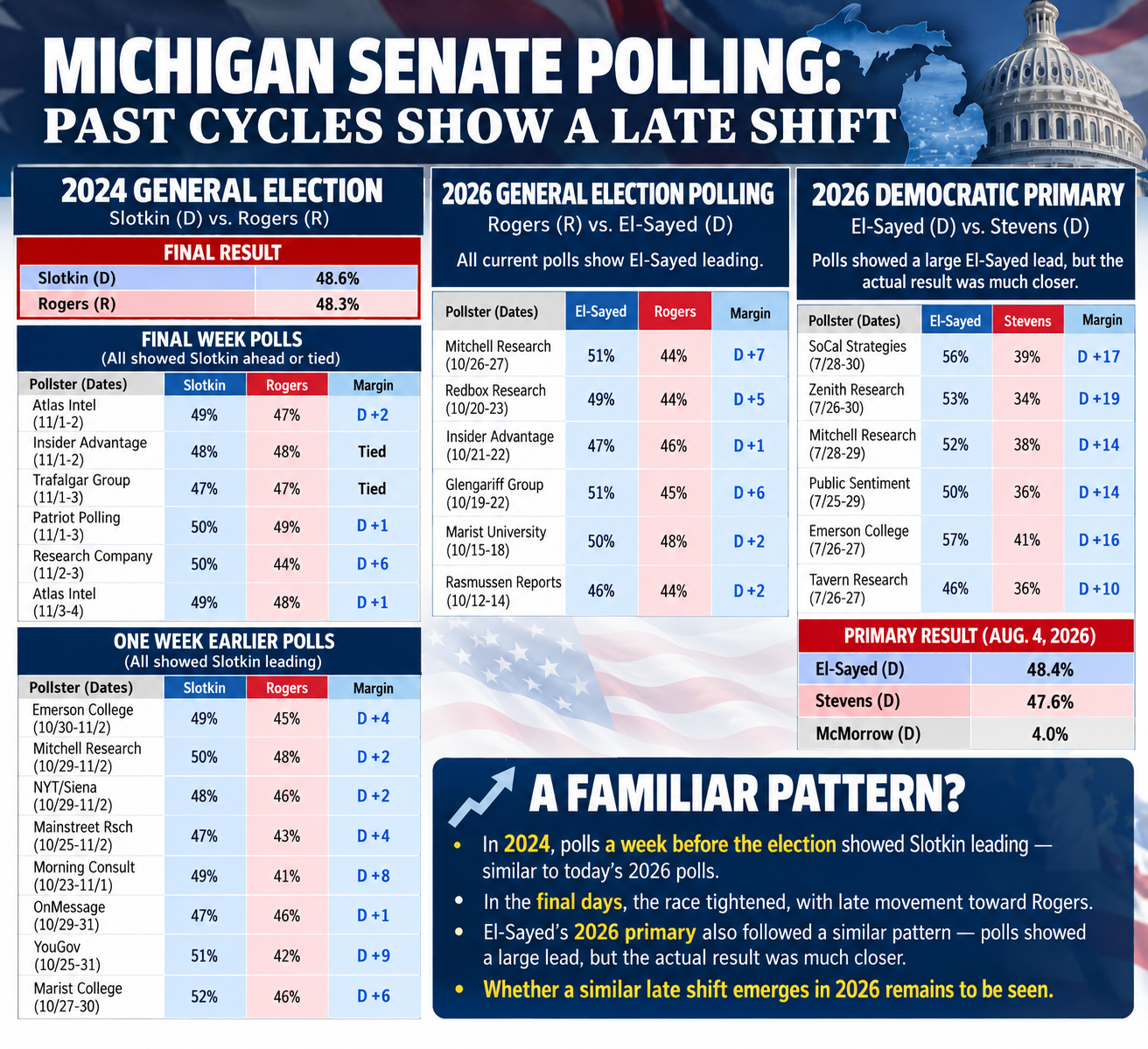
With that background in mind, let us examine recent polling data and compare it with the 2024 Senate race, in which Republican nominee Mike Rogers, again the party’s nominee in 2026, fell just 19,006 votes short out of more than 5.57 million ballots cast. Sen. Elissa Slotkin’s (D) victory margin was a mere three-tenths of one percentage point.

The polling in 2024, however, painted a slightly different picture, and many of the same firms are now surveying the 2026 contest. Below is a comparison of the final pre-election ballot tests and the actual election results. We then examine data from some of those same pollsters in the current race between Rogers and former Wayne County Health Director Abdul El-Sayed.

Click on chart above to see full-size.

In the closing days of the 2024 campaign, six polls from five polling organizations were conducted between Nov. 1 and Election Day, which was on Nov. 5. Their final ballot test results are presented below and, collectively, came quite close to the eventual outcome.

As you can see from the chart below, the actual 2024 numbers show the result of Slotkin (D) edging Rogers (R) 48.6-48.3 percent.

All polls between Nov. 1-4 projected Slotkin to be ahead or tied.

While the polls from a week before the election, commensurate with now in 2026, largely showed a different trend: All of these polls found Slotkin leading. There were two in the Oct. 26-30 time period, from Mitchell Research and the Tarrance Group, that found Rogers holding a two-point edge, but at the time those were regarded as outlier results.

Juxtapose that in the chart above with current polling for the 2026 Rogers/Ed-Sayed contest, all of which find El-Sayed leading.

As you can see, the polling trajectory one week before the 2024 election closely resembles what we are seeing today. In that race, the late movement broke in Rogers’ favor, though not by enough for him to secure victory. Whether a similar pattern emerges in 2026 remains to be seen.

Another important point of comparison is El-Sayed’s performance in the Democratic primary. Recall that he defeated Rep. Haley Stevens (D-Birmingham) by just nine-tenths of a percentage point in the Aug. 4 Democratic primary.

Across six individual polls conducted slightly more than a week before the election, with early voting already underway, El-Sayed held an average lead of 15 percentage points.

Obviously, these numbers represent a major polling miss in an election that tested Abdul El-Sayed’s strength with the electorate. Whether pollsters have corrected the errors evident in the Aug. 4 primary for the general election remains undetermined.

The one constant, however, is that the Michigan Senate race remains one of the most consequential contests in the country and will almost assuredly play a decisive role in determining the next Senate majority.

Senator Governors

By Jim Ellis — Thursday, October 22, 2026

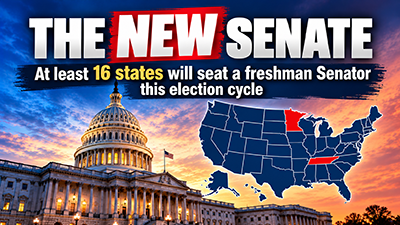
A modern‑day record for open Senate seats is emerging in this election cycle. At least 16 states will seat a freshman Senator in January and that assumes no incumbent loses in November, which is an unlikely prognostication.

The number rises to 18 when including the two Senators, Marsha Blackburn (R‑TN) and Amy Klobuchar (D‑MN), who are favored to win their gubernatorial races. Once they take office in January, two additional Senate vacancies will occur, producing a pair of new Senators through gubernatorial appointment.

Speculation is already underway in both states regarding who the new Governors, or the current Governors should either Senator resign early, might select.

In Tennessee, the most frequently mentioned potential appointees – assuming Sen. Blackburn makes the appointment – are Rep. Tim Burchett (R‑Knoxville), Knox County Mayor Glenn Jacobs, and former CoreCivic CEO Damon Hininger.

Should Sen. Blackburn resign early and Gov. Bill Lee (R) make the appointment, speculation is largely absent. Blackburn has publicly stated she intends to appoint her own successor. Most observers believe she would choose Rep. Burchett, with Mayor Jacobs then running in a special election for the open 2nd District.

In Minnesota, assuming a Gov. Klobuchar appoints her own successor, early speculation centered on retiring Gov. Tim Walz. He quickly removed himself from consideration, however, saying he would “rather eat glass” than serve in the Senate.

Other rumored possibilities include Rep. Angie Craig (D‑Prior Lake), who lost the Senate nomination earlier this year; Secretary of State Steve Simon; Rep. Kelly Morrison (D‑Wayzata); and state Sen. Erin Maye Quade (D‑Apple Valley). They are among several prominent Democrats mentioned as potential appointees.

While Sen. Blackburn remains favored in Tennessee, the gubernatorial race is showing competitive signs. Independent candidate David Hatley, who describes himself as owning “the largest hot tub manufacturing operation on American soil,” has spent $12 million on his Senate campaign.

The most recent available Tennessee gubernatorial poll from TargetSmart (Oct. 9-12; 600 likely voters) showed Blackburn leading with 45 percent, well below the 50 percent threshold, followed by Democrat Jerri Green, a Memphis City Councilmember, at 36 percent, and Hatley at 10 percent. This survey, however, was conducted before most of Hatley’s spending took effect.

The Hatley offensive against Blackburn has instigated action: according to The Down‑Ballot political blog, Blackburn supporters have launched a $4 million independent expenditure attacking Hatley. Even so, Sen. Blackburn remains the likely winner, regardless of her final percentage.

In Minnesota, Sen. Klobuchar’s Republican opponent, state House Speaker Lisa Demuth (R‑Cold Spring), is polling closer than expected in a reliably Democratic state. A SurveyUSA poll for KSTP‑TV (Oct. 8-12; 718 likely voters) shows Klobuchar leading 48-41 percent, a surprisingly narrow margin in a cycle where Republican performance elsewhere has generally lagged previous benchmarks.

In her four US Senate campaigns, Klobuchar has averaged 60 percent of the vote. Therefore, she is running well below her previous support levels but is still expected to win.

The same is true for the rest of the Minnesota statewide ticket. Lt. Gov. Peggy Flanagan, running against former national sportscaster Michele Tafoya (R), is in a tight race and her polling margin continues to shrink. The rest of the Minnesota Democratic races are also closer than we typically see. Whether a more competitive election than expected influences who receives the Senate appointment remains to be seen.

With two additional new Senators arriving from Tennessee and Minnesota shortly after the next congressional session begins, it is likely that at least 20 percent of the new Senate will consist of freshman members, a very high percentage when compared with historical data.

Senate Snapshot

By Jim Ellis — Wednesday, October 21, 2026

Senate

With the Democrats well positioned to capture the House majority, most of the political attention has shifted to the Senate races and whether the Democrats can gain the four Republican seats required to reach a 51-49 majority.

Much has already been written about the GOP-held seats now considered competitive, so with two weeks remaining in the election cycle, this is an appropriate moment to review the key contests.

Alaska

The Last Frontier ordinarily would not be considered a Democratic conversion opportunity, but former Rep. Mary Peltola has a credible chance to unseat GOP Sen. Dan Sullivan.

Alaska’s election system adds complexity: the top four finishers advance from a single primary regardless of political party preference, and if none of the general election finalists reaches 50 percent, the Ranked Choice Voting process begins. Should RCV be triggered, the final outcome might not be known for roughly two weeks after election day.

The race became significantly more competitive after the primary, where Sen. Sullivan finished eight points behind Peltola. For the incumbent, one encouraging sign is primary turnout: only about 29 percent of registered voters participated, leaving substantial room for him to expand his support. Polling has been frequent, and Peltola generally posts small leads within the margin of error, underscoring how tight the contest remains.

Continue reading →

The Switch States

By Jim Ellis — Tuesday, October 20, 2026

As we move closer to Election Day, and with early voting now underway in 27 states, several statewide contests are beginning to gel. Notably, polling in four states suggests voters may be poised to split their tickets between Governor and US Senator, a pattern that has been rare in recent cycles.

In Iowa, the latest individual poll finds respondents leaning toward Republican Ashley Hinson for the Senate and Democratic State Auditor Rob Sand for Governor. In three other states, Georgia, New Hampshire, and Texas, the Republican candidates lead the Governor’s race, while Democrats have the edge in the respective Senate campaigns.

The co/efficient polling firm conducted the Iowa poll (Oct. 15-19; 863 likely Iowa general election voters; live interview) and found GOP Rep. Hinson trending ahead of state Rep. Josh Turek (D-Council Bluffs) by a 48-45 percent count. In the Governor’s race, the same polling sample respondents favor Democrat Sand over Republican businessman Zach Lahn by a reversed 49-45 percent split.

Continue reading →

South Dakota Close

By Jim Ellis — Monday, October 19, 2026

Late last week, a Concord Public Opinion Partners poll drew attention for producing a Montana US Senate result that showed Independent candidate Seth Bodnar, the former University of Montana president, leading Republican former US Attorney Kurt Alme. A new Concord survey now reports a similarly competitive finding in the South Dakota Senate race.

The Montana poll, however, was largely debunked due to a sampling universe that skewed Democratic. In response, the Alme campaign released a counter‑survey from Peak Insights (Oct. 7-12; 500 likely Montana voters; live interview) showing Alme ahead of Bodnar and Democrat Alani Bankhead, 44-29-12 percent. This result aligns with all other polling of the race aside from Concord’s.

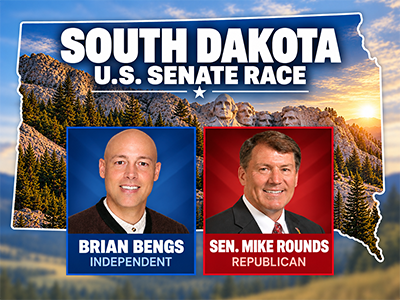
In South Dakota, Concord’s numbers fall within the range of other post‑primary surveys. The new study (conducted for Democrats for Education Reform; Oct. 6-8; 400 likely South Dakota voters; live interview & text) finds Sen. Mike Rounds (R) in a virtual dead heat with Independent Brian Bengs, trailing 42-43 percent.

Within the same sampling universe, Republican Gov. Larry Rhoden leads Democratic former state legislator Dan Ahlers by 10 points, 48-38 percent. Concord also shows Attorney General Marty Jackley running ahead of Democrat Nikki Gronli by just a 44-41 percent spread, also a closer‑than‑expected margin for the open at‑large US House race.

Continue reading →

Montana Shock Poll

By Jim Ellis — Friday, October 16, 2026

Senate

A new poll conducted for Independent Montana Senate candidate Seth Bodnar finds him, for the first time, leading Republican former US Attorney Kurt Alme in the open statewide race. While the survey raises methodological questions, its topline results suggest the campaign’s closing weeks could prove more challenging for Republicans than initially expected.

The Concord Public Opinion Partners poll (Oct. 6-8; 405 likely Montana general election voters; live interview & text), conducted for the Bodnar campaign, shows the Army Green Beret veteran and former University of Montana president running as an Independent, leading Alme, Democratic nominee Alani Bankhead, and Libertarian candidate Kyle Austin by a 37-35-13-1% margin.

Controversy has surrounded this race since filing time. Sen. Steve Daines (R) initially filed for re‑election, but withdrew as the filing window closed. Standing with him at the Secretary of State’s office was Alme, who filed his own candidacy just as the period expired. The maneuver prevented any other Republican from entering the race, effectively rigging the primary for Alme. Unsurprisingly, the move angered GOP leaders and a substantial share of Republican base voters.

According to the Bodnar poll, those feelings persist: Alme’s approval rating stands at a dismal 31:48 favorable/unfavorable, compared to Bodnar’s 41:35. President Trump is also significantly underwater at 41:58 in a state he carried three times by landslide margins. Additionally, the generic congressional ballot favors Republicans by only one point, 37-36 percent.

Continue reading →