Category Archives: TEXAS

The Redistricting Wars Begin

By Jim Ellis — Monday, July 21, 2025

Redistricting

Texas Gov. Greg Abbott’s (R) call to add congressional redistricting to the special legislative session has already elicited a response from a Democratic adversary.

California Gov. Gavin Newsom (D), has attacked Gov. Abbott’s redistricting move, calling it a partisan power grab, and says he will retaliate with his own legislature redrawing the Golden State congressional map to neutralize any seat gain that the new Republican map yields.

Several points make Newsom’s planned response unrealistic.

First, the California legislature has no redistricting power. In 2008, voters adopted a constitutional ballot proposition that created the California Citizens Redistricting Commission, which took the redistricting pen away from the legislature and awarded it to an appointed panel of individuals who are not in elected office. Therefore, Newsom and the legislators would first have to find a way to disband the Commission in order to proceed with a new map.

According to an article from The Down Ballot political blog that quoted Gov. Newsom from an interview he conducted with the Pod Save America hosts, the California chief executive indicated that he could call his own special session to place a measure on a special election ballot to void the Commission.

Gov. Newsom said on the podcast that he thinks “… we would win that. I think people understand what’s at stake in California. I think we come out in record numbers. I think it would be [an] extraordinary success,” the Governor concluded.

His prediction may or may not be accurate, and Newsom acknowledges that the calendar would be a major obstacle for such a movement because the commission invalidation process would require so much time.

The second option would be to claim, as Newsom said, that the Commission lacks mid-decade redistricting authority. The Governor argued that the ballot proposition awarded the Commission redistricting power after the Census was released and the lines would hold for the full decade. He said answering whether the Commission even has redistricting authority beyond once every 10 years and immediately after a Census should be pursued.

The third obstacle would be simply drawing a map that would give the Democrats five more seats in the California delegation. Gov. Newsom quoted President Trump as saying a new Texas Republican map could provide US House Speaker House Johnson with five additional Republican seats. Therefore, Newsom said California could neutralize such an increase.

The California delegation has 52 members and only nine are Republican. Can the Republicans be reduced to just four seats without endangering some Democratic incumbents? Seems the difficulty factor to avoid such an outcome is high when considering that President Trump received 38 percent of the statewide vote in 2024 and even Gov. Newsom’s own 2022 opponent, then-state Sen. Brian Dahle (R), garnered 41 percent.

Additionally, since the Census was released, Democrats have lost almost a full percentage point in voter registration affiliation and the Republicans have gained a point, not to mention that the overall state population figure is reduced.

According to the latest published voter registration figures (February 2025), Democrats claim 45.27 percent of the affiliations, Republicans 25.22 percent, and the non-affiliated, or Declined to State, option records 25.34 percent. Minor parties absorb the remaining 4.17 percent. Therefore, considering these numbers in trying to reduce the Republicans to just 7.7 percent of the seats (4 of 52), would prove to be quite a mathematical feat.

Additionally, using the Texas Democrats’ argument that the Lone Star State map is already gerrymandered because Republicans control 66 percent of the congressional seats but their presidential nominee only received 56 percent of the vote pales in comparison to the ratios in the current California map. There, Democrats control 83 percent of the districts even though the Democratic presidential candidate, and California winner, garnered only 58 percent.

The Texas map is explained in that President Trump carried all 25 Republican districts and two of the Democratic seats and ran almost four points ahead of the statewide Republican partisan lean calculation. In California, Kamala Harris carried no Republican congressional district and ran five points below the Democratic partisan lean figure.

The Texas legislature convenes today, and a new map will be released soon after since the special session is only 30 days long. At that point, further analysis can be conducted, and Gov. Newsom’s countermove strategy may begin.


Redistricting Action Continues:
Texas & Wisconsin

By Jim Ellis — Tuesday, July 15, 2025

Redistricting

A look at how things might play out in two key states — Texas & Wisconsin — in the redistricting tug of wars

Texas Gov. Greg Abbott (R), as expected, has added the congressional redistricting issue to the upcoming special session. The legislature is scheduled to reconvene on July 21. The session can last up to 30 days to handle the issues that the Governor places on the legislative call. Under Texas law, the Governor has the power to call an unlimited number of 30-day special sessions after the legislature adjourns for the biennial.

In Wisconsin, though the state Supreme Court justices recently said they would not hear the congressional redistricting case before them, a new lawsuit has been filed.

A group called the Wisconsin Business Leaders for Democracy filed the lawsuit claiming the current map is an “anti-competitive gerrymander,” distinguishing their claim from the partisan gerrymander lawsuit the Supreme Court refused to hear according to an Associated Press news story. An anti-competitive gerrymander refers to all incumbents rather than those of one particular party.

The Wisconsin suit was filed in before a Dane County circuit court where the plaintiffs will likely get a favorable ruling. The process, however, will be lengthy as appeals to any lower court ruling will occur before again reaching the state Supreme Court. Therefore, it may be a longshot to see the Wisconsin map redrawn before the 2026 midterm elections.

The Texas situation is much different, and Republican leaders may be able to produce a new map that increases the current plan’s 25R-13D split.

South Texas appears to attract the most attention in the special session. Using the Dave’s Redistricting App statisticians’ partisan lean calculations (methodology employed to develop the partisan lean figures can be found on the following “About Data” link from the DRA website: About Data – Dave’s Redistricting App), we generally see the Republicans overperforming in the region.

Under the current Texas plan, the DRA partisan lean calculation correctly projected which party would hold the particular congressional district in 37 of the 38 CDs. The only officeholder to win a congressional seat where the opposing party held the partisan lean advantage occurred in South Texas District 15 where two-term GOP Rep. Monica de la Cruz (R-McAllen) held her seat with a 57-43 percent majority. The DRA 15th District partisan calculation gives the Democrats a 4.1 percentage point advantage.

President Trump carried 27 of the state’s 38 CDs, including three seats where the partisan lean calculation favored the Democrats. In addition to District 15, Trump also topped Kamala Harris in District 28 (Rep. Henry Cuellar; D-Laredo) and 34 (Rep. Vicente Gonzalez; D-McAllen). All of these CDs are located in South Texas.

Thus, the Trump performance largely destroys part of the Democrats’ racial gerrymander argument because he carried these three districts that have overwhelming minority populations.

In District 34, the Voting age minority population figure is 90.5 percent and 88.5 percent Hispanic. Trump won the district with a 51.8 – 47.4 percent majority. In District 15, the minority Voting Age Population (VAP) figure is 82.4 percent with the Hispanic VAP at 78.9 percent. President Trump carried this district with a strong 58.5 – 40.7 percent majority. District 28 has a minority VAP of 80.7 percent with a Hispanic VAP of 72.9 percent. The Trump winning margin here is 53.2 – 45.9 percent.

There are 19 Texas districts where White voters are the majority of the Voting Age Population. Trump won 18 of the 19. The one exception that supported Kamala Harris was Rep. Lloyd Doggett’s (D-Austin) 37th CD that stretches from Austin to San Antonio down the I-35 corridor.

Eighteen of the Texas congressional districts feature majority minority populations. Of those, Trump won nine of the 18 seats and exceeded the Republican benchmark in all 18. Trump also exceeded the DRA partisan lean GOP benchmark in the nine majority minority seats that Harris claimed. These statistics, to a significant degree, at least partially spoil the Democrats’ Voting Rights Act racial gerrymandering arguments.

Regarding the partisan lean figures from all of the Lone Star State’s 38 congressional districts, Trump exceeded the Republican benchmark in 32 of the seats. In the 14 districts where Democrats hold the partisan lean advantage, Trump exceeded the Republican benchmark in all.

In six districts, the Trump performance failed to reach the Republican benchmark, even though he carried each of the seats. Those where the President finished below the GOP partisan mean were TX-2 (Rep. Dan Crenshaw-R), TX-3 (Rep. Keith Self-R), TX-22 (Rep. Troy Nehls-R), TX-24 (Rep. Beth Van Duyne-R), TX-26 (Rep. Brandon Gill-R), and TX-38 (Rep. Wesley Hunt-R).

In Wisconsin’s eight congressional districts, we see similar patterns relating to President Trump’s performance in reference to the DRA partisan lean figures.

There, President Trump carried six of the state’s eight districts on his way to a 49.6 – 48.7 percent statewide victory. His vote total exceeded the DRA partisan lean in six of the eight districts. The only seats where he underperformed in relation to the Republican benchmark were in District 5 (Rep. Scott Fitzgerald-R), which ironically is the most Republican district in the state, and District 4 (Rep. Gwen Moore-D), Wisconsin’s most Democratic seat.

Though redistricting is designed to be done once per decade, changes in laws and procedures along with unending legal challenges to the district plans have made map drawing a perennial issue.

An Early Redistricting Cycle

By Jim Ellis — Thursday, June 26, 2025

Redistricting

Putting together the redistricting puzzle

It appears we will see at least three states soon begin a mid-decade redistricting effort for various reasons.

It has been long assumed that the Wisconsin state Supreme Court justices would re-draw the congressional boundaries before the 2026 election. After the Democrats secured their high court majority before the 2024 election, the members reconfigured the state Assembly and Senate as a way to “rectify the Republican majority’s partisan gerrymander.” Surprisingly, the court did not follow suit to simultaneously change the congressional district map. It is probable they will take such action soon.

It is believed that a majority of the court justices, as at least two publicly stated when campaigning for their position, see the current 6R-2D congressional map as constituting a partisan gerrymander. It is expected that the justices will assign a special master to draw districts that would bring the partisan ratio to 4-4, which could mean Reps. Bryan Steil (R-Janesville) and Derrick Van Orden (R-Prairie du Chien/La Crosse) might lose their seats while threatening the very tight US House Republican majority.

The state of Ohio is also preparing for a re-draw, but not because of a partisan gerrymandering. Under Ohio election law, plans must pass both houses of the legislature with three-fifths of the voting members. Because the 2021 congressional plan was adopted with only majority support, the map would only be in effect for two succeeding elections, 2022 and 2024. Therefore, in order to comply with state law, the Ohio redistricting commission, comprised of elected officials, and the legislature must again embark upon the redistricting process.

Republicans hold a 10-5 advantage in the congressional delegation with two of the Democratic seats, District 9 (Rep. Marcy Kaptur; 48.3 – 47.6 percent 2024 election result) and District 13 (Rep. Emilia Sykes; 51.1 – 48.9 percent), being very tight from a partisan perspective. The weakest Republican showing in the last election came from Rep. Max Miller (R-Rocky River; 51.1 – 36.1 percent). Excluding Rep. Miller’s 51 percent tally, the remaining nine Republicans averaged 65.2 percent of the vote.

With Republicans generally in charge of the redistricting process expect moves to make the Kaptur and Sykes’ districts more Republican.

Texas Gov. Greg Abbott (R) has called a special legislative session to begin July 21. Because Texas only has a short 140-day legislative session every other year, it has been commonplace after the last few sessions to bring the members back into an extra session to complete unfinished business.

Under Texas law, the Governor has sole authority to call a special session, but the legislative period can only consume 30 days. It is possible for the Governor to call additional sessions if more time is needed. Also importantly, it is only the Governor who sets the agenda for the legislative session. It is widely believed that Gov. Abbott will add congressional redistricting to this particular legislative special session.

Each of the three states has a unique reason for conducting a mid-decade redistricting session. In Texas’ case, it is because excessive growth has made several districts severely overpopulated.

Using the US Census Bureau’s mid-decade population estimates, Texas has grown in population by a 7.2 percent rate since the 2020 census was concluded. During this same time period, the national growth rate is 2.6 percent. The Texas number translates into over 1.2 million more people living in the state since the last Census. Should this trend continue, the Texas population will swell by over 4 million more people by 2030 when compared to 2020.

Therefore, the growth numbers account for the early estimated national reapportionment calculations that suggest Texas could gain an additional four congressional seats for the next decade. Hence, the Governor and legislative leaders will again redistrict to more equitably distribute the state’s major raw number growth figure throughout its current 38 congressional districts.

The Texas congressional delegation stands at 25R-13D; therefore, it would not be surprising to see the GOP dominated legislature attempt to expand the Republican position within the current congressional delegation through the redistricting session.

New York City Mayoral Results;
Major Texas Action

By Jim Ellis — Wednesday, June 25, 2025

New York City

Zohran Mamdani posters

Campaign posters for Zohran Mamdani pasted on a wall in New York City. / Photo by EdenPictures

After leading in polling for most of the race until falling behind just days before the election, former Gov. Andrew Cuomo conceded yesterday’s Democratic mayoral primary to state Assemblyman Zohran Mamdani even though the Ranked Choice Voting rounds have not yet begun.

Still, with more than a 90,000-vote lead with well over 90 percent of the precincts reporting, and a joint campaign from opponents to dissuade voters from ranking Cuomo in the later rounds, it is clear that the Assemblyman, who ran as a Democratic Socialist, will win the party nomination.

Cuomo did not, however, rule out advancing into the general election potentially as an Independent or the nominee of a minor party. Incumbent Mayor Eric Adams is already in the general election running as an Independent. With New York City Democrats holding a 65-24 percent registration advantage over Independents and minor party registrants – Republicans are only at 11 percent – it is clear that Mamdani will be very difficult to overtake in the November election.

Assemblyman Mamdani pledged to make bus fares free, community college tuition-free, provide child care for children five years of age and under, freeze rents on municipal housing, and have the city operate grocery stores to drive down prices, among other things. His platform appealed to the far left and to young people who would directly benefit from his proposals; most, however, don’t believe implementing all of these proposals will be fiscally or practically possible.

Assemblyman Mamdani’s biggest negative for the general election, in a city with more than 1 million Jewish residents, is his refusal to condemn the extreme anti-Israel demands of protestors and pro-Palestine activists; he went so far as to “appear to defend the slogan globalize the intifada.”

It remains to be seen how active the opposition general election campaigns will be, or if a coalition candidate will emerge, but last night was a clear victory for Mamdani who is certainly the early favorite to win the general election.

Texas

In the past few days, the state of Texas has come roaring to the political news forefront. Perhaps the most significant story is Gov. Greg Abbott (R) calling a state legislative special session that will likely lead to a re-drawing of the Texas congressional map. While the Governor has not yet added redistricting to the special session agenda, reports suggest he will do so imminently.

Because the state has grown by more that 2.1 million people since the 2020 census was released, translating into a 7.3 percent growth rate, the mid-decade estimates suggest that the state’s current 38 districts are already significantly imbalanced from an equivalent population perspective. To put the Texas growth figure into context, the national rate of population increase during the same period is 2.6 percent.

Democrats now have a Lone Star State US Senate candidate. Retired astronaut Terry Virts announced his candidacy this week with attacks directed more toward GOP challenger and Attorney General Ken Paxton rather than incumbent Sen. John Cornyn (R). For his part, Sen. Cornyn who has been trailing Paxton in every early Republican primary poll, for the first time indicated he might step aside if he could be assured that another Republican contender could deny Paxton the nomination.

In addition to Virts, former Congressmen Colin Allred, the 2024 Democratic Senate nominee, Beto O’Rourke, the party’s 2018 Senate and 2022 gubernatorial nominee, and state Sen. Nathan Johnson (D-Dallas) are also confirming having interest in entering the Senate race.

In the South Texas 28th Congressional District that veteran Rep. Henry Cuellar (D-Laredo) represents, a budding Republican primary is also developing.

Webb County Judge (Executive) Tano Tijerina (R) announced that he is forming a congressional exploratory committee to assess his chances of winning both the Republican primary and a general election against veteran Rep. Cuellar.

Webb County, which houses the city of Laredo, is the largest population entity in the 28th CD just slightly ahead of the Bexar County (San Antonio) portion. Already in the Republican primary is former Congresswoman Mayra Flores who is moving into this district from the 34th CD (Brownsville) where she was elected in a special election but defeated in two subsequent campaigns after more Democratic boundaries were enacted in the 2021 redistricting plan.

Clearly, the 28th will feature both a competitive Republican primary on March 3 and a hotly contested general election. In November, Rep. Cuellar, despite being under federal indictment, defeated retired Navy officer Jay Furman (R) 53-47 percent, while President Trump was carrying the CD over Kamala Harris with a 53-46 percent margin. It remains to be seen how this district will be adjusted in the coming redistricting effort.

To the west of the Cuellar district, wealthy conservative Texas rancher Susan Storey Rubio announced late last week that she will challenge three-term Rep. Tony Gonzales (R-San Antonio) in the sprawling 23rd Congressional District that stretches from San Antonio all the way to El Paso. Considering Rubio’s ability to self-fund and already casting Rep. Gonzales as a “spineless moderate” suggests that this may be a March primary challenge that could draw significant political attention.

Redistricting Update – Part II

By Jim Ellis — Wednesday, Oct. 4, 2023

House

A look at how things might play out in key states in the redistricting tug of wars

Five States Affected: Democrats Have Upper Hand — Today we conclude our two-part series on the current status of Round II redistricting. We now examine the affected states from North Carolina through Wisconsin.

• North Carolina: In what looks to be a strong new redistricting run for the Democrats in most of the other states, the North Carolina situation will mitigate some of the national Republican losses. North Carolina redistricting had been a virtual omnipresent issue throughout the previous decade, since we saw a new congressional map created in almost every election cycle.

The problem was largely politics. The state legislature alone controls redistricting (the North Carolina governor has no veto power over redistricting legislation), and the majority consistently held a different view of how districts should be drawn than did the Democratic state Supreme Court.

In the 2022 election, Republicans gained two seats on the seven-member judicial panel, thus turning a 4-3 deficit into a 5-2 majority. Now, seeing the legislature and judiciary largely on the same page as it relates to redistricting, it is very likely that the map legislators will draw in the next week or so will obtain the needed judicial approval. If so, such will be the final congressional redistricting map until the 2030 census.

It also appears that the legislature will return to the basic model that the Democratic Supreme Court failed to approve. Therefore, we can expect the current 7R-7D delegation map to probably end with 10 districts favoring Republicans and four trending Democratic.

Thus, Reps. Kathy Manning (D-Greensboro), Wiley Nickel (D-Cary), and Jeff Jackson (D-Charlotte) each could find themselves without a winnable district. Gaining three Republican seats in North Carolina would go a long way toward keeping the GOP in position to hold their slim US House majority.

• South Carolina: Soon after the first of this year, a federal three-judge panel declared the state’s Charleston anchored 1st Congressional District (Rep. Nancy Mace-R) to be an illegal racial gerrymander. This means the map drawers will likely add to the 1st African Americans from Rep. Jim Clyburn’s (D-Columbia) adjacent 6th District. This would make Rep. Mace more vulnerable to a Democratic candidate.

Nothing, however, has happened since the ruling, and it is unclear when the legislature will address the issue. Some movement is expected before the next election, but chances are strong that the legal challenges are not over.

Therefore, the Republicans may be able to delay long enough to push the final judicial decision, after the inevitable appeals are filed against whatever new map version is developed, until after the 2024 general election.

• Tennessee: A lawsuit claiming the new central Tennessee 5th Congressional District (Rep. Andy Ogles-R) is a partisan gerrymander is filed, but no judicial action has yet occurred. Even if the lower court rules in the plaintiffs’ favor, an appeal to the state Supreme Court will likely require more time than remains in the 2024 election cycle. Therefore, any change in the Tennessee map most likely will not happen until the 2026 election cycle.

• Texas: As in Tennessee, a lawsuit challenging the Texas map as a partisan gerrymander has been filed without seeing any judicial action. In this situation, regardless of how a lower court may rule, the Texas state Supreme Court would almost assuredly become involved. Therefore, it is probable that we will not see any substantive action changing the Texas congressional map in the 2024 election cycle.

• Wisconsin: The 6R-2D congressional map became a key point in the campaign to elect a new state Supreme Court Justice. Democrat Janet Protasiewicz won a seat on the high court, and her presence now gives her party a majority. She campaigned on what she sees as a Republican gerrymandered congressional map. The GOP filed a motion saying that she should be recused from hearing the 2023 redistricting because her stated campaign positions against the map demonstrates a preconceived bias. Predictably, the Supreme Court rejected the motion.

If the Democrats can get a map to the state Supreme Court, the result will almost assuredly be adverse for Republicans. The two most affected members will be those representing districts in the southern part of the state, Reps. Bryan Steil (R-Janesville) and Derrick Van Orden (R-Prairie du Chien/La Crosse).

One Democrat who may not be in favor of drawing a new map, however, is Sen. Tammy Baldwin. Currently, she is not being seriously challenged for re-election, but if a new map forces either Steil or Van Orden out of their districts, at least one would likely jump into the Senate race.

Chances are fair to good that the Democrats can force a new map to be drawn. The state has a late primary – August 13, 2024 – so time remains for a new redistricting plan to be enacted. If so, then count on seeing either Rep. Steil or Van Orden, or both, being displaced. This will likely mean one of the two enters the Senate race to challenge Baldwin. Though the GOP would sustain a US House loss, redistricting could ironically put the Wisconsin US Senate seat into play.

A Changing South Texas

By Jim Ellis — Monday, March 20, 2023

States

Demographics: A Shifting South Texas Electorate — Typically, not much used to happen politically in the Texas’ Rio Grande Valley congressional districts that touch the US-Mexico border, but such is not the case anymore.

Republican freshman Rep. Monica de la Cruz (R-McAllen) converted what became an open 15th District, which stretches from the San Antonio area all the way to the border.

We began seeing the political waves shifting in the 2020 presidential election when then-President Trump ran well ahead of a typical Republican national nominee in a region that was historically solid Democratic. In the five congressional districts that touch the Texas-Mexico border, President Biden was able to break 52 percent in only one of the seats, and that one is in the El Paso-anchored 16th District.

The trend carried over into the 2022 election where almost all of the state’s political action was centered in the border districts, and it’s not just because the cross points are being challenged and overrun with foreigners illegally coming into the United States. Largely due to the Biden Administration’s energy policies and the Democrats’ “Green New Deal” that is causing the area to lose energy-related jobs, Republicans are making political gains. In what were once highly safe Democratic CDs, we now see heightened political competition.

The region is changing to such a degree that now even one of the area’s Republican congressmen, Rep. Tony Gonzales (R-San Antonio) — in the district that stretches from San Antonio all the way to El Paso and contains more of the border territory than any district in the country — is facing a new primary challenge from his political right. This seat has been competitive for years in the general election, but now is settling itself as the South Texas region’s most reliable Republican seat.

Republican freshman Rep. Monica de la Cruz (R-McAllen — above), who converted what became an open 15th District that stretches from the San Antonio area all the way to the border in and around the McAllen area, looks to be in solid position for re-election next year.

Redistricting is a factor in the results, and if the GOP map drawers had known what would happen in a special election in the Brownsville-anchored 34th District early in 2022, they would likely have crafted different boundaries.

Mayra Flores

As a result, Republican Mayra Flores, who made national news in 2022 when she scored an upset special election win in the 34th, ultimately fell 51-43 percent to fellow Rep. Vicente Gonzalez (D-McAllen) in the general election. Rep. Gonzalez, seeing the trends in his 15th CD, decided to run for re-election in the more Democratic 34th after then-Rep. Filemon Vela resigned the seat to accept a position in the private sector.

Continue reading

Rep. Vela to Resign; Another Special?

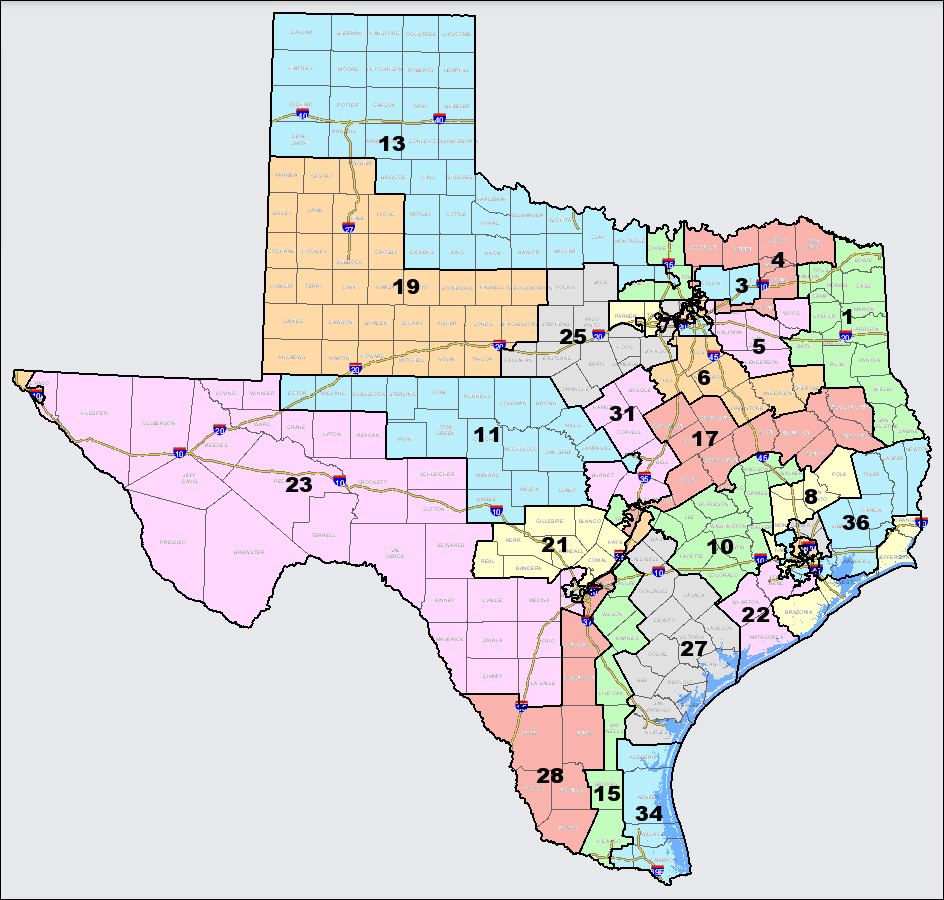
Texas Congressional Redistricting Map (click here or on map to see larger, interactive version)

By Jim Ellis

March 28, 2022 — If the upcoming Alaska special election isn’t complex enough, with the top-four jungle primary feature complete with Ranked Choice Voting that will be used to replace the late at-large Rep. Don Young (R-Ft. Yukon), the developing situation in Texas may be even more confusing.

A year ago March, five-term South Texas Rep. Filemon Vela (D-Brownsville) announced that he would not seek re-election in 2022, becoming one of the first sitting incumbents to enter into lame duck status. Late last week Vela made public his intention to resign in the “next few weeks” in order to accept a position with the Akin Gump law firm.

Texas election law states that a vacancy in office must be filled at the next regular election, or earlier if the governor rules that an emergency exists. In a similar situation before the regular 2018 election, Gov. Greg Abbott (R) called an emergency special election to immediately replace resigned GOP Rep. Blake Farenthold. Current Rep. Michael Cloud (R-Victoria) won his initial election as a result.

In the current political climate, with the country facing record inflation, sky-high energy prices, a border crisis, oil and gas production limitations as a matter of policy, and a hostile invasion in eastern Europe not seen since the days of Adolph Hitler in the pre-World War II period, the governor could easily claim that enough issues need addressing by a full Texas delegation. Therefore, he could justify calling an immediate special election.

If so, the situation becomes interesting. The winner of Rep. Vela’s 34th District open Democratic primary on March 1 was sitting 15th District Congressman Vicente Gonzalez (D-McAllen). He is seeking re-election in the 34th with Rep. Vela’s endorsement instead of in his original district that is trending more Republican. Therefore, if a special election is held prior to the regular election, Rep. Gonzalez would have to resign his 15th CD seat upon winning the subsequent election, thus creating another short-term vacancy.

Continue reading