Category Archives: Polling

Graham Below 50%; NYC Mayoral Update

Sen. Lindsey Graham

Sen. Lindsey Graham

A new poll shows South Carolina Sen. Lindsey Graham (R) dropping below majority support in his battle for renomination in next year’s Republican senatorial primary. Graham, running for a third six-year term, is opposed by three Republicans, only one of whom has been elected to any office. The poll, however, possesses a significant methodological flaw, which could cast doubt upon the results.

The survey, from Landmark Communications and Rosetta Stone Communications (Aug. 25; 500 South Carolina Republican voters; released Sept. 5) posts Sen. Graham to a 42-13-10-7 percent lead over state Sen. Lee Bright, businesswoman Nancy Mace – the first female graduate from The Citadel – and businessman and former 3rd Congressional District candidate Richard Cash, respectively.

While Graham clearly has a large cumulative lead over his opponents, this study projects him far away from reaching the 50 percent mark necessary for clinching the party nomination without a run-off election.

Under South Carolina law, such run-off elections are generally held only two weeks after the primary vote. Considering that the 2010 federal MOVE Act requires a 45-day period for military and overseas voters to receive and return their ballots, it is conceivable that a court could force the state to schedule a longer time between elections, just as judges in at least New York, Texas, and Georgia have done. Should the run-off be rescheduled to create a longer election cycle, the conventional wisdom is such a change may help a potential Graham head-to-head challenger because the individual will have some time to raise the  Continue reading >

New Yorkers Vote Today

Mayor

The long-awaited New York City mayor’s race features its primary election today, and three new polls all arrive at similar findings. According to Marist College/New York Times (Sept. 3-6; 936 registered NYC Democrats), Public Policy Polling (Sept. 7-8; 683 likely NYC Democrat voters), and Quinnipiac University (Sept. 6-8; 782 likely NYC Democrat voters), NYC Public Advocate Bill de Blasio will place first in tonight’s vote, but will he obtain enough votes to avoid an Oct. 1 run-off election?

Marist scores the candidates 36-20-20 percent in de Blasio’s favor, followed by former NYC Comptroller Bill Thompson and City Council President Christine Quinn. PPP shows a similar 39-19-13 percent spread, with the candidates in the same order. Finally, the Q-Poll projects a 39-25-18 percent finish for the trio.

To avoid a post-primary run-off a candidate must receive at least 40 percent of the vote, so it is obvious that de Blasio is teetering right around the minimum figure. Should he fall into a run-off, he is likely to face Thompson, who has more upward momentum than Council President Quinn. Once the leader of the race, Quinn’s support level has been steadily digressing for the past several weeks. Disgraced former US Rep. Anthony Weiner (D-NY-9) has dropped to also-ran status, registering only single-digits in all polling.

At least right now, de Blasio appears to be a heavy favorite if he is forced to a secondary election. Against Thompson, Marist finds the public advocate leading with a 50-38 percent advantage. If Quinn sneaks into the run-off, de Blasio would destroy her 56-34 percent.

PPP gives de Blasio a larger 53-33 percent advantage over Thompson and a massive 67-21 percent spread against Quinn.

Quinnipiac did not test a potential run-off scenario.

Whether it happens tonight or on Oct. 1, current polling points to de Blasio as the eventual Democrat nominee.

Though the pollsters have paid little attention to the Republican side, internal research sources suggest that former New York Metropolitan Authority chairman Joe Lhota is favored to defeat outright supermarket magnate John Catsamitidis and Doe Fund founder George McDonald. Though the Democrats have not held this  Continue reading >

Louisiana House Vacancy

Two days ago, Rep. Rodney Alexander (R-LA-5) surprisingly announced that he would retire from Congress. Yesterday we find he means to exit right away, leaving mid-term in order to accept a position in Gov. Bobby Jindal’s (R) administration as the state’s Veterans’ Affairs Director.

Jindal (R) has already taken action and defined the 5th District special election calendar. As you most likely remember, Louisiana employs the jungle primary system, which means all candidates appear on the same primary ballot regardless of political party affiliation. If a candidate receives an outright majority of the vote, said individual is elected. If no candidate secures at least 50 percent plus one vote, then the top two finishers advance to a final run-off election.

In this instance, Gov. Jindal has chosen Oct. 19 for the first election, with the run-off to occur on Nov. 16. The candidate filing deadline is a quick Aug. 21, therefore giving prospective candidates little time to decide whether they will make the race.

Already, two state legislators have announced their special election candidacies. Republican state Sen. Neil Riser and Democratic state Rep. Marcus Hunter will both soon form campaign committees. Alexandria Mayor Jacques Roy admits that he is considering running, saying that he believes his “centrist Democrat” philosophy is in line with the majority of the 5th District’s constituency.

The 5th CD consumes all of northeastern Louisiana and then takes the upper half of the state’s eastern tail. The Alexandria and Monroe areas are the largest population centers, but each metropolitan region fails to top 65,000 residents.

Mitt Romney defeated President Obama here 61-38 percent in 2012. John McCain carried the seat 62-37 percent over Mr. Obama in 2008. Republicans are the early favorites to hold the district.

2013 Polling Notes:

Two new polls were released covering northeastern 2013 political action.

New Jersey

In the Garden State, Quinnipiac University (Aug. 1-5; 2,042 registered New Jersey voters) tested the upcoming governor’s race where incumbent Chris Christie (R) appears to be steaming toward re-election.
 Continue reading >

NJ Senate Race: Already Over

Newark Mayor Cory Booker

Newark Mayor Cory Booker

The New Jersey special primary election to replace the late Sen. Frank Lautenberg (D) is scheduled for next Tuesday (Aug. 13), but according to Quinnipiac University’s final poll before the vote, the race is virtually over.

When Lautenberg died in early June and Gov. Chris Christie (R) scheduled the special election to choose a replacement, the early polling showed Newark Mayor Cory Booker with numbers approaching or breaking 50 percent of the Democratic vote with the other candidates, representatives Frank Pallone (D-NJ-6), Rush Holt (D-NJ-12), and state House Speaker Sheila Oliver, barely breaking past 10 percent or registering only in single digits.

In the just-released Q-Poll (Aug. 1-5; 2,042 registered New Jersey voters; 388 likely Democratic primary voters) the results have barely changed. According to the data, Booker commands support from 54 percent of the polling sample versus just 17 percent for Rep. Pallone, 15 percent for Rep. Holt, and only 5 percent for Speaker Oliver. With less than a week to go, it’s hard to conceive of any scenario that does not result in a Booker victory.

Forecasting toward the special general to be held Oct. 16, the Democrat vs. Republican results are similar. With former Bogota Mayor Steve Lonegan enjoying a commanding lead in the special Republican primary, a projected Booker-Lonegan pairing appears to be no contest. According to the Q-Poll, Booker would lead such a campaign 54-29 percent.

Though this primary battle has lacked serious competition, there are still some interesting points to be made. First, as it relates to the Q-Poll, there does appear to be some potential irregularities in the polling sample. With 2,042 people being interviewed, it’s hard to see how only 388 and 267 of them identify themselves as either Democratic or Republican primary voters, respectively. One would expect at least the Democratic number to be much  Continue reading >

Pryor vs. Cotton: It’s On in Arkansas

In what could become the premier Senate race of the election cycle, Rep. Tom Cotton (R-AR-4), as expected, officially announced his challenge campaign for the US Senate last evening. The freshman congressman spoke before a boisterous crowd in his small hometown of Dardanelle, just off Interstate 40 between Little Rock and Ft. Smith.

Anticipating the move, incumbent Sen. Mark Pryor (D) immediately launched a television attack ad (below), using the typical Democratic campaign strategy of painting his Republican opponent as favoring across the board reduction in government benefits from the farm bill to Medicare to Social Security:

http://youtu.be/OTZpvmkVRYQ

Polling here is already underway at a brisk pace. During the last two weeks, three polls have been released. The American Federation of State, County, and Municipal Employees (AFSCME) first tested the Arkansas electorate (July 23-27; 729 registered Arkansas voters) and found Sen. Pryor to be leading Rep. Cotton 43-35 percent.

The Magellan Strategies organization (July 30-31; 1,600 registered Arkansas voters) just concentrated on Sen. Pryor’s re-elect score, not even bringing forth a ballot test question. They then added push questions after the original query. According to the initial results, 37 percent of the people would vote to re-elect Pryor while 47 percent would prefer to support someone new. After posing negative push questions that attack the senator for “adding to the deficit,” being the “deciding vote for Obamacare,” and “voting for President Obama’s 93 percent of the time” the second re-elect question swings to only 30 percent supporting Pryor’s re-election and 59 percent wanting a replacement.
 Continue reading >

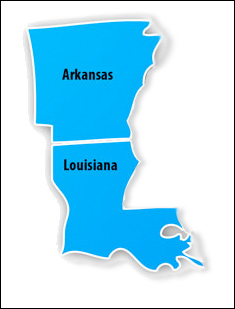
Polling Louisiana & Arkansas

LA-ARK

Magellan Strategies just polled two 2014 focal point state electorates from which we will be hearing a great deal in the coming months. Both the Arkansas and Louisiana statewide races could well determine the outcome of the battle for the Senate majority. Realistically, if the Republicans hope to have any chance of capturing control of the body late next year they will have to defeat three-term incumbent, Sen. Mary Landrieu (D-LA), and Arkansas Sen. Mark Pryor (D) who is completing his second term in office.

The Magellan approach is interesting in that they asked virtually the same questions in each state during the same time period, and did not test either Sen. Landrieu or Pryor in a ballot test configuration. Rather, they concentrated solely on the incumbents’ re-elect score.

In both instances, the pollsters asked the respondents whether the incumbent in their state deserves re-election in 2014. After answering, several “push” questions were presented in order to determine attitudes and feelings about their senator’s support for the major Obama Administration policies. Then, a second re-elect was asked.

These are the push questions common to both surveys. In each instance, the respondent is asked if he/she is more or less likely to support the senator after hearing the statement:

1) The senator recently voted to support immigration reform legislation that offers amnesty to illegal aliens.

2) The senator supported President Obama’s agenda more than 95 percent (Landrieu) or 93 percent (Pryor) of the time.

3) The senator cast the deciding vote for Obamacare, which in some states has increased insurance premiums by 88 percent for people who buy their own insurance.

Here’s how the two senators fared:
 Continue reading >

Minnesota Rumblings; Weiner Under Fire

Several developments are unfolding in budding Minnesota congressional races. A new Democratic poll in the state’s 2nd District shows House Education and Workforce Committee chairman John Kline dropping under 50 percent to the man he summarily defeated in 2012, while a serious Democratic challenger is potentially surfacing against Rep. Erik Paulsen (R-MN-3) in the adjoining district.

Victoria Research (July 17-21; 400 registered MN-2 voters), polling for the liberal House Majority PAC, tested former state Rep. Mike Obermueller against incumbent Kline and found the congressman to be leading 45-32 percent. But, the poll appears slanted.

Repeatedly the questionnaire stresses “compromise” in law making and clearly attempts to paint Kline as one not inclined to bend. For example, Obermueller was cast as a person who is “working together with others to achieve common goals.” The inference is that Kline is not. After characterizing Obermueller in this manner, another ballot test was then asked and, unsurprisingly, the Democrat forges into the lead 44-38 percent. Such a push question skews the poll’s overall results.

In any event, however, Kline did not receive a particularly favorable draw in redistricting and his Minneapolis suburban district is marginal in nature. President Obama carried the seat over Republican nominee Mitt Romney, but by only the smallest of spreads, just 0.1 percent of the vote. In the last congressional election, Rep. Kline defeated Obermueller 54-46 percent, a margin of some 29,000-plus votes.

Next door, former news anchorman Don Shelby (D) is confirming that he is considering launching a challenge to three-term incumbent Paulsen.

The 3rd CD, which encompasses the western Minneapolis suburbs of Bloomington, Eden Prairie, Plymouth, and Brooklyn Park, is also a marginal district but trends a bit more Republican though President Obama topped Romney by one point and almost four in 2008.

Paulsen, a former seven-term state Representative and legislative leader, originally won the district in 2008 with a 48-41 percent victory. He has since been re-elected with margins of 59-36 percent and 58-42 percent in 2010 and ’12, respectively. Neither of his re-election opponents, however, spent more than $530,000 against him.

It remains to be seen if either Democratic challenge develops in these Twin Cities’ suburban districts, but the voting patterns will yield competitive campaigns under the right circumstances. It is difficult to see, however, the climate becoming ripe for Democrats under a mid-term turnout model as we will experience in 2014.
 Continue reading >