Category Archives: Election Analysis

The Ohio Ins and Outs

Ohio-congressional-districtsBy Jim Ellis

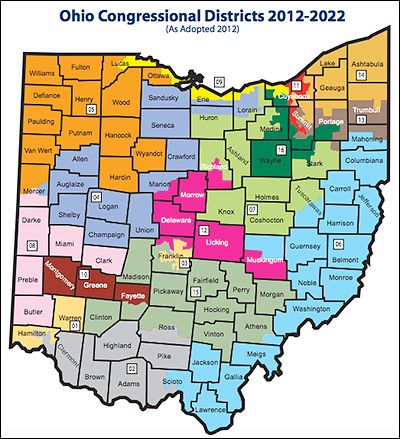
Jan. 15, 2018 — Since the turn of the century, the state of Ohio has become crucial in deciding national elections, and its status for 2018 is no exception. This week, several key moves were made that began to define the general election ballot even before candidate filing closes and the May 8 primary is conducted.

The Senate race was shaken last week when state treasurer Josh Mandel (R), the 2012 Senate nominee who had the inside track to again win the Republican primary in order to force a re-match with Sen. Sherrod Brown (D), unexpectedly announced he was dropping out of the race due to a newly diagnosed health condition for his wife. Though investment banker Michael Gibbons was still in the race, a Republican void existed in a campaign that has all the underpinnings of becoming highly competitive. Even with President Obama leading the Democratic ticket and carrying Ohio six years ago, Mandel managed to hold Sen. Brown to only a 51-45 percent re-election victory.

Rep. Jim Renacci (R-Wadsworth), who had been competing in the governor’s race, announced late last week that he would switch to the Senate campaign. The Republican gubernatorial primary underwent significant change in November, and both Renacci and Lt. Gov. Mary Taylor found themselves on the outside looking in. Because attorney general and former US senator, Mike DeWine, and Secretary of State Jon Husted, the candidates who were running 1-2 in early polling, decided to join forces and form a ticket, the odds of either Taylor or Renacci upsetting the race leader, DeWine, grew to long-shot proportions.

While Taylor remains in the governor’s race, Renacci has now bolted for the Senate campaign to hopefully compete against Sen. Brown. The incumbent is clearly taking his re-election campaign very seriously, as the coming financial disclosure report will show his cash-on-hand figure to be already approaching $10 million. With Renacci’s ability to self-fund a statewide campaign and Republicans looking fondly on President Trump’s eight-point victory in Ohio, the eventual GOP nominee – whether it’s Rep. Renacci, Gibbons, or another late-entry candidate – will command the resources necessary to match whatever Brown and his Democratic allies spend.
Continue reading

The Daily Retirement Briefing

California Rep. Darrell Issa

California Rep. Darrell Issa

By Jim Ellis

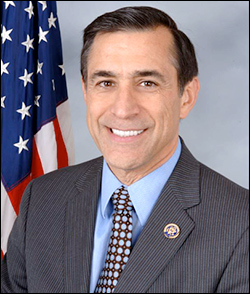
Jan. 12, 2018 — California Rep. Darrell Issa’s (R-Vista) latest re-election, a 1,621-vote victory over retired Marine Corps Colonel Doug Applegate (D) in CA-49, proved to be the closest US House result in the nation during 2016, but there will not be a re-match this year.

Rep. Issa announced Wednesday that he will not seek re-election to a 10th term, becoming the 48th House member to take this action in the current election cycle. With Arizona Rep. Martha McSally (R-Tucson) reportedly primed to declare her Senate candidacy today, the number will quickly grow to 49. Issa’s action directly follows that of fellow California Rep. Ed Royce (R-Yorba Linda/ Fullerton), who announced on Monday that he won’t run for a 14th term.

Both men faced difficult re-election battles, as do five other California Republicans that Democrats are targeting. Because President Trump fared so poorly in California, the Democratic strategists believe the same pattern will carry over into the midterm cycle. But, such a result remains to be seen.

Though Republicans are clearly in worse position without Rep. Royce running again, that might not be the case concerning Issa’s. With his negatives growing and a close call in the previous election, the party might actually fare better with a fresh face, particularly when the Democrats do not have a clear alternative. Though Applegate is running again, he is facing a stiff challenge from at least two other Democrats, wealthy attorney Mike Levin, and former US State Department and United Nations official Sara Jacobs. Real estate investor Paul Kerr rounds out the current Democratic field.

Continue reading

Arizona Senate Activity;
North Carolina Map … Again

Former Maricopa County, Arizona Sheriff Joe Arpaio

Former Maricopa County, Arizona Sheriff Joe Arpaio

By Jim Ellis

Jan. 11, 2018 — Former Maricopa County, Arizona Sheriff Joe Arpaio made a political move regarding the open Senate race on Tuesday, just as Rep. Martha McSally (R-Tucson) was scheduling a series of statewide “events” for Friday.

The controversial ex-sheriff, who President Trump pardoned earlier in the year just before his sentencing for a contempt of court conviction, announced his candidacy for Sen. Jeff Flake’s (R) open seat. Many, however, including Sen. Flake himself, do not believe that Arpaio will follow through with his candidacy. The former sheriff, who was defeated for re-election in 2016, has frequently said he was going to launch a statewide campaign but ultimately backed away from doing so. As an aside, should Arpaio be elected at 85 years of age, he would become the oldest freshman senator in American history.

Rep. McSally’s Friday appearances are reported to be a Senate announcement tour. Since Sen. Flake announced his retirement, it has been expected that McSally would become a Senate candidate.

Ironically, should Arpaio run, the big beneficiary might actually be McSally. With ex-state Sen. Kelli Ward in position to attract the more conservative Arizona primary voter, Sheriff Arpaio’s presence, complete with his virtually universal name identification and well-known border protection positions, would clearly split the former legislator’s political base. In a state with no secondary run-off election system, this would likely allow McSally the opportunity of winning the nomination without having to secure a majority vote.

Continue reading

Monday’s Retirement

California Rep. Ed Royce (R-Yorba Linda/Fullerton) | Facebook

California Rep. Ed Royce (R-Yorba Linda/Fullerton) | Facebook

By Jim Ellis

Jan. 10, 2018 — It’s getting to the point where literally every day we witness a new retirement announcement from Congress, and Monday was no exception.

In another surprise political decision, veteran California Rep. Ed Royce (R-Yorba Linda/Fullerton), the chairman of the House Foreign Affairs Committee, disclosed that he will not seek a 14th term this year, preferring to dedicate his last year in Congress to finishing his committee agenda.

The move was unexpected in that Royce appeared to be preparing his political operation for a major battle. Reportedly through the year-end financial disclosure period, he already amassed a treasury exceeding $3.5 million. Until this week, his actions suggested that he was well equipped to run a strong re-election campaign.

Unlike most of the other 31 Republican seats that are being vacated for the next election, Royce’s California district has strong Democratic conversion potential. The constituency voted 51-43 percent for Hillary Clinton, but backed Mitt Romney 51-47 percent in 2012, and gave John McCain a 49-47 percent margin four years earlier. The Romney and McCain votes are more consistent with the district electorate’s long-term political performance history, but this area of the state, like many regions in the nation’s most populous domain, is turning more Democratic as significant demographic change continues.

Continue reading

An Ohio Curve Ball

Ohio Senate Candidate Josh Mandel

Ohio State treasurer and presumed Senate candidate Josh Mandel

By Jim Ellis

Jan. 9, 2018 — Most people believed the 2018 Ohio Senate general election would be a re-match of the 2012 contest, but now big changes are afoot. On Friday, presumed Republican nominee Josh Mandel, the Ohio State treasurer, announced that he will not file for the Senate race when the deadline expires on Feb. 7. Unfortunately, Mandel says that his wife’s undisclosed health situation, apparently just recently diagnosed, has forced him to the political sideline. He did not indicate whether or not he would seek re-election to his current position.

Mandel was quoted as saying, “[I] recently learned that my wife has a health issue that will require my time, attention and presence,” and that it “has become clear to us that it’s no longer possible for me to be away from home and on the campaign trail for the time needed to run a US Senate race,” as reported on the Daily Kos Elections website.

This means there will not be a repeat performance between Mandel and Sen. Sherrod Brown (D). The two ran against each other six years ago, with the Democratic incumbent winning 51-45 percent. At the time, Mandel, a first-term state treasurer elected only two years before, raised an impressive $18.9 million for the race, losing by only six points while Sen. Brown had the advantage of President Obama topping the Democratic ticket and carrying the Buckeye State. In comparison, Sen. Brown expended just under $21.5 million to secure his first re-election.

Continue reading

New Year House Preview

US-House-of-Representatives-balance-of-power-January-2018By Jim Ellis

Jan. 8, 2018 — Continuing our federal race outlook to set the political stage in this first week of the actual midterm election year, we now turn to the House races.

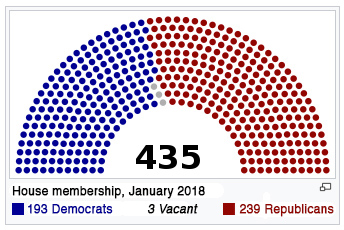
Republicans have a 24-seat margin (counting their three vacant seats that will go to special election in the early part of this year: PA-18, AZ-8, and OH-12), and though Democrats and most in the media claim that a new majority is just around the corner, a race-by-race House analysis shows that the road to converting the majority remains difficult to attain. This is so for several key reasons, not the least of which is the typical House incumbent retention factor. In 2016 the rate hit 97 percent (377 victories for the 389 House members who ran for re-election).

Additionally, even though President Trump’s job approval rating is historically low, we must remember that he won the 2016 national election with a personal approval index no higher than his present positive to negative ratios. And, even though congressional approval was well below 20 percent for the entire 2016 election year, Republicans lost only six House seats from their previous modern era record majority of 247 that was attained in the 2014 election.

When we have seen major seat changes occur in past elections, the winning party has done well in converting open seats. For the fourth election cycle in a row, the 2018 House cycle features an above average quantity of incumbent-less US House campaigns – the current number is 45, counting the two latest announced retirees, Reps. Bill Shuster (R-PA) and Gregg Harper (R-MS).

Continue reading

New Year Senate Preview – Part II

By Jim Ellis

Jan. 5, 2018 — Continuing our New Year’s preview, today we look at the 2018 Senate races from the Democrats’ perspective.

THE DEMOCRATS

Sen. Claire McKaskill | (Facebook)

Sen. Claire McKaskill | (Facebook)

Because they are now defending 26 of the 34 in-cycle seats, with the addition of the Minnesota special election, the Dems must primarily develop a solid defense before venturing into attack mode. If they are to have any chance of gaining a 51-49 majority, they will realistically have to win all 26 of the incumbent and open seat races they are forced to risk. This includes three contests already considered toss-up campaigns: Missouri Sen. Claire McCaskill likely facing Attorney General Josh Hawley (R), Sen. Joe Donnelly in the Indiana race, and the budding Florida campaign likely between Sen. Bill Nelson and Gov. Rick Scott.

Regardless of whom Sen. Donnelly ultimately faces in the Hoosier State, he will draw a top-tier opponent. Reps. Todd Rokita (R-Brownsburg/Lafayette) and Luke Messer (R-Greensburg/Muncie) battle for the Republican senatorial nomination, and they also face a credible third challenger in former state Rep. Mike Braun (R-Jasper). Braun has the strong ability to finance his own campaign, thus allowing him to adequately compete with the two congressmen. Since he has the promise of becoming his own force, Braun could conceivably strike a chord with the Republican electorate if the two congressmen continue fighting amongst themselves and allow him to slip by both of them.

Republicans will also be competitive in several other Senate races, as they project to have a strong opponent against West Virginia Sen. Joe Manchin (Attorney General Patrick Morrisey and Rep. Evan Jenkins battle for the GOP nomination to be decided in May), while state Treasurer Josh Mandel looks to provide a stronger challenge to Ohio Sen. Sherrod Brown (D) than he did in 2012 when he fell 51-45 percent. The Pennsylvania GOP electorate looks to be coalescing behind Rep. Lou Barletta (R-Hazelton) but upsetting Sen. Bob Casey Jr. is still a highly formidable task, and this developing contest must be considered a long shot as the new year begins.

Continue reading