By Jim Ellis — Monday, May 4, 2026
Redistricting
The Supreme Court ruling on the Callais v. Louisiana racial gerrymandering case has thrown the House election cycle into disarray. As a result of the high court’s decision, redistricting options are again being contemplated in several states.
Alabama Gov. Kay Ivey (R), despite previously stating she opposed redistricting ahead of the 2026 elections, issued a proclamation on Friday calling the legislature into special session later today to redraw the state’s congressional and state Senate maps.
Alabama is in exactly the same situation now as Louisiana. Under court orders, both states were required to redraw their 2021 congressional maps to add a majority minority district. Following last week’s Supreme Court Callais ruling, those revised maps are now invalid.
It is probable that the Alabama legislature will revert to a map like the one enacted in 2021. Such a plan would collapse Rep. Shomari Figures’ (D‑Montgomery) current District 2 and shift the seat back to southeast Alabama. That change would likely return the state’s congressional delegation to a 6R–1D alignment, rather than the current 5R–2D split.
The principal beneficiary of such a map would be former Congressman Jerry Carl (R), who lost his seat in a 2024 paired‑incumbent primary. He is currently running in the reconfigured 1st District now that incumbent Rep. Barry Moore (R) is seeking a Senate seat. Carl, however, trails state Rep. Rhett Marques (R‑Enterprise) in a recently released poll.
A new map would likely restore Mobile County as the population anchor of District 1 and shift District 2 back to southeast Alabama. Such a draw would allow both Carl and Marques to run in separate districts. While each would still face primary competition under a new configuration, they would no longer be forced to run against one another.
The Alabama primary is scheduled for May 19, which means the legislature will have to act quickly. The most likely scenario is that the regular primary proceeds as planned for all offices except the US House of Representatives and state Senate. Once new maps are enacted, a separate filing period and new primary dates for those offices would be set for later in the year.
Georgia is another state that could potentially redraw its congressional map, but with candidate filing already closed and the May 19 primary fast approaching, Gov. Brian Kemp (R) is taking the opposite position of Gov. Ivey. Kemp said he does not support redistricting for 2026, though indicated he would be open to considering a new map for the 2028 election cycle.
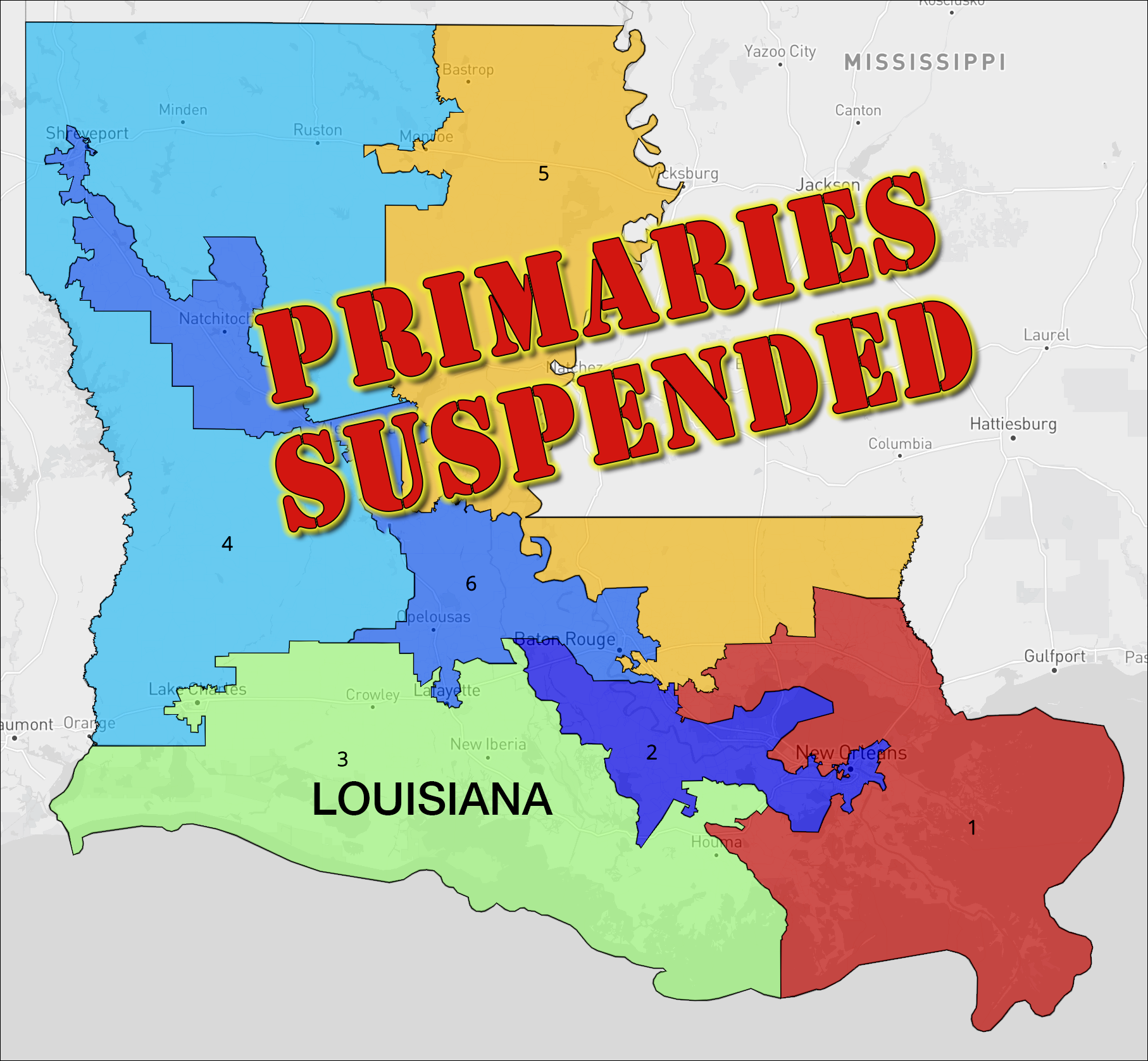
In Louisiana, state Senate President Cameron Henry (R‑Metairie) said Friday that the 2026 election scheduling decision will likely return the state’s US House races to the jungle primary format that has been in place since the late 1970s.
Gov. Jeff Landry (R) has already suspended the May 16 primary for US House campaigns in response to the Supreme Court ruling. The other affected contests, most notably the US Senate race, will continue to proceed under the May 16 partisan primary schedule.
With other offices still operating under the jungle primary system, which runs concurrently with the November general election and employs December runoffs when no candidate wins a majority, it is likely the Governor will simply return the US House races to this previous format and election calendar. Such would be the least expensive way for the state to conduct elections under a revised schedule.
Once the Virginia state Supreme Court renders a decision upholding the April 21 redistricting referendum, and the new Florida plan wins approval from its state Supreme Court after a lawsuit is formally filed, along with Alabama and Louisiana overcoming the legal objections to moving their primaries, the national redistricting landscape will finally come into clear focus.
Assuming all of these courts rule as suggested, we can reasonably predict that the new California and Texas maps would offset one another in terms of partisan gains, as would the changes in Virginia and Florida. Republicans would probably gain one seat each in Alabama, Louisiana, Missouri, and North Carolina, with the potential for one or two additional seats in Ohio. Democrats would gain one seat in Utah under that state’s new court‑ordered map.
Therefore, if the national redistricting picture ultimately unfolds as outlined above, the 2026 changes would likely result in Republicans achieving a net gain of four to five seats nationwide.