Tag Archives: Wisconsin

Senate Recap – Part II

By Jim Ellis

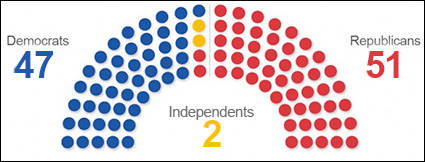
US Senate makeup

US Senate makeup

Sept. 24, 2018 — Today we continue our look at the most competitive 17 US Senate contests with our second and final installment. To take a look at our Part I recap, please see our writeup this past Friday at: Senate Recap – Part I.


NEVADA

Sen. Dean Heller (R) is embroiled in an intense re-election battle with freshman Rep. Jacky Rosen (D-Henderson) as the two compete for a toss-up Senate seat. Heller won here in 2012 by a single percentage point over then-Rep. Shelley Berkley (D-Las Vegas), but that was in the election when President Obama carried Nevada, 52-46 percent.

Polls go back and forth between the senator and congresswoman, but neither leads beyond the margin of polling error. Since the beginning of September three polls have been released, and the average spread between the contenders is just two points. This is a pure toss-up election and, as a Republican defense seat, one of the most important campaigns in the nation.


NEW JERSEY

The Garden State is often a teaser for Republicans, meaning polls routinely suggest their candidates will fare better than actual results portend. The Senate race between incumbent Bob Menendez (D) and pharmaceutical CEO Bob Hugin (R) is likely no exception. Though several polls have indicated the race is competitive, it is probable that Sen. Menendez will pull away and score a comfortable win.

Polling has been scarce. The most recent survey was released in mid-August from Quinnipiac University (Aug. 15-20; 908 registered New Jersey voters) and projects the senator to be leading Hugin, 43-37 percent. Obviously, Menendez corruption trial that ended in the case against him falling apart and being dropped has taken a toll on his favorability index, but it is doubtful that even a 29:47 percent positive to negative personal approval rating (aforementioned Q-Poll) would cost him the election.


NORTH DAKOTA

If polling were the only factor in determining race outlook, then North Dakota would be the Republicans’ best conversion opportunity. Though polls have been anything but plentiful, those that have been published find at-large Rep. Kevin Cramer (R-Bismarck) leading incumbent Sen. Heidi Heitkamp (D).

The most recent study came in early September from Fox News (Sept. 8-11; 701 likely North Dakota voters) and finds Rep. Cramer holding a 48-44 percent advantage. This is the first survey release since the beginning of July.

The North Dakota race is a strong Republican conversion opportunity, but though Cramer appears to have a discernible edge right now, this contest is far from over.

Continue reading

Primary Results:
Pawlenty Falls; Wisconsin Set

the-primariesBy Jim Ellis

Aug. 15, 2018 — Forty states have now chosen their nominees for the fall, as voters in Connecticut, Minnesota, Vermont, and Wisconsin made their choices known yesterday.


MINNESOTA

The big story was former two-term Gov. Tim Pawlenty failing in his bid to return to the Governor’s mansion. Pawlenty, who served from 2003-2011 and won two tough general elections, lost last night to Hennepin County Commissioner Jeff Johnson, the party’s 2014 gubernatorial nominee and this election’s endorsed Republican Party candidate. Johnson recorded a 53-44 percent primary victory.

For the Democrats, US Rep. Tim Walz (D-Mankato), who scored the barest of re-election victories in 2016, won a highly competitive party primary last night with a 42-32-24 percent win over state Rep. Erin Murphy (D-St. Paul), the party-endorsed candidate, and Attorney General Lori Swanson who was originally running for re-election but switched races when she failed to win the party endorsement at the state convention. Rep. Walz performed strongly in his southern Minnesota base, carrying every county from the Iowa border through the central part of the state while splitting the Twin Cities area. Though Rep. Murphy won a convincing victory at the party convention, she was never able to convert her momentum into a winning coalition among voters.

In the two Senate races, two-term Democratic incumbent Amy Klobuchar was easily re-nominated for the fall as was appointed Sen. Tina Smith. Sen. Klobuchar is a lock in the general election, while Sen. Smith will face a competitive challenge from state Sen. Karin Housley (R-St. Croix River Valley), who scored a clear Republican primary victory.

In the competitive House races, Republican Jim Hagedorn, who came within less than one percentage point of upsetting Rep. Walz in 2016, again won the party nomination, this time over state Sen. Carla Nelson (R-Rochester) who had support from some conservative organizations. Hagedorn will face the Democratic winner, former Defense Department official Dan Feehan, in what should be a hotly contested general election campaign.

Continue reading

Four More Primaries Today

the-primariesBy Jim Ellis

Aug. 14, 2018 — Voters in Connecticut, Minnesota, Vermont, and Wisconsin will choose their nominees today. Minnesota and Wisconsin, in particular, feature some key contests.


MINNESOTA

Most of today’s action will occur in the Land of 10,000 Lakes, as a major open race for governor will see party finalists determined in both political camps. Republicans feature former Gov. Tim Pawlenty and 2014 gubernatorial nominee Jeff Johnson, a Hennepin County commissioner who is the officially endorsed party candidate.

Democrats have a three-way battle among state Rep. Erin Murphy (D-St. Paul), the official party endorsed candidate, Attorney General Lori Swanson, and US Rep. Tim Walz (D-Mankato). Though Murphy is the sanctioned candidate, she appears to be trailing both Swanson and Walz. The winners will set up a highly competitive general election that will probably be considered a toss-up campaign all the way to Election Day.

Both US senators are on the ballot. Sen. Amy Klobuchar (D) is a lock for re-election, while appointed Sen. Tina Smith (D) is finding a competitive battle coming from state Sen. Karin Housley (R-St. Croix River Valley), but these scenarios are dependent upon all of the aforementioned easily winning their respective nominations tonight.

The state could yield as many as four competitive campaigns from their eight congressional districts, but today the real nomination battles are in Districts 1, 5, and 8.

Continue reading

Gauging the Enthusiasm Gap

By Jim Ellis

i-vote-i-countJuly 13, 2018 — Much has been written over the past few elections cycles about voting enthusiasm and whether it is a predictive political factor. It has been seemingly apparent that the party members most interested in participating in an election, most particularly for a midterm or special election vote, generally see its candidates enjoy the greater success.

Yesterday, we looked at the extensive just-released Survey Monkey-Axios Media data that covered 13 US Senate races. The combined number of states also hosts a minimum of 15 competitive US House races. To re-cap, while the Survey Monkey analysts posted results under various turnout models in each of the tested states, it generally became clear about which candidate has the current advantage from the Senate contests in question.

Democrats were performing well in the Midwest and Mid-Atlantic regions, where incumbents in Pennsylvania, Michigan, Wisconsin, Ohio, and West Virginia all held substantial leads over their Republican opponents.

The GOP held the upper hand in Indiana and North Dakota challenge races. In the South, Republican Gov. Rick Scott looks to be topping Florida Sen. Bill Nelson, and US Rep. Marsha Blackburn (R-TN) has opened a substantial lead over Tennessee former Gov. Phil Bredesen.

Turning to the West, Democrats are moving ahead in both Arizona and Nevada and securely lead in Montana.

The Missouri contest between Sen. Claire McCaskill (D) and Attorney General Josh Hawley (R) stretches from a five-point Democratic lead all the way to a five-point Republican advantage depending upon the turnout model.

The Survey Monkey pollsters tested voter enthusiasm in all 13 states. They asked the following question:

Continue reading

US Senate: 13 Telling Polls

By Jim Ellis

capitolJuly 12, 2018 — The Survey Monkey organization polling for the Axios Media news and information website went into the field during the June 11 – July 2 period to test US Senate campaigns in 13 different states. All of the most competitive races were studied, including the 10 Trump states where a Democratic senator is standing for re-election this year.

The cumulative result actually brings some good news to both parties, but Republicans fare better because the representative predictive models suggest the GOP is in position for a net gain of at least one seat even while falling behind in their two key defense states of Arizona and Nevada.

Though the survey sampling period is long, the three-week time frame is the period consumed to survey all 13 states. Survey Monkey begins with a regular sampling universe of 3,000,000 individuals who have agreed to participate in their polls. For this project, 12,677 registered voters participated from a high of 1,280 in Arizona to a low of 457 from North Dakota. The sample size in the largest state tested, Florida, was 1,080. All of the surveys were weighted to reflect the demographic and political trend history for each state. The polling error factor for each place ranged between 4.5 and 5.5 for all states but North Dakota. In the latter, the error factor was 7.5.

There are several bright spots for both parties. Democrats fare better on the question of voter enthusiasm, which is consistent with data results recorded in virtually every poll conducted over the past year. Regarding intent to vote across the board in these Survey Monkey polls, however, both parties record about equal numbers. Overall, President Trump’s job approval scores have greatly improved. Looking at the combined 13-state universe, the president scored a 50:49 percent job approval ratio, going from a high of 60:39 percent in Tennessee to a low of 44:55 percent in Pennsylvania. But, even his lowest rating is an improvement from where he stood earlier in the election cycle.

According to the SM numbers, Democrats are in position to convert both the Arizona and Nevada races. Rep. Kyrsten Sinema (D-Phoenix) leads all three individuals competing in the Republican primary. Her strongest opponent, unsurprisingly, is US Rep. Martha McSally (R-Tucson). In the various modeling scenarios, Sinema posts leads of between one and six percentage points over Rep. McSally and far greater margins over the other two GOP candidates.

Continue reading

Wisconsin Gerrymandering Ruling;
Greitens Still Lingering

By Jim Ellis

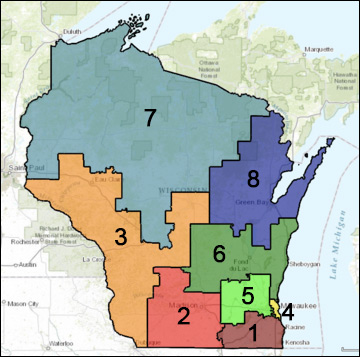
Wisconsin Congressional Districts

Wisconsin Congressional Districts

June 20, 2018 — The United States Supreme Court issued their long-awaited ruling on the Wisconsin political gerrymandering case on Monday, and it basically sends the parties back to the drawing board. At one time it was thought that Wisconsin was the vehicle for the high court to issue a definitive ruling regarding political gerrymandering, which continues to be the subject of many live redistricting lawsuits. Instead, on a rare 9-0 vote, the Supreme Court ruled that the plaintiffs did not have the necessary standing to bring the action.

The plaintiffs came from four Wisconsin Assembly districts who claimed they were personally harmed by the state legislative boundaries the legislature and governor adopted back in 2011. The court ruled that such plaintiffs did not have adequate standing to bring a statewide lawsuit.

The court did issue some orders, however, that will make later political gerrymandering suits more difficult to bring because certain technical standards must now be met in future action. As part of the plaintiffs’ standing ruling, the justices vacated the lower court ruling that ordered the state assembly districts re-drawn. It is now likely that political boundaries around the country are finally set for the 2018 election.

Continue reading

Ryan’s Departure: Ramifications

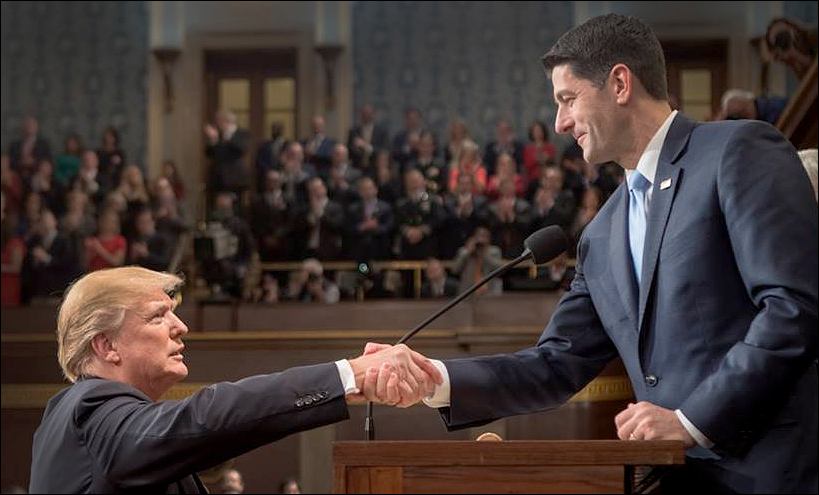
US House of Representatives Speaker Paul Ryan and President Donald Trump shake hands at the 2018 State of the Union speech.

US House of Representatives Speaker Paul Ryan and President Donald Trump shake hands at the 2018 State of the Union speech.

By Jim Ellis

April 12, 2018 — As we know, Speaker Paul Ryan (R-WI) announced his retirement yesterday, and even more change can be presumed coming to Capitol Hill as a result.

In the short term, expect increased analyses predicting an ensuing Democratic majority forming in House races and further predictions over what party strategists refer to as an impending “blue wave.” They will suggest that the Ryan retirement shows the speaker understands the “wave” is becoming a political tsunami, and one not destined to fail in the manner that the predicted presidential “blue wall” crumbled.

Long term in this election cycle, however, things have a chance to play out differently. With a sure change in leadership coming no matter what the general election produces, Republican members and candidates will be freer to re-set the GOP agenda and join the chorus charging that the current Congress has failed to deliver on enough campaign promises.

Ryan has been a huge fundraiser for party candidates, and is credited in some reports with being responsible for some $54 million already being distributed to GOP contenders and party institutions. And, that’s before the latest Federal Election Commission (FEC) quarterly disclosure reports are released after April 15.

Continue reading