
Tag Archives: North Carolina

Presidential Paths to Victory

Today we turn our attention to the national election between President Barack Obama and former governor Mitt Romney in order to determine each candidate’s path to victory as the political map begins to evolve and change.

It is evident that are there are approximately a dozen battleground states upon which the candidates are focusing. The competitive states considered to be in this swing category include, alphabetically: Colorado (9 Electoral Votes), Florida (29), Iowa (6), Michigan (16), Nevada (6), New Hampshire (4), New Mexico (5), North Carolina (15), Ohio (18), Pennsylvania (20), Virginia (13) and Wisconsin (10).

Last year Obama advisers mapped out five different routes that would secure the minimum 270 Electoral College votes the president needs for re-election. Each path included Obama retaining some, but not all, of the swing states that he won in 2008. As we have seen through nationwide polling data, Team Obama’s strategic tenet in spreading the map as wide as possible is having some effect. Conversely, the Romney brain trust indicates that any realistic course to capturing their identified 270 votes requires them to win back historically Republican states that Obama carried four years ago, such as North Carolina, Indiana, and Virginia.

Each candidate understands the importance of winning the quintessential large swing states of Florida (29 Electoral Votes) and Ohio (18). In 2008, Obama claimed these places and is now spending heavily in hopes of retaining both. Romney advisers see Florida as their candidate’s most important swing state because there is no realistic way to score a national victory without its inclusion. Simply put, Florida’s 29 Electoral Votes are too many to replace.

Currently, several polls reveal Obama as having the edge in Ohio but a recent Gravis Marketing poll of 728 likely voters shows Romney opening up a three-point lead in Florida.

In the past few days two Great Lakes states, Michigan and Wisconsin, are showing signs of teetering toward Romney. Recent polls in both places have returned conflicting results and each candidate can point to data showing him to be in the lead. But even a split decision in August is a positive trend for the challenger.

Michigan, a traditionally Democratic state but one that turned hard for Republicans two years ago, is a place where Romney will heavily contest. A fundamental reason for the strategic decision to do so is his Wolverine State family ties. It is here where the Republican nominee grew up and the electorate twice voted for his father as governor. The Obama senior strategists scoff at the idea that Romney can win Michigan, citing his opposition to the auto bailout and recalling that Sen. John McCain, the 2008 Republican nominee, publicly abandoned the state some six weeks before the election.

Wisconsin, home of vice presidential running mate Paul Ryan, has been trending toward the Republicans in similar patterns to Michigan, cemented by Gov. Scott Walker’s recall election victory earlier this year. With former governor Tommy Thompson running strong in the open Senate race, the Badger State is certainly in play for a close Romney victory.

Early in the cycle we, as most other analysts, suggested that after counting Indiana returning to the Republican camp, Romney would have to carry Florida, Ohio, North Carolina and Virginia, and then one more 2008 Obama state to win the presidency. While such a formula remains valid, the president’s continued performance in Ohio and Virginia suggests that Romney will not likely sweep the four core states. But, numbers coming from the aforementioned Michigan and Wisconsin, and Midwestern and western states such as Iowa, Colorado and possibly Nevada, demonstrates other Republican victory paths are now possible.

Here are the scenarios:

• If the president carries Virginia, a Wisconsin-Iowa combination is the easiest way for Romney to neutralize this Obama core state victory. The Republican would still need one more state, such as New Hampshire, where Obama consistently leads, or Nevada or Colorado to claim national victory. New Mexico, normally a swing state, appears to be currently off the table as the President continues to score double-digit polling leads.

• If Obama wins Ohio, then Romney would be forced to win Wisconsin and Colorado. Under this scenario, Michigan comes into play. Unless Romney carries New Hampshire, Nevada, or Iowa, then the Wolverine State becomes his last neutralization option.

• Should the President carry both Ohio and Virginia, then Romney could still win by taking Iowa, Wisconsin, Michigan, and Colorado or Nevada. All scenarios assume that Romney re-unites Nebraska by winning that state’s 2nd Congressional District and thus providing one more vote to his electoral column.

The overall state chart still favors the president, but the campaign’s recent fluidity suggests several new victory options are now attainable for the challenger.
Presidential Popular Vote is Even

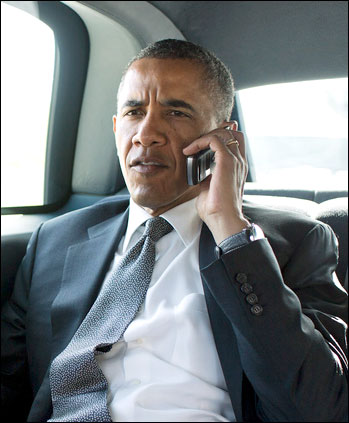
President Obama. / Photo: The White House

A series of new presidential election polls reveals a further tightening of the campaign on the national level, though President Obama maintains a lead over Mitt Romney in the most competitive states.

The two daily tracking pollsters, Gallup and Rasmussen Reports, both give the president only a one-point national lead, 46-45 percent and 45-44 percent, respectively. Looking at an actual benchmark survey, Public Policy Polling, conducting their study (July 19-22; 1,000 registered voters) for the Daily Kos national liberal blog and the Service Employees International Union, projects a flat 46-46 percent tie.

The only national poll not showing a dead heat, taken over virtually the same time frame as PPP’s survey with an identical sample size (July 18-22; 1,000 registered voters) from Republican pollster Bill McInturff and his Democratic counterpart Peter Hart, actually stakes the president to a 49-43 percent advantage. Based upon the available data, though the polling methodology appears sound, the McInturff/Hart result appears to be an outlier.

National Public Radio released their poll of the 12 commonly viewed battleground states (conducted by the Resurgent Republic and Democracy Corps organizations, July 7-12; 1,000 voters nationwide with an oversample of 462 from the battleground states) but its aggregate result is of little consequence. Though this poll, too, shows an Obama-Romney tie at 46 percent, such a figure is virtually useless because the combined popular vote in the most hotly contested states doesn’t translate into specific electoral votes.

What is valuable are battleground voters’ perceptions and attitudes about the candidates. As we have seen for months, there is severe polarization between the two major parties. By almost a 9:1 majority, Democrats believe the president has performed well in office. Conversely, the same virtual ratio of Republicans believes he has not. Independents tend to fall more on the Republican side, slightly rating Obama’s job performance more negative than positive. Also, Independents in these states generally oppose the Obama healthcare law and, by a slight margin, believe that the Supreme Court decision upholding the law is incorrect. This could prove significant as the campaign continues to evolve.

One thing that does deviate somewhat from at least the conventional wisdom, the NPR battleground state poll does show that both candidates have a strong base. Especially for Romney, this is a change. Before, most data indicated weakness among Republicans for their presumptive nominee, but the NPR data gives both contenders right around 90 percent support within their own party voter cell sample. This finding is good news for both men.

New individual key state surveys stack up relatively well for the president in the fact that he leads in most, but in no case is his advantage more than mid-level single-digit numbers.

Rasmussen Reports gives the President a six-point, 48-42 percent advantage in Michigan. Survey USA finds a similar five-point, 48-43 percent margin for Obama in all-important Florida; and We Ask America returns similar 49-42 percent and 49-43 percent spreads (in Obama’s favor) in Wisconsin and Nevada, respectively. Magellan Strategies produced a much closer 50-46 percent Nevada model. Quinnipiac University shows a tie in Virginia, and the Civitas Institute projects Romney to a one point, 49-48 percent razor-thin edge in North Carolina. Though it’s not a battleground state, Survey USA detects only a 46-40 percent advantage for the president in liberal Minnesota, which is a surprise.

The cumulative effect of the most recent survey data makes the president and his advisers uncomfortable. These are not the type of results strong incumbents would be seeing at this point in the election cycle. It’s going to be quite a remainder of the year.

Analyzing the North Carolina Run-off Elections

Yesterday’s North Carolina congressional run-off elections concluded with three districts producing Republican nominees, all with strong chances of winning the general election in November.

In the 8th District, occupying the area to the north and east of Charlotte and around Fayetteville, business consultant and former congressional aide Richard Hudson won a landslide 64-36 percent win over dentist and ex-Iredell County Commissioner Scott Keadle. Only 16,078 votes were cast in the secondary election, just under 4 percent of the entire universe of registered voters. It was a decisive win for Hudson, who built a coalition comprised of conservatives, Washington insiders, and North Carolina establishment individuals and entities. Some national conservative organizations, such as the Club for Growth, supported Keadle’s unsuccessful candidacy.

Hudson now challenges two-term Rep. Larry Kissell (D) in a district that has been radically re-configured. With the new 8th being 21 points better for Republicans based upon the Obama-McCain 2008 presidential election scale, and Kissell only currently representing 54 percent of the new territory, it is arguable that Hudson is now the favorite here even against the incumbent. Republican map architects designed this seat to be one of the best GOP conversion opportunities in the country, and Hudson is proving worthy of the task of unseating an incumbent. We will hear much more from this campaign in the coming weeks.

To the west, encompassing most of Charlotte proper and stretching northward more than half-way toward Winston-Salem, the 9th District also has a new Republican nominee. For all intents and purposes, last night’s vote actually selected the new congressman here because this seat trends safe Republican. With Rep. Sue Myrick (R) retiring after nine terms, 11 candidates ran in the original primary and the field whittled down to former state Sen. Robert Pittenger
and Mecklenburg County Commissioner and ex-sheriff Jim Pendergraph. As was the case in the primary, the result ended in relatively close fashion.

Mr. Pittenger, who spent more than $2 million of his own money and was the self-proclaimed most conservative candidate in the race, clinched a 53-47 percent win last night. The former state senator is now the prohibitive favorite to defeat Democratic Mecklenburg County Commissioner Jennifer Roberts in the general election.

The new 9th went for John McCain in 2008 by a 54-45 percent count, one point under the margin from the current 9th CD. Three-quarters of the territory remains constant in the new district. More than 35,000 people voted, the largest congressional turnout in the state. Though Pendergraph took Mecklenburg County by a 51-49 percent margin, Pittenger’s strong performance in Iredell (70-30 percent) and Union (57-43 percent) counties was enough to offset him losing the most populous area.

Moving to far western North Carolina, in the Asheville area seat being vacated by retiring three-term Democratic Rep. Heath Shuler, businessman Mark Meadows becomes the 2012 Republican nominee for the new 11th Congressional District. He swamped entrepreneur Vance Patterson 76-24 percent in a run-off race that was never close. Almost 23,000 votes were cast in this run-off, the second highest of the three congressional contests decided last evening.

Meadows will now face Democratic nominee Hayden Rogers, Shuler’s chief of staff. The Republican businessman has the inside track to victory in the general election because the post-redistricting 11th has swung hard toward the GOP. On the Obama-McCain scale, the new NC-11 is now the most Republican district in the state, moving a net 13 partisan points.

Because North Carolina figures to be the Republicans’ best state countrywide during these elections, and will neutralize a similar Democratic performance in Illinois, it is likely that all three men nominated last night will win their respective general elections. So, despite a statewide voter turnout of only 3.58 percent, this North Carolina run-off election will prove significant when painting the 2012 national political picture.

NC Run-offs Tomorrow

There are only two federal elections of any kind in July, and tomorrow’s North Carolina run-off vote will decide three GOP nominations. All Tar Heel State Democratic nominees and the other Republican standard bearers were chosen outright in the May 8 primary.

The 8th Congressional District occupies the area east and north of Charlotte on the way to Fayetteville. The post-redistricting NC-8, represented by two-term Democratic Rep. Larry Kissell, moves a net 21 points toward Republicans on the presidential scale. The new draw adds more than 45 percent new territory for Kissell, forcing him to move right in order to survive politically. He was one of five Democrats to vote to repeal Obamacare care last week after opposing previous such attempts. He originally voted against the legislation when it was first passed, and then fought repeal only to reverse course again, so his inconsistency on the subject could become a campaign issue.

Fighting for the Republican nomination are business consultant and former congressional aide Richard Hudson and dentist and ex-Iredell county commissioner Scott Keadle (pronounced Kay-dle). Hudson placed first in the five-candidate Republican primary, capturing 32.1 percent of the vote versus Keadle’s 22.0 percent. Both men are conservatives, but Hudson enjoys North Carolina Republican establishment support, House GOP leadership backing (Majority Leader Eric Cantor’s leadership PAC), and even landed the liberal Charlotte Observer newspaper’s endorsement.

The two candidates are about even in financial resources and each has invested six figures into his own campaign, though Keadle has loaned himself more than three times Hudson’s personal contribution amount. Because of its new partisan configuration, the winner of tomorrow’s run-off will likely become the 8th District’s new congressman.

Perched on the western side of Charlotte and then driving due north half-way to Winston-Salem is the new 9th Congressional District, open because nine-term Rep. Sue Myrick (R) is retiring. The GOP battle here, tantamount to victory in November, is between former state senator Robert Pittenger and Mecklenburg County Commissioner and former sheriff Jim Pendergraph. As in the 8th District, both men are running as conservatives. Myrick has endorsed Pendergraph, but Pittenger, because of a huge $2 million self-donation, has a major financial advantage. Pittenger placed first in the primary of eleven candidates, capturing 32.4 percent of the vote as compared to Pendergraph’s 25.3 percent. Tomorrow’s winner will claim the general election and keep the reliable GOP seat in the Republican column.

Farther to the west in the Asheville area, encompassing the entire western tail of the state, lies the 11th District. This seat, like both the 7th and 8th CDs, was changed heavily to the Republicans’ benefit. Eliminating most of the city of Asheville, with its Democratic voting base, from the 11th is the main reason that three-term Rep. Heath Shuler (D) decided not to seek re-election. Shuler’s chief of staff, Hayden Rogers, is the new Democratic nominee, but the 13-point GOP redistricting adjustment will give tomorrow’s Republican nominee the inside track to victory in November.

The two 11th District run-off participants are businessmen, each in their first political campaign. Real estate investor Mark Meadows, who captured 37.8 percent of the vote and missed winning outright by just over two percentage points (North Carolina’s run-off law requires only 40 percent of the vote to win a partisan nomination as opposed to 50 percent in all other states that use a two-tiered primary system), is favored over Vance Patterson who posted 23.6 percent in the field of nine candidates. Originally, it appeared that local District Attorney Jeff Hunt was the presumed favorite, but he performed poorly and both Meadows and Patterson blew past him to secure their run-off positions.

Through the end of June, Meadows held a healthy fundraising advantage, though about half of his campaign treasury is self-contributed. Patterson is his campaign’s virtual sole source of funds and pledges to donate all of his congressional salary to local western North Carolina charities, if elected. Look for a Mark Meadows victory tomorrow and in November.

House Realignment Scorecard

The conventional wisdom during the past 18 months was that Democrats were going to make modest gains in the post-redistricting House, but such prognostications are changing. Considering the re-maps from a national perspective without regard to campaign competition factors, the Republicans are the ones who now appear to have the slight advantage.

The outlook is changing because none of the major Republican seat-risk situations appear to be producing multiple losses. Neither the New York, Florida, California, Virginia, nor Texas map is, on the surface, going to add large numbers of new Democratic House members solely because of plan configuration.

Since we now know where the new seats are going and where the lost districts are coming from, more complete analyses can be rendered. While the straight numbers suggest that Democrats must score a net gain of 25 districts to re-capture the House majority by a single seat, the adjusted post-redistricting number actually increases that figure to 29.

The basis for such a conclusion is in accounting for the 12 seats that have shifted states along with several obvious conversion districts. Other factors are equally as viable in projecting an overall House partisan balance figure, but how competitive various seats are in states like California and New York can be debated in another column. For now, looking at the placement and displacement of the new seats, along with what appear to be some obvious open-seat campaigns going decidedly toward either a Democratic or Republican nominee, lead us to a +4 Republican gain figure.

Let’s first look at the multiple-seat gain or loss states, which tend to be a wash in terms of partisan divide. In Texas, the biggest gainer, the new seats of TX-25, 33, 34, and 36 are headed for a 2R-2D split. In Florida, their two new districts, FL-9 and FL-22, look to be leaning Democratic (certainly so for FL-22), but the campaign evolving in the new 9th puts the outcome in question. Republicans have recruited a strong candidate in local county commissioner John Quinones, while the Democrats are again tapping controversial one-term ex-Rep. Alan Grayson who was defeated for re-election in 2010.

On the multiple-seat reduction side, both Ohio and New York also appear to be neutralizing themselves between the parties. Both sides look to lose one net seat in each state.

But it is among the single-seat gaining and losing states where the GOP has scored well. The Republicans look to be coming out on top in gainers like Georgia (GA-9), South Carolina (SC-7), and Utah (UT-2). Democrats will have a slight edge in Arizona’s new district (AZ-9), and are likely winners in Nevada (NV-4), and Washington (WA-10).

In the states losing congressional representation, while New York and Ohio don’t give either party a clear advantage, Democrats are forced to absorb the loss in Massachusetts (MA-10), New Jersey (NJ-13), Michigan (MI-15), Pennsylvania (PA-4), and Missouri (MO-3). Republicans take the hit in Illinois (IL-19) and Louisiana (LA-7).

The GOP looks to be headed for conversion victories in Arkansas (AR-4, Rep. Mike Ross retiring), Oklahoma (OK-2, Rep. Dan Boren retiring), and likely in Indiana (IN-2, Rep. Joe Donnelly running for Senate). They will also gain three to four seats in North Carolina, but those are neutralized by what appear to be similar gains for Democrats in Illinois. All totaled, before the campaigns hit their stretch drive, it is the GOP that now enjoys a slight post-redistricting advantage and makes a 2012 House majority change even more remote.

Weekly Redistricting Update

The federal three-judge panel in Kansas adopted and released the state’s new congressional plan, meaning all 43 multi-district states have now completed the redistricting process.

Litigation drags on in Florida and North Carolina, but it is likely that both of those enacted maps will be in effect for the 2012 elections, meaning the national political stage is set for November. Changes for 2014 and beyond could occur in Florida and North Carolina, however, in addition to Texas and West Virginia, where new maps will be drawn after the 2012 election due to previous legal rulings.

Weekly Redistricting Update: Spotlight, North Carolina

Today’s spotlight takes us to North Carolina where we review the state’s 13 congressional districts after the dust has settled from the May 8 primary. The run-off date for several of the races is July 17.

NORTH CAROLINA (current delegation: 7D-6R) – The Tar Heel State is one of the most important of the 2011 redistricting process. Along with Illinois, and possibly California, North Carolina will likely see greater change in their congressional delegation than any other state. While Illinois is likely to see a three- to four-seat Democratic gain, it’s probable that North Carolina will see the same level of change but in the Republicans’ favor.

We’ll focus on key districts that are either “toss ups” or “likely” to go to go one way or the other:

• District 2: Rep. Renee Ellmers (R) – With 71 percent new territory, freshman Rep. Ellmers’ biggest test was winning the Republican nomination, which she did with 56 percent of the vote against three GOP opponents. The 2nd District was changed greatly to give Ms. Ellmers a much better chance of sustaining her congressional career. The previous 2nd, the one in which she upset Rep. Bob Etheridge (D) in 2010, went for President Obama in 2008 in a 52 percent count. The new 2nd supported John McCain with 56 percent, a swing of eight full percentage points. This being said, Rep. Ellmers is a heavy favorite now to defeat Democratic businessman Steve Wilkins. LIKELY REPUBLICAN

• District 7: Rep. Mike McIntyre (D) – This is a seat greatly changed in redistricting, and Rep. McIntyre now has a difficult road to re-election. The district has 36% new territory, most of it unfriendly for the incumbent. The McCain score went from 52 percent in the current NC-7 to 58 percent within the new boundaries. McIntyre will face state Sen. David Rowser in the general election, a former staff member to the late Sen. Jesse Helms (R-NC). Rowser defeated 2010 congressional nominee Ilario Pantano, who held McIntyre to a 54-46 percent re-election victory. This has the makings of a top tier general election campaign. TOSS-UP

• District 8: Rep. Larry Kissell (D) – Rep. Kissell is another of the Democratic incumbents who fared poorly under the Republican redistricting plan. In this instance, the district swings a full ten points toward the Republicans on the Obama scale. In 2008, the President carried the current 8th District with 53 percent of the vote. Under the new boundaries, John McCain would have scored 57 percent. Kissell then tallied a 53 percent re-election win two years ago in the mid-term election. Additionally, only 54 percent of Kissell’s current constituency carries over to the new 8th. The congressman will also have to wait until July 17 to learn the identity of his general election opponent. Republican business consultant and former congressional staff member Richard Hudson and ex-Iredell County Commissioner and dentist Scott Keadle face each other in the GOP run-off. Hudson garnered 32 percent of the Republican primary vote against four opponents, but still eight points away from winning the nomination outright. Keadle posted 22 percent. This should be a highly competitive run-off campaign and one of the best Republican general election conversion opportunities in the country. TOSS-UP

• District 9: Rep. Sue Myrick (R) – The July 17 Republican run-off will decide the next congressman in this Charlotte suburban seat. The 9th is solidly Republican, and Democratic nominee Jennifer Roberts, a Mecklenburg county commissioner, is not expected to be competitive in the fall for this open seat. The original 11 Republican candidates have now winnowed down to two. The run-off features former state Sen. Robert Pittenger, a favorite of the national conservative movement, and Mecklenburg County Commissioner Jim Pendergraph. In the primary, Pittenger placed first with 32 percent of the vote and Pendergraph was second with 25 percent. LIKELY REPUBLICAN

• District 11: Rep. Heath Shuler (R) – When redistricting made the new 11th the most Republican district in the state, Rep. Shuler decided to call it quits and announced his retirement. Now that the 11th is an open seat, his chief of staff, Hayden Rogers, is attempting to keep it in the Democratic column, but he has a very difficult task to do so. Republicans are in a run-off featuring two non-elected officials, one of whom is running for his first time. Businessman Mark Meadows obtained 38 percent of the vote, just two points away from winning the nomination outright. He will face businessman and former congressional candidate Vance Patterson. Meadows looks to be the favorite for the July 17 vote and in the general election against Rogers. LIKELY REPUBLICAN