Category Archives: VIRGINIA

Redistricting:
New York, Utah, and Virginia

By Jim Ellis — Thursday, February 19, 2026

Redistricting

Redistricting news is coming to the forefront in three states, New York, Utah, and Virginia. Today, we will review the latest information.

New York
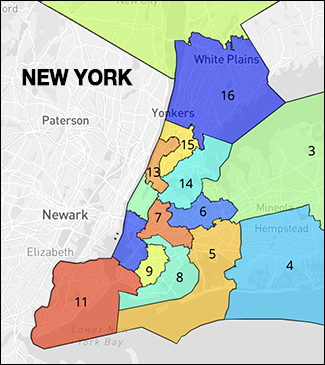
Empire State Congresswoman Nicole Malliotakis (R-Staten Island) previously filed a lawsuit appealing a lower court ruling that declared her 11th Congressional District as a racial gerrymander. Her appeal is before the New York Appellate Division. The initial ruling was made in relation to the New York Voting Rights Act.

This is the first time that a federal political district has been adjudicated under a state voting rights law. While the ruling declared NY-11 as a racial gerrymander, it also included a redraw order that negated the use of the current NY-11 CD in the 2026 election.

Under the New York judicial procedure, a motion to appeal automatically stays the previous ruling until heard by the upper courts. This week, the New York Court of Appeals, the state’s highest court and equivalent to a Supreme Court in most states, released a statement saying they would not hear the case on an expedited basis and further emphasizing that the Appellate Division is the proper authority to rule on the motion.

Therefore, a great deal of confusion remains. If the appellate division fails to act before the New York candidate filing deadline of April 6, would this lead to a postponement of the filing procedure and possibly the June 23 primary? And, if the court delays the filing deadline and potentially the primary, would this apply statewide or just to the 11th Congressional District and the neighboring CDs that a redraw would affect?

Once again, we see another redistricting issue causing widespread confusion. It remains to be seen how the courts rule; until they do at least a portion of the New York congressional map hangs in abeyance.

Utah
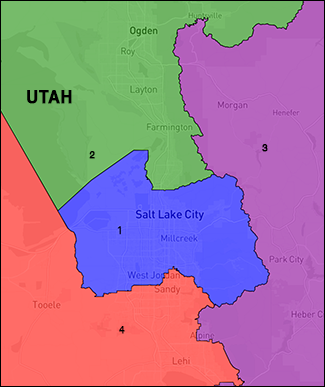
Utah Congressional Districts / Dave’s Redistricting App

In 2025, a Utah court ruled that the Beehive State’s congressional map was illegal because the legislature failed to adhere to voter passed criteria relating to the drawing of congressional districts.

As a result, the court imposed a new map, one that will create a Salt Lake City-anchored seat, labeled District 1, that a Democrat will win. In fact, at this point, about a month before the congressional filing deadline of March 13, no Republican has even announced their candidacy. Therefore, a gain of one Democratic seat under this new Utah map appears certain.

According to a report from The Down Ballot political blog, Republican activists took to the streets and submitted ballot petition signatures to repeal the new map and thereby restore the previous plan. The activists have submitted well over the number of signatures required to qualify a ballot initiative, but whether the signatures adhere to all provisions of the petition law remains unclear.

Not only does a petition need 140,748 signatures, but a specific number must come from various geographic regions. Therefore, whether the petitions submitted meet the regional requirements remains unknown. The election authorities have until March 7 to issue a decision.

It is most likely that the new map will remain in place at least for the 2026 elections. If so, we will see a new Democrat coming from Salt Lake City, along with Congressman Mike Kennedy (R-Alpine) and Rep. Celeste Malloy (R-Cedar City) paired in new District 3. This draw takes UT-3 south and east of Salt Lake City before stretching down the Colorado border all the way to Arizona.

Virginia

Despite a lower court ruling that negated the Virginia attempt to redistrict because the judge ruled that the legislature violated their own rules in order to schedule a redistricting referendum vote, the state Supreme Court is allowing the proposed April 21 referendum to proceed.
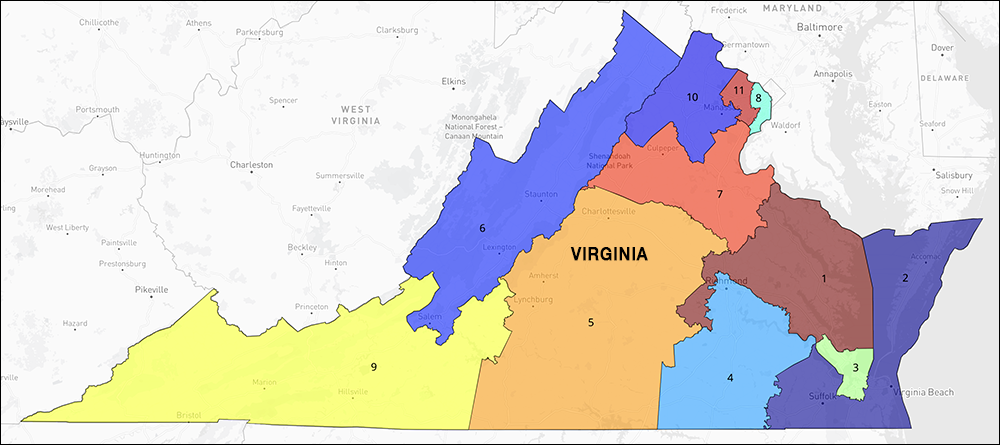
Virginia Congressional Districts / Dave’s Redistricting App

The decision would allow the public to vote on a proposed map, likely without the voters actually seeing the draw, and although the justices indicated they will continue to hear the case and review the previous ruling, the issue of whether the new map will be used for the 2026 election remains unclear.

It is probable, after the referendum vote likely passes that the new map will be in place for the current 2026 election cycle.

This new plan will radically change the state. Currently, the Democrats have six congressional seats in the Virginia delegation and the Republicans’ five. The new plan projects that Democrats could gain four seats, thus making a 10D – 1R delegation.

Some analysts suggest that a 9D – 2R split is more likely, however. Congresswoman Jen Higgins (R-Virginia Beach) would be placed in a 50-50 District 2, and her likely opponent is the woman she unseated in 2022, former Congresswoman Elaine Luria (D). Therefore, the Virginia Beach race might be the tightest in the state. The rest of the GOP members will be likely drawn out of their seats or paired with another Republican.

From a national redirecting standpoint, the Virginia situation is extremely critical because if the Democrats gain four seats here, they very possibly could finish slightly ahead of Republicans in national redistricting if they meet their stated goals in California, Utah, and Virginia.

The national redistricting picture is still cloudy. It is unclear exactly how many new maps will be in place for the 2026 election, and if either party could meet their stated maximum goals regarding the flipping of congressional districts to their side.

Therefore, many unanswered questions remain regarding which maps will be in place for election year 2026 and is largely due to judicial inaction.

The new maps locked into place lie in California, North Carolina, Ohio, and Texas. The states where legal and political challenges remain are Louisiana, still before the US Supreme Court; Missouri, regarding a qualification of a balance initiative that can negate their new map; and Florida, balanced on whether will or not a new map will pass in a special legislative session. Those are in addition to the three states we covered in this column, New York, Utah, and Virginia.

Redistricting After-Effects

Click the map above or this link to go to an interactive version: Dave’s Redistricting App

By Jim Ellis

Feb. 24, 2022 — As more states complete their redistricting process and additional data becomes available, we are beginning to catch a glimpse of each party’s path to either keeping or re-claiming the House majority in the coming midterm election.

The FiveThirtyEight statistical organization along with the Dave’s Redistricting App operation are the two data groups that are charting each district as the states complete their decennial task of drawing new congressional district boundaries.

At this point, we have usable projection data from the two organizations in 350 of the nation’s 435 congressional districts, meaning newly completed maps in all but eight states. (FiveThirtyEight has not yet analyzed the new North Carolina map because the court has not yet given final approval, but Dave’s App has calculated based upon the version now before the judicial panel.) As an aside, several of the outstanding states are large, including Florida (28 congressional districts), Ohio (15 CDs: map was complete but rejected before the state Supreme Court), and Pennsylvania (17 CDs).

At this point we can see, after analyzing each of the 350 completed districts, that redistricting in and of itself will return only a narrow advantage to one party or the other. Considering the still incomplete outstanding states, it is unclear which political entity may earn a slight advantage once the entire process is finalized. Currently, newly created maps are complete (or pending court approval) in 42 states, including five of the six at-large domains whose single-state districts are included in the aforementioned aggregate number.

The FiveThirtyEight projections and Dave’s Redistricting App agree on party advantage in 344 of the completed districts even though they used different mathematical formulas and election complexion to arrive at their conclusions. Therefore, the assigned D or R-plus ratings from FiveThirtyEight consistently align with Dave’s numerical projections for Democratic and Republican strength in each of the 344 CDs.

Of the six districts where the two organizations disagree over party advantage, in each of the half-dozen CDs, the FiveThirtyEight data has projected a stronger Republican number. Three of the six lie in the state of Michigan.

The conflicting districts are:

STATE-DIST MEMBER FiveThirtyEight DAVE R DAVE D
CO-8 NEW SEAT            R+3 46.91% 48.24%
MI-7 SLOTKIN, ELISSA            R+4 47.75% 49.18%
MI-8 KILDEE, DAN            R+1 46.05% 50.84%
MI-10 CREATED SEAT            R+6 47.82% 49.44%
TX-15 CREATED SEAT            EVEN 46.73% 51.02%
VA-2 LURIA, ELAINE            R+6 48.35% 49.58%

(Note: a “New Seat” is one drawn in a state that was awarded an extra seat, or two in the case of Texas, through national reapportionment. A “created seat” is a new open district that came as a result of the redistricting process.)

Totaling the 344 districts where FiveThirtyEight and the Dave’s App are in agreement as to party advantage, the Democrats would gain 12 Republican, new, or created districts; while the GOP would gain 10 Democratic, new, or created seats.

Continue reading

Redistricting Challenges – Part II

By Jim Ellis

Jan. 26, 2022 — Yesterday, we covered the US House members whose districts have changed to the point of having seats where a majority of their new constituencies are unfamiliar. Today, we delve deeper.

To reiterate, a total of 28 states have now completed their redistricting process, and 41 incumbents seeking re-election in these places will be in new seats where a majority of the electorate has not previously seen their names on the congressional ballot.

Interestingly, many of the changes are positive for some of the members in question, because the new constituents are favorable to the incumbent’s party. Others, however, face potentially tough re-nomination or re-election battles, and some will see challenges coming from both Republicans and Democrats.

In 16 specific instances the outlook is seriously negative as nine Democratic members and five Republicans face major challenges toward continuing their congressional careers.

The members in the worst situations are those paired with another incumbent. Illinois Rep. Sean Casten (D-Downers Grove) faces freshman Rep. Marie Newman (D-La Grange). Casten has only a quarter of the new Chicago suburban constituency as compared to Newman’s 42.9 percent carryover factor. Her home base in La Grange, however, is not included in the new 6th District.

Remaining in Illinois, neither paired Republican Reps. Mary Miller (R-Oakland) nor Rodney Davis (R-Taylorville) have large constituencies in the new 15th CD. Rep. Miller has only a 34.7 percent carryover factor from the current 15th but is larger than her opponent’s, Mr. Davis, 30.8 percent figure coming from his 13th CD.

Michigan Rep. Bill Huizenga (R-Holland) has announced that he will run in his state’s new 4th District, meaning a pairing with veteran Rep. Fred Upton (R-St. Joseph). He has only 25.1 percent of his constituents in the new 4th as compared to Upton’s much stronger 68.8 percent carryover factor. Still, Rep. Upton says he is unsure as to whether he will seek re-election to a 19th term.

Staying in Michigan, Rep. Andy Levin (D-Bloomington Township) has decided to enter in a paired battle with Rep. Haley Stevens (D-Rochester Hills). He has only 26.7 percent of his current 9th District constituency in the new 11th CD as compared to Rep. Stevens’ having 46.1 percent coming from her current 11th District. Her home base of Rochester Hills, however, does not carryover, while Rep. Levin’s base in Bloomington Township becomes the anchor population in the new CD.

Continue reading

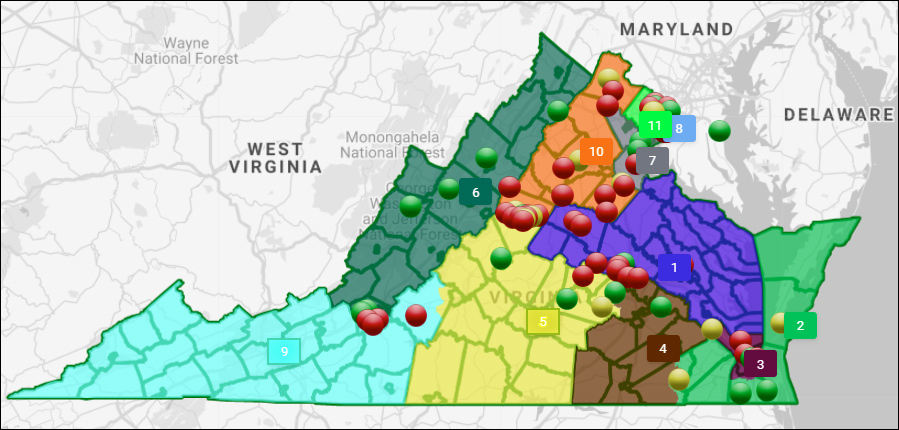
Virginia Map Released

By Jim Ellis

Dec. 13, 2021 — The Virginia congressional redistricting map was just published and it contains some surprises. Unexpectedly, the overall plan features more competitive districts than the current map, and the state’s three female members each drew more difficult political situations. All eight males would have safe seats.

Because the Virginia Redistricting Commission members failed to produce a new congressional map by the stated deadline, the Supreme Court of Virginia was forced to assume map drawing responsibilities. The court hired two special masters, a Democrat and a Republican, to collaborate and produce a new federal map.

The 11-district plan enhances the political competition in two seats when compared to vote totals typically yielded from the current map and creates a new open seat that sets the scene for a highly contested Democratic primary. The districts of Reps. Elaine Luria (D-Norfolk) and Jennifer Wexton (D-Leesburg) clearly become more competitive, while Rep. Abigail Spanberger (D-Glen Allen) has no reasonable place to run.

Instead of placing the new 7th District in the central part of the state beginning in Henrico County where Rep. Spanberger resides, the seat is transferred to Northern Virginia and will occupy all of Prince William and Stafford counties along with the cities of Manassas, Manassas Park, and Fredericksburg in addition to a small piece of southeastern Fairfax County. The FiveThirtyEight statistical organization rates the new 7th as D+14.

Immediately, two Democratic candidates who this year ran statewide — gubernatorial candidate Jennifer Carroll Foy and Hala Ayala, the lieutenant governor nominee — both expressed interest in running for the new seat. Both women are former state delegates. Though the new Prince William-anchored district is numbered seven, none of Spanberger’s current constituents reside here.

First District Rep. Rob Wittman (R-Montross) loses the Northern Virginia region he currently represents and sees his district move west. It picks up the western part of Henrico County and pairs him with Rep. Spanberger. With the statistics projecting the new 1st as R+16, it appears any Wittman-Spanberger campaign would end badly for the Democratic congresswoman.

The remaining parts of the Spanberger constituency have gone to Rep. Donald McEachin’s (D-Richmond) 4th District, and Rep. Wexton’s 10th CD. Such would force Rep. Spanberger to challenge a sitting Democratic incumbent if she were to choose to run in one of these seats. In no situation does Rep. Spanberger have a reasonable victory path.

Continue reading