Category Archives: Primary

Gen. Bolduc Leads;
Gov. McKee Survives

By Jim Ellis — Sept. 14, 2022

The Final Primaries

Retired Army Gen. Don Bolduc (R)

New Hampshire — The last major US Senate primary is close to concluding as retired Army Gen. Don Bolduc, despite being wildly outspent, appears to have turned back state Senate President Chuck Morse’s late race momentum and is staked to a one-point, 37-36 percent lead (1,270 votes) in the New Hampshire Republican Senate primary with 85 percent of the expected vote counted.

Though the margin is tight, it is most likely that Gen. Bolduc will advance into a shortened general election cycle against incumbent Sen. Maggie Hassan (D).

A great deal of controversy surrounded this primary, particularly a verbal sparring battle between Gen. Bolduc and Gov. Chris Sununu (R). Both had unflattering things to say about the other, and now it will be interesting if we see a quick healing between the two. No doubt Democrats will use the governor’s words against Bolduc. Even before the votes were tabulated, however, Gov. Sununu was sending more conciliatory signals and stressing the importance of Republicans uniting to defeat Sen. Hassan, whom he says, “nobody likes.”

Though Bolduc was viewed as the weakest general election candidate in the field of six, head-to-head test polling didn’t show him any further behind Sen. Hassan than those, such as Sen. Morse, who were viewed as the better options to become the Republican standard bearer.

The Republican leadership will now have a difficult decision about how to proceed. Do they invest heavily in this race to back a candidate who they believe is weak even though Sen. Hassan appears vulnerable in a state that could easily swing Republican, or to do they cut their losses early and transfer the funds to another place where their chances for victory might be brighter? It will be interesting to see what they decide.
Continue reading

Final Primary Preview

By Jim Ellis — Tuesday, Sept. 13, 2022

We have finally reached the end of primary season, as voters in three northeastern states will cast their nomination ballots today. Once these votes are counted, all of the stand-alone primary states will have nominated their general election candidates. At that point only Louisiana, which holds its qualification election concurrently with the general, will remain in primary mode.

Each of the states holding their primaries are in the east, with New England’s New Hampshire and Rhode Island on the schedule along with Delaware in the Mid-Atlantic region.

New Hampshire — The most noteworthy primary is the New Hampshire Republican Senate race, complete with its share of controversy. Polling leader Don Bolduc, a retired Army General who ran unsuccessfully in 2020 (failing to prevail in the Republican primary in order to challenge Democratic Sen. Jeanne Shaheen), and Gov. Chris Sununu (R) have been in a public war of words. Gen. Bolduc accused the governor of being a “communist sympathizer” and that his family’s business supports terrorism. The governor retorted that Bolduc is a “conspiracy theory type” who is not “a serious candidate.”

Many in the Republican Party, including Gov. Sununu, believe that Gen. Bolduc will not be a strong enough nominee against Sen. Maggie Hassan (D) even though polling shows that she is vulnerable. The governor has endorsed state Senate President Chuck Morse (R-Salem), who seems to be the only viable competitor who could deny Bolduc the nomination among the 10 others on the ballot.

The latest available Senate poll, this from the University of New Hampshire (Aug. 25-29; 892 likely New Hampshire Republican primary voters; online), found Gen. Bolduc leading Sen. Morse, 43-22 percent. Since this poll was conducted, however, some $4 million has been spent attempting to deny Bolduc the nomination, and Democratic organizations have come from the outside to help him win the primary since they, too, believe that he would be easiest for Sen. Hassan to beat.

The retired General is at an extreme financial disadvantage, so he has little ability to promote himself. This race will draw the most attention tonight.

New Hampshire’s two congressional districts also feature competitive Republican primaries. Both seats will be hotly contested in the general election because Reps. Chris Pappas (D-Manchester) and Annie Kuster (D-Hopkinton/Concord) are clear Republican targets.

Another crowded ten-person Republican 1st District primary appears to be coming down to a battle among 2020 nominee Matt Mowers, who held Rep. Pappas to a 51-46 percent re-election victory before an electorate that has defeated more incumbents than any other in the nation, former Trump White House aide Karoline Leavitt, and ex-television news reporter Gail Huff Brown, wife of former Massachusetts Sen. Scott Brown (R). Polling suggests that Mowers has the slight edge heading into election day.

In the western 2nd District, the Republican race is a two-way battle between former Hillsborough County Treasurer Robert Burns and Keene Mayor George Hansel. Should Burns win the GOP nomination, and polling suggests he will, his challenge opposite Rep. Kuster will be formidable.

Rhode Island — The most notable race on the Rhode Island card is the Democratic primary for governor. Dan McKee assumed the governorship when incumbent Gina Raimondo (D) resigned to accept her appointment as US Commerce Secretary.

The new governor, running for a first full term in his own right, has four Democratic challengers, and a close outcome in tomorrow’s primary is expected. McKee’s four opponents are Secretary of State Nellie Gorbea, businesswoman Helena Foulkes, former Secretary of State Matt Brown, and physician Luis Daniel Munoz. It appears the race is winnowing to a battle between Gov. McKee and Gorbea. Today’s winner becomes the prohibitive favorite in the general election.

Delaware — With no governor or senator on the ballot this year, the Delaware primary is basically a non-event. At-large Rep. Lisa Blunt Rochester (D-Wilmington) is unopposed in the Democratic primary, and educator/actor Lee Murphy is the only candidate on the Republican side. The general election will not be competitive, since Rep. Blunt Rochester is a lock for re-election.

Close Polling in Washington; NH-1 Still Undecided; Survey in NY Shows Gov. Race Tightening

By Jim Ellis — Wednesday, Sept. 7, 2022

Senate

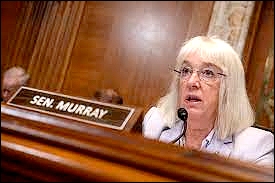
Washington Sen. Patty Murray (D)

Washington: Despite Jungle Vote, Close Polling — After a strong showing in the Washington jungle primary on Aug. 2 when Sen. Patty Murray (D) placed first with a 52-34 percent spread over veterans’ advocate and former nurse Tiffany Smiley (R), a new Trafalgar Group survey finds a surprisingly close general election count. The Trafalgar survey (Aug. 30-Sept. 1; 1,087 likely Washington general election voters; multiple sampling techniques) yields a ballot test with a Murray advantage of only 49-46 percent, the closest result we have seen since the primary.

The only other post-primary survey came from McLaughlin & Associates, like Trafalgar, a Republican pollster (Aug. 15-17; 500 Washington likely general election voters; live interview & text). This ballot test featured a similar, but slightly stronger margin for Sen. Murray. The result broke 49-43 percent, just beyond the polling margin of error.

The McLaughlin poll found the respondents believing the country is on the wrong track by a major 24:68 percent margin, but President Biden’s favorability index was 48:51 percent favorable to unfavorable, one of his better marks in the country. Sen. Murray remains the favorite in this election, but the polling margins are tighter than what one would have predicted based upon Washington voting history and the actual jungle primary results.

House

NH-1: Primary Still Undecided — The University of New Hampshire released their latest Granite State Poll (Aug. 25-29; 1,993 New Hampshire online panel members; 419 NH-1 likely Republican primary voters; online) and, like the Remington Research Group survey concluded eight days earlier, sees a dead heat in the 1st Congressional District’s Republican primary. The UNH survey finds 2020 congressional nominee Matt Mowers holding a slight 26-24 percent edge over former Trump White House aide Karoline Leavitt with former news reporter Gail Huff Brown, the wife of ex-Sen. Scott Brown (R-MA), trailing at 16 percent.

The Remington ballot test (Aug. 14-17; 462 NH-1 likely voters; live interview & text) saw a 21-21 percent tie between Mowers and Leavitt with Brown attracting just nine percent support. Clearly, the Sept. 13 primary will feature a very close finish. The winner will then immediately move into a competitive race with second-term Rep. Chris Pappas (D-Manchester) in a district that has defeated more incumbents than any other seat in the nation since 2004.

NH-2: Clear GOP Primary Leader — The University of New Hampshire’s Granite State Poll also tested the competitive western NH-2 District (Aug. 25-29; 1,993 New Hampshire online panel members; 469 NH-2 likely Republican primary voters; online) and projects that former Hillsborough County treasurer Robert Burns holds a 32-18 percent advantage over Keene Mayor George Hansel. The winner will then advance into a competitive race against five-term Rep. Annie Kuster (D-Hopkinton/Concord) in November.

Governor

New York: New Closer Survey — The Trafalgar Group and Insider Advantage teamed to produce a New York gubernatorial survey (Aug. 31-Sept. 1; 1,019 likely New York general election voters; multiple sampling techniques). Their ballot test yielded Gov. Kathy Hochul (D) and US Rep. Lee Zeldin’s (R) closest result. The Trafalgar/IA responses posted the governor to a 48-43 percent edge. The most recent previous poll, from Survey USA (Aug. 17-21; 1,200 New York adults; 1,046 registered voters; 715 likely New York governor election voters; online) found a 51-33 percent spread in Gov. Hochul’s favor.

Examining the Role of the RCV System in Alaska’s Special Election; Rep. Crist Resigns in Fla.; Indiana “Shock” Poll

By Jim Ellis — Friday, Sept. 2, 2022

House

Sarah Palin (R)

AK-AL: Sarah Palin Loses Special Election — The headline here is that former Alaska governor and 2008 GOP vice presidential nominee Sarah Palin fell to Democrat Mary Peltola in the at-large Alaska special election, and the first full usage of the state’s new Ranked Choice Voting (RCV) system was fully in play. Yesterday we reported the results; today we’ll delve into the RCV system that delivered those results.

At the end of the final counting, which was when the Aug. 16 deadline to accept ballots in the primary election expired, 60 percent of voters chose a Republican candidate. However, the RCV system yielded a Democratic victor. Therefore, in a system that is designed to create a majority candidate, in this case the RCV system produced a minority vote share winner.

The finalists from the jungle primary election began with Peltola, who recorded 40.2 percent of the vote. Palin secured 31.3 percent, and Nick Begich III (R) captured 28.5 percent. Begich III is the grandson of former Democratic US Rep. Nick Begich, Sr. (D), and the nephew of former US senator and ex-Anchorage Mayor Mark Begich (D). In finishing third, Begich was eliminated from further competition, and his first-place votes were located and then allocated to the remaining two candidates via the voters’ ranking.

Former state Rep. Mary Peltola (D) winner of the Alaska special election race.

As we predicted, based upon the experiences of other states and cities that have used the RCV system, a large number of votes were disqualified, or “exhausted” to use the Alaska vernacular.

Of the 192,158 individuals who participated in the special election and/or regular primary, a total of 3,401 ballots were listed as “blank,” meaning the individuals voted in the election but bypassed the special congressional contest. Another 342 ballots were categorized as “overvotes.” This terminology suggests the owners of such ballots voted incorrectly. Typically, it means the individual, presumably inadvertently, voted more than once for the same candidate, thus disqualifying the ballot.

The categories that likely cost Palin the election, despite the large majority voting for a Republican candidate, came in RCV’s Round 2. In that round, a total of 11,222 Begich voters did not properly manage the RCV system on their ballots, which was to rank the three candidates in the order of the individual voter’s preference.

Lawyers who challenged the RCV system in other places around the country warned that their experience showed a large number of disqualified, or “exhausted,” ballots would be present here, which certainly proved to be the case.

This latter number added to the initial overvotes, meant a total of 11,269 Begich first-place voters saw their ballot disqualified, more than twice the number of votes (5,219) that comprised Palin’s deficit against Peltola’s final victory total. Adding this number to those who chose to bypass the special congressional race meant that 14,965 individuals who voted in this election failed to have their ballot count in the RCV process.

The second category leading to Palin’s demise were the 15,445 individuals who voted for Begich on the first ballot, but decided to support Peltola with their second choice. This is a much higher number than our pre-election estimate projection, and are chiefly responsible for the ex-governor failing to win the general election.

A possible reason that some of these voters chose Peltola is that the Begich name identification comes from the current candidate’s family predecessors mentioned above who were, and are, affiliated with the Democrats. It is possible that the multiple confusion factors present in this race also extended to Begich’s name, with many traditional Democratic voters still thinking he is a member of their party and not noticing his Republican label on the ballot.

Also adding to the confusion factor was the RCV system being used only in this special general election that was run concurrently with the regular state primary. In all other races on Aug. 16, voters were simply choosing one candidate to advance into the general election, where four jungle primary candidates from each race would do so. Therefore, the almost 15,000 ballots being disqualified before the end of the RCV special election process suggests a large amount of confusion within the electorate.

With the same three finalists again advancing into the regular election from the regular congressional primary, which was also held on the same day (Aug. 16), thus producing one more confusion factor, we could see a rerun of the RCV results in the November election. If either Palin or Begich were to withdraw from the regular general election, however, Peltola’s fate would then likely be sealed, since the Republican vote would then presumably overwhelm the number of her Democratic preference ballots.

While the intrigue associated with this one race has now been resolved, new questions will immediately begin to unfold for the impending general election. For now, however, Mary Peltola will be sworn in as the House of Representatives’ newest member.

FL-13: Rep. Crist Resigns — Congressman Charlie Crist (D-St. Petersburg) resigned his Pinellas County-anchored US House seat Wednesday in order to fully concentrate on his gubernatorial campaign. Crist won the statewide Democratic primary on Aug. 23 and will face Gov. Ron DeSantis (R) in the general election. Another member of the Florida congressional delegation, Rep. Ted Deutch (D-Boca Raton), who announced in February that he would leave Congress to become the CEO of the American Jewish Committee, will reportedly officially resign on Oct. 1.

With the Crist and Deutch resignations, the Democrats will be down to 220 seats in the House even after adding New York Rep. Pat Ryan (D-Poughkeepsie) after his special election victory certification and the Alaska at-large seat where Democrat Mary Peltola was declared the special election winner. It is unclear if Gov. DeSantis will call a special election to fill the Florida vacancies or just leave them vacant until the new term begins in January.

Senate

Indiana: Shock Poll — Hoosier State Democratic US Senate nominee Tom McDermott’s campaign released the results of their recently conducted Change Research poll (Aug. 20-24; 2,111 likely Indiana general election voters; online), which posted Sen. Todd Young (R) to only a 45-42 percent lead. The Indiana Senate race had been considered non-competitive. The Young campaign responded with criticism over the online methodology and weighting system that Change Research employs. Expect the Young campaign to quickly counter this data with a poll release of their own.

Governor

South Carolina: Gov. McMaster Leading in Consecutive Polls — In a race that had not been polled during the general election period to-date, two new surveys were released on consecutive days. Yesterday, we reported that Gov. Henry McMaster (R) led in The Trafalgar Group survey (Aug. 25-28; 1,071 likely South Carolina general election voters; multiple sampling techniques) by a 51-43 percent margin over former Congressman Joe Cunningham, who won the Democratic nomination back in the June primary.

The next day’s polling release featured a survey from the Democratic firm, Blueprint Polling (Aug. 24-25; 721 likely South Carolina general election voters; live interview), that actually posted McMaster to a larger lead than the Trafalgar result, 50-39 percent.

Palin Loses in Alaska; Walker Leads in Second Poll in Georgia, Kemp Holds Edge; Gen. Bolduc Again Leading in NH; Gov. McMaster’s SC Quest

By Jim Ellis — Thursday, Sept. 1, 2022

House

Former state Rep. Mary Peltola (D) wins the Alaska special election race.

AK-AL: Sarah Palin Loses Special Election — Former Alaska governor and 2008 GOP vice presidential nominee Sarah Palin fell to Democrat Mary Peltola in the at-large Alaska special election, which marked the first full usage of the state’s new Ranked Choice Voting system.
At the end of the final counting, 60 percent of voters chose a Republican candidate, but the RCV system yielded a Democratic victor. Therefore, in a system that is designed to create a majority candidate, in this case it produced a minority vote share winner.

The finalists were Peltola, who recorded 40.2 percent of the vote; Palin, who secured 31.3 percent, and Nick Begich III (R), the grandson of former Democratic US Rep. Nick Begich, and the nephew of former US senator and ex-Anchorage Mayor Mark Begich (D), who captured 28.5 percent. Finishing third, Begich was eliminated from further competition, and his first-place votes were located and then distributed to the other candidates via the voters’ ranking. In the end, Peltola defeated Palin by a 5,219 votes; another 14,965 ballots were disqualified in the Ranked Choice Voting process.

Senate

Georgia Sen. Raphael Warnock (D) and Republican challenger Herschel Walker[/caption]Georgia: Walker Leading in Second Poll — Previously, an early August Phillips Academy poll projected Republican Herschel Walker to be holding a slight 45-44 percent lead over Sen. Raphael Warnock (D) after trailing in seven of eight July surveys. Emerson College released the result of their most recent Georgia survey Tuesday (Aug. 28-29; 600 likely Georgia general election voters; interactive voice response system, text, and online), which found Walker posting an almost identical 46-44 percent edge, again providing more evidence that this race is a long way from being over.

New Hampshire: Gen. Bolduc Again Leading — In mid-August, when St. Anselm College released a survey showing retired Army general and 2020 US Senate Republican candidate Don Bolduc developing a substantial lead for the Sept. 13 GOP Senate primary, Gov. Chris Sununu (R) went public in an attempt to negate his advantage. Many believe, including Gov. Sununu, that Gen. Bolduc would lose to Sen. Maggie Hassan (D) in November. Previously, Gen. Bolduc had accused Gov. Sununu of being “a Chinese communist sympathizer,” among other comments that created bad blood between the two men.

The University of New Hampshire (Aug. 25-29; 892 likely New Hampshire Republican primary voters; online) reported the results of their new statewide survey. According to the UNH Granite State Poll, Gen. Bolduc continues to lead state Senate President Chuck Morse (R-Salem) by over 20 points, 43-22 percent, with three other candidates languishing in low single digits.

Georgia: Kemp Again Holds Advantage — The aforementioned Emerson College survey (see Georgia Senate above) also tested the Peach State governor’s race between incumbent Brian Kemp (R) and challenger Stacey Abrams (D) who returns for a re-match from their close 2018 contest. The Emerson results give Gov. Kemp a 48-44 percent edge, which appears as a consistent margin routinely found in eleven of 12 July-August polls in which the incumbent held an edge. The lone outlier poll, a Research Affiliates study that concluded on Aug. 1, found the two candidates tied at 47 percent apiece.

South Carolina: Gov. McMaster Leading in Re-election Poll — Gov. Henry McMaster (R) succeeded then-Gov. Nikki Haley (R) when she resigned her office in 2017 to become US Ambassador to the United Nations. McMaster would then win a full term in 2018, and now seeks re-election. Because of the state’s former one and now two-term limit, winning re-election this year and serving most of the next term would make McMaster the longest-serving governor in state history.

The Trafalgar Group, as part of their nationwide polling series (Aug. 25-28; 1,071 likely South Carolina general election voters; multiple sampling techniques) tested the Palmetto State electorate and sees Gov. McMaster jumping out to a 51-43 percent lead over former Congressman Joe Cunningham, who won the Democratic nomination back in the June primary. Four years ago, Gov. McMaster was re-elected with a 54-46 percent margin.

Polling Conflict in Nevada;
Dr. Oz Draws Closer in PA;
Two Polls, Different Results

By Jim Ellis — Aug. 29, 2022

Senate

Nevada Sen. Catherine Cortez Masto (D)

Nevada: Polling Conflict — The Nevada Senate race is one of the most competitive and important statewide contests in this midterm election cycle, and two polls conducted within the same sampling realm report drawing opposite conclusions. Suffolk University, polling for the Reno Gazette Journal (Aug. 14-17; 500 likely Nevada general election voters; live interview), projects Sen. Catherine Cortez Masto (D) to be leading former Attorney General Adam Laxalt (R), 45-38 percent. Conversely, The Trafalgar Group (Aug. 15-18; 1,082 likely Nevada general election voters; multiple sampling techniques) sees a complete opposite picture. They find Laxalt holding a three-point edge, 47-44 percent.

It is not particularly surprising to see The Trafalgar Group with different results since their polling methodology is unique. Their accuracy rate, however, is among the best in the survey research industry.

Pennsylvania: Oz Drawing Closer — Despite what even a casual observer would perceive as Pennsylvania Republican Senate nominee Mehmet Oz’s campaign going poorly, two new statewide surveys find him trailing Lt. Gov. John Fetterman (D) by only four percentage points as the two research firms arrived at exactly identical ballot test results.

The pollsters, The Trafalgar Group (Aug. 15-19; 1,087 likely Pennsylvania general election voters; multiple sampling techniques) and Emerson College (Aug. 22-23; 1,034 likely Pennsylvania general election voters; interactive voice response system, online & text) both see Fetterman leading Dr. Oz, 48-44 percent. On the other hand, the new Franklin & Marshall College poll (Aug. 15-21; 522 registered Pennsylvania voters; live interview), with a much higher error rate than the other two, finds Fetterman’s advantage to be 43-30 percent.

House

MI-10: Two Polls, Same Time, Different Results — Regular Michigan pollster Mitchell Research, again surveying for the Michigan Information & Research Service (Aug. 16-21; 429 ikely MI-10 lgeneral election voters), finds former US Senate Republican nominee John James leading ex-Macomb County prosecutor Carl Marlinga (D), by a 47-38 percent clip, well beyond the polling margin of error. The Marlinga campaign countered with a Target Insyght survey (Aug. 16-18; 400 likely Michigan general election voters) that gives their candidate, Marlinga, a slight 47-45 percent edge. The new 10th was drawn as a highly competitive district, so a close finish here is clearly on the political horizon.

Governor

Pennsylvania: Same Pattern as Senate — The three pollsters that tested the Pennsylvania Senate race, The Trafalgar Group, Emerson College and Franklin & Marshall College (see PA Senate above) the same partisan pattern is also appearing in the governor’s race. The Trafalgar and Emerson results are similar, and the F&M conclusion greatly differs, though they all agree on the race order.

In the governor’s race, The Trafalgar Group finds Attorney General Josh Shapiro (D) leading state Sen. Doug Mastriano (R-Fayetteville), 49-45 percent, while Emerson posts a similar 47-44 percent division. Like in the Senate race, Franklin & Marshall sees the Democratic performance in much better position. Their ballot test projects AG Shapiro with a stronger 44-33percent advantage. The stated margin of error factor on the Trafalgar poll is 2.9, while Emerson’s is an almost identical 3.0. The F&M error factor, however, is listed as 4.3percent.

Updated Alaska Results; First Poll From Arizona’s New 6th District; A Resolution in NY-10?

By Jim Ellis — Friday, Aug. 26, 2022

House

Sarah Palin, former Alaska governor and vice presidential candidate, now running for US House Representative

AK-AL: Updated Results — Alaska officials have updated the election totals as more ballots have been received, counted, and recorded. Under Alaska voting procedure, ballots can still be accepted from the outlying rural regions until Aug. 31 as long as they were postmarked on primary day, Aug. 16.

In the special election to fill the remainder of the late Rep. Don Young’s (R) current term, Democratic state Rep. Mary Peltola maintains the lead with an adjusted 38.9 percent of the vote. Former governor and 2008 vice presidential nominee Sarah Palin is second with 31.4 percent of the vote, a total of 5,630 votes ahead of third-place finisher Nick Begich III (R). Palin has maintained this 5,000-plus vote margin over Begich for virtually the entire counting process. Second place is critical, since the first two finishers will advance into the Ranked Choice Voting round.

State officials estimate that approximately 90 percent of the votes are now recorded. This means another 20,000 ballots could be outstanding. If so, calculations suggest that Begich would have to garner approximately 73 percent of the vote pool that remains for a Republican candidate. So far, he has only received 47.2 percent of the ballots that were marked for either he or Palin. Should this standing hold, Palin would need approximately 40 percent of the Begich second choice votes to overtake Peltola and win the special election. This is a reasonable number, but her biggest problem could be the number of votes that are disqualified in the second round for mis-marking the multiple entries due to voter confusion over the new system.

Votes are also being counted for the regular House primary election where the top four finishers will advance into the regular general election. Like in the special general election, the top three finishers kept the same order, Peltola-Palin-Begich. The person currently running fourth, Republican Tara Sweeney, who has only four percent of the vote, says she will not continue if she qualifies. The Board of Elections officials ruled that when Independent candidate Al Gross withdrew from the competition after qualifying for the special general that only three would then advance. Therefore, we are likely to see a rerun of this special general election in the regular November vote.

AZ-6: First Poll, No Surprise — Democratic pollster Greenberg Quinlan Rosner Research released the first post-primary survey of Arizona’s new 6th District, the seat located in the southeast corner of the state that encompasses the largest part of the city of Tucson. The district leans slightly Republican, R+6 according to the FiveThirtyEight data organization with a partisan lean index of 52.0-R – 47.1-D from Dave’s Redistricting App.

The GQR survey (Aug. 16-21; 500 likely AZ-6 general election voters; live interview) finds Democratic former Tucson state senator and representative Kirsten Engel posting a two-point lead over ex-Hispanic Chamber of Commerce official Juan Ciscomani (R), 49-47 percent. This is Ciscomani’s first run for elective office.

NY-10: Candidates May Return for General Election — Once all of the thousands of yet-to-be-counted mail ballots are finally tabulated and recorded, it is projected that attorney Dan Goldman (D) will win the crowded open seat Democratic primary. NY election officials are not releasing any new results until Aug. 31, they’ve announced, and it could take as long as just before the Sept. 9 primary election certification deadline to officially crown a party primary winner in this and other races.

Goldman, however, may face another electoral hurdle before taking the seat. He did not hold the Working Families ballot line, and this liberal political party has a slot in the general election. Rep. Mondaire Jones (D-Westchester County), who left his 17th District to run for re-election in the new 10th, failed to win the primary but does carry the WFP endorsement in his previous district. There is an argument that Jones would be entitled to the ballot line in this election.

The Working Families Party, however, endorsed state Assemblywoman Yuh-Line Nioh (D-Manhattan) instead of Rep. Jones for this election, thus a dispute is beginning to arise as to who would represent the party in the 10th District general election. Having the ballot line would give one of these two the opportunity of challenging Goldman for the seat in the general election. At this point, Rep. Jones is indicating he would not pursue running in the general election, thus leaving the ballot line for Nioh.