Monthly Archives: October 2026

Utah’s Congressional Numbers

By Jim Ellis — Thursday, October 2, 2026

House
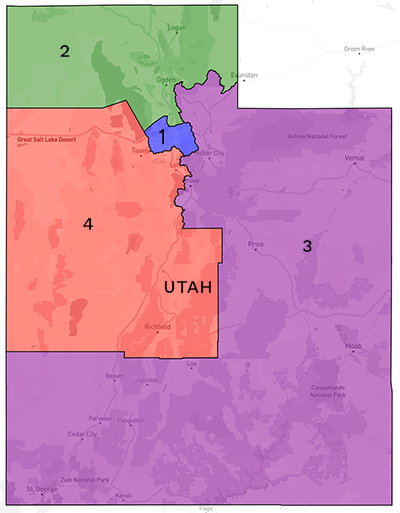
Utah Congressional Districts (Dave’s Redistricing App)

A polling firm has released a full set of surveys in each of Utah’s four newly redrawn congressional districts, and several results suggest closer‑than‑expected contests.

All three Republican incumbents seeking re‑election (a fourth, Rep. Burgess Owens, is retiring) post tighter margins than their voting histories would imply. The lower ballot scores, however, likely stem from each incumbent being forced to represent significantly new territory. With voters less familiar with their new representatives, undecided rates rise accordingly.

Lighthouse Research conducted the polling series for the Hinckley Institute of Politics at the University of Utah and the Utah Debate Commission. Each survey was fielded between Aug. 31 and Sept. 24 and released on Sept. 29. The four polls sampled between 508 and 515 registered voters per district, using live telephone interviews and online participation.

In the new 1st District, drawn specifically to elect a Salt Lake City Democrat, former Congressman Ben McAdams is a lock to win the general election. He leads Republican Riley Owen by a commanding 63-21 percent.

Creating this district, which contains downtown Salt Lake City along with West Jordan, West Valley City, Millcreek, and Taylorsville, was the focal point of the entire redistricting process and the reason the courts mandated a redraw. Democrats were effectively awarded the seat, giving the party a guaranteed place at the delegation table. The Dave’s Redistricting App (DRA) partisan lean of 56.2D – 39.7R is about as Democratic a district as can be reasonably drawn in Utah.

In District 2, Rep. Blake Moore (R-Salt Lake City) leads Democrat Peter Crosby by a closer‑than‑expected 39-34 percent in the Lighthouse poll. The new 2nd District lies along the Nevada, Idaho, and Colorado borders and includes North Salt Lake City, Ogden, Logan, Farmington, Brigham City, and Layton. With a DRA partisan lean of 65.6R – 20.1D, the Republican nominee is a prohibitive favorite in any general election.

While most of Rep. Moore’s former 1st District remains within the new 2nd, he loses his northeastern Salt Lake City base, altering the district’s population complexion. His underwhelming 57-43 percent GOP primary win over state Rep. Karianne Lisonbee (R-Clearfield) reflected lingering doubts among Republican voters, but Rep. Moore will easily win in November regardless of this latest poll.

District 3 finds Rep. Celeste Maloy (R-Cedar City) leading Democrat Kent Udell by a comfortable 45-26 percent margin. Rep. Maloy now runs in a district very different from her previous 2nd District seat.

Formerly representing the western sector south of Salt Lake City along the Nevada border all the way to Arizona, her new 3rd District begins east of Salt Lake City, moves south to Arizona, and then cuts west in southern Utah to include her home base in Cedar City and St. George.

With a DRA partisan lean of 70.1R – 24.7D, the new 3rd is the state’s strongest Republican district. The Congresswoman’s toughest race, the GOP primary, which she won 66-34, is already behind her.

Finally, in the new 4th District, freshman Rep. Mike Kennedy (R-Alpine) leads Democrat Jonny Larsen 42-33 percent. Like Rep. Maloy, Kennedy will represent a completely new sector of the state, shifting from east to west.

The new 4th contains most of the Jordan Valley south of Salt Lake City, including Sandy, Lehi, and Pleasant Grove. With a DRA partisan lean of 67.5R – 27.8D, Rep. Kennedy will have little difficulty winning in November while he becomes acquainted with his new constituency.

The bottom line from a national context is the Democrats will gain one seat in the Utah delegation, but the remaining Republicans all control safe political districts for as long as this map stands.
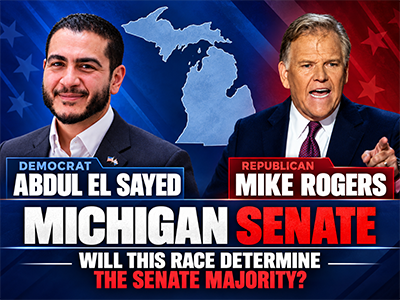
Close Race Watch: Michigan Senate

By Jim Ellis — Thursday, October 1, 2026

With the Senate majority up for grabs, the Michigan race continues to be the national point race toward determining which party controls the chamber in the next Congress.

If GOP nominee Mike Rogers wins the race, thus converting a Democratic seat to the Republican column, it becomes very difficult for Democrats to capture enough Republican seats elsewhere to overcome their current 53-47 deficit. If Democrat Abdul El Sayed prevails — combined with the North Carolina seat likely flipping to the Democrats — the path toward the net four seat gain needed to eclipse the Republican majority becomes considerably more achievable.

Republican Rogers, a former seven term Congressman who lost the 2024 open Senate race by just 19,006 votes out of more than 5.5 million cast despite being outspent by a 6:1 ratio, returns with a stronger chance to win in 2026.

Democrats nominated former Wayne County Health, Human, and Veterans Services Department Director El Sayed in a much closer primary than polling had projected. Nine pollsters found him leading by an average of 15 points heading into the August primary, yet he won by only one point — and even failed to carry his home county.

In the general election, polling consistently shows a small El Sayed lead, but those numbers may be deceiving. Polling aggregators — 270toWin, Decision Desk HQ, FiftyPlusOne, RealClearPolitics, and the Silver Bulletin — place his cycle to date advantage between 3.0 and 3.2 points. Since the Aug. 4 primary, the average has slipped to 2.8.

For comparison, at the beginning of October during Rogers’ 2024 campaign, Democrat Elissa Slotkin’s polling advantage averaged 6.4 points across 35 surveys conducted from the Aug. 6 primary through Oct. 1. In the final month, Rogers nearly erased the entire margin, with Slotkin ultimately winning by just three-tenths of one percentage point.

Therefore, combining Rogers under-polling in the 2024 general election and El-Sayed’s considerable over-polling in the 2026 Democratic primary suggests that we will again see another close finish in this most critical of Senate campaigns.

Resources are not a problem for either nominee. Through the July 15 pre-primary Federal Election Commission disclosure report, El-Sayed had raised $14.5 million while Rogers had attracted $10.8 million. Because El-Sayed had to overcome two strong Democratic opponents, his available assets were less during the last reporting period. He held $2.2 million, most of which would be spent in the final days before the Aug. 4 primary, whereas Rogers had $4.5 million, most of which he held over for the general election.

Outside spending is heavy on both sides, with media reports suggesting roughly $55 million has been spent on Rogers’ behalf and about $45 million aiding El Sayed.

With President Trump’s approval numbers in the lowest range of his career and gas and grocery prices remaining high, the political climate — and Michigan’s statewide voting history — cuts in El Sayed’s favor. Conversely, El Sayed’s weak primary performance relative to his polling, and his failure to carry Wayne County — signaling limited strength within the Black electorate — gives Rogers a legitimate opening to assemble a winning coalition.

As is the case in virtually every competitive race this cycle, the candidate who maximizes turnout within their own party, rather than mastering the difficult task of persuading wavering voters from the other side, will prevail. At this point in the pivotal Michigan Senate race, it remains to be seen who will perform better.