Tag Archives: California

Calif. Rep. Alan Lowenthal to Retire

By Jim Ellis

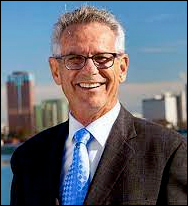
California Rep. Alan Lowenthal (D-Long Beach)

Dec. 20, 2021 — California Congressman Alan Lowenthal (D-Long Beach) announced late last week that he will not seek a sixth term in the House next year becoming the 18th Democratic member to either retire or run for another office.

Rep. Lowenthal, 80, will have been in elective office for 30 consecutive years at the completion of this term, including his time in the California Senate, State Assembly, and on the Long Beach City Council. Prior to venturing into elective politics, Lowenthal was a college psychology professor at the California State University at Long Beach.

The congressman’s 47th District is a small urban CD that contains parts of Los Angeles and Orange Counties. He represents the cities of Long Beach and Signal Hill in LA County, and Cypress, Westminster, and Garden Grove in Orange County. His district also is home to the Port of Long Beach, which is the largest container terminal in the nation, and is one of the key reasons Lowenthal sits on the Transportation and Infrastructure Committee.

With a second California open seat coming in a period of just over a week — Rep. Devin Nunes (R-Tulare) announced Dec. 6 that he would resign — redistricting strategy could significantly change. The California Citizens Redistricting Commission members are in the process of developing a new congressional map.

California loses a seat in reapportionment, and the population numbers suggest that one of the Los Angeles area seats will be collapsed. Rep. Lowenthal’s district appeared to be one of the prime targets for elimination. The first draft map, however, yields a collapsing of Rep. Karen Bass’ 37th CD in the Culver City area largely because she announced her campaign for mayor of Los Angeles early, thus giving everyone advance notice that she would not be seeking re-election to the House. The Lowenthal retirement coupled with Nunes’ in the Central Valley, however, could change the redistricting strategy.

A total of 18 congressional districts touch Los Angeles County. Nine are fully contained within the county boundaries, while the other nine, such as Rep. Lowenthal’s 47th District, expand into neighboring domains. All 18 require more residents to meet the new state per district population quota of 760,350 individuals. CA-47 needs an additional 45,679 people to reach the resident requirement, making it the 13th highest California CD that requires increased population.

Rep. Bass’ district, one of the nine fully contained within LA County, ranks 17th among the California CDs needing more people, translating to 38,173 bodies.

Continue reading

Rep. Devin Nunes to Resign

By Jim Ellis

Ten-term US Rep. Devin Nunes (R-CA)

Dec. 8, 2021 — Ten-term US Rep. Devin Nunes (R-CA) will leave Congress at the end of this year according to an announcement made late Monday.

Rep. Nunes, the ranking Republican on the House Intelligence Committee and the man who appeared to have the inside track to become chairman of the House Ways & Means Committee if the Republicans re-gain the chamber majority next year, will become CEO of the Trump Media & Technology Group that former President Donald Trump is launching.

While the congressman, who was first elected in 2002 to his Central Valley California seat, will leave the legislative scene, he certainly will still be very active in politics as he attempts to position a new social media platform that will give right of center individuals a greater voice in the public issues discussion arena.

“The time has come to reopen the Internet and allow for the free flow of ideas and expression without censorship,” Nunes was quoted as reported in the New York Post. “The United States of America made the dream of the Internet a reality and it will be an American company that restores the dream. I’m humbled and honored President Trump has asked me to lead the mission and the world-class team that will deliver on this promise,” Nunes concluded.

Rep. Nunes’ departure creates major change in the Central Valley’s politics. His current 22nd District is one of the just seven California districts that Trump carried in the 2020 presidential election campaign.

One would think that a special election would be called with a year remaining on the term, but in a similarly timed situation in 2020, when then-Rep. Duncan Hunter (R) resigned in January, such was not the case. Gov. Gavin Newsom (D), taking advantage of a quirk in California election law, was able to leave Hunter’s 50th District – like the Nunes seat, a safe Republican domain – vacant for the balance of the entire year.

Considering that the likely special election winner in the Nunes Fresno County-anchored district would be a Republican, and cognizant of the ongoing redistricting process, it is entirely possible that Newsom will again let the seat remain vacant for all of 2022.

Continue reading

The Open and Collapsed Seats

By Jim Ellis

A look at how things might play out in key states in the redistricting tug of wars

Dec. 2, 2021 — In a redistricting year, tracking the open seats can be a bit confusing. Not only do we record retiring members and those seeking other offices, as we do in every election cycle, but in a redistricting year we also see new seats awarded to states in reapportionment, new districts created through map drawing, and collapsed seats. This, in addition to members being paired and certain incumbents choosing to run in districts other than the one they currently represent.

The open seat numbers have grown significantly during the past month. As a result, we see 24 members leaving their current districts either for retirement or to run for another office. Sixteen are from the majority Democratic conference, with eight coming from their Republican counterparts.

One seat, FL-20, remains in special election cycle and will be filled on Jan. 11. At that point, the House will have its full compliment of 435 members for the first time in this Congress.

Reapportionment changed locations within states for seven congressional seats, and map drawing has added an additional four new seats to date for a total of 11 nationally. The new seats also lead to a commensurate number of incumbent pairings or collapsed districts.

Adding the numbers from all of these categories tells us that 43 House seats have been affected in addition to four members who have declared for seats they don’t currently represent.

The collapsed seats tell their own story. In this category, certain members have nowhere to run, typically in states that lost a seat in reapportionment. In many instances, the member without a place to run is one who had previously indicated that he or she is leaving the House.

In California, the first draft redistricting map shows that Rep. Karen Bass’ (D-Los Angeles) seat would be the one collapsed, because the state is, for the first time in history, losing a district. Bass, however, previously announced that she is running for mayor of Los Angeles, so seeing her seat as the one forfeited was not a surprise.

Illinois Rep. Adam Kinzinger (R-Channahon) was geographically in a difficult position because the map drawers needed the leftward voters in his district to enhance two adjoining Democratic seats. Therefore, he became the odd man out.

Continue reading

California Rep. Jackie Speier to Retire

California Rep. Jackie Speier (D-Hillsborough/San Mateo)

By Jim Ellis

Nov. 18, 2021 — The second congressional retirement of the week was announced Tuesday as veteran California Rep. Jackie Speier (D-Hillsborough/San Mateo), following Vermont Sen. Patrick Leahy’s similar statement Monday, said in a video to her constituents that she will not seek an eighth full term in the House next year.

Speier has a long career in politics that began well before her first election to the San Mateo County Board of Supervisors in 1980. Two years prior, Speier, as a staff member for then-US Rep. Leo Ryan (D-CA), was shot five times on a remote airport runway in Guyana exactly 43 years ago today during the infamous Jim Jones mass murder-suicides of his so-called religious followers. (See this brief article as Speier recounted that day at a National Archives lecture.)

A total of 918 people died during the mass killing, including Rep. Ryan who was on a mission to investigate reports of criminal activity in the commune. Jones had run what was described as a church in the congressman’s district and most of his followers were from the northern California region. Speier, left for dead after being attacked and shot, lay for a reported 22 hours before being rescued and treated.

She obviously recovered from her wounds and was successful in her first run for public office. Six years later, she won a state Assembly seat, and then captured the area state Senate seat before winning a special election to the US House in 2008 after then-Rep. Tom Lantos (D-CA) passed away.

The 14th District contains over 85 percent of San Mateo County, and a portion of south San Francisco, adjacent to Speaker Nancy Pelosi’s 12th District. The seat is safely Democratic, voting in a 78-21 percent clip for President Biden in 2020, and a similar 77-18 percent spread for Hillary Clinton in 2016.

Continue reading

Bass for Mayor; Redistricting Update

By Jim Ellis

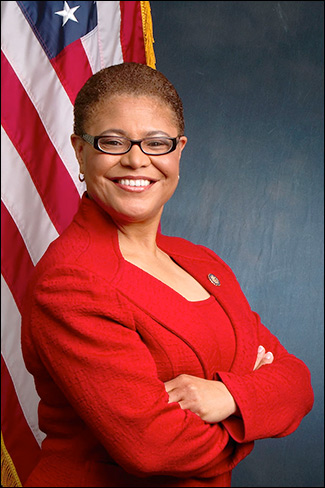
California Rep. Karen Bass (D-Los Angeles)

Sept. 29, 2021 — Reports were surfacing last week that California Rep. Karen Bass (D-Los Angeles), who had been on candidate Joe Biden’s short list for the vice presidential nomination, was deciding whether to eschew re-election next year for a chance to run for LA mayor. Now, she has made the decision. On Monday, Rep. Bass formally entered the citywide race.

The mayor’s election likely will be semi-open. Mayor Eric Garcetti (D) has been nominated as US ambassador to India, and upon obtaining his Senate confirmation, the City Council will be empowered to appoint an interim mayor. That individual will have the opportunity of then seeking a full four-year term during the regular election cycle. Certainly, Rep. Bass could be a potential appointee. Should Mayor Garcetti not receive a timely confirmation as ambassador, he would be ineligible to seek a third term, so in any event, the mayor’s contest will be highly competitive.

From a federal perspective, Bass running for mayor means her 37th Congressional District will be open. Of the 18 congressional districts that are wholly or partially contained within Los Angeles County, 17 of them need a population influx. With California losing a seat, it appears that the Los Angeles area will absorb the reduction.

Since Rep. Bass is the first Golden State House member to announce that he or she won’t seek re-election, her 37th District that needs 38,173 people to meet the state’s CD population quota of 760,350 people for the new 52 district map – a west Los Angeles County seat centered around the Culver City community – now becomes a prime target for elimination.

In the mayor’s race, Bass will at least face Los Angeles City Council President Pro Tempore Joe Buscaino, LA City councilman and former state Senate president and ex-US Senate candidate Kevin de Leon, and LA City Attorney Mike Feuer. It is likely others will enter the race once the political situation surrounding Mayor Garcetti is defined, and the congressional and legislative redistricting picture becomes clearer.

Redistricting Update

Several states are making progress in drawing new congressional maps. Colorado will send a final plan to the state Supreme Court as early as today. Indiana and Maine are close to finalizing maps that will strengthen both states’ political divisions, 7R-2D in the Hoosier State, and 2D-0R in the latter.

Oregon is also moving toward completion of a map that may prove a reach for the Democratic majority. Gaining a sixth seat in national reapportionment, the Democrats are trying to craft a 5D-1R map. Though Republicans have a significant base in the state, the Democrats maintain a tight grip on the statewide races thanks to dominant Portland, which serves as the lynchpin to their Beaver State political success.

Therefore, though the Dems have a clear edge in five of the new CDs, the early partisan analysis figures suggest that the Republicans would have at least an outside chance of prevailing in one of the districts, most likely that of Rep. Kurt Schrader (D-Canby/Salem), and possibly in the new 6th District open seat. More will be known when in depth political data is available and candidates begin to come forward.

The Texas Republican Senate’s congressional map was unveiled yesterday. As predicted, the GOP map drawers used the state’s two new seats as somewhat of a buffer, at least in the Austin area, to strengthen districts that were showing weakness. Should this map be enacted, Reps. Chip Roy (R-Austin), Michael McCaul (R-Austin), John Carter (R-Round Rock), and Roger Williams (R-Austin) all receive much stronger Republican seats. In exchange, one of the new seats goes to Travis County and will await a new Democratic inhabitant.

The other new seat appears destined for Harris County. There, sophomore Rep. Lizzie Pannill Fletcher (D-Houston) moves from a political marginal district to a rock solid Harris-Ft. Bend County Democratic District. This allows the second new seat to fall to a Republican and be fully contained within Harris County. In the northern part of the region, Rep. Dan Crenshaw (R-Houston) receives a substantially better district, and assumes part of Republican Montgomery County.

In the Dallas-Ft. Worth Metroplex, the region doesn’t get a new district, but a reconfiguration allows all incumbents, both Republicans and Democrats, to improve upon their present internal political standing.

This Texas map is a long way from enactment. The state House Democrats are unified to vote against any Republican map, and while the GOP has the strength to pass what they want in the Senate, the state House is a different story. It is likely we will see the current 30-day special session end in deadlock, with another 30-day session to follow. The Democratic strategy is to force the redistricting process to court, while the Republicans will attempt to pass a series of maps into law. Expect this story to be with us for many weeks to come.

Newsom Wins Recall; Other Elections

By Jim Ellis

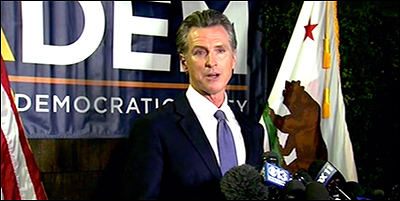
California Gov. Gavin Newsom (D)

Sept. 16, 2021 — California Gov. Gavin Newsom (D) easily avoided being recalled in last night’s statewide election, but the margin will likely close once all of the ballots are received and finally counted. The reported results are largely from mail ballots received well before election day. The posted turnout totals exceed 9 million voters, and this number will continue to grow.

The NO option on the recall ballot, meaning the vote individuals cast in order to keep Gov. Newsom in office, is running just under 64 percent, but under the California system of ballot signature verification it will be several weeks before we see official final totals. California also allows a long post-election period for ballots postmarked on election day to be received. It is clear, however, that Newsom will survive in office by a wide margin, but with an end-result closer margin than we see in early returns.

Though the replacement election became moot with the recall being rejected, conservative commentator Larry Elder was the clear leader, recording a tick under 47 percent of the vote. The next closest candidate was Democrat Kevin Paffrath with 10 percent. Former San Diego Mayor Kevin Faulconer (R) finished third with just under 9 percent. John Cox (R), who was one of the leading recall effort funders and the finalist against Newsom in the 2018 election, fell back to less than 4.5% of the vote. Media star Caitlin Jenner (R), who proved not to be a serious candidate, scored just 1.1% in the replacement election.

All of the replacement candidates were at a disadvantage in terms of financial resources. Though Elder raised a reported $18 million, an impressive amount in a short time frame, Gov. Newsom spent possibly as much as $80 million.

The rules for Newsom, however, were different. Because he was the recall subject, and the people were deciding the question as to whether or not he alone should remain in office, the campaign financial structure for him was that of a referendum. Therefore, he could raise unlimited amounts of money from individuals and entities. The replacement candidates, because they were running in an election campaign, were bound by the state campaign finance laws that feature contribution amount limits.

Continue reading

The Lost California Seat

Los Angeles, California-area Congressional Districts


By Jim Ellis

Aug. 24, 2021 — Continuing our series about the states losing seats in reapportionment and which members might be on the outside looking in, today we analyze the Golden State of California. The largest US House delegation will downsize one seat, meaning it will send 52 members to the next Congress.

To put the California population change into historical perspective, during the 1980 census the state gained seven new US House seats. In the 2010 census, for the first time in history, California did not add, and now we see actual reduction.

For the second time, the California Citizens Redistricting Commission will draw the congressional map and under specific criteria. The districts are supposed to be constructed on a nonpartisan basis without regard to specific incumbents’ residences or political situation, adhere to the Voting Rights Act pertaining to their substantial number of majority minority districts, and keep cities and counties whole where possible.

Looking at the actual census population by district as opposed to the previously published census estimates, changes in which districts may be on the chopping block are evident. Under the estimates, it appeared that Rep. Adam Schiff (D-Burbank) was the low population CD, but his 28th District seat now is 12th from the bottom. The new low is veteran Rep. Lucille Roybal-Allard (D-Los Angeles), whose 40th District needs to gain 70,139 people.

Of the current 53 districts, 35 must gain population while 18 will shed; hence, the reason the state is losing a seat. From a county perspective, it appears the Los Angeles members will be most at risk. A total of 18 congressional districts encompass LA County including nine that are wholly-contained. The other nine districts cross county borders into such places as Kern, Orange, San Bernardino, and Ventura.

Of the 18 districts wholly or partially within the LA County borders, Democrats represent 15 and Republicans just three. Only one of these 18, the 23rd District of House Republican Leader Kevin McCarthy (R-Bakersfield), must shed population. Though certain other places in the state are also resident-low, there is a good possibility that the seat reduction will come from one of the Los Angeles districts, particularly among the nine seats wholly within the county since all of those contiguous seats must gain residents.

Continue reading