Wisconsin Shake Up

By Jim Ellis — Tuesday, July 29, 2025

Governor

Wisconsin Gov. Tony Evers (D)

On Friday, Wisconsin Gov. Tony Evers (D) surprisingly announced that he will not seek a third term next year, which has initiated a game of Badger State political musical chairs.

Previously, most observers believed that Gov. Evers would run and comments he made leading to the decision were clearly giving the impression that he wanted to call himself, “Three-Term Tony.” Gov. Evers would turn 75 years old at the next election, and he is already the second-oldest Governor in Wisconsin history. Therefore, longevity and quality of retirement life could have factored into his decision.

Immediately, Lt. Gov. Sara Rodriguez (D) said she would run to succeed Gov. Evers and Sen. Ron Johnson (R) made a statement saying he will not enter an open gubernatorial race. Rodriguez, however, can expect to compete in a crowded Aug. 11 Democratic primary before someone advances into the general election.

Two-term Attorney General Josh Kaul (D) has long been considered a gubernatorial prospect. Several state legislators and county and city officials, particularly from Milwaukee, are also expressing interest. So has former Lieutenant Governor and 2022 US Senate candidate Mandela Barnes.

In the congressional delegation, we see little early movement toward what is now an open Governor’s race. Democrats hold only two US House seats, those of Reps. Mark Pocan (D-Town of Vermont/Madison) and Gwen Moore (D-Milwaukee), but neither have given any early indications about running for Governor.

On the Republican side, Rep. Tom Tiffany (R-Minocqua) has been publicly considering launching a challenge to Gov. Evers, so the open seat may be a greater enticement for him to enter the statewide race.

Since it is now highly unlikely the Wisconsin congressional districts will be redrawn before the 2026 election, most of the six House Republicans are in strong political position. The one key exception is Rep. Derrick Van Orden (R-Prairie du Chien/La Crosse) who will again face a well-funded opponent, likely 2024 Democratic nominee Rebecca Cooke, in a politically marginal district.

Rep. Van Orden defeated Ms. Cooke 51-49 percent in 2024. The Dave’s Redistricting App statisticians rate the WI-3 seat as one of the most evenly divided districts in the nation with a 48.9D – 48.5R partisan lean. President Trump, however, carried the district in all three of his elections and scoring a 53-45 percent victory here in November. Prior to Van Orden converting the seat to the Republican column in 2022, however, Democratic former Rep. Ron Kind held the seat for 26 years.

Cooke also became the top Democratic congressional challenger fundraiser during the 2nd Quarter, and she has already amassed a war chest of $1.27 million. Rep. Van Orden showed a campaign account balance of $1.67 million at the June 30 candidate financial disclosure quarterly deadline.

Considering that the Republican nomination field could be wide open and ooking at a difficult re-election race ahead, it would not be surprising to see Rep. Van Orden at least consider a run for Governor.

Nationally, there are 38 gubernatorial elections in the 2025-26 election cycle, with two coming this year in New Jersey and Virginia. Of the 38, the Evers retirement decision moves the open race count to 18, mostly due to term limits. Overall, both parties risk 19 gubernatorial positions in the next election.

Expect a great deal of post-announcement jockeying to come forth in Wisconsin as the political players continue to digest Gov. Evers’ surprise retirement decision.

Cooper v. Whatley in North Carolina

By Jim Ellis — Monday, July 28, 2025

Senate

Former North Carolina Gov. Roy Cooper (D)

While major potential North Carolina US Senate candidates in both parties had been keeping their leaders at bay for several months about whether they would enter the open contest, we now see evolving what is likely to be the state’s general election pairing.

Late last week, a report was published indicating that former Gov. Roy Cooper (D) had informed his party leaders that he will run for the Senate and is expected to make a formal declaration of candidacy this week.

Presidential daughter-in-law Lara Trump, who previously said she would decide about entering the Senate race “before Thanksgiving,” announced Thursday that she would not run, and immediately Republican National Committee chairman Michael Whatley declared his own candidacy. Just as fast, President Trump issued an endorsement for Whatley.

Thus, within this short period after long being in suspension, it appears we already have our general election pairing for one of the most important and competitive of the 2026 Senate campaigns.

For the Democrats, one potential obstacle remains. Former Rep. Wiley Nickel (D) had declared his Senate candidacy as he announced in 2023 that he would not seek a second term in the House because of what he termed an adverse redistricting map. Later, Nickel said he would step aside if Cooper decided to run but has not recently reiterated such comments. Therefore, it remains to be seen if Nickel remains in the Senate race.

The 2026 Senate race promises to be close, as are most statewide races in North Carolina. From the 2016 election through 2024, a total of 36 statewide campaigns were conducted from President to Superintendent of Public Instruction.

Republican candidates won 23 of those elections and Democrats’ 13, and two of the latter were Cooper’s close victories for Governor. Calculating the mean average for the 36 campaigns, the Republican candidates attracted 50.4 percent of the vote, while Democratic candidates recorded 48.3 percent.

Cooper won six Tar Heel State campaigns, four as Attorney General (2000 through 2012) and two for Governor. In his pair of chief executive contests, 2016 and 2020, Cooper averaged 50.2 percent. In 2016, he won with 49 percent of the vote unseating then-Gov. Pat McCrory (R), and four years later secured re-election against then-Lt. Gov. Dan Forest (R) with a 51.5 percent tally.

Michael Whatley, an attorney, was appointed RNC chairman after President Trump’s renomination in 2024. Previously, he served as chair of the North Carolina Republican Party and as a chief of staff to then-Sen. Elizabeth Dole (R-NC) among other political positions. It had been presumed that Whatley would enter the open Senate race after incumbent Sen. Thom Tillis (R) announced that he would not seek a third term. That is, presuming Ms. Trump would ultimately decide against running.

While prognosticators are giving Cooper at least a slight early edge, which is reasonable considering the Democrat has won six statewide races and the Republican has never been on the ballot, the overall statistics over the previous eight-year period as shown above, provide the Republicans with a slight cushion.

One thing is for certain: the impending Senate race will be the most expensive in North Carolina electoral history. In 2022, then-Rep. Ted Budd (R) defeated former state Supreme Court Chief Justice Cheri Beasley (D) in an open contest even though he was outspent $39 million to $16 million when comparing the two candidates’ campaign committee reports.

Outside spending, however, allowed Budd to close the gap. Republican outside group allies poured in just over $75 million into the campaign as compared to Democratic allies spending $30 million. Expect all of these financial numbers to be eclipsed in 2026.

This race is now officially on, and we can routinely expect a great deal of national attention being directed toward the Tar Heel State over the next 15 months.

Two Major Senate Questions
Answered: Michigan, North Carolina

By Jim Ellis — Friday, July 25, 2025

Michigan

Michigan Republicans have caught a break.

Michigan Rep. Bill Huizenga (R-Holland) / Photo by Daigas Mieriņas vizīte ASV

Rep. Bill Huizenga (R-Holland) who had been testing the waters for an open Senate bid, announced that he will not enter the statewide race and is likely to seek re-election in his 4th Congressional District.

Republican leaders had been striving to clear the Senate nomination field for former Representative and 2024 Senate nominee Mike Rogers who came within 19,006 votes (three-tenths of one percentage point) of scoring an upset win last November, and now it appears their goal has been achieved.

In the 2024 race, Rogers proved a weaker early fundraiser and never reached resource parity with his Democratic opposition. While eventual winner Elissa Slotkin outspent Rogers $51 million to $12 million, outside organizations somewhat closed the deficit gap with $78 million coming into the state to aid Rogers while Slotkin supporters spent $65 million.

After the 2nd Quarter filing for the 2026 campaign, the three major Democratic candidates’ (US Rep. Haley Stevens, state Sen. Mallory McMorrow, and former Wayne County Health Director Abdul El-Sayed) recorded an aggregate $6.7 million in campaign receipts compared to Mr. Rogers’ $1.1 million.

Therefore, considering the continuing financial disparity among the Michigan Democrats and Republicans, Rep. Huizenga deciding not to pursue a challenge to Rogers for the party’s Senate nomination is an even greater help to the GOP team since they won’t have to issue major expenditures during the primary cycle.

Another advantage Rogers will have as a consensus candidate, in addition to being able to pool his lesser resources for just one campaign, is having until Aug. 4, 2026, to draw largely unencumbered contrasts with the Democrats who will be battling among themselves for their own party nomination.

The unfolding candidate developments again underscore that the open Michigan Senate race will become one of the premier national Senate races next year.

North Carolina

North Carolina Democrats also have caught a break.

According to a report from Axios News, former Gov. Roy Cooper is communicating to North Carolina Democratic Party leaders that he will enter the state’s open Senate race and formally declare his intention as early as next week.

Cooper, who was elected four times as North Carolina’s Attorney General and then twice as Governor, was clearly the party’s first choice to run for the Senate and even more so after incumbent Sen. Thom Tillis (R) announced that he would not seek a third term.

The Senate move also suggests that Cooper will not launch a presidential campaign in 2027. This becomes particularly good news for Kentucky Gov. Andy Beshear (D), who is clearly moving along the presidential track and thus foregoing a bid for his own state’s open Senate seat. Several more Governors, or recently replaced state chief executives, are also contemplating between running for Senate and President, and it is thought that most will enter the national race.

The real advantage to a potential Beshear presidential campaign is now having the clear opportunity of uniting the southern states in a fight for the party nomination, thus becoming a very strong regional candidate. This strategy would not have worked had Cooper joined the race also operating from a southern base.

If the above presidential scenario plays out as depicted, it would also provide a boost to the Kentucky GOP. Beshear heading to the national campaign means the state’s open Senate race will now almost assuredly remain in GOP hands since the Governor was realistically the only Kentucky Democrat who could put the open Senate campaign into play.

Now the North Carolina focus turns to Republican National Committee chairman Michael Whatley; with presidential daughter-in-law Lara Trump stepping aside. Ms. Trump said during the week that she would decide whether to return to her home state to run for the Senate by Thanksgiving, but the Cooper decision to enter the Senate race earlier than expected, along with the state’s voter registration deadline, shortened the GOP announcement timeline. Yesterday, Whatley announced he would run; had Ms. Trump decided to run, she would have, like ex-Gov. Cooper on the Democratic side, a clear run for the party nomination. That, however, is now moot. Ms. Trump posted on X that “After much consideration and heartfelt discussions with my family, friends, and supporters, I have decided not to pursue the United States Senate seat in North Carolina at this time. I am deeply grateful for the encouragement and support I have received from the people of my home state whom I love so much.”

North Carolina always features close races, and a 2026 US Senate race even with ex-Gov. Cooper leading the Democratic ticket will prove highly competitive.

While Cooper was an overwhelming favorite to win re-election as Governor in 2020, he ended with only 51 percent of the vote in clinching the second term. This means his average gubernatorial vote in his two elections was exactly 50 percent. In his three contested terms for Attorney General (2004, 2008, 2012), Cooper averaged a 56 percent support factor. In the 2016 election, Cooper ran unopposed for election to a fourth consecutive term.

Rep. Collins Expected to Enter
Georgia Senate Race Later This Month

By Jim Ellis — Thursday, July 24, 2025

Senate

Georgia Rep. Mike Collins (R-Jackson)

Reports are surfacing from Georgia that two-term US Rep. Mike Collins (R-Jackson) will announce a US Senate bid before the end of July.

Should Rep. Collins follow through and enter the race, he will join US Rep. Buddy Carter (R-Pooler/Savannah), state Agriculture Commissioner John King, and state Sen. Colton Moore (R-Trenton) as prominent candidates in the GOP primary. The eventual Republican nominee will challenge first-term incumbent Jon Ossoff (D).

According to the latest Federal Election Commission candidate financial disclosure report for the period ending June 30, 2025, Rep. Collins would have just over $1 million to transfer into a Senate race. Rep. Carter is considerably ahead on the money front, reporting a cash-on-hand figure of just over $4 million after raising slightly under $3.6 million for the 2026 election cycle. Commissioner King disclosed only $450,405 in his federal campaign account. State Sen. Moore has yet to file a committee statement with the FEC and is unlikely to become a top-tier contender.

Should the Republican field remain constant, it appears the race could narrow significantly to a battle between the two Congressmen. For his part, Sen. Ossoff, obviously considered highly vulnerable in 2026, leads the nation in fundraising with a whopping $41.97 million since he was originally elected in 2020.

During his term, however, Sen. Ossoff has spent over $30.8 million leaving a reported cash-on-hand figure a touch under $15.5 million. Clearly, the Senator will be financially well-heeled in what could become the most competitive 2026 national Senate race.

In 2020, Ossoff upset then-Sen. David Perdue (R) in a post-general election runoff, from the same November election where Joe Biden was edging President Trump by 11,779 votes statewide. Georgia is one of two states that has a general election run-off law, meaning the top two finishing candidates would advance into a post-election December secondary vote should the first place finisher fail to attract majority support.

Such a scenario occurred five years ago, with Sen. Perdue finishing first in the general election, but who fell 13,471 votes short of securing a majority that would have clinched his re-election. The percentage total for the general election found Sen. Perdue topping Ossoff, 49.7 – 47.9 percent. In the runoff, fortunes turned as Ossoff pushed ahead at the December finish line, 50.6 – 49.4 percent, a margin of 54,944 votes from more than 4.48 million ballots cast.

In 2024, Trump scored a Georgia rebound, topping Kamala Harris, 50.7 – 48.5 percent. Two years earlier in the 2022 midterm election, Gov. Brian Kemp (R) topped former state House Minority Leader Stacey Abrams (D), 53-46 percent, and Republicans won eight of nine Georgia statewide races.

This most recent Peach State voting history creates optimism among the 2026 Republican candidates, thus making the Georgia Senate race the campaign likely to attract the most national political attention and possibly the most combined outside independent expenditure dollars.

The Georgia election system could yield a Republican Senate nomination also advancing into a secondary election. The Georgia primary is scheduled for May 19, 2026, with a runoff, if necessary because the first place finisher does not command majority support, to be scheduled for a Tuesday in June, likely the 16th or 23rd.

Others could still join the GOP race, but as the cycle unfolds and the fundraising leaders continue to pad their accounts further entries become more unlikely. Still said to be considering the race is Secretary of State Brad Raffensperger, among others, but it appears more likely at this point in time that the Secretary will either seek re-election for a third term or run for the open Governor’s position.

In terms of the two House seats that Reps. Carter and presumably Collins will vacate, we can expect crowded Republican primary battles to form in the respective 1st and 10th Districts likely ending in tight results.

Both seats are safely Republican according to the Dave’s Redistricting App partisan lean calculations (GA:1 – 57.3R – 41.1D; GA-10 – 61.2R – 37.2D). In 2024, President Trump captured 57.6 percent in GA-1, and 60.1 percent in GA-10.

Even at this early date, the Georgia voting electorate will again be bombarded with very competitive 2026 campaign efforts over what promises to be a busy ballot from top to bottom.

Republicans May Have Challenger in WA-3 to Flip Seat From Incumbent Dem

By Jim Ellis — Wednesday, July 23, 2025

House

Rep. Marie Gluesenkamp Perez (D-Skamania County) has repeatedly confounded Republicans. She has twice won a southwestern Washington congressional district that is arguably the second-most Republican seat in the country that elects a Democrat to the US House, behind only Rep. Jared Golden’s 2nd District of Maine.

Washington Senate Minority Leader John Braun (R-Centralia)

It appears, however, that the Republicans may have found a stronger candidate for 2026. In the past two elections, Perez has defeated Army veteran Joe Kent (R) who proved himself too extreme for the district’s electorate. Though he is not yet completely confirming that he will be a candidate, most believe that state Senate Minority Leader John Braun (R-Centralia) will formally announce his congressional candidacy sometime this week.

If the Republicans are to hold their slim majority, converting Washington’s 3rd District becomes a must-win. Before Rep. Perez recorded her initial upset victory in 2022, the seat had been under Republican control since the 2010 election.

The Dave’s Redistricting App organization calculates a 52.0R – 46.4D partisan lean. It is one of 13 districts that voted for President Trump in 2024 but reverted to electing or re-electing a Democratic nominee for the House.

Rep. Perez, then a local automotive business owner along with her husband, upset Kent in 2022 with a 50.1 – 49.3 percent victory. This, after six-term incumbent Republican Jaime Herrera Beutler failed to qualify for the general election from the state’s jungle primary. Two years later, despite President Trump carrying the district over Kamala Harris with a 50-47 percent margin, Rep. Perez won re-election, again opposite Kent, with a 52-48 percent spread.

Washington’s 3rd District lies in the southwestern corner of the state and is anchored in the city of Vancouver in Clark County, which lies directly across the Columbia River from Portland, Oregon. In addition to housing all of Clark County, the 3rd encompasses Cowlitz, Lewis, Pacific, and Skamania counties, with part of Thurston. The population is predominantly white, but with a Hispanic Voting Age Population figure of just about nine percent. Hispanics constitute the district’s largest minority group.

John Braun was initially elected to Washington’s state Senate in 2012 and has run unopposed in the next three succeeding campaigns. He was chosen Minority Leader after the 2020 election. Should he make the final decision to run for Congress, Braun would not have to risk his state Senate seat since the 2026 election is the mid-term of his four-year tenure.

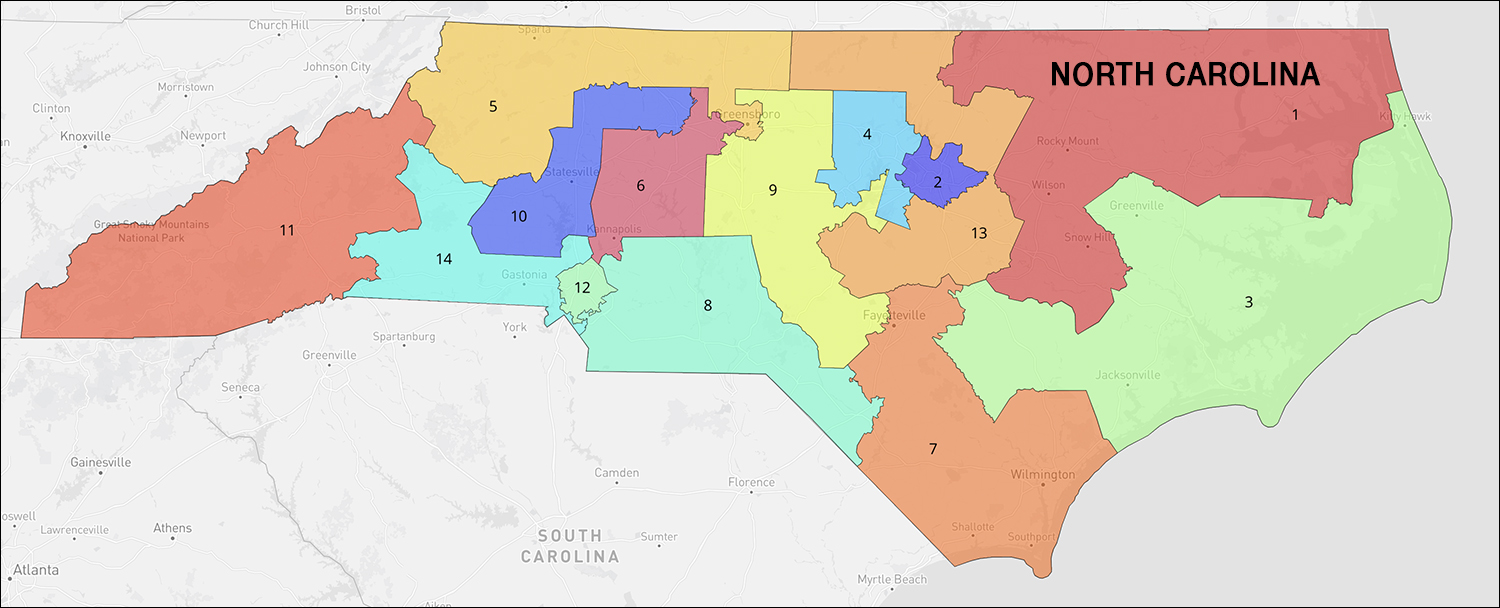
Prior to the 2024 election, most political prognosticators were predicting that the Democrats would assume control of the House. The reason Republicans held was due to converting several seats from the Democrats, namely through the new North Carolina redistricting map that yielded three flips, another two in eastern Pennsylvania, and one each in Alaska, Colorado, and an open seat in Michigan. Winning these seats mitigated Republican losses in California, Louisiana, New York, and Oregon.

A similar pattern will have to appear again in 2026 if the GOP is to hold their slim majority. With few conversion opportunities apparent for either party during the early part of this election cycle, the GOP converting the WA-3 seat becomes a paramount district in their plan to hold and potentially expand the current majority.

CO-8 Freshman Rep. Gabe Evans
Now Faces Nine Challengers

By Jim Ellis — Tuesday, July 22, 2025

House

Colorado Rep. Gabe Evans (R)

In a Colorado post-redistricting congressional seat designed to revert between the parties, a ninth Democrat, venture capitalist and Marine Corps veteran Evan Munsing, announced his 2026 candidacy late last week.

The large Democratic field is vying to challenge freshman Rep. Gabe Evans (R-Fort Lupton). The group includes former Congresswoman Yadira Caraveo, State Treasurer David Young, and state Reps. Manny Rutinel (D-Commerce City) and Shannon Bird (D-Westminster), among the nine contenders to date.

One of the legislators, state Rep. Rutinel, has already raised $1.6 million with over $800,000 cash-on-hand. Rep. Evans has also raised $1.6 million for his re-election campaign and has a more substantial $1.5 million in his campaign coffers. In contrast, Caraveo, who lost to Evans in November, raised only $214,000 since her 2026 announcement of candidacy.

State Rep. Bird has raised a substantial amount, and also more than the former incumbent. Bird recorded campaign receipts of $446,559 through the June 30 campaign finance 2nd Quarter deadline and holds just under $374,000 in her campaign account. Lagging behind is State Treasurer Young who attracted less than $75,000.

Colorado, as previously reported many times, redistricted in 2021 through a citizens’ commission. The congressional panel drew the state’s newly awarded 8th District to be one that would reflect the electorate’s twists and turns as the political climate evolves throughout the ensuing decade. The Dave’s Redistricting App statisticians calculate the CO-8 partisan lean at 48.3D – 47.0R, and in its two election cycles the district has performed largely as intended.

In November, President Trump carried CO-8 with a tight 49.6 – 47.8 percent spread. Four years earlier, however, President Biden also posted a close win in the new district, 50.8 – 46.3 percent. That year, Caraveo, then a state Representative, was elected as the district’s first US Representative with a 48.4 – 47.7 percent victory over Republican state Sen. Barbara Kirkmeyer. In 2024, Evans, himself then a state Representative, unseated Caraveo with again a similarly close margin, this time, 48.9 – 48.2 percent.

The district became one of the focal points in the 2024 battle for the House majority, and it will undoubtedly again be a key factor in which party controls the chamber come January of 2027.

The 8th District lies just north and east of Denver, stretching from the metro bedroom communities of Commerce City, Thornton, and Westminster northward 50-plus miles to the city of Greeley, a municipality with a population of just under 100,000 in Weld County. The district holds almost all of Adams County, with a portion of Weld, and a sliver of Larimer counties.

Though Caraveo, a physician, represented the district in its initial term, her return so far this year has been marred with controversy. A news story that she has relatively recently attempted suicide is a large reason why campaign is off to a slow start and her fundraising poor.

Still, she has high name identification and in a plurality system with a crowded field, she cannot be counted out. At the beginning of this 8th District nomination campaign, the leaders appear to be the two state Reps., Rutinel and Bird.

Regardless of who wins this hotly contested Democratic primary, Rep. Evans will have his hands full in a first attempt to hold this politically marginal district, a seat that has proven difficult for either party to establish a lasting foothold.

Before coming to Congress, Rep. Evans served one term in the Colorado House of Representatives. He has a military service record that includes active duty in the US Army and has logged time in both the Colorado and Virginia National Guard. He was also a policeman for the city of Arvada, Colorado.

Though the Democratic candidates are raising substantial early funds, most of their initial monies will be used to win the nomination. Because this race will be a top national target, financing for the general election both through individual contributions to the candidates’ committees and outside spending from both parties’ allies will be extraordinarily high. In the 2024 race, the combined candidate and outside spending aggregate figure exceeded $40 million. It is probable the financial totals will be even higher in 2026.

Rep. Evans will continue to raise and bank campaign funds as the Democrats engage in what promises to be an intense fight for the party nomination. It’s possible the field will thin as the campaign progresses, however. Some of the contenders will be forced to drop their bid after the party endorsing convention if they fail to make the ballot through delegate votes and don’t choose the signature petition route. The Democratic endorsing assembly will likely be held in late April. The Colorado primary is scheduled for June 30, 2026.

Expect to read much more about this race as the campaign unfolds throughout the bulk of the current election cycle.

The Redistricting Wars Begin

By Jim Ellis — Monday, July 21, 2025

Redistricting

Texas Gov. Greg Abbott’s (R) call to add congressional redistricting to the special legislative session has already elicited a response from a Democratic adversary.

California Gov. Gavin Newsom (D), has attacked Gov. Abbott’s redistricting move, calling it a partisan power grab, and says he will retaliate with his own legislature redrawing the Golden State congressional map to neutralize any seat gain that the new Republican map yields.

Several points make Newsom’s planned response unrealistic.

First, the California legislature has no redistricting power. In 2008, voters adopted a constitutional ballot proposition that created the California Citizens Redistricting Commission, which took the redistricting pen away from the legislature and awarded it to an appointed panel of individuals who are not in elected office. Therefore, Newsom and the legislators would first have to find a way to disband the Commission in order to proceed with a new map.

According to an article from The Down Ballot political blog that quoted Gov. Newsom from an interview he conducted with the Pod Save America hosts, the California chief executive indicated that he could call his own special session to place a measure on a special election ballot to void the Commission.

Gov. Newsom said on the podcast that he thinks “… we would win that. I think people understand what’s at stake in California. I think we come out in record numbers. I think it would be [an] extraordinary success,” the Governor concluded.

His prediction may or may not be accurate, and Newsom acknowledges that the calendar would be a major obstacle for such a movement because the commission invalidation process would require so much time.

The second option would be to claim, as Newsom said, that the Commission lacks mid-decade redistricting authority. The Governor argued that the ballot proposition awarded the Commission redistricting power after the Census was released and the lines would hold for the full decade. He said answering whether the Commission even has redistricting authority beyond once every 10 years and immediately after a Census should be pursued.

The third obstacle would be simply drawing a map that would give the Democrats five more seats in the California delegation. Gov. Newsom quoted President Trump as saying a new Texas Republican map could provide US House Speaker House Johnson with five additional Republican seats. Therefore, Newsom said California could neutralize such an increase.

The California delegation has 52 members and only nine are Republican. Can the Republicans be reduced to just four seats without endangering some Democratic incumbents? Seems the difficulty factor to avoid such an outcome is high when considering that President Trump received 38 percent of the statewide vote in 2024 and even Gov. Newsom’s own 2022 opponent, then-state Sen. Brian Dahle (R), garnered 41 percent.

Additionally, since the Census was released, Democrats have lost almost a full percentage point in voter registration affiliation and the Republicans have gained a point, not to mention that the overall state population figure is reduced.

According to the latest published voter registration figures (February 2025), Democrats claim 45.27 percent of the affiliations, Republicans 25.22 percent, and the non-affiliated, or Declined to State, option records 25.34 percent. Minor parties absorb the remaining 4.17 percent. Therefore, considering these numbers in trying to reduce the Republicans to just 7.7 percent of the seats (4 of 52), would prove to be quite a mathematical feat.

Additionally, using the Texas Democrats’ argument that the Lone Star State map is already gerrymandered because Republicans control 66 percent of the congressional seats but their presidential nominee only received 56 percent of the vote pales in comparison to the ratios in the current California map. There, Democrats control 83 percent of the districts even though the Democratic presidential candidate, and California winner, garnered only 58 percent.

The Texas map is explained in that President Trump carried all 25 Republican districts and two of the Democratic seats and ran almost four points ahead of the statewide Republican partisan lean calculation. In California, Kamala Harris carried no Republican congressional district and ran five points below the Democratic partisan lean figure.

The Texas legislature convenes today, and a new map will be released soon after since the special session is only 30 days long. At that point, further analysis can be conducted, and Gov. Newsom’s countermove strategy may begin.