
Author Archives: Jim Ellis

Analyzing the North Carolina Run-off Elections

Yesterday’s North Carolina congressional run-off elections concluded with three districts producing Republican nominees, all with strong chances of winning the general election in November.

In the 8th District, occupying the area to the north and east of Charlotte and around Fayetteville, business consultant and former congressional aide Richard Hudson won a landslide 64-36 percent win over dentist and ex-Iredell County Commissioner Scott Keadle. Only 16,078 votes were cast in the secondary election, just under 4 percent of the entire universe of registered voters. It was a decisive win for Hudson, who built a coalition comprised of conservatives, Washington insiders, and North Carolina establishment individuals and entities. Some national conservative organizations, such as the Club for Growth, supported Keadle’s unsuccessful candidacy.

Hudson now challenges two-term Rep. Larry Kissell (D) in a district that has been radically re-configured. With the new 8th being 21 points better for Republicans based upon the Obama-McCain 2008 presidential election scale, and Kissell only currently representing 54 percent of the new territory, it is arguable that Hudson is now the favorite here even against the incumbent. Republican map architects designed this seat to be one of the best GOP conversion opportunities in the country, and Hudson is proving worthy of the task of unseating an incumbent. We will hear much more from this campaign in the coming weeks.

To the west, encompassing most of Charlotte proper and stretching northward more than half-way toward Winston-Salem, the 9th District also has a new Republican nominee. For all intents and purposes, last night’s vote actually selected the new congressman here because this seat trends safe Republican. With Rep. Sue Myrick (R) retiring after nine terms, 11 candidates ran in the original primary and the field whittled down to former state Sen. Robert Pittenger
and Mecklenburg County Commissioner and ex-sheriff Jim Pendergraph. As was the case in the primary, the result ended in relatively close fashion.

Mr. Pittenger, who spent more than $2 million of his own money and was the self-proclaimed most conservative candidate in the race, clinched a 53-47 percent win last night. The former state senator is now the prohibitive favorite to defeat Democratic Mecklenburg County Commissioner Jennifer Roberts in the general election.

The new 9th went for John McCain in 2008 by a 54-45 percent count, one point under the margin from the current 9th CD. Three-quarters of the territory remains constant in the new district. More than 35,000 people voted, the largest congressional turnout in the state. Though Pendergraph took Mecklenburg County by a 51-49 percent margin, Pittenger’s strong performance in Iredell (70-30 percent) and Union (57-43 percent) counties was enough to offset him losing the most populous area.

Moving to far western North Carolina, in the Asheville area seat being vacated by retiring three-term Democratic Rep. Heath Shuler, businessman Mark Meadows becomes the 2012 Republican nominee for the new 11th Congressional District. He swamped entrepreneur Vance Patterson 76-24 percent in a run-off race that was never close. Almost 23,000 votes were cast in this run-off, the second highest of the three congressional contests decided last evening.

Meadows will now face Democratic nominee Hayden Rogers, Shuler’s chief of staff. The Republican businessman has the inside track to victory in the general election because the post-redistricting 11th has swung hard toward the GOP. On the Obama-McCain scale, the new NC-11 is now the most Republican district in the state, moving a net 13 partisan points.

Because North Carolina figures to be the Republicans’ best state countrywide during these elections, and will neutralize a similar Democratic performance in Illinois, it is likely that all three men nominated last night will win their respective general elections. So, despite a statewide voter turnout of only 3.58 percent, this North Carolina run-off election will prove significant when painting the 2012 national political picture.
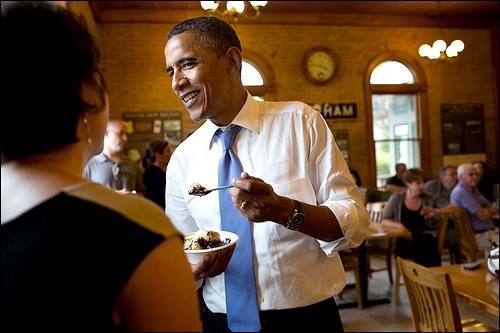
State Presidential Polling Tightens

Photo: The White House

Polling in the presidential race is interesting because the national numbers have been projecting a very tight race, but not particularly so for the key states. Several surveys released yesterday now show a pattern similar to the tight nationwide margins in the core states of Florida, Ohio and Virginia, and second-tier swing state, Colorado.

Nationally, Gallup, Marist College for the McClatchy Newspapers, and the Purple Strategies organizations all give President Obama a two-point lead over presumptive Republican nominee Mitt Romney. But, Rasmussen Reports projects Mr. Romney to be holding the same two-point lead. All of the polls were conducted during the July 9-15 period, though the Rasmussen data is derived from daily tracking surveys.

While the president’s numbers in Florida, Ohio, Virginia and Colorado have exceeded his national performance, such is not the case in the latest wave of studies.

In all-important Florida, Mason-Dixon Polling & Research gives Obama only a one-point, 46-45 percent razor-thin edge, but Purple Strategies (PS) actually detects a three-point Romney lead, 48-45 percent.

Ohio, where the president’s margins have typically been in the high single digits, now brandishes only a three-point Obama lead, 48-45 percent, again according to Purple Strategies.

To the west in Colorado, a state that Obama carried 54-45% in 2008, PS sees the president’s advantage dwindling to just one point, 45-44 percent.

Finally, in Virginia, where the Obama edge has been consistent and relatively strong, Purple Strategies forecasts that his Old Dominion lead is now down to just two points, 46-44 percent.

NC Run-offs Tomorrow

There are only two federal elections of any kind in July, and tomorrow’s North Carolina run-off vote will decide three GOP nominations. All Tar Heel State Democratic nominees and the other Republican standard bearers were chosen outright in the May 8 primary.

The 8th Congressional District occupies the area east and north of Charlotte on the way to Fayetteville. The post-redistricting NC-8, represented by two-term Democratic Rep. Larry Kissell, moves a net 21 points toward Republicans on the presidential scale. The new draw adds more than 45 percent new territory for Kissell, forcing him to move right in order to survive politically. He was one of five Democrats to vote to repeal Obamacare care last week after opposing previous such attempts. He originally voted against the legislation when it was first passed, and then fought repeal only to reverse course again, so his inconsistency on the subject could become a campaign issue.

Fighting for the Republican nomination are business consultant and former congressional aide Richard Hudson and dentist and ex-Iredell county commissioner Scott Keadle (pronounced Kay-dle). Hudson placed first in the five-candidate Republican primary, capturing 32.1 percent of the vote versus Keadle’s 22.0 percent. Both men are conservatives, but Hudson enjoys North Carolina Republican establishment support, House GOP leadership backing (Majority Leader Eric Cantor’s leadership PAC), and even landed the liberal Charlotte Observer newspaper’s endorsement.

The two candidates are about even in financial resources and each has invested six figures into his own campaign, though Keadle has loaned himself more than three times Hudson’s personal contribution amount. Because of its new partisan configuration, the winner of tomorrow’s run-off will likely become the 8th District’s new congressman.

Perched on the western side of Charlotte and then driving due north half-way to Winston-Salem is the new 9th Congressional District, open because nine-term Rep. Sue Myrick (R) is retiring. The GOP battle here, tantamount to victory in November, is between former state senator Robert Pittenger and Mecklenburg County Commissioner and former sheriff Jim Pendergraph. As in the 8th District, both men are running as conservatives. Myrick has endorsed Pendergraph, but Pittenger, because of a huge $2 million self-donation, has a major financial advantage. Pittenger placed first in the primary of eleven candidates, capturing 32.4 percent of the vote as compared to Pendergraph’s 25.3 percent. Tomorrow’s winner will claim the general election and keep the reliable GOP seat in the Republican column.

Farther to the west in the Asheville area, encompassing the entire western tail of the state, lies the 11th District. This seat, like both the 7th and 8th CDs, was changed heavily to the Republicans’ benefit. Eliminating most of the city of Asheville, with its Democratic voting base, from the 11th is the main reason that three-term Rep. Heath Shuler (D) decided not to seek re-election. Shuler’s chief of staff, Hayden Rogers, is the new Democratic nominee, but the 13-point GOP redistricting adjustment will give tomorrow’s Republican nominee the inside track to victory in November.

The two 11th District run-off participants are businessmen, each in their first political campaign. Real estate investor Mark Meadows, who captured 37.8 percent of the vote and missed winning outright by just over two percentage points (North Carolina’s run-off law requires only 40 percent of the vote to win a partisan nomination as opposed to 50 percent in all other states that use a two-tiered primary system), is favored over Vance Patterson who posted 23.6 percent in the field of nine candidates. Originally, it appeared that local District Attorney Jeff Hunt was the presumed favorite, but he performed poorly and both Meadows and Patterson blew past him to secure their run-off positions.

Through the end of June, Meadows held a healthy fundraising advantage, though about half of his campaign treasury is self-contributed. Patterson is his campaign’s virtual sole source of funds and pledges to donate all of his congressional salary to local western North Carolina charities, if elected. Look for a Mark Meadows victory tomorrow and in November.

New Hawaiian Senate Twist: Lingle Takes the Lead

Linda Lingle

One of the most bizarre Senate races of this election cycle is occurring in the Aloha State of Hawaii, and it just produced another surprise. As both Democratic candidates, Rep. Mazie Hirono (D-HI-2) and former Rep. Ed Case (D-HI-2), continue to trade barbs while releasing internal campaign polling data showing them each leading the primary contest, we now find former Republican governor Linda Lingle taking a turn at promoting favorable new survey data.

According to her internal Voter/Consumer Research poll (July 8-10; 600 likely Hawaii voters), Lingle now holds a 45-40 percent lead over Rep. Hirono on the general election ballot test. Perhaps even more surprising is finding that she trails Mr. Case by a single point, 40-41 percent, if he were to become the Democratic nominee. It is conventional wisdom that Hirono is the strongest candidate in the race, that Case is an annoying “also-ran” and that, while she is certainly the best possible contender for the Republicans to field, Lingle can’t overcome the Obama Hawaii performance level (expected to be in the 70 percent range) and will ultimately lose the race.

Except for Hirono internal campaign polls being released and an early February Ward Research/Honolulu Star Telegram survey that staked the 2nd District Democrat congresswoman to a substantial lead, the available public research data fails to support the conventional wisdom.

Lingle has been quietly assembling a major campaign. As a former two-term governor, her ability to raise money is strong and she continues to accumulate more financial resources than both of her Democratic counterparts. With the new 2nd quarter disclosure filings just days away from becoming public, Lingle had already posted raising $3.12 million at the end of the first quarter compared to Hirono’s $2.33 million and Case’s $595,000. Though the filing deadline is July 15, the Lingle campaign has already announced it obtained over $1.1 million more in the 2nd quarter. Neither Rep. Hirono nor Mr. Case have yet to comment upon their own fundraising for the immediate past three months.

Lingle’s financial advantage will grow as the weeks wane down to the Hirono-Case Aug. 11 Democratic primary. Facing only frequent candidate John Carroll, the former governor doesn’t have to spend large sums to win her party’s nomination but the Democrats certainly do.

All three candidates have run statewide campaigns before. Before winning the governor’s office in 2002, Lingle came close to unseating then-governor Ben Cayetano four years earlier. Rep. Hirono lost to Lingle 47-51 percent in the 2002 Governor’s race after serving eight years as Cayetano’s lieutenant governor. Lingle racked up a 62 percent win percentage for re-election in 2006. Case, elected to the House at the end of 2002 when then-Rep. Patsy Mink (D) died, ran an ill-fated 2006 Democratic primary challenge to Sen. Daniel Akaka, the man who is now retiring. Case lost that primary 54-45 percent. Had he not forced the nomination fight with Akaka and simply stayed in the House, Mr. Case would most likely have been a shoo-in for this Senatorial election.

What should be a relatively easy Democratic open seat hold is turning out much differently. Expect this race to be competitive in the general election, and it will likely conclude in close fashion. Though the prediction model may be a difficult one considering the inconsistent polling results, it is clear that ex-governor Linda Lingle, true to form, is again becoming a very viable Republican general election candidate.

Countervailing Polls in Texas, Wisconsin

Earlier in the week we presented surveys from Texas and Wisconsin that showed underdog Republican Senatorial candidates Ted Cruz (Texas, vs. Lt. Gov. David Dewhurst) and Eric Hovde (Wisconsin, vs. Tommy Thompson, Mark Neumann and Jeff Fitzgerald) surging to the lead in their respective campaigns. Yesterday, their main opponents, both considered heavy favorites when their efforts began, cited polls that produced a different result.

In Texas, Dewhurst, stung by the Cruz campaign’s Wilson Perkins Allen poll showing him trailing 40-49 percent, countered with his own Baselice & Associates data (July 5-8; 601 likely Texas GOP run-off voters) that posts him to a 50-42 percent lead. In comparison, the Cruz poll is likely the better of the two. Wilson Perkins Allen drew their sample from only those people who actually voted in the May 29 primary. Dewhurst’s survey is pulled from a larger universe and then screened for likely run-off participants. Though non-primary voters have the right to vote in a run-off election, it seldom happens. The overwhelming majority of people casting ballots in the July 31 election will be those who previously voted.

In Wisconsin, Marquette University Law School released a new survey (July 5-8; 1,000 Wisconsin adults, 949 registered voters), that puts former governor Thompson back into the lead. Yesterday, we covered a new Public Policy Polling study that showed businessman Eric Hovde holding a two-point advantage. According to Marquette, Thompson has a 35-23 percent lead over Hovde among the 427 people who identified themselves as planning to vote in the Aug. 14 Republican primary.

Like the PPP survey of yesterday, Marquette, too, shows Democratic Rep. Tammy Baldwin (D-WI-2) in very tight races with all four Republican candidates. Against Thompson, among likely voters (799), she trails 41-45 percent. When paired with Hovde, she leads 44-38 percent.

The Republican primary will be decided as a matter of turnout, but it is more plausible to believe that Thompson has the advantage. Both PPP and Marquette are in the same range for the general election, thus confirming all previous polls projecting that the two parties are in a close contest.

Hovde Surges Past Thompson in Wisconsin

Photo: Hovde Campaign

Public Policy Polling (July 5-8; 1,057 registered Wisconsin voters; 564 “usual” Republican primary voters) just confirmed what two previous campaign surveys claimed last week. That is, upstart hedge fund manager Eric Hovde is gaining in the Wisconsin Senate race and now is a legitimate top-tier candidate.

According to PPP, Hovde has actually overtaken former governor Tommy Thompson in the Republican primary. Ex-representative Mark Neumann (R-WI-1) and Assembly Speaker Jeff Fitzgerald have dropped back into a clear second tier. The numbers give Hovde a 31-29-15-9 percent lead over Thompson, Neumann, and Fitzgerald, respectively. If Hovde and Thompson were in a two-way race, the newcomer would lead the former Wisconsin chief executive 46-39 percent.

Though the spread is virtually even between Hovde and Thompson, the momentum is not. When compared to PPP’s April 13-15 poll, one that did not test Hovde, Thompson has fallen 10 points. Neumann has dropped seven points in support, and Fitzgerald 13. Two other research studies released last week, one from Democratic candidate Tammy Baldwin and the other from Hovde’s campaign, also showed a change in the Republican field. Baldwin’s data showed Hovde leading Thompson. The businessman’s own poll had him close to, but still behind, the former four-term Governor.

Mr. Hovde has been dominating the airwaves with a series of ads focusing on government spending and the debt crisis, while others offered a vigorous defense of Gov. Scott Walker. As you will remember, the governor successfully repelled a recall effort that gained national attention.

In his best series of spots, Hovde’s daughters talk about their father in the family kitchen with the candidate in the background reading the newspaper at the counter. They banter back and forth about how Hovde won’t be liked in the Senate because he won’t vote for increased debt and more government spending, at which point Hovde chimes in about not caring if he’s liked but certainly approves of their message.

Clearly Mr. Hovde’s campaign strategy is working as evidenced by his move past the other candidates and because his substantial personal favorability rating, at 50:9 percent positive to negative, is better than all of the other candidates including Democrat Baldwin.

The Wisconsin Senate race, open because four-term incumbent Herb Kohl (D) is retiring, is one of the most important in the nation and its result will go a long way toward determining which party will control the chamber in January.

The current Public Policy Polling survey, as found in other polls, continues to detect weakness for Tammy Baldwin. The consensus Democratic candidate, a seven-term congresswoman from Madison, again fails to take command on the general election ballot test. A Democrat leading in the early going of a Wisconsin general election is expected. The fact that Baldwin is virtually tied with all four GOP candidates is a troublesome sign for her. In the latest PPP poll, Hovde leads the Madison Representative 45-44 percent. Thompson and Baldwin are tied at 44 percent. The congresswoman leads both Neumann and Fitzgerald by only four points apiece.

Clearly the conglomeration of polls is making several things clear. First, whether he has overtaken Thompson or not, Hovde clearly has positive momentum in the Republican race. Second, Rep. Baldwin is under-performing for a Democrat at this point in a Wisconsin statewide race, and third, the GOP has a strong chance of winning this open seat, which would constitute a major step in wresting the Senate majority away from the Democrats.

The Wisconsin primary is Aug. 14, and its result will be significant in shaping the national political landscape.

Espaillat Concedes to Rangel … Again

It’s now official. After new tallies in New York’s 13th Congressional District were released showing Rep. Charlie Rangel (D) actually gaining votes, state Sen. Adriano Espaillat again conceded defeat. The Senator acknowledged that he had lost on primary election night (June 26), but when all the precincts actually reported their results, the margin tightened. With thousands of votes remaining uncounted and Rangel’s lead down to 802 votes, Espaillat asked for further canvassing since the state Board of Elections was reporting the tallies in such a time-consuming and haphazard manner. Now that the recount is actually showing Rangel gaining strength – his lead is up to 990 votes – Espaillat decided to bow out for the second time.

The result is now final. Other than it being virtually impossible for Rangel to lose mathematically, there is a practical political reason for also supporting this conclusion. To qualify for the state primary in September, Espaillat must file for re-election to the state Senate no later than Thursday. He cannot run for state office if he is still a federal candidate, so continuing to protest the congressional result could make him ineligible to seek re-election to his current position.

In order to comply with the new provisions of the federal Military and Overseas Voter Empowerment Act (MOVE), a federal judge transferred the New York congressional primary from Sept. 13 to June 26. Since the state then chose to keep its statewide primary in September, New York is holding two nominating elections. Therefore, Espaillat could run for Congress without putting his legislative office at risk.