
Tag Archives: Sen. Jon Husted

Ohio Senate Race Moves to Toss-Up

By Jim Ellis — Friday, June 12, 2026

Senate

The Center for Politics at the University of Virginia has revised its ratings in three Senate races, including the Ohio special election. North Carolina shifts from Toss‑Up to Lean Democratic, while Alaska moves from Lean Republican to Toss‑Up. Ohio was cast in the same manner as Alaska.

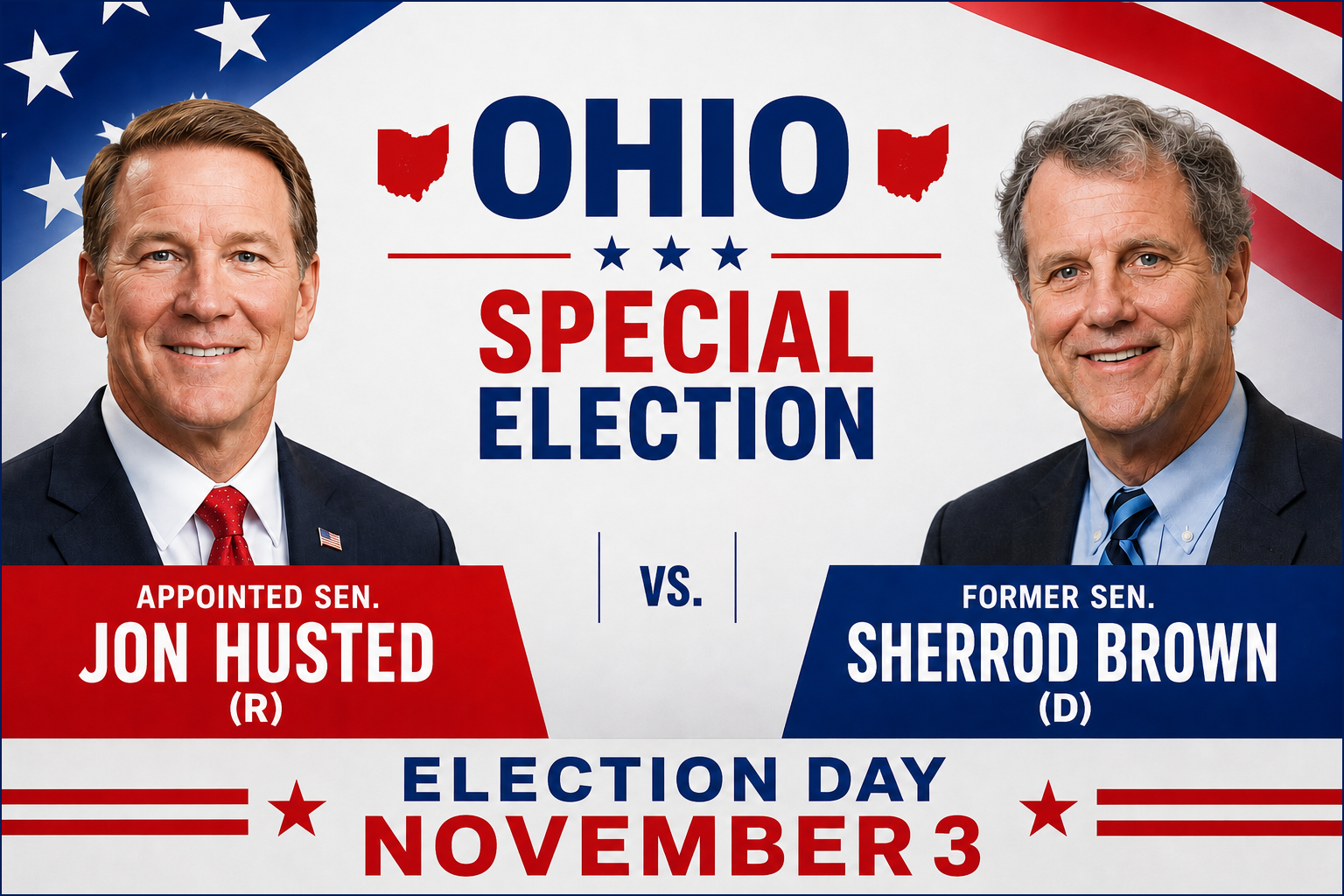
The Ohio special election features appointed Sen. Jon Husted (R) facing former Sen. Sherrod Brown (D). It is one of the most consequential contests of 2026 and will play a major role in determining which party controls the Senate in the next Congress. Although the race appears competitive at this stage, the Ohio electorate continues to show signs of returning to its pre‑Obama era pattern as a reliably Republican state.

Husted was appointed to replace JD Vance, who resigned from the Senate after being elected Vice President. Before his appointment, the new Senator served two terms as Lieutenant Governor and eight years as Secretary of State.

Brown, who lost his 2024 re‑election bid after three Senate terms and 14 years in the US House, is attempting a comeback to reclaim the seat he held for 18 years. He previously served as Ohio’s Secretary of State and in the state legislature.

A recently released Fox News poll (May 28-June 1; 1,015 registered voters) likely contributed to the Center for Politics’ new rating. The survey shows Brown leading Sen. Husted 53-45 percent. The poll raises questions, however, because the same sample found the gubernatorial race between Republican Vivek Ramaswamy and Democrat Amy Acton separated by just one point – an unusually tight margin given earlier polling trends.

Three earlier surveys conducted from mid‑March through mid‑April, each from a different pollster, showed Husted leading. In total, 12 polls from eight organizations between February and early June found Husted ahead in seven instances and ex-Sen. Brown ahead in five. Viewed collectively, the Fox News poll appears to be an outlier. It is also atypical for the Senate and gubernatorial races to diverge so sharply in the same polling sample.

A key indicator of Ohio’s political trajectory comes from comparing Brown’s 2024 performance with his 2018 victory. In 2024, then-Sen. Brown received 295,026 more votes than he did in 2018, yet still lost by 3.5 points.

This suggests a shifting electorate increasingly favorable to Republicans. Such data points are important when assessing where Ohio voters may stand by Election Day 2026. Early signs indicate that 2026 is shaping up as a turnout‑driven election rather than a persuasion‑driven one, making political climate and base enthusiasm especially significant.

Fundraising will also play a major role. In 2024, Brown raised over $103 million – second only to Texas Sen. Ted Cruz (R) – yet still fell short. For 2026, Brown ranks fifth nationally with more than $25 million raised. Sen. Husted trails with just over $10 million but is expected to have sufficient resources. Both sides will be supplemented through substantial outside spending.

If economic conditions – particularly gasoline and grocery prices – improve by early voting in October, and if the Iran conflict stabilizes, historical voting patterns will likely reassert themselves. If so, expect the Ohio Senate race to return to a Lean Republican rating and produce an eventual GOP victory.
Husted, Ramaswamy Lead in New Poll

By Jim Ellis — Tuesday, Aug. 26, 2025

Senate

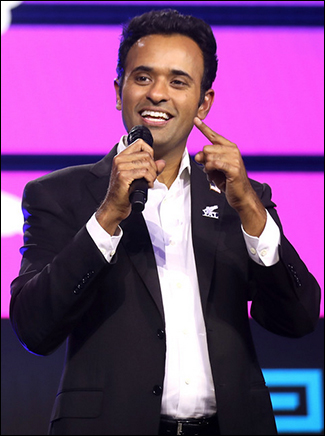
Republican Vivek Ramaswamy / Photo by Gage Skidmore

Both appointed Sen. Jon Husted (R) and businessman Vivek Ramaswamy (R) lead in a new statewide Ohio 2026 general election poll, and the data also contain some interesting ancillary results.

Emerson College conducted the new statewide Ohio poll (Aug. 18-19; 1,000 registered Ohio voters; 490 likely OH Republican primary voters; 383 likely Ohio Democratic primary voters; multiple sampling techniques) and the results project Sen. Husted leading former Sen. Sherrod Brown (D), 50-44 percent. This is the first Senate survey released since Brown officially announced that he will make a political comeback.

In the Governor’s contest, Ramaswamy, the endorsed Ohio Republican Party candidate, leads former state Health Director Amy Acton (D) 49-39 percent, and former Congressman and ex-US Senate candidate Tim Ryan (D) 49-41 percent. Last week, Ryan said he would make a decision about entering the Governor’s race by the end of September.

President Trump’s job approval score was 49:42 positive to negative, with unsurprisingly almost all of the Republicans approving and a near unanimous Democratic segment disapproving. As part of the survey, Emerson then tested the personal approval index of nine Buckeye State public figures.

In the Senate race, appointed incumbent Husted’s favorability index is 33:28 positive to negative, while former Sen. Brown is better known but has a tighter favorable lean, 44:42.

Interestingly, the only one of the nine tested political personalities to post an upside-down personal rating was first-term Sen. Bernie Moreno (R) at 38:42. On the job approval score, Gov. Mike DeWine (R) also scored in negative territory, 32:40.

The political figure with the lowest unfavorable personal rating (17 percent), is Lt. Gov. Jim Tressel (R), the former Ohio State University head football coach. Tressel still has not completely ruled out running for Governor, but it appears highly unlikely that he will enter the statewide race.

Vice President and former Ohio Sen. J.D. Vance (R) posted a 48:43 percent favorability index, which also is the highest individual negative score of anyone tested but, again, the split is purely partisan with Republicans overwhelmingly favorable and Democrats viewing him unfavorably in virtually equal proportions.

To underscore the partisanship view, when asking this sample of Ohio Republican voters who they would favor to succeed President Trump in 2028, favorite son Vance was the overpowering choice, 55-9-7-6-4 percent over Secretary of State Marco Rubio, Florida Gov. Ron DeSantis, Ohio gubernatorial candidate Ramaswamy, and former UN Ambassador and 2024 presidential candidate Nikki Haley, respectively.

The Democratic sample was also polled regarding their next presidential preference. On this question it is California Gov. Gavin Newsom who placed first within the Democratic sample of 388 respondents, which is a low number for a state the size of Ohio. Irrespective of the potential sampling flaw, Newsom captured a 20 percent preference figure. Obviously, this is a very low number, but it is still tops among the tested potential candidates.

In what should be considered bad news for ex-US Transportation Secretary and former South Bend, Indiana Mayor Pete Buttigieg, he finished behind Newsom with only 15 percent support. Rep. Alexandria Ocasio-Cortez (D-NY) was third with eight percent, followed by a three-way tie with seven percent apiece among Sen. Bernie Sanders (I-VT), a two-time presidential candidate, former Vice President and 2024 Democratic presidential nominee Kamala Harris, and Minnesota Governor and 2024 Democratic Vice Presidential nominee Tim Walz.

Sen. Sanders, referring to his age (he will be 87 years old during the 2028 campaign), is indicating that he will not run for President again. The Harris-Walz showing is particularly poor for the most recent presidential ticket nominees within a Democratic Party segment cell.