

Tag Archives: Rep. Henry Cuellar

House Incumbent Primaries, Part II: Democrats

By Jim Ellis

Feb. 21, 2022 — Part II of our incumbents’ primary challenges report concentrates on the Democratic members who find themselves in serious nomination contests. (Note: Part I — the Republicans — was published Friday. Please scroll down to read.) Nine such situations are covered in this update, with one of them, the Texas race of veteran Rep. Henry Cuellar (D-Laredo) to be decided on March 1.


GA-7: Dem Pairing

Primary: May 24
Runoff: July 26

Rep. Carolyn Bourdeaux (D-Suwanee)
Rep. Lucy McBath (D-Marietta)
• Bourdeaux Cash-on-Hand (Dec. 31, 2021): $2,005,771
• McBath Cash-on-Hand (Dec. 31, 2021): $2,452,731
FiveThirtyEight Statistical Rating: D+16
Dave’s Redistricting App Historical Voting: 58.4% D

Republicans held the redistricting pen in Georgia and after losing two Atlanta metropolitan districts in consecutive elections, it was clear the GOP map drawers were going to take one back. That translated into loading Democrats from the previously Republican 6th District into the transitioning 7th CD.

Along with bringing more Democrats into the 7th, the 6th District incumbent, Rep. McBath, decided to join them. Instead of fighting for re-election in a new Republican 6th District (R+24), she moved south to challenge freshman Democrat Carolyn Bourdeaux in the party primary. As you can see from the cash-on-hand totals above, both incumbents are well-heeled financially, so a major campaign is underway.

Also in the Democratic field is state Rep. Donna McLeod (D-Lawrenceville), who points out that she is the only one of the three that actually lives in the 7th CD. Her campaign has been slow to begin, so it is doubtful that she will be much of a factor, and probably will not draw enough support to force the two congressional incumbents into a runoff. Therefore, it is likely that this pairing will be settled in the May 24 primary.

Among carryover constituents Rep. Bourdeaux has a big advantage in seeing a majority of her current 7th District constituency (57 percent) remaining in the new 7th. McBath, however, sees only 12.1 percent carryover from her 6th District. The larger Democratic influx came from Rep. Hank Johnson’s 4th CD, as 26 percent of his constituency was transferred to the new 7th.

On the other hand, the new 7th is overwhelmingly minority: 29.8 percent black, 21.3 percent Hispanic, and 15.8 percent Asian. Thus, the demographics could help Rep. McBath, who is African American. Her strength within the party’s leftward faction is also a benefit in a primary contest. With each incumbent showing similar strength levels, this will be an interesting race to watch on May 24.


GA-13: Rep. David Scott

Primary: May 24
Runoff: July 26
• Scott Cash-on-Hand (Dec. 31, 2021): $1,107,286
FiveThirtyEight Statistical Rating: D+52
Dave’s Redistricting App Historical Voting: 77.9% D

After only scoring 52.9 percent in the 2020 Democratic primary against three opponents, Rep. David Scott’s (D-Atlanta) 2022 race may be even more serious. Opposing him in this election are two candidates with an election track record, former state senator and 2017 Atlanta mayoral candidate Vincent Fort, and South Fulton City Councilman Mark Baker. The latter man bills himself as the “strongest progressive” in the race, but ex-Sen. Fort was well entrenched with the Bernie Sanders campaign.

Therefore, both opponents are attacking Rep. Scott from the left, which should help him split the opposition vote. Whether such a split will be enough to again allow him to capture majority support in the May 24 primary may be another question. Rep. Scott has long been attacked over not being further to the left on the ideological spectrum, which could again be a problem for him in a district that is overwhelmingly Democratic. Neither Baker nor Fort filed an FEC report at the end of the 2021, meaning they are behind on fundraising.

Rep. Scott must still be rated as the favorite to prevail, but this is another contest that will merit attention on May 24.


IL-6: Dem Pairing

Primary: June 28

Rep. Sean Casten (D-Downers Grove)
Rep. Marie Newman (D-La Grange)
• Casten Cash-on-Hand (Dec. 31, 2021): $1,580,171
• Newman Cash-on-Hand (Dec. 31, 2021): $573,120
FiveThirtyEight Statistical Rating: D+6
Dave’s Redistricting App Historical Voting: 51.4% D

The Illinois race is the second of the three Democratic congressional pairings, and it features sophomore Rep. Casten and freshman Rep. Newman. This particular pairing came about because of complaints that a second Hispanic seat should be drawn in Chicago.

Fearing a loss in court, the Democratic legislative leadership acquiesced and drew a new open 3rd District that is 44 percent Hispanic. As a result, Rep. Newman’s home was placed in Rep. Chuy Garcia’s (D-Chicago) 4th District, but she pivoted to run in the 6th against Rep. Casten. Her move made sense because 43 percent of her constituency was drawn into the new 6th District versus just 24 percent coming from Rep. Casten’s current 6th District.

While Casten has a financial advantage and the support of most of the Chicago Democratic establishment, Rep. Newman is a darling of the far left and will likely attract the more ideological voter that tends to dominate primary voting in both parties.

The aspect of this race that attracts little attention is that the pairing winner is not necessarily home free in the general election. With the Illinois gerrymander drawing 14 Democratic seats of 17 total districts, some of the Dem seats are weak. The 6th, with a D+6 rating from the FiveThirtyEight data entity, is one of those. Therefore, a divisive primary could make the eventual Republican nominee even more viable in the general election.

This draw was not favorable to either Democratic incumbent, and we will see a spirited fight between now and the June 28 primary.
Continue reading
Texas 2022 Candidate Filing Closes

By Jim Ellis

Dec. 17, 2021 — Texas became the first state to see candidate filing close for the 2022 elections, so the campaign season has officially been launched.

In the Lone Star State, candidates file with their respective state party organizations, or county parties if their race is fully contained within one entity, and not the Secretary of State. Therefore, the filings might not yet be fully recorded and approved. The statewide primary is scheduled for March 1. If no candidate for whatever office does not receive majority support in the first election, a runoff between the top two finishers will occur on May 24.

What we know so far is that Gov. Greg Abbott (R) will face a significant Republican primary challenge from former Florida congressman and ex-Texas Republican Party chairman Allen West and former Dallas state Sen. Don Huffines. The latter man, who was defeated for re-election in 2018, has the ability to self-fund a statewide primary campaign. Former congressman and 2020 presidential candidate Beto O’Rourke will be the Democratic nominee as he faces only minor opposition in the party primary.

Regardless of the level of competition, Gov. Abbott, though his approval ratings are at a low ebb in his seven-year career as the state’s chief executive, is a heavy favorite in both the Republican primary and the 2022 general election.

The main constitutional office of interest is the attorney general’s race. Here, embattled incumbent Ken Paxton (R), who has for years been under a federal SEC indictment that has yet to move forward, and who has been publicly accused of having an ongoing extra-marital affair, faces three strong candidates for re-nomination: State Land Commissioner George P. Bush, US Rep. Louie Gohmert (R-Tyler), and state Supreme Court Justice Eva Guzman.

Though Paxton has personal and legal problems, his favorability ratings among Republican primary voters is still surprisingly high. Forcing the two-term attorney general into a runoff election, however, is a clear possibility.

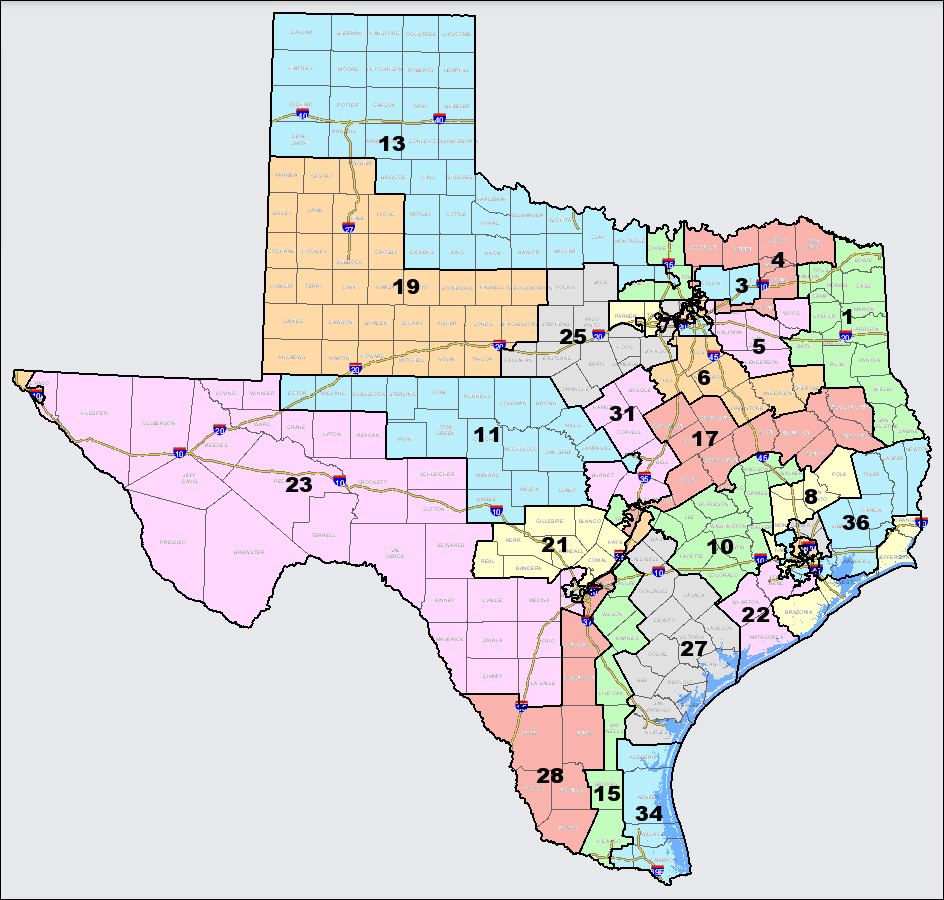
With the state having no Senate race in 2022, the federal focus turns to the new 38-member US House delegation. Texas gained two seats in national reapportionment, thus increasing their delegation size from 36 to 38 seats. The state will wield 40 electoral votes in the next presidential election, second only to California’s reduced 54.

Continue reading

Texans Planning Moves

By Jim Ellis

Oct. 5, 2021 — The Texas congressional map was unveiled in the state Senate last week, and already many incumbents and challengers are making or announcing political plans based upon what they are seeing … but this congressional plan is a long way from enactment.

In the past few days we have seen Rep. Vicente Gonzalez (D-McAllen) concede that he would consider moving to run in the open 34th District, which is due east of his own 15th CD and anchored in the city of Brownsville. Rep. Filemon Vela (D-Brownsville) is not seeking re-election to a sixth term, and he reportedly is favorable toward Gonzalez coming into his district.

The 34th remains solidly Democratic under the Senate introduced congressional map, but the 15th, already trending more Republican than in past elections, would actually have favored former President Trump by three percentage points under the proposed boundaries. Thus, Republicans would have a strong chance of winning here in an open seat race.

The 2020 GOP nominee, Monica de la Cruz-Hernandez, who held Rep. Gonzalez to a 50-48 percent re-election victory while spending barely over $400,000, has announced she is running again and House Republican Leader Kevin McCarthy (R-CA) has already endorsed her for the 2022 race.

Gonzalez is not the only one working on his next political move. Wesley Hunt (R), who lost 51-47 percent to Rep. Lizzie Fletcher (D-Houston) in 2020, said months ago that he would run for the House again, but was mum on exactly where he would land in hopes that one of the new seats would fall into his area. Under this proposed map, the new 38th District does encompass part of the current Fletcher district, and it is highly favorable to an eventual Republican nominee.

For her part, Rep. Fletcher gets a much stronger Democratic district in southern Harris County and now into Ft. Bend County, which is one of the fastest growing regions in the state. Reports also suggest that Hunt has over $1 million in his campaign account at the reporting period ending Sept. 30 despite not previously declaring where he would run. He announced last week that he has chosen District 38 if this new map becomes law.

Late last week, Republican businessman and retired Air Force officer Steve Fowler announced his congressional candidacy in the 28th District, Rep. Henry Cuellar’s (D-Laredo) seat that begins in San Antonio and spans to the Mexican border. Earlier this year, Jessica Cisneros, who held Cuellar to a 52-48 percent Democratic primary win in 2020, announced she is returning for a re-match.

Rep. Lloyd Doggett (D-Austin) will also have a decision to make. The new 37th District is wholly contained within Travis County and safely Democratic. He could easily run in this seat, thus leaving his 35th CD that is co-anchored in Austin and San Antonio for a Hispanic Democrat to likely win.

Continue reading

Texas Data

By Jim Ellis

Texas US House Districts

Dec. 17, 2020 — Yesterday, we analyzed the California official 2020 Statement of the Vote and today we turn out attention to voting statistics from the Lone Star State of Texas, a particularly interesting domain for the coming redistricting process. Estimates project that Texas will gain three congressional districts from reapportionment, which should become official at some point in January.

Despite predictions of a “blue wave” hitting Texas and putting the state in play for Joe Biden, Republicans once again swept the competitive races. Though President Trump’s margin did decline from 2016, his 52-46 percent margin was still more than comfortable, especially when considering he was simultaneously losing the nationwide vote.

As was the case in California, down-ballot GOP candidates, as a rule, performed better than President Trump. Sen. John Cornyn (R) was re-elected, and the GOP won 23 congressional races in the state, accounting for almost 11 percent of their party’s national total.

Sen. Cornyn topped 53 percent of the vote in recording a nine-point win over his Democratic opponent, retired Army helicopter pilot M.J. Hegar. In the 23 victorious Republican House races, the winning GOP candidate outpaced President Trump in 19 districts most of which were competitive at least to a degree.

Compared with the Democratic improvement in elections two years ago, the GOP rebounded in 2020. A total of 16 Republican incumbents sought re-election, and 11 of those improved their vote percentages from 2018. Additionally, all five of those falling below their previous benchmark did so by less than one percentage point.

For the Democrats, all 13 of their House incumbents saw a downgrade in their voter support from 2018. Rep. Henry Cuellar (D-Laredo), who fought off a tough Democratic primary challenge in early March, saw the biggest drop for any Texas House incumbent, falling from 84.4 percent in 2018 to a 58.3 percent win in November. The more serious drop, however, was for Rep. Vicente Gonzalez (D-McAllen) who won re-election to a third term from his South Texas district with just 50.5 percent of the vote against an opponent who spent only $404,000. Gonzalez’s victory percentage slipped from 59.7 percent in 2018.

The TX-15 district is largely a Mexican border seat that starts just east San Antonio in the Seguin area and travels south all the way through the city of McAllen in Hidalgo County. The latter entity hosts three-quarters of the 15th District’s population. Republicans, including President Trump, improved their standing throughout the Mexican border area in the 2020 election, which was a principal reason that Democratic gains in the Dallas, Houston, Austin, and San Antonio metropolitan areas were somewhat offset.

Statewide turnout was up a strong 23.7 percent when compared to 2016, enabling the state to exceed 11 million voters (11,315,056) for the first time. The Texas population grew 3.9 percent during that same time interval.

Continue reading

Setting the Stage: The Texas Primary

By Jim Ellis

Feb. 23, 2018 — We’re now inside two weeks before the first-in-the-nation regular midterm primary election, as the Texas early voting process is now well underway in preparation for the March 6 regular primary vote.

texas-primary-election-2018Seventy-six candidates are running for major statewide office — races for governor, US senator, lieutenant governor, attorney general, comptroller, agriculture commissioner, land commissioner, and one slot on the state railroad commission. A record total of 304 Democrats, Republicans, Independent and minor party candidates are vying for their respective party nominations in the state’s 36 US House districts.

Texas is a run-off state, meaning if no candidate in the various primaries receives majority support, the top two finishers will advance to a run-off election on May 22. Since a vast number of races have multiple candidates, including 28 individual candidates alone fighting to succeed retiring Rep. Lamar Smith (R-San Antonio) in his open central Texas CD, the secondary election calendar promises to also have a large slate of late May voting contests.

Two Democrats off to late starts are vying to face Gov. Greg Abbott (R), and though nine candidates are on the Democratic gubernatorial ballot, there remains some possibility that either Dallas County Sheriff Lupe Valdez or businessman Andrew White, the son of the late former Gov. Mark White (D), will emerge as the party’s nominee on March 6.

Continue reading