Tag Archives: Louisiana

Updates on Louisiana, Maryland,
& Ohio Redistricting Plans

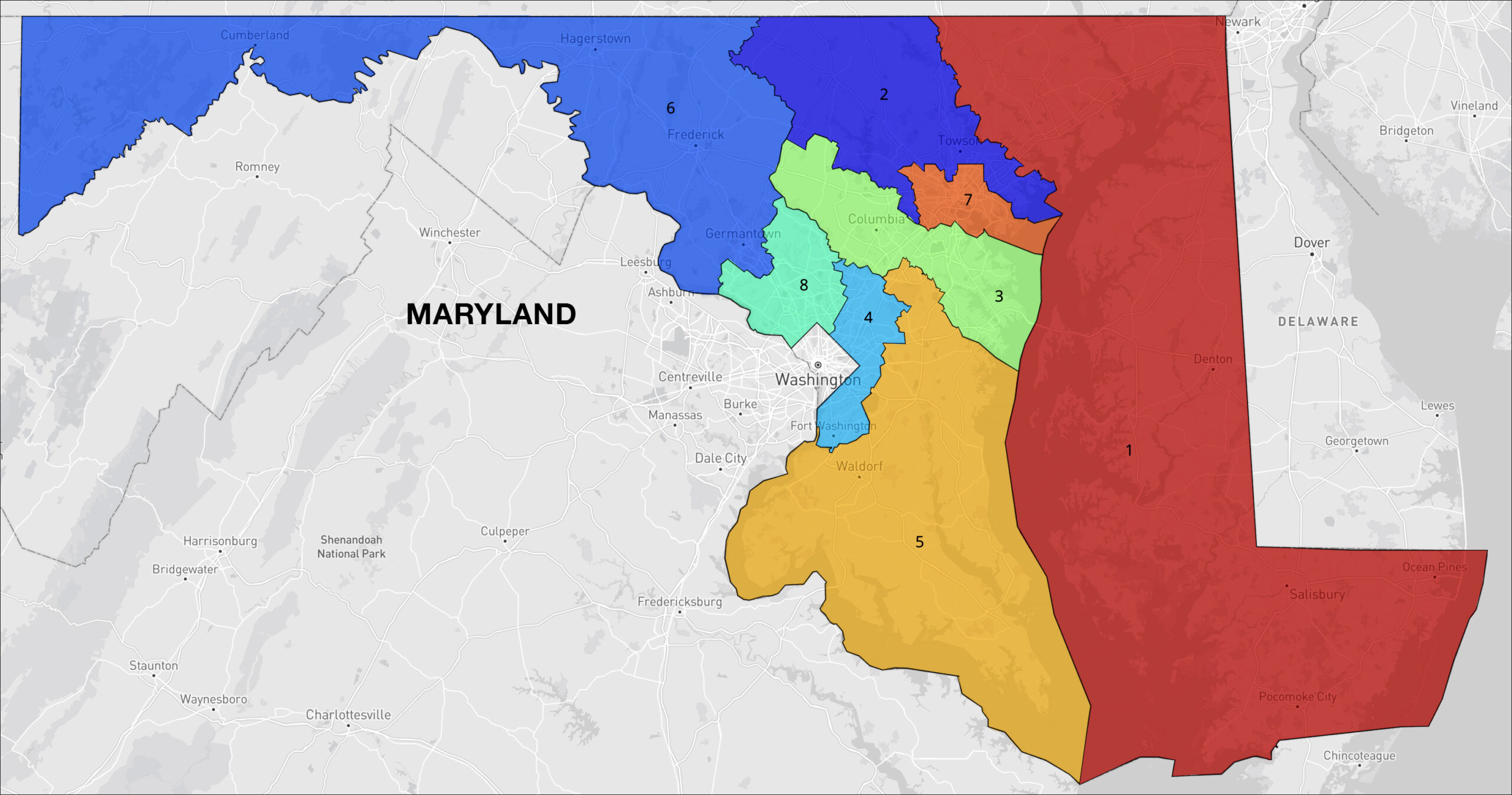
Maryland Congressional Districts

Maryland Congressional Districts (Click on map to see interactive version on DavesRedistricting.org.)

By Jim Ellis — Monday, Nov. 3, 2025

Redistricting

We saw redistricting moves occur in several states last week. Below is a recap of the action:

Louisiana

As the redistricting world awaits the US Supreme Court’s ruling on the Louisiana racial gerrymandering case, the Bayou State’s Governor and legislature passed legislation to move the state’s primary in anticipation of a ruling coming well after the first of next year.

Previously, the legislature and Gov. Jeff Landry (R) changed the Louisiana primary system to do away with their jungle primary held concurrently with the general election and an accompanying December runoff for those races where no candidate received majority support on the initial vote.

The new primary system returned to a partisan format scheduled for April 18, 2026, with a two-candidate runoff on May 30 for the races where no candidate received majority support.

The legislation passed earlier last week, now on its way to Gov. Landry for his signature, would move the initial primary date to May 16 with the associated runoff election on June 27.

Changing the primary will give the state more time to adjust their congressional map to adhere to whatever the Supreme Court eventually decides. The change also gives the candidates more time to campaign in the Senate primary where several contenders are mounting GOP nomination challenges against Sen. Bill Cassidy.

Maryland

It appears the Maryland legislature will not engage in another redistricting. According to a report from The Down Ballot political blog, state Senate President Bill Ferguson (D-Baltimore) sent a letter to his colleagues saying that the Senate leadership “is choosing not to move forward with mid-cycle congressional redistricting.”

Sen. Ferguson’s argument is that redrawing the current map “… could reopen the ability for someone to challenge” the present plan upon which the Democrats were able to routinely claim seven of the state’s eight congressional seats. Basically, the Senate President was explaining he was not going to risk a 7D-1R map for an uncertain attempt to add one more to the Democratic column.

Without the Senate’s participation, redistricting in Maryland will not occur. Thus, we see a break for the state’s lone Republican Congressman, Andy Harris (R-Cambridge), and the national Republican goal of maximizing their number of seats through mid-decade redistricting.

Ohio

The Buckeye State has both a complicated redistricting system and law. The process first starts with a commission of elected officials who authorize the drawing of maps, then votes upon and presents the approved plan to each house of the legislature. A map must receive three-fifths support in both houses to remain in place for the entire decade. Passing with a lesser amount means the plan can stand for only two elections. The Governor retains veto power over the completed legislative process.

Since the 2021 congressional plan failed to receive three-fifths support in both the state House of Representatives and Senate, it could only remain in place for the 2022 and 2024 elections. Therefore, Ohio must enact a new congressional plan before the 2026 election.

The bipartisan commission came to an agreement on a map last week, which will now be reported to the legislature. Understanding that the Republicans have strong majorities in both houses, but not three-fifths strength, the plan appears to give the GOP a chance to increase their delegation share by two seats.

The partisan percentage increase in both principal targets, however, appears to still make Democratic victories possible. The purpose of the compromise is to obtain enough bipartisan support to keep a new map intact for the decade’s remaining elections.

Statistics for the districts are not yet publicly available, but the new plan appears to make Districts 7, 9, and 13 slightly more Republican.

District 7 is already a Republican seat that two-term Congressman Max Miller (R-Rocky River) represents. The 9th is veteran Democratic Congresswoman Marcy Kaptur’s Toledo-anchored seat where her victory margin under the current boundaries fell to less than a percentage point in 2024. Finally, the politically marginal Akron anchored 13th CD is also made a bit redder. Rep. Emilia Sykes (D-Akron) has averaged just under 52 percent in two consecutive elections.

Both Reps. Kaptur and Sykes were going to be major 2026 Republican targets and this map will make them only slightly more vulnerable.

Republicans were also looking to target 1st District Congressman Greg Landsman (D-Cincinnati), but this map keeps the district in the marginal category and likely makes the Congressman at least a slight favorite for re-election.

Much more will be known when the map statistics and voting history under the new boundaries become publicly available. Until then, the swing margins remain points of conjecture.

Competitive Senate Finance – Part I

By Jim Ellis — Tuesday, Oct. 21, 2025

Senate

The Federal Election Commission has released new Senate campaign finance numbers and today we begin to preview the resource standing of the key 2026 statewide contests. This Update covers the most competitive campaigns from Alabama through Maine. Tomorrow, we’ll look at Michigan through Texas.

Alabama

Sen. Tommy Tuberville (R) running for Governor has opened the in-cycle Senate contest, and the Republican primary will be the determinative election. Attorney General Steve Marshall, Rep. Barry Moore (R-Enterprise), and retired Navy SEAL Jared Hudson are the major contenders.

Hudson has $357,000 cash-on-hand, while Marshall and Moore each have just over $555,000 in their campaign accounts. It is probable the May 19 primary will end with no candidate having majority support. If such is the case, the top two finishers will advance to a June 16 runoff election.

Florida

Appointed Sen. Ashley Moody (R) must run in 2026 to fill the final two years of the current term. At the end of third quarter 2025, she held $3.6 million cash-on-hand.

The most credible Democrat appears to be technology company executive Hector Mujica. He just announced his candidacy last week; therefore, he is not yet required to file a campaign financial disclosure report. Former Congressman Alan Grayson (D), who has tried and failed several times to win statewide office, holds only $127,000 in his campaign account.

Sen. Moody has won two statewide elections as state Attorney General. In a state turning safely Republican, she is favored to hold her seat.

Georgia

First-term Sen. Jon Ossoff (D) is the 2026 election cycle’s leading fundraiser, having raised more than $54 million. From the gross receipts total, he holds $21.3 million in his account.

The Republicans are headed for a competitive primary, which will likely culminate in a June runoff. Reps. Buddy Carter (R-Pooler/Savannah) and Mike Collins (R-Jackson) along with former University of Tennessee football coach Derek Dooley, son of former University of Georgia legendary coach Vince Dooley, are the top contenders.

Rep. Carter has done best on the fundraising circuit and holds just under $4 million in his campaign account. Rep. Collins has $2.3 million, and Dooley, $1.7 million.

The Republicans’ collective problem is their candidates will have to spend heavily just to win the nomination while Sen. Ossoff can continue to build in unopposed fashion for the general election. Irrespective of who becomes the Republican nominee, the general election promises to evolve into a tight finish.

Illinois

Retiring Sen. Dick Durbin (D) leaves a contested March Democratic primary in his wake, one that will effectively elect the state’s next Senator.

At this point, Rep. Raja Krishnamoorthi (D-Schaumburg) has a commanding lead in fundraising and polling. According to the third quarter FEC report, he has raised just under $25 million and holds a touch over $18 million in the bank.

His two major opponents, Rep. Robin Kelly (D-Matteson/Chicago) and Lt. Gov. Julianna Stratton, are well behind in cash-on-hand. Rep. Kelly reports $2 million in available funds and Stratton just under $1 million. This means that Rep. Krishnamoorthi enjoys a respective 9:1 and 18:1 cash advantage over his two main opponents.

Kentucky

Without Gov. Andy Beshear (D) in the open Senate race, the May Republican primary for all intents and purposes will determine retiring Sen. Mitch McConnell’s successor.

Three candidates are vying for the nomination: Rep. Andy Barr (R-Lexington), former Attorney General and 2023 gubernatorial nominee Daniel Cameron, and businessman Nate Morris. Norris has already been spending heavily and running attack ads, particularly against Rep. Barr.

While Cameron enjoys significant polling leads, it is Rep. Barr who is in the best financial position. He holds $6.7 million in his federal campaign account, while Cameron has just under $630,000. Morris, who is self-financing, reported $1 million at the Sept. 30 disclosure deadline.

Louisiana

Sen. Bill Cassidy (R) may have dodged his toughest general election opponent (former Gov. John Bel Edwards (D) last week announced he would not run for the Senate), but the same can’t be said for the new partisan Republican primary. Louisiana changed its election law, so instead of a jungle primary in November, we will see an April 18 primary followed by a May 30 runoff election if no one reaches the majority support level in the first vote.

At the end of last week, state Rep. Julie Emerson (R-Carencro), who chairs the House Ways and Means Committee, announced her Senate candidacy. This very likely means that Rep. Julia Letlow (R-Start) will not run, as the two were unlikely to oppose each other. Already in the race are State Treasurer, former Deputy White House chief of staff and ex-Congressman John Fleming; state Sen. Blake Miguez (R-New Iberia); and Public Service Commissioner Eric Skrmetta.

Sen. Cassidy is well ahead in fundraising, but President Trump clearly wants to settle a political score with him since the Louisianan was one of seven Republican Senators to vote for impeachment regarding the January 6 US Capitol controversy. Only two of those seven, Sens. Cassidy and Susan Collins, will be on the ballot in 2026. Four are no longer members — Sens. Ben Sasse (NE), Richard Burr (NC), Pat Toomey (PA), and Mitt Romney (UT). Sen. Lisa Murkowski (R-AK) is not in-cycle but is at least a potential gubernatorial candidate.

In terms of fundraising, Sen. Cassidy posts $9.5 million in cash-on-hand. This compares to Sen. Miguez’s $2.5 million and Fleming’s $2.1 million. Rep. Emerson and Skrmetta are not yet required to file disclosure reports.

Maine

Sen. Susan Collins (R) overcame $60 million of spending against her in 2020 and can expect another difficult campaign next year. She is well prepared, with $6.7 million in the bank.

Her principal opponent will be Gov. Janet Mills (D), who just announced her candidacy last week. Like several others in this report, the Governor is not yet required to file a financial disclosure report.

Expect this race to be hot all the way through November and will carry at toss-up rating.

US Supreme Court Hears
Louisiana Redistricting Case

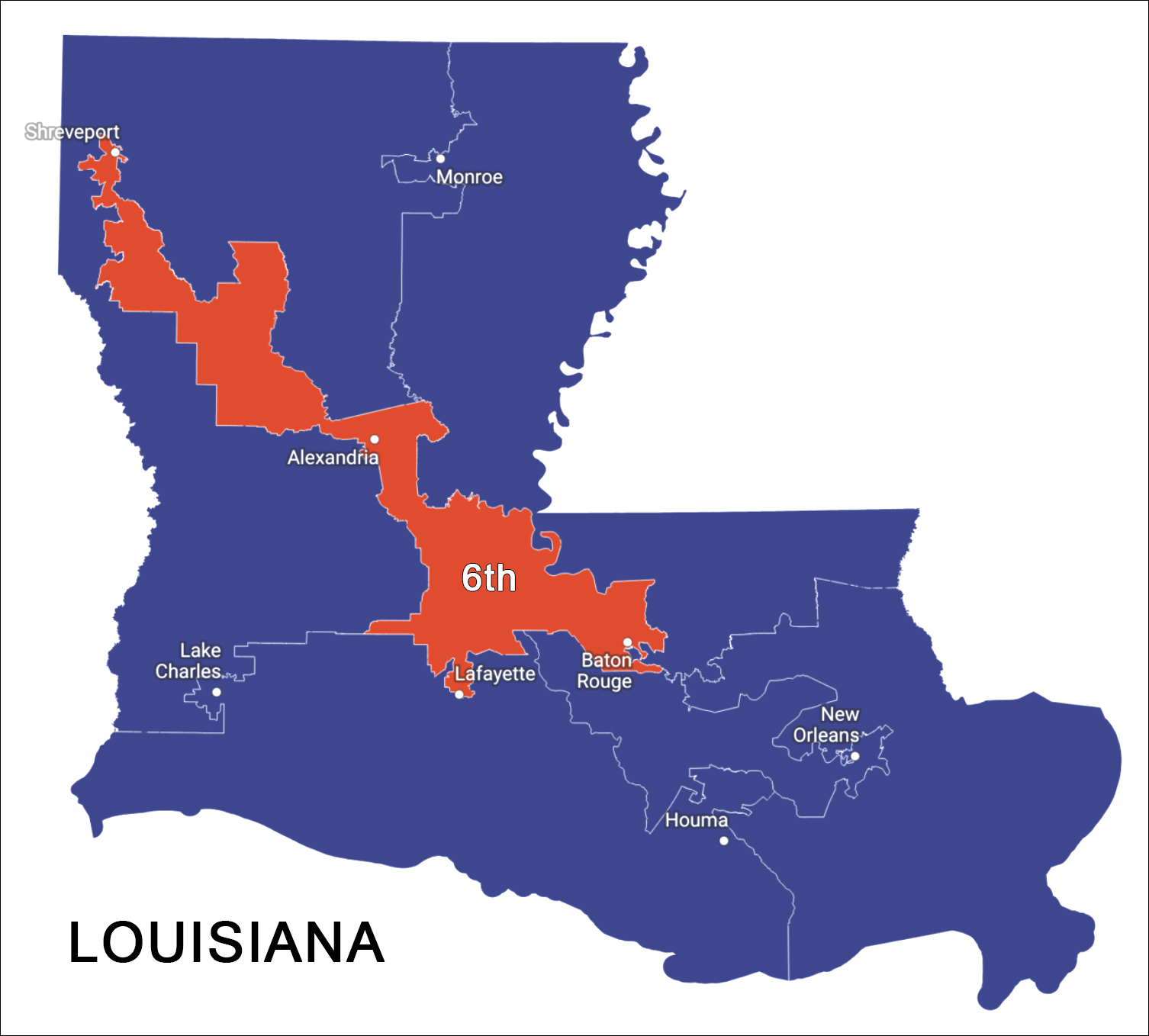
Louisiana’s 6th Congressional District / Graphic by VeriteNews.org

By Jim Ellis — Thursday, Oct. 16, 2025

Redistricting

Yesterday, the nine United States Supreme Court justices heard oral arguments for the second time on the Louisiana racial gerrymandering case. How this case is decided could have a major impact on the 2026 US House election cycle and in district elections throughout the remainder of the current decade.

At issue is Louisiana’s 6th Congressional District (in red on above map), which stretches from Baton Rouge to Shreveport. This CD was put in place before the 2024 election in response to a court order to create a second majority minority district that would elect an African-American Representative. Ironically, this very draw was rejected in a 1994 ruling, but the 2024 map drawers reinstated the same district 30 years later.

A lawsuit was filed over the redraw and the plaintiffs earned a favorable decision from the initial three-judge federal panel constructed to hear the case, but the US Supreme Court stayed the ruling. After briefs and oral arguments were conducted, the high court chose not to rule in June opting for a second round of oral arguments, which were held yesterday.

According to news stories and observations, impressions suggest that several justices appear favorable toward changing the particulars that heretofore have governed the parameters relating to minority district construction. Whether a majority exists to do so and to what extent change may be forthcoming remains unanswered.

The eventual decision could have wide-ranging ramifications to maps in several other states, and not just those where legislators are currently either drawing new districts or contemplating such action.

A SCOTUS decision to uphold the three-judge panel ruling would allow the Louisiana legislature to return to the previous map, or a similar one. That particular map produced a 5R-1D partisan division. The current Louisiana congressional delegation consists of a 4R-2D split.

If the three-judge panel ruling is upheld or expanded upon, the Alabama map would be affected because that state is in virtually the same situation as Louisiana with regard to minority district composition. Such a decision would also virtually eliminate any serious challenge to the new Texas map.

Therefore, with the updated Lone Star State map projected to net Republicans five seats — and should the previously described scenario in Louisiana and Alabama come to fruition and before the 2026 election — the Republicans could net seven seats from the three states. Even if the California redistricting referendum passes and the Democrats net five seats to neutralize the GOP’s Texas gains, the net Republican increase from the four domains would be two. Adding the new completed Missouri map, and the Republicans would see a net three-seat national gain.

Other states in some way, shape, or form considering redistricting either with a special legislative session or when their next regular session begins, or through a court directive are Florida, Georgia, Indiana, Kansas, Nebraska, North Carolina, and Ohio. These could favor Republicans. While Illinois, Maryland, and Utah would likely produce Democratic gains.

Not all of these states will move forward, but should the Supreme Court ruling on the Louisiana case be of a landmark proportion, some of these states and others may then be compelled to follow suit.

Another factor is when SCOTUS rules. Louisiana now has an April partisan primary schedule, so one would think the ruling will be revealed in time for the nomination elections to be conducted as scheduled. A later ruling would suggest that a great deal of the redistricting action will greatly affect the 2028 House election schedule instead of 2026.

We can expect many future political twists and turns in the pending redistricting war, but the catalyst to developing clear district construction criteria lies with the US Supreme Court.

Sen. Cassidy Draws New Opponent

By Jim Ellis — Thursday, June 19, 2025

Senate

Sen. Bill Cassidy (R-LA)

In an attempt to deny Sen. Bill Cassidy (R-LA) renomination, Louisiana state Sen. Blake Miguez (R-New Iberia) announced early this week that he will enter the 2026 Republican Senate primary. Already in the race is State Treasurer John Fleming, along with four minor GOP candidates.

Cassidy is one of the seven Republican Senators (just three remain in office) who voted to impeach President Trump in post-election 2020; therefore, Cassidy earning an endorsement from Trump seems unlikely. Trump’s public support in Republican primaries has, for the most part, been extremely helpful to the anointed candidate.

Hence, Sen. Cassidy faces some obstacles toward his 2026 re-election bid. In addition to his problems with the President and facing credible opponents, he also must navigate an entirely new election system.

In 2024, Gov. Jeff Landry (R) and the state legislature changed Louisiana election law. For federal races, the jungle primary system is eschewed, and a partisan structure reimposed. The new primary schedule means that Sen. Cassidy, and all other federal incumbents, must stand for renomination on April 18, 2026, with a runoff election scheduled for May 30 if no candidate secures majority support on the first vote.

In Louisiana’s previous system, and one that still holds for most state races, all candidates are placed on the same ballot for an election scheduled in November. If a leading candidate fails to receive majority support, the top two finishers advance into a December runoff.

The argument for adopting the new law for federal elections was accentuated with change proponents saying that the Louisiana freshmen US House members forced into December runoffs were put in an adverse position that hurt the state. They pointed out their new members were getting lesser committee assignments and behind in other internal House matters because the entire body was elected a full month earlier.

According to Louisiana’s Advocate news site, Sen. Cassidy was actively opposing the new election law even after adoption. He was lobbying the legislature this year to eliminate the law’s runoff provision in order to allow plurality victories. The current session ended without the legislature making such a change.

Incumbents forced into runoff elections generally fare poorly because a majority of primary voters have already chosen a different candidate. Such is likely the principal reason Sen. Cassidy was attempting to convince the legislature to change the new law.

John Fleming, a physician, was elected State Treasurer in 2023. He previously served four terms in the US House, succeeding former House Ways and Means Committee chairman Jim McCrery in the 4th Congressional District and immediately preceding now-Speaker Mike Johnson. Rep. Fleming ran for US Senate in 2016, losing the Republican nomination to now-Sen. John Kennedy (R).

Upon leaving the House, Dr. Fleming was appointed by President Trump as Assistant Secretary of Commerce for Economic Development, and later Deputy White House Chief of Staff. In the House, Dr. Fleming was an original co-founder of the House Freedom Council.

In the initial Federal Election Commission campaign finance disclosure report for the 1st Quarter of 2025, Dr. Fleming self-funded his campaign with a $2.03 million cash influx but raised only $269,479 from other sources. It remains to be seen how well he does in the 2nd Quarter, which will end on June 30.

Blake Miguez was first elected to the state House of Representatives in a 2015 special election. He secured full terms later in 2015 and 2019 before winning a state Senate seat in 2023. During his tenure in the House, Miguez was elected Majority Leader in 2020. Professionally, he is an oil and gas company executive and has won national handgun shooting contests.

We can expect a primary campaign to be dominated with attacks against Cassidy arguing that he is a “RINO” (Republican In Name Only) because he voted to impeach Trump and for his votes, stances, and public statements on certain other issues.

With at least two major candidates making similar arguments against the Senator, the possibility grows that he will be forced into a runoff. If so, Cassidy’s chances of winning renomination would become diminished.

The Louisiana Senate primary will be a race to watch early next year because Sen. Cassidy’s renomination appears far from certain. We have yet to see any major action on the Democratic side, but it is certain the party will file a credible nominee.

A Senate Review – Part I

By Jim Ellis — Tuesday, May 6, 2025

Senate

Already we’ve seen a great deal of jockeying for political position in 2026 Senate races. Today and tomorrow, we will review the 18 Senate races where significant action is occurring.

This edition looks at the situations in Alabama through Maine. Tomorrow, Michigan through Virginia. If a state is not mentioned, it means the incumbent is seeking re-election and, at this early point in the election cycle, has no serious competition.

Alabama — Sen. Tommy Tuberville (R) will reportedly soon announce that he will eschew a second term in the Senate to enter the open Alabama Governor’s race. Once Tuberville makes his plans official, others will finalize their own plans. Expect a crowded open Republican Senate primary with the winner having the inside track to carrying the seat in the general election.

Florida — Sen. Ashley Moody (R), the former Florida Attorney General who was appointed to replace Sen. Marco Rubio when he resigned to become US Secretary of State, must run to fill the balance of the term in 2026. So far, several people have announced their candidacies, but all should be considered minor candidates in both parties. The biggest name in the field is former Congressman Alan Grayson (D), but his attempts to return to public office after spending three non-consecutive terms in the House have not gone well.

Unless the quality of candidates improves, Sen. Moody should have little trouble retaining her seat. It is probable, however, that credible competition will emerge. At this time, appointed Sen. Moody must be considered a clear favorite to win next year.

Georgia — The Peach State is one of several places where a term-limited or recently retired Governor could run for the Senate. Most of the Governors in this category, however, have their eyes on the Presidency in 2028. Georgia Gov. Brian Kemp (R) is a state chief executive with rumored presidential aspirations but leads the Senate Democratic incumbent in early polling.

However, yesterday’s announcement that Gov. Kemp will not run for the Senate certainly changes the political picture, and we will devote a column to that evolving campaign after our Senate Review, Part II is published. With Kemp now not running for Senate, at least four US House members are expressing interest. They are: Reps. Buddy Carter (R-Pooler/Savannah), Rich McCormick (R-Suwanee), Mike Collins (R-Jackson), and Margorie Taylor Greene (R-Rome). Without Kemp in the race, Sen. Ossoff establishes a polling lead against all other potential Republican nominees.

Idaho — Just turning 82 years of age, rumors swirled that three-term Sen. Jim Risch (R) would retire. Recently, however, Risch announced that he will seek a fourth term and appears to be a lock to win both the Republican primary and general election.

Illinois — Sen. Dick Durbin (D) is retiring, and the meaningful action will occur in the March 2026 Democratic primary. Lt. Gov. Juliana Stratton (D), armed with public support from Gov. J.B. Pritzker (D) and Sen. Tammy Duckworth (D-IL), is an announced candidate. She could, however, face as many as three members of the Illinois congressional delegation in the Democratic primary: Reps. Robin Kelly (D-Matteson/Chicago), Raja Krishnamoorthi (D-Schaumberg), and Lauren Underwood (D-Naperville).

The Illinois primary is scheduled early in the election cycle on March 17, so this race will begin immediately. The eventual Democratic nominee will be a lock to win the general election.

Iowa — The big early winner from Gov. Kim Reynolds’ (R) decision not to seek a third term could well be Sen. Joni Ernst (R). An open, competitive race for Governor is now likely to capture the attention of those who originally considered challenging the Senator.

Iowa’s only elected Democratic statewide official, State Auditor Rob Sand, appears headed into the Governor’s race and is no longer contemplating challenging Sen. Ernst. Former state legislator Jim Carlin is an announced Republican candidate against Ernst, along with two minor candidates. Nathan Sage, a local Chamber of Commerce executive and former sports announcer is a declared Senate candidate on the Democratic side.

With the Hawkeye State Democrats having a short political bench, expect the credible potential Ernst challengers to head for the Governor’s race.

Kentucky — This is another state where a Governor with presidential aspirations could be a major contender for an open Senate seat. Incumbent Mitch McConnell (R) is not running for an eighth term, but two-term Governor Andy Beshear would give the Democrats a major candidate and is clearly the best choice of any party member to convert the seat. Republican former Attorney General and 2023 gubernatorial nominee Daniel Cameron and US Rep. Andy Barr (R-Lexington) are the announced GOP candidates.

If Gov. Beshear runs for the Senate, this becomes a top national Senate battle. If he does not, the eventual Republican nominee will punch his ticket to the Senate.

Louisiana — The Bayou State is one place where a Republican Senator has a bigger challenge winning renomination than re-election. Louisiana has returned to a partisan primary structure, eschewing their jungle nominating system for federal campaigns and some other offices. Therefore, Sen. Bill Cassidy (R), who voted in favor of impeaching President Trump as he was leaving office at the end of 2020, will certainly face competition from his political right.

State Treasurer and former Congressman John Fleming (R), announced his candidacy months ago and will be a major contender. Others, potentially Rep. Julia Letlow (R-Start) or former Congressman Garret Graves, could also join the Senate campaign. Rep. Clay Higgins (R-Lafayette) stated earlier that he will remain in the House.

Regardless of the eventual mix of Republican candidates, Sen. Cassidy faces a real prospect of being forced into a runoff, which could lead to a renomination defeat. Democrats are attempting to convince former Gov. John Bel Edwards to run for the Senate, but so far their overtures have not been successful.

Maine — In 2020, Sen. Susan Collins (R) was one of the Democrats’ chief national targets, and their candidate, then state House Speaker Sara Gideon (D), and allied Super PACs spent records sums of money in a small state.

Polling suggested the Senator would lose, but in the end Collins repelled the massive charge and won by almost nine percentage points.

Sen. Collins announced early in the ’26 cycle that she would run for a sixth term, thus extinguishing retirement rumors. The veteran incumbent will no doubt be a Democratic conversion target again next year, but the fervor to defeat her appears to be less in this cycle.

Democrats hope to recruit term-limited 78-year-old Gov. Janet Mills into the Senate race, but so far she has not accepted the challenge. The party will field a credible candidate irrespective of Gov. Mills’ ultimate decision but, in the election cycle’s early phase, Sen. Collins must be rated as at the very least a slight favorite to win re-election and once again overcome Maine’s reliably Democratic voting patterns.

House Overview – Part II

By Jim Ellis — Wednesday, April 23, 2025

House

Today, we continue our House Overview analysis, this time of districts in Florida through Michigan. If a state is not listed, it means there are no major developments currently affecting the sitting incumbents.

Florida

FL-6 — New Congressman Randy Fine (R-Melbourne Beach) won his seat in the April 1 special election with 56.7 percent of the vote. Fine, who was badly outspent in the irregular election campaign, still won comfortably even though polling suggested a much closer outcome.

Despite national Republican concern that Fine might be upset, he actually outperformed his predecessor’s initial 6th District election, current National Security Advisor Mike Waltz (R). In 2018, Waltz recorded a result that was half a percentage point lower than that of Fine.

Seeing the end result, Rep. Fine should have little problem securing a full term next year in a 6th District that carries a partisan lean of 60.8R – 37.4D according to the Dave’s Redistricting App statisticians.

Georgia

GOP Delegation — The House Republican picture is figuratively suspended until Gov. Brian Kemp (R) decides whether he will run for the Senate. If Gov. Kemp passes on a Senate run, then it is likely that all or some of the following Republican House members could declare a Senate candidacy: Reps. Buddy Carter (R-Pooler/Savannah), Rich McCormick (R-Suwanee), Mike Collins (R-Jackson), and Marjorie Taylor Greene (R-Rome). These members all moving toward a statewide campaign could force the Georgia GOP to defend as many as four open seats in 2026.

GA-13 — Due to health reasons, veteran Rep. David Scott (D-Atlanta) is a retirement prospect, even though the Congressman indicates he will seek re-election. If so, Scott will face major Democratic primary competition. At this point, state Sen. Emanuel Jones (D-Decatur) and former Gwinnett County School Board chairman Everton Blair (D) are both announced candidates.

Georgia is a runoff state, and with several high level contenders competing, forcing a July runoff from the scheduled May primary is a distinct possibility. Against much weaker Democratic opposition in 2020, Rep. Scott only managed to obtain 52.9 percent of the partisan vote.

Iowa

IA-1 — Congresswoman Mariannette Miller-Meeks (R-Le Claire) was re-elected in November with only a 799-vote margin making this the third closest House campaign in the country. So far, the challenger who held Rep. Miller-Meeks to her close victory, former state Rep. Christina Bohannan (D), has not yet stated whether she will return for a re-match.

One person who has announced, however, is 2024 GOP congressional candidate David Pautsch. Holding the Congresswoman to a 56 percent Republican primary win without spending any money on his campaign certainly signaled weakness for Miller-Meeks. Pautsch is running again this year and promises to put forth a stronger campaign effort. In the first quarter, however, he only raised $4,000.

The tight partisan nature of the 1st District again will yield another close congressional race in 2026 irrespective of who ultimately runs. The Dave’s Redistricting App partisan lean finds a 50.0R – 46.7D split.

IA-2 — Three-term Rep. Ashley Hinson (R-Marion/Cedar Rapids) has won a trio of strong victories against credible Democratic opponents in a politically marginal CD. Hinson has already drawn another competitive challenger for 2026. Former US Attorney Kevin Techau (D) announced his candidacy just last week.

The Congresswoman has averaged 54.1 percent of the vote in her three campaigns including defeating then incumbent Rep. Abby Finkenauer (D) in 2020. The Dave’s Redistricting App partisan lean calculation for the 2nd District is 51.4R – 45.3D.

Kentucky

KY-6 — Rep. Andy Barr (R-Lexington) running for the state’s open Senate seat means we will see a hotly contested open Republican primary followed by what could be a competitive general election. The Dave’s Redistricting App partisan lean for the KY-6 CD is 51.8R – 46.1D suggesting a tight general election assuming the Democrats field a strong candidate. Individuals from both parties will soon be announcing their candidacies.

Louisiana

LA-6 — Louisiana Rep. Cleo Fields (D-Baton Rouge) first won his congressional seat in 1992 and was re-elected two years later. Before the 1996 election, however, his district was declared unconstitutional, and he did not seek re-election. In 2023, a new redistricting map awarded Fields another chance to run for Congress and he successfully returned to the House after an absence of 28 years. Rep. Fields spent much of his time between congressional terms as a member of the Louisiana state Senate.

Now, however, redistricting again may send him to the political bench. Since his current seat is virtually identical to the one declared illegal almost three decades ago, the US Supreme Court will make a final decision. The high court heard oral arguments on the Louisiana redistricting case in March and will rule before the end of June. Their decision will have a major effect upon the 2026 Louisiana congressional contests.

Maine

ME-2 — Though President Trump has carried Maine’s 2nd Congressional District in all three of his national elections, Democratic Rep. Jared Golden (D-Lewiston) still managed to win in both 2020 and 2024 despite the partisan tide against him at the top of the ticket. In 2024, Rep. Golden’s victory margin over retired NASCAR driver and then-state Rep. Austin Theriault (R) dropped to seven-tenths of a percentage point, his smallest edge since originally winning through Ranked Choice Voting in 2018.

Rumors abound that Rep. Golden will run for Governor, but the Congressman has so far been noncommittal. He has not ruled out a gubernatorial bid to replace retiring Governor Janet Mills – appointed Secretary of State Shenna Bellows is the only announced Democratic candidate to date – nor re-election or even retiring from elective politics. Golden has indicated, however, that he would not challenge Sen. Susan Collins (R), of whose staff he was once a member.

Theriault says he will seek a re-match next year. Former Gov. Paul LePage (R) has also expressed interest in running. Regardless of who becomes the general election nominees, this race will be competitive in 2026.

Michigan

MI-4 — Michigan’s southwestern congressional district is not as safe for Rep. Bill Huizenga (R-Holland) as his pre-redistricting 2nd CD, but the new 4th is still comfortably Republican. Huizenga defeated attorney Jessica Swartz (D) 55-43 percent in November. She will return for a re-match next year, but the Democrats are looking for a stronger candidate. Cybersecurity professional Richard Aaron (D) is also an announced contender. Additionally, Rep. Huizenga is reportedly considering a Senate bid. The seat could become highly competitive if open.

MI-8 — Freshman Michigan US Rep. Kristen McDonald Rivet (D-Bay City) defeated frequent congressional candidate Paul Junge (R), 51-45 percent, in an expensive open seat campaign. She was mentioned as a potential 2026 Senate candidate but recently announced that she will seek re-election next year.

The Dave’s Redistricting App statisticians calculate a 51.0D – 46.2R partisan lean for the district that includes the cities of Flint, Midland, Bay City, and Saginaw. Rep. Rivet will be favored for re-election, but the Republicans will likely field a stronger candidate in 2026 than the thrice-failed MJunge.

MI-10 — Rep. John James (R-Farmington Hills) is running for Governor, so the politically marginal 10th District will be open in the 2026 election. Already, three Democrats have announced: 2024 Macomb County DA candidate Christina Hines, Pontiac Mayor Tim Greimel, and ex-congressional aide Alex Hawkins. Retired judge Carl Marlinga, who held Rep. James to two close victories, will not return in 2026. He has publicly endorsed Hines. Surprisingly, no Republican candidate has yet come forward.

The 2026 election cycle will again host a highly competitive campaign in this Detroit suburban CD, and this will be one of the top Democratic conversion opportunities in the country. The Dave’s Redistricting App statisticians find a 49.5D – 47.9R partisan lean suggesting an open seat race will deliver another close finish.

MI-11 — Incumbent Rep. Haley Stevens (D-Birmingham) will reportedly soon announce her Senate candidacy, thus also leaving this seat open for 2026. Because Michigan lost a congressional seat in 2020 reapportionment, she and fellow Democrat Andy Levin were paired in one district.

Rep. Stevens convincingly won the 2022 party primary, and the succeeding general election in what is now a safely Democratic district. She was re-elected in November with 58 percent of the vote. In an open seat configuration, we can expect a very competitive Democratic primary. Levin is viewed as a possible contender. The former Congressman has not ruled out a comeback bid.

MI-13 — Rep. Shri Thanedar (D-Detroit) has won two tough Democratic primaries, which is tantamount to election in the Detroit anchored CD-13. In 2024, Rep. Thanedar defeated Detroit City Council at-large member and former state Rep. Mary Waters in the Democratic primary. In 2022, Thanedar, then a state Representative, defeated then-state Sen. Adam Hollier 28-23 percent. Hollier attempted to run again in 2024 but failed to qualify for the ballot due to submitting insufficient petition signatures. Hollier has already announced he will run again in 2026.

This district will again host a competitive Democratic primary, but Rep. Thanedar’s incumbency and substantial personal wealth gives him the inside track toward winning renomination and re-election.

Tomorrow’s Elections

By Jim Ellis — Monday, March 31, 2025

Elections

Florida state CFO Jimmy Petronis (R)

Important special elections will be held in Florida and Wisconsin tomorrow, and voting in Louisiana on four constitutional amendments this past Saturday did not go the Republican Governor’s way.

At stake tomorrow are two key Sunshine State Republican congressional seats and a crucial state Supreme Court race that will decide the Wisconsin high court majority. The latter election could lead to significant redistricting ramifications for the 2026 campaign cycle.

Florida — In Florida, Republican Jimmy Patronis, the state’s Chief Financial Officer, appears poised to hold the 1st District for the GOP despite being outspent by his Democratic opponent, athletic trainer Gay Valimont.

Patronis does not live in the 1st District for which he is campaigning. This is the CD that former Rep. Matt Gaetz (R) resigned at the beginning of the Congress, thus forcing the special election. The Patronis family, however, owns a major restaurant in the Florida Panhandle which increases Jimmy Patronis’ familiarity throughout the region.

Additionally, he has twice been on the ballot in his statewide runs for CFO, carrying the 1st District both times. Furthermore, at R+38 according to the FiveThirtyEight data organization and FL-1 ranking as the 39th-safest seat in the Republican Conference according to the Down Ballot statistical blog makes a Democratic upset here extremely unlikely.

Democrats have greater optimism about the 6th District even though 538 rates this seat as R+28 and Down Ballot forecasts it as the 105th-safest GOP district.

The candidate campaign spending imbalance favors the Democratic nominee, educator Josh Weil, by almost a 10:1 ratio, which has put the seat in play. Two polls were conducted at the end of last week, and both show a small spread between the two candidates, with Weil and Republican nominee Randy Fine, a state Senator, each leading in one.

The Fabrizio Lee & Associates firm tested the race but did not publicly release the data. Yet, it is being reported that this survey found Fine trailing Weil by three percentage points. The only fully released survey, from St. Pete Polls (March 22-25; 403 likely FL-6 special election voters; interactive voice response system & text; 38 percent of whom stated they had already voted), projects Fine leading 48-44 percent.

Additionally, Sen. Fine’s district is more than 100 miles from the heart of Congressional District 6, and he represents no carryover constituents in the CD. Republican leaders have been complaining that Fine is a poor fundraiser but moving him into a district where the average Republican voter has never heard of him makes his task all the more difficult.

A Republican loss here would bring potentially disastrous ramifications to the Trump legislative agenda and at least for the short term reverse the GOP’s positive momentum.

Wisconsin — The stakes are also high in Wisconsin where a Supreme Court race could lead to an early redraw of the current congressional district map. Dane County Circuit Judge Susan Crawford (D) and former state Attorney General Brad Schimel (R) are the candidates but will appear on the ballot with no party label.

Spending on both sides has been heavy. Should Crawford win, it is quite possible the court will then order the congressional map redrawn, which could mean the loss of two Republican seats. This would be especially dangerous for the GOP if the court orders special elections to be held after a redraw is complete.

A superintendent of public instruction election is also being conducted. Both candidates are Democrats, but the more conservative of the two has a fundraising advantage and a chance to defeat the incumbent. A ballot initiative to enshrine the state’s voter ID law in the state constitution is also before the electorate’s consideration.

Louisiana — In Louisiana, Gov. Jeff Landry (R) was advocating for four different constitutional amendments that pertained to several subjects including budget, taxes, spending caps, teacher bonuses, juvenile justice, and special elections.

Liberal organizations, largely intent on defeating the amendment that would have increased penalties for juvenile crime, created a “No on All” campaign to sink all four amendment proposals. Some conservative organizations also opposed several of the ballot propositions for other reasons. A major reason for the landslide defeat of all the measures was their complexity. Some analysts believed the lengthy intricacies of the four amendments made them difficult to fully understand, so the safer move was voting “no on all.”