Tag Archives: Alaska

Key Senate Races Taking Shape

By Jim Ellis — Friday, January 16, 2026

Senate

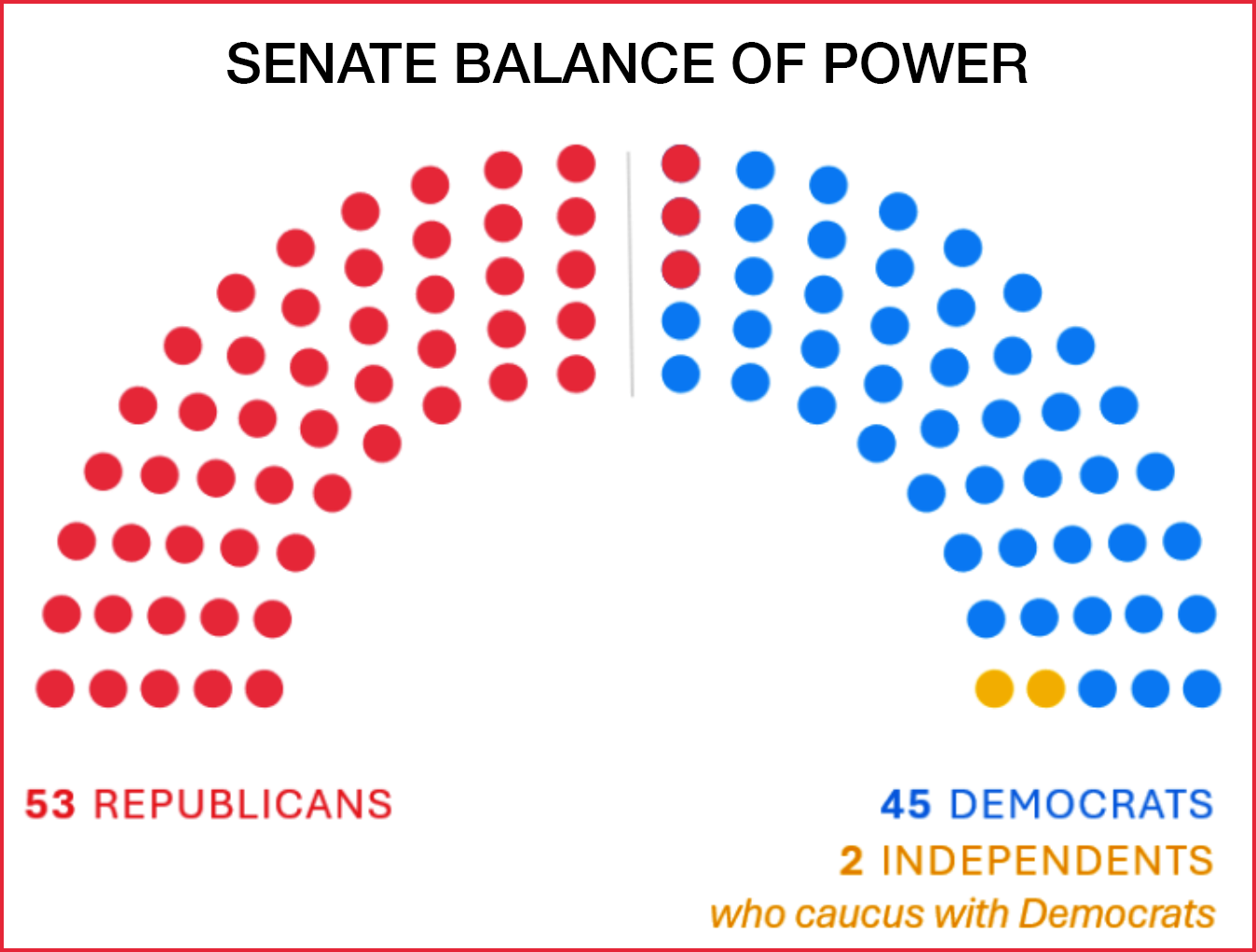
As we know, Republicans currently have a 53-47 Senate majority and the unfolding competitive statewide races suggest that the GOP will retain chamber control, but their margin could lessen.

A total of nine Senate seats are open but only two of those, Michigan and North Carolina, appear hotly competitive for the general election. The remaining seven are projected to retain the party that currently holds the respective seat. Eight of the nine in this group, however, will host highly contested primary elections for at least one party. North Carolina features the only open Senate race where the party nominees already appear set.

Another group of nine seats are contested for the general election, and it is here where Democrats will make a run at taking the Senate majority away from Republicans. To do so, they must reach 51, since Vice President Vance would break a 50-50 tie; Democrats would have to win seven of the nine contested races.

The Republicans are defending seats in Alaska, Iowa, Maine, North Carolina, Ohio, and Texas, while the Democrats must protect Georgia, Michigan, and New Hampshire.

Earlier this week former Alaska at-large Rep. Mary Peltola (D), who lost her seat to current Rep. Nick Begich III (R-Chugiak) in 2024, surprisingly launched a Senate campaign. Most believed she would enter the open Governor’s race where her prospects appear brighter. In the Senate race, she faces an uphill challenge against two-term incumbent Dan Sullivan (R), who has posted an average winning margin of 14.9 percentage points in his two elections including defeating Democratic Sen. Mark Begich in 2014.

Alaska’s unique top four/Ranked Choice Voting system does give Peltola some chance of winning the Senate race in the same manner as how she cobbled together two US House victories. If she can hold Sullivan under 50 percent in the general election, Ranked Choice Voting will begin and then all bets are off. At the outset, however, Sen. Sullivan is favored to win re-election.

Iowa Sen. Joni Ernst (R) is retiring after two terms, and Rep. Ashley Hinson (R-Marion/Cedar Rapids) appears as a consensus 2026 GOP Senatorial candidate. She will be favored to hold the seat probably against the Democratic leadership’s top choice, state Rep. Josh Turek (D-Council Bluffs), though several credible party members are competing for the nomination.

Maine Sen. Susan Collins (R) will defend her seat against either Gov. Janet Mills (D) or oysterman Graham Platner. Platner is the chosen Democratic Socialist candidate and has attracted major far left political figures to his campaign such as Sens. Bernie Sanders (I-VT) and Elizabeth Warren (D-MA). The general election will be close no matter who the Maine Democrats nominate.

North Carolina Republican Sen. Thom Tillis is retiring after two terms, and we will see a tight contest develop between former two-term Gov. Roy Cooper (D) and ex-Republican National Committee chairman Michael Whatley. North Carolina always features tight statewide elections, but for the first time in history Republicans have overtaken Democrats in party registration. This race, however, will likely end in a photo finish.

Appointed Ohio Sen. Jon Husted (R) faces the voters in his new role for the first time (he previously won two statewide races as Secretary of State and was twice on the gubernatorial ticket with Gov. Mike DeWine), and his opposition will be former Sen. Sherrod Brown (D). The fact that ex-Sen. Brown lost his seat in 2024 even though he garnered almost 293,000 more votes than when he last won in 2018 shows strongly the Ohio electorate is moving to the right.

The Texas Republican primary is likely going to a runoff between two of three candidates: Sen. John Cornyn, Attorney General Ken Paxton, and Rep. Wesley Hunt (R-Houston). The Democrats feature a battle between Rep. Jasmine Crockett (D-Dallas) and state Rep. James Talarico (D-Austin). A better general election picture will be drawn once the party nominees are chosen, but Texas Democrats have not won a statewide race since 1994.

Georgia Sen. Jon Ossoff (D) will be seeking a second term, and he already leads the nation in campaign fundraising. Republicans likely won’t have a nominee until a May runoff election concludes. A secondary election campaign potentially between Reps. Mike Collins (R-Jackson) and Buddy Carter (R-Pooler/Savannah) could well determine who challenges Sen. Ossoff in November.

The most vulnerable Democratic Senate seat may lie in Michigan. Here, an open contest between favored Republican Mike Rogers, a former seven-term Congressman and 2024 US Senate nominee, and one of the following: Rep. Haley Stevens (D-Birmingham), state Sen. Mallory McMorrow (D-Royal Oak), or former Wayne County Health Director Abdul El-Sayed, will take place.

The Michigan Democrats not only face a difficult primary campaign, but the nomination election isn’t until Aug. 4. The lengthy Democratic primary means Rogers will enjoy a long period of political open field running where he can build volunteer support and funding reserves.

Should former Sen. John E. Sununu win the New Hampshire Republican Senatorial nomination — and he is favored to do so over former ex-Massachusetts Sen. Scott Brown — the GOP will have a strong candidate to battle presumptive Democratic nominee Chris Pappas, the 1st District Congressman.

Though Pappas will be considered at least a slight favorite to win the general election, the Sununu name in New Hampshire has generally been political magic over the years. The Sununu family, including former Gov. John Sununu, ex-Gov. Chris Sununu, and ex-Senator and former Rep. John E. Sununu, have combined to win 11 major New Hampshire elections.

It remains to be seen if any other Senate contests enter the competitive realm, but electoral history suggests that an unexpected campaign is also likely to reach the political forefront.

Republicans are likely to hold their majority, but all of the aforementioned campaigns should be regularly monitored throughout this election year.


Peltola Announces for Senate

By Jim Ellis — Wednesday, January 14, 2026

Senate

Former Alaska at-large Rep. Mary Peltola (D) announces her Senate candidacy in this Facebook post.

Reports from last week suggesting that former Alaska at-large Rep. Mary Peltola (D) was seriously considering running for the Senate this year have proven correct. Peltola, defeated for re-election to the House in 2024, announced Tuesday that she will challenge two-term Republican Sen. Dan Sullivan later this year.

Though the Senate race was always on the table for Peltola, her decision to jump into this challenger contest is still a bit surprising. Considering the crowded Republican field running in the open Governor’s campaign, it appeared that Peltola would be assured of qualifying for the general election with a reasonable chance of winning the Governorship against possibly three Republicans advancing from the state’s unique top four primary system. Peltola’s chance improves even further when such a scenario advances to the Ranked Choice Voting round, through which she won her two congressional races.

The Alaska electoral system features an August jungle qualifying election where all candidates are placed on the same ballot regardless of political party affiliation. The top four finishers then advance into the general election. If no candidate receives majority support, the Ranked Choice Voting rounds begin.

The top four/Ranked Choice Voting system was challenged at the ballot box in 2024 through a voter initiative and survived by just 664 votes in the statewide tabulation. System opponents have again filed for another run at repealing the system and it appears enough signatures have been filed to qualify for the 2026 ballot. Even if the repeal proponents are successful in the ‘26 election, however, the top four process will still be in effect for the present cycle.

Though polling is already showing a Sullivan-Peltola Senate race to be a virtual toss-up, such is not surprising at this point in the election cycle. It is common to see the Alaska Democratic candidates consistently polling better early than they actually perform when votes are counted on election day.

For example, in the 2020 presidential race, President Trump appeared to be in a dead heat with future President Joe Biden in the Last Frontier, but the Republican ended with a secure 10-point win. In the 2024 congressional race, then-Rep. Peltola led Republican Nick Begich III by 9-14 percentage points in early polling before losing in a 51-49 percent Ranked Choice Voting final.

While Sen. Sullivan should still be regarded as the favorite for re-election, Peltola’s candidacy certainly makes the Senate race competitive. Looking at the rest of the country, we now see eight states where voters will decide a potentially tight Senate election.

In addition to Alaska, Republicans will be defending key Senate seats in Iowa, Maine, North Carolina, and Texas, while Democrats must protect Georgia, Michigan, and New Hampshire. For Democrats to reach a majority status of 51 Senate seats in this election, they would have to win seven of these eight hotly contested campaigns.

While the Peltola candidacy in Alaska puts another Republican Senate state in play for the Democrats, the party chances of capturing the majority in 2026 are still slim, but they may lessen the current 53-47 GOP margin.

Senate Turnover

By Jim Ellis — Monday, Sept. 22, 2025

Senate

Without any incumbent losing in the 2026 election, it is possible we will see as many as a dozen new Senators come to Washington when the 120th Congress convenes. Obviously, the number will grow even higher should any incumbent fall to a challenger, and further retirements as state candidate filing deadlines begin to approach are of course possible.

At this point, eight Senators have announced they will not seek re-election, but the cycle’s wild card is potentially seeing five Senators running for Governor in their respective states. This unusually high number includes four Senators who are not in-cycle, meaning they would not have to risk their current position to enter the state race.

Currently, Sens. Tommy Tuberville (R-AL), Michael Bennet (D-CO), and Marsha Blackburn (R-TN) are announced gubernatorial candidates. Two more, Sens. Alex Padilla (D-CA) and Lisa Murkowski (R-AK), have made public statements admitting they are considering entering open Governor’s races in their states. From this entire group, only Sen. Tuberville is eschewing re-election to run for Governor.

Sen. Padilla said he will wait to determine if he will launch a gubernatorial bid until the special redistricting vote scheduled for Nov. 4. Just this week, Sen. Murkowski again said she “isn’t ruling out” running for Governor of Alaska and made the point of having the “luxury” of waiting until deeper in the election cycle to make a final decision.

All of the Senators running or potentially running for Governor have or would have a strong chance of winning. This means that all but one would have the opportunity of appointing their own successor to the Senate upon election. Already speculation is running high in places like Colorado and Tennessee as to who will be the chosen replacement. Alabama voters will choose their next Senator in the 2026 regular election.

Of the 35 Senate races in the ’26 election cycle, including the two special elections in Florida and Ohio, Republicans must defend 22 of the in-cycle seats as compared to just 13 for the Democrats. Today, it appears that only three are in the toss-up category, Georgia, Michigan, and North Carolina, with the remaining 32 being safe for the incumbent party or at least leaning in its direction.

A Georgia poll released just this week (Quantus Insights; Sept. 9-12; 624 likely Georgia general election voters; online and text) projects Sen. Jon Ossoff (D) and Rep. Mike Collins (R-Jackson) locked in a 38-38 percent tie.

In the open Michigan race, Republican Mike Rogers, who lost the 2024 Senate contest by just 19,006 votes (three-tenths of a percentage point), has an unencumbered path to the Republican nomination, while the Democrats are embroiled in a three-way primary battle that won’t be decided until Aug. 4.

Recent North Carolina polling data (Change Research; Sept. 2-8; 855 likely North Carolina voters; online) finds former Gov. Roy Cooper (D) leading ex-Republican National Committee chairman Michael Whatley 48-41 percent in a race to replace retiring Sen. Thom Tillis (R) that is expected to be close through the entire campaign.

In the races involving Senators running for Governor, Sen. Tuberville to date faces no major Alabama Republican primary opposition in his open race. Incumbent Gov. Kay Ivey (R) is ineligible to seek a third term. A Democratic nominee will have a difficult time overcoming Sen. Tuberville in the general election. The party hopes to recruit former Sen. Doug Jones into the race, but he lost to Tuberville 60-40 percent in the 2020 Senate campaign. Therefore, Sen. Tuberville appears as a lock to win the Governorship next year.

Colorado Sen. Bennet would have little trouble in his state’s open Governor’s election as incumbent Jared Polis (D) is also term-limited in 2026. In the Democratic primary, Attorney General Phil Weiser remains in the race, and he is Sen. Bennet’s strongest potential opponent. The only published poll of this campaign came from the Global Strategy Group in June (June 9-11; 600 likely Colorado Democratic primary voters; live interview) and posted Sen. Bennet to a strong 53-22 percent advantage over Weiser.

Tennessee Sen. Blackburn faces GOP primary opposition in the person of Rep. John Rose (R-Cookeville). The latest poll comes from Quantus Insights (Aug. 5-7; 600 registered Tennessee voters; online & text) and posts Sen. Blackburn to a large 35-6 percent lead for the party nomination.

California Sen. Padilla would be a very formidable candidate, and likely the favorite, in the open Governor’s race to replace incumbent Gavin Newsom (D). A large jungle primary field awaits with no candidate so far even reaching 20 percent in any poll. The ostensible leader by a small percentage is former Rep. Katie Porter (D), but a Padilla entry would almost certainly allow him to advance into the general election. There, he would be a big favorite even in a two-way Democratic November campaign.

Sen. Murkowski, on the other hand, should she run for Governor, could face major general election opposition. Waiting in the wings is Democratic former at-large Rep. Mary Peltola. Even though she lost a close 2024 general election, Peltola remains a popular figure and would clearly be the Democrats’ best option to convert the Governor’s position away from the Republicans. As in other discussed situations, incumbent Mike Dunleavy (R) is ineligible to seek re-election.

The addition of multiple Senators running as candidates for Governor across the nation changes the 2026 Senate election cycle. Therefore, it is probable we will see several more freshman Senators in 2027 than the regular election will produce.

Murkowski for Governor?

By Jim Ellis — Wednesday, Aug. 13, 2025

Governor

Alaska Sen. Lisa Murkowski (R)

It might have been an off-handed comment in response to a reporter’s question, but late last week Sen. Lisa Murkowski (R) confirmed that she is “considering” entering the open Alaska Governor’s race next year.

Almost simultaneously, a Data for Progress survey from July was publicly released (July 21-27; 678 likely Alaska jungle primary voters; text from an online sample pool) and it finds former Rep. Mary Peltola (D) leading businesswoman and former radio talk show host Bernadette Wilson (R) and Lt. Gov. Nancy Dahlstrom (R) 40-11-10 percent in a hypothetical 2026 gubernatorial jungle primary poll.

Most believe the Governor’s race would dramatically change if Sen. Murkowski were to enter, though she was not added to the DfP ballot test. For her part, Peltola, who was defeated for re-election in November but still maintains positive name identification, has yet to officially enter the Governor’s race though recent comments lead most observers to believe that she will run.

Should Sen. Murkowski enter the Governor’s race, that would certainly change the budding campaign’s trajectory. The Republican candidates appear weak, at least in the early phase, and adding Sen. Murkowski to the candidate list would certainly make a more interesting contest. Yet, would she overtake Peltola?

According to the Data for Progress poll, Sen. Murkowski is not popular right now and certainly not with Republican voters. DfP tested 13 well-known Alaska political figures and Sen. Murkowski posted a 37:60 percent favorable to unfavorable image, the worst among all who were included. It in important to note, however, that only four of the 13 tested individuals scored in positive numbers (Peltola, President Trump, former state Sen. Tom Begich, and Wilson) and only Peltola had a positive rating of more than plus-5 percentage points.

Examining the poll’s crosstabs, we see in terms of partisan support that Sen. Murkowski performs better among Democrats than she does with Independents and her own Republican Party voters. Within the Democratic cell segment, her favorability index is 61:35 percent favorable to unfavorable. This compares with a 38:59 percent ratio among self-identified Independent survey respondents and a terrible 23:74 percent among Republicans.

Despite her poor ratings, the unique Alaska election system plays to Sen. Murkowski’s favor. A 2020 ballot initiative that the Murkowski forces supported created a Top Four jungle primary system that adds Ranked Choice Voting rounds if no one receives majority support on the initial vote. The measure was adopted with 50.5 percent of the statewide vote.

In 2024, the Top Four system opponents qualified a ballot initiative to return to the previous partisan primary system. The Top Four survived with a bare 50.1 percent of the vote.

Sen. Murkowski is the chief beneficiary of the Alaska system because she no longer must win renomination in a Republican primary. Therefore, if she were to enter an open Governor’s election, Murkowski would again easily capture one of the four available positions for advancement into the general election. Once in the November campaign, her ability to win general elections would again come to the forefront.

In her career after her father, then-Governor and former US Sen. Frank Murkowski (R), appointed her to the Senate in 2002, Lisa Murkowski has only averaged 46.6 percent of the vote in winning largely plurality elections mostly because Alaska typically features many Independent and minor party candidates in its elections.

The Murkowski average includes the 53.7 percent she received in 2022, but that higher percentage came through three rounds of Ranked Choice Voting. Her initial 2022 percentage prior to advancing into the RCV rounds was 43.4 percent. Therefore, her four-election average without the Ranked Choice system would be 44.0 percent. In 2010, she was upset in the Republican primary but won the general election as a write-in Independent candidate with only 39.7 percent of the vote but topping both a Republican and Democratic nominee.

The Dave’s Redistricting App statisticians calculate an Alaska partisan lean of 52.8R – 41.8D. President Trump slightly exceeded the aggregate partisan lean in all three of his elections (54.5 – 41.4 percent over Kamala Harris; 53.1 – 43.0 percent opposite President Biden; and 51.3 – 36.6 percent against Hillary Clinton), while Sen. Murkowski typically runs significantly below the Republican benchmark.

Soon we will see if the Senator’s comment about “considering” the Governor’s race will prove more than a flippant response. If so, then the open Alaska Governor’s campaign will certainly become more interesting.

House Overview – Part I

By Jim Ellis — Tuesday, April 22, 2025

House

Already we have seen developments occur in key 2026 House election cycle campaigns. Over the next four days, we will recap the action. Today, we look at districts in Alaska through Colorado; tomorrow, Florida to Minnesota. If a state is not listed, it means there are no major developments currently affecting the sitting incumbents.

At this point, it appears there are 49 races in the competitive category. Republicans currently hold 26 of the seats and Democrats 23. Therefore, we can expect another tight election cycle.

Alaska

AK-AL — While polling again suggests another dead heat race for at-large freshman Rep. Nick Begich, III (R-Chugiak) if former Rep. Mary Peltola (D) were to return for a re-match, it appears such a contest will not materialize. It is highly likely that Peltola will enter the state’s open Governor’s race.

Arizona

AZ-1 — In November, Rep. David Schweikert (R-Fountain Hills) defeated state Rep. Amish Shah (D) 52-48 percent. Already, Dr. Shah, former news anchor and 2024 congressional candidate Marlene Galen-Woods (D), and businessman Jonathan Treble (D) have announced their candidacies. A competitive Democratic primary and general election is on the horizon for this Maricopa County congressional seat.

AZ-6 — Rep. Juan Ciscomani (R-Tucson) again defeated former state Sen. Kirsten Engel (D) and did so with a 50-47 percent margin. Engel stated that she will not return for a third congressional race. Retired Marine Corps Sergeant JoAnna Mendoza (D) has already raised over $800,000 for her announced campaign. She reports over $726,000 cash-on-hand, while Rep. Ciscomani posts over $1.2 million in his campaign account. This will again be a highly competitive national congressional campaign.

AZ-7 — The special general election to replace the late Rep. Raul Grijalva (D-Tucson) is scheduled for Sept. 23. The determinative battle, however, will be the July 15 Democratic primary. Though five candidates have filed for the party primary, the race is realistically between Pima County Supervisor Adelita Grijalva, the late Congressman’s daughter, and former state Rep. Daniel Hernandez. This district will not be competitive in the 2026 regular election.

California

CA-3 — Rep. Kevin Kiley (R-Rocklin/Sacramento) was re-elected to a second term with 55 percent of the vote in November. He has drawn a significant Democratic opponent for 2026. Nevada County Supervisor Heidi Hall (D) announced that she will enter the ’26 campaign. Her constituency represents approximately 15 percent of the district population.

CA-9 — Rep. Josh Harder (D-Tracy) defeated Stockton Mayor Kevin Lincoln (R) by a slight 52-48 percent margin in 2024. Lincoln says he is considering returning for a re-match but has not yet announced his 2026 candidacy. Rep. Harder already reports over $2.2 million in his campaign war chest.

CA-13 — This district hosted the closest House race in the entire country last year, as now-Rep. Adam Gray (D-Merced) defeated then-Rep. John Duarte (R) by just 187 votes. Republicans appear to have their act together for 2026. They have recruited Ceres Mayor Javier Lopez (R) into the developing contest. Duarte has already announced that he will not return for a re-match and endorsed Lopez. Rep. Gray had a weak 1st Quarter from a fundraising perspective. He posts only $344,000 in his campaign account.

CA-22 — Rep. David Valadao (R-Hanford/Fresno) represents the most Democratic seat in the nation to elect a Republican to the House. In November, he again defeated former Assemblyman Rudy Salas (D), this time, 53-47 percent. Salas may return for a third run but has not yet announced his intentions. Visalia School Board Trustee Randy Villegas (D) is a declared candidate and says he will remain in the race irrespective of what Salas decides. In 2026, this will again be a top national congressional campaign.

CA-41 — The Inland Empire will again feature a competitive race for 17-term Congressman Ken Calvert (R-Corona), but he will have a different general election opponent. Democratic former federal prosecutor Will Rollins, who ran two close races against the veteran Congressman, has already announced that he will not return for a third run. Democrats have recruited Grammy Award winning musician Tim Myers in his place.

CA-45 — Freshman Rep. Derek Tran (D-Orange) defeated then-Rep. Michelle Steel (R) by just 683 votes, making it the second-closest congressional race in the country. Steel immediately filed a 2026 FEC committee upon her defeat but only raised a little over $74,000 in the 1st Quarter. She has over $942,000 in her campaign account, however. Therefore, we are likely to see another highly competitive Tran-Steel contest here in 2026. For his part, Rep. Tran posted just over $547,000 in his campaign committee.

CA-49 — Four-term Rep. Mike Levin (D-San Juan Capistrano) defeated Republican Matt Gunderson 52-48 percent in November but is likely to face a stronger opponent in 2026. San Diego County Supervisor Jim Desmond (R) is an announced candidate and only one of two Republican US House challengers nationwide to raise over $400,000 in the 1st Quarter. Though the Orange County candidates have dominated this district in recent elections, San Diego County holds two-thirds of the CD’s residents. Therefore, this should be a race to watch in 2026.

Colorado

CO-8 — The politically marginal 8th District of Colorado that lies north and east of Denver will perennially be on the competitive House race list. In 2022, Democrat Yadira Caraveo won the seat with 48 percent of the vote. In 2024, Republican state Rep. Gabe Evans unseated her with 49 percent. Another tough race is in store for what will always be a vulnerable incumbent.

Caraveo has announced she will return for a rematch but must first get past state Rep. Manny Rutinel (D-Commerce City) to secure the party nomination. Rutinel posted impressive fundraising numbers in the 1st Quarter, attracting more than $1.2 million in support. Therefore, we can expect to see a hot Democratic primary and general election here in 2026.

The Hot Senate Cycle

By Jim Ellis — Wednesday, March 19, 2025

Senate

Examining developing political events, we are already seeing the prelude to what might become the most competitive US Senate campaign cycle in decades.

Since Michigan Sen. Gary Peters (D) declared in late January that he will not seek re-election, three other Senators announced that they will also retire at the end of the current term. Depending upon the candidates each party fields, all of these newly open races have the potential of becoming expensive toss-up campaigns.

As we know, the other open seats are found in Kentucky (Sen. Mitch McConnell-R), Minnesota (Sen. Tina Smith-D), and New Hampshire (Sen. Jeanne Shaheen-D). Should the Kentucky Democrats convince Gov. Andy Beshear to run and likewise the New Hampshire Republicans recruit former Gov. Chris Sununu, these two states would certainly host major toss-up campaigns. Absent Beshear and Sununu running, each party would be favored to hold their respective seat.

Democrats expect to have the advantage in Minnesota, but it is unclear at this early point who their party will nominate. With Gov. Tim Walz (D) not running for Senate, Lt. Gov. Peggy Flanagan and former state Senate Minority Leader Melisa Lopez Franzen have announced their candidacies, while Rep. Angie Craig (D-Prior Lake) is listed as a possible contender. If Republicans can recruit a credible nominee, this open seat could transform into a competitive battle.

Perhaps the Republicans’ most vulnerable incumbent is North Carolina’s Thom Tillis; Democrats are trying to convince former Gov. Roy Cooper to enter that state’s Senate race. Like many others, Cooper is said to have presidential ambitions that could forestall a Senate challenge.

National Democrats would also like to see Maine US Rep. Jared Golden (D-Lewiston) challenge Sen. Susan Collins (R), but this is unlikely to happen. Golden is a former Collins staff member, and if he does run statewide it is more likely he will enter the open Governor’s race.

Two other Republican Governors are being recruited to run for the Senate, but it is unclear at this point if either will declare a bid. Georgia Gov. Brian Kemp and Virginia Gov. Glenn Youngkin would pair with Sens. Jon Ossoff (D-GA) and Mark Warner (D-VA), but there is no guarantee that either will make the move. Both have presidential aspirations and may not want to test their prospects for a national campaign in a Senate race where they stand a reasonable chance of losing.

Alabama Sen. Tommy Tuberville (R), reversing himself from his earlier statements and now saying he may well enter his state’s open Governor’s race, means we could see a very crowded, but determinative nominating campaign to succeed the Senator as the Republican nominee. Such an individual would then become a heavy favorite to win the general election, but the nominating process would be highly competitive.

Alaska Democrats would like to recruit former Rep. Mary Peltola (D) to challenge Sen. Dan Sullivan (R), but the lure of an open Governor’s race will likely be more tempting for Peltola.

Kansas Sen. Roger Marshall (R) stands for a second term next year, and the Democrats’ best potential candidate for this race is term-limited Governor Laura Kelly who cannot succeed herself. Kelly or Rep. Sharice Davids (D-Roeland Park) would be the Democrats’ best options for the Senate, but at this point there is little indication that either plan to run.

Expect, however, that Democratic Senatorial Campaign Committee chair Kirsten Gillibrand (D-NY) will make a strong push to convince one of those two to enter the Jayhawk State Senate race.

Louisiana Sen. Bill Cassidy (R) is likely to also experience a competitive re-election race but not for the general election. With his state returning to a partisan primary system, Sen. Cassidy, for the first time, will have to face a strong Republican challenger before only Republican voters. One such individual, State Treasurer and former Rep. John Fleming (R), is already campaigning and leading in a late February poll (JMC Analytics; Feb. 26-28; 600 likely Louisiana Republican primary voters; Fleming 40 – Cassidy 27 percent).

Should Texas Sen. John Cornyn (R) stumble in the early 2026 Republican primary, Democrats would have a chance of putting Texas in play particularly if flawed Attorney General Ken Paxton becomes the Republican nominee. National Democrats would like to see 2024 Senate nominee and former Congressman Colin Allred run again.

Additionally, two appointed Senators, Florida’s Ashley Moody (R) and Jon Husted of Ohio (R) must run in special elections to fill the balance of the current terms and both will be expensive campaigns in large states.

If all of the most prominent potential candidates were to run in these 15 potentially competitive states, we would see a very volatile set of US Senate campaigns.

Chances are, however, the list of eventual nominees from both parties will be a bit more mundane than in the aforementioned outlined scenarios. Several of these big-name potential Senate contenders may be more inclined, like former US Transportation Secretary Pete Buttigieg who just bowed out of the Michigan race, to follow the presidential winds.

House Re-Match Recap – Part I

By Jim Ellis — Thursday, Feb. 27, 2025

House

We have been witnessing recent 2026 campaign action in some of the closest 2024 US House races. Several re-matches are on the political horizon.

Today and tomorrow, we will review 23 of the closest ‘24 House contests and identify which of the districts could host a re-match campaign. Part I will cover the most competitive CDs from Alaska through Iowa.


AK-AL:

  • Nick Begich III (R) unseated then-Rep. Mary Peltola (D)
  • 51.2 – 48.8% — Vote Difference: 7,876

Reports suggest that former Rep. Peltola is getting Democratic Party and community leader pressure to run for Governor, US Senate, and US House. There is a good chance that she chooses the open Governor’s race.

Therefore, a re-match between she and Rep. Begich currently appears as a long shot. No candidate from either party has yet come forward to declare interest in challenging Begich.


AZ-1:

  • Rep. David Schweikert (R) defeated State Rep. Amish Shah (D)
  • 51.9 – 48.1% — Vote Difference: 16,572

Veteran Rep. Schweikert, now in a more competitive post-redistricting seat, won a relatively comfortable victory over then-State Representative and physician Amish Shah. At this point, Dr. Shah is signaling returning for a re-match but will again have competition in the Democratic primary.

Administrative Law Judge Brian Del Vecchio (D) has already announced his congressional candidacy. Former news anchor Marlene Galan-Woods, who placed a close third in the 2024 First District Democratic primary, is viewed as a possible candidate as is National Guardsman Jimmy McCain (D), the son of the late Sen. John McCain (R). The 2026 AZ-1 race will again be a highly competitive race.


AZ-2:

  • Rep. Eli Crane (R) defeated former Navajo Nation President Jonathan Nez (D)
  • 54.5 – 45.5% — Vote Difference: 36,450

Rep. Crane defended his northeastern Arizona district with a nine-point win, but this was a closer than expected contest from what is regarded as a safe Republican seat (FiveThirtyEight data rating: R+15). Nez spent over $5.4 million, which put his campaign on the political map.

The 2024 challenger has already announced that he will return for a re-match and no Democratic primary opposition is expected. This race could become a second-tier target.


AZ-6:

  • Rep. Juan Ciscomani (R) topped ex-state Senator Kirsten Engel (D)
  • 50 – 47.5% — Vote Difference: 10,822

The 2024 campaign marked the second time Ciscomani and Engel fought to a close finish. In last November’s race, Rep. Ciscomani, while still winning a close matchup, almost doubled his victory margin from 2022 when the newly constructed seat was open.

Engel is indicating she will not return for a third run, and retired Marine Corps Sgt. Jo Mendoza (D) has already declared her candidacy. The nature of the Tucson-anchored southeastern Arizona 6th CD is tightly partisan, so we can expect seeing a close finish here in 2026 and likely in every election year throughout the remainder of the decade.


CA-9:

  • Rep. Josh Harder (D) outpaced Stockton Mayor Kevin Lincoln (R)
  • 51.8 – 48.2% — Vote Difference: 9,009

Republicans recruited a strong candidate in Mayor Kevin Lincoln, who won an election in the 9th District’s most Democratic locality. He is reportedly undecided about seeking a re-match with Rep. Harder who outspent the Mayor in a 2:1 ratio. It is likely that only Mayor Lincoln could put this seat in play for 2026.


CA-13:

  • Adam Gray (D) unseated Rep. John Duarte (R)
  • 50.04 – 49.96% — Vote Difference: 187

The closest US House contest in the country went the Democrats’ way as former state Assemblyman Adam Gray returned for a 2024 re-match with MDuarte and this time landed on the winning side of a razor-thin margin of 187 votes from 210,921 ballots cast. In 2022, Duarte won with a 564-vote spread.

Duarte is lobbying for a position in the new Trump Administration as the Administrator of the Bureau of Reclamation. He says he is open to running for the House again, so it remains to be seen if a third Gray-Duarte campaign will transpire.

The former Congressman losing was a bit of a surprise considering President Trump carried the 13th District by six percentage points. One would have believed such a coattail margin would have been enough to bring an incumbent Representative through.


CA-45:

  • Derek Tran (D) unseated Rep. Michelle Steel (R)
  • 50.1 – 49.9% — Vote Difference: 653

The second-closest House race in the country was also found in California, as attorney Derek Tran just slipped past two-term Rep. Steel by 653 votes from 315,875 ballots cast. This is a race where a re-match was immediately announced, as Steel said she would make a return appearance in 2026 right after the election and filed a campaign committee before 2024 ended.

Though the FiveThirtyEight data organization rates this seat as D+5, Steel has already proven she is very competitive within the region. This will once again be a hotly contested race next year that could go either way.


CO-8:

  • State Rep. Gabe Evans (R) unseated Rep. Yadira Caraveo (D)
  • 48.9 – 48.2% — Vote Difference: 2,449

In a district designed as politically marginal and one that would consistently reflect the will of a tight partisan electorate, Colorado’s 8th CD in its two terms of existence has performed as intended. Both Caraveo in 2022 and Evans in 2024 won the seat with less than majority support. We can again expect a highly competitive campaign next year.

It does not appear that Caraveo will attempt to reclaim the seat that she lost in November. Already, however, the Democrats have a new candidate in the person of state Rep. Manny Rutinel (D-Commerce City) who has officially announced his congressional candidacy. CO-8 will become a top targeted 2026 national campaign.


CT-5:

  • Rep. Jahana Hayes (D) defeated ex-state Sen. George Logan (R)
  • 53.4 – 46.6% — Vote Difference: 23,010

After surviving a close call with then-state Sen. Logan in 2022, Rep. Hayes expanded her victory margin and has likely sent her opponent into political exile at least for a while. There is no indication that Logan will return for a third try especially since he lost ground in his second attempt. The district is competitive (FiveThirtyEight: D+3), so expect the GOP to recruit another strong challenger, but probably not Logan.


IA-1:

  • Rep. Mariannette Miller-Meeks (R) defeated ex-St. Rep. Christina Bohannan (D)
  • 48.4 – 48.2% — Vote Difference: 799

The third-closest House race was present in southeast Iowa. Four years ago, a different configuration of this district delivered the closest election of the decade, a six-vote win for Miller-Meeks.

This campaign signaled that a close general election would occur when Rep. Miller-Meeks recorded a low 56 percent win over her GOP challenger David Pautsch, an opponent who spent only $38,382 on his campaign. Pautsch has announced he will return for a primary re-match and promises to run a more professional campaign.

In the 2024 general election, Rep. Miller-Meeks again defeated — and this time by a much smaller margin — ex-state Rep. Bohannan. Whether a third version of this pairing happens in 2026 remains to be seen, but Bohannan has not ruled out another comeback attempt.

Expect the Congresswoman to move to the right to blunt her primary opposition. Regardless of who the Democrats put forth this general election campaign will evolve into another political dogfight.