By Jim Ellis — Tuesday, November 24, 2026
 As was predicted, the beginning of the 2028 open presidential campaign would come soon after the 2026 midterm elections closed, and it appears the Democrats just fulfilled the forecast.
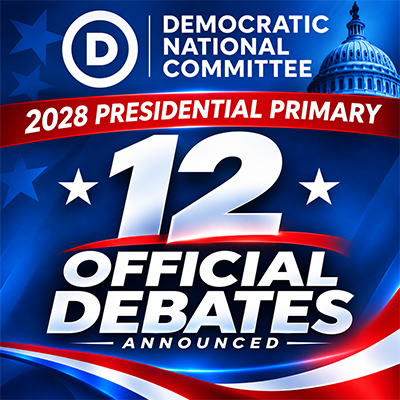
Yesterday, Democratic National Committee Chairman Ken Martin announced that the party will hold 12 official presidential primary debates. Five are scheduled for 2027, with the first targeted for an unscheduled date in June. Of the seven primary debates to be held after Jan. 1 and before Super Tuesday (March 7, 2028), six will be held in states with early primary elections.
The DNC has released the presidential primary schedule that begins in South Carolina on Jan. 22, 2028. The candidates will then compete in Nevada on Feb. 1, New Hampshire on Feb. 8, New Mexico on the 15th, Michigan, the 22nd, and Virginia on Feb. 29, setting the stage for Super Tuesday.
Republicans have not yet released a full primary schedule but have indicated they will return to the traditional pre-Super Tuesday early states of Iowa, New Hampshire, Nevada, and South Carolina. While Democrats have moved away from caucuses, Republicans will continue to allow them in some states. Iowa and Nevada are expected to allocate GOP delegates through caucuses, while New Hampshire and South Carolina will hold primaries. The precise order and dates remain unsettled, but the traditional sequence is expected to hold.
Possibly because the New Hampshire political primary is an economic engine for the state and it has such historical significance, the Democrats are returning after abandoning the “First in the Nation” primary in the 2024 presidential nomination process.
The New Hampshire Secretary of State will likely schedule the two primaries on the same day – in this case Feb. 8, 2028 – and it will prove to be the one pre-Super Tuesday state that will simultaneously host both major party primaries. The other states in common on the early schedule, Nevada and South Carolina, will hold their nomination event on separate days for each party.
Democratic leaders also outlined qualification rules for candidates securing a debate podium. Contenders must meet still-to-be-determined polling thresholds from selected survey firms and satisfy a grassroots fundraising requirement.
The most contentious condition is a new “Fair Campaign Practices Pledge” requiring candidates to disavow outside spending by super PACs or dark-money groups that either supports them or attacks their Democratic opponents during the primary. Many Democratic leaders have long opposed unlimited independent expenditures since the Supreme Court’s 2010 Citizens United decision.
While Republican-aligned groups led in reported outside spending during the 2026 cycle, Democratic-aligned groups still accounted for a substantial share (roughly 40 percent of the nearly $2 billion total). Enforcing a complete disavowal could prove difficult and may invite legal challenges if the party bars candidates who do not fully comply when the Supreme Court ruled that such expenditures are protected free speech under the First Amendment.
The debate announcement also stated that party leaders will not allow more than 20 contenders in any one event. If they have that many qualified candidates under the party acceptance criteria, it is probable a second day would be added with half of the qualified individuals speaking on the first night and the second half on the second. It is also presumed that the party would conduct a random draw to determine who is assigned to the first and second night.
With the midterm election essentially complete except for the two Louisiana congressional runoffs scheduled for Dec. 12, and with one major party now releasing a concrete debate framework, it is possible that between Thanksgiving and Christmas the first formal presidential campaign announcements from candidates in both parties may be forthcoming.