
By Jim Ellis — Monday, November 23, 2026
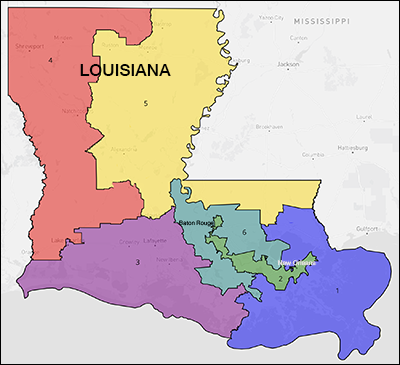
Click on image above or here to see interactive Louisiana Congressional Map: Dave’s Redistricting App.
Both seats were drawn as strongly Republican districts, yet the Nov. 3 results showed that no Republican seat is completely safe in the current political environment. In each district a Democrat finished first, though with less than 20 percent of the vote, and no candidate even came close to approaching a majority.
Adding the aggregate partisan vote, the total Republican vote share was a cumulative 63.1 percent among the six candidates in District 5. The 6th CD returned a similar result: 57.3 percent among six GOP contenders.
District 5 stretches from the Arkansas border south along the Mississippi Delta that comprises Louisiana’s eastern border. It then juts sharply east below the Mississippi border to annex five more parishes. The largest population centers are the cities of Monroe and Alexandria. The current incumbent, Republican Julia Letlow, risked the seat to run successfully for the US Senate.
State Rep. Patricia Moore (D-Monroe) placed first in the jungle primary with 17.9 percent of the vote, just ahead of state Rep. Gabe Firment (R-Pollock) who posted 17.2 percent. The two were separated by 1,660 votes. The third-place finisher, Republican Misti Cordell, received 14.6 percent of the vote. According to the Dave’s Redistricting App statisticians, the post-redistricting District 5 partisan lean calculates to 64.6R – 33.6D.
The 31-point Republican advantage should normally be decisive for Firment in a runoff. Democrats, however, flipped 34 House seats this cycle in Republican-favorable partisan lean districts. None of those flips, however, occurred in a seat with a partisan lean larger than 24.4 points (the number found in Colorado’s 4th District, which Lauren Boebert lost).
Interestingly, the biggest spender in the 5th District race, Republican Michael Echols, poured more than $3 million into the contest (including roughly $2.4 million in personal loans) yet finished fourth and missed the runoff. He outspent Firment by a 7:1 ratio, who advanced. Rep. Moore, by contrast, reported only about $23,000 in spending through the mid-October Federal Election Commission’s pre-primary report and still finished first.
In the 6th District, drawn as an inverted horseshoe around Baton Rouge, former East Baton Rouge Parish Councilwoman Chauna Banks (D) finished first with 19.4 percent, just 628 votes ahead of state Sen. Blake Miguez (R-New Iberia) at 19.2 percent. Republican Rick Edmonds was a close third at 18.8 percent. The district’s partisan lean is even more Republican-favorable than CD-5, at R+32.5. The seat opened when incumbent Democrat Cleo Fields retired.
The 6th District reconfiguration is the result of the US Supreme Court’s ruling on the Louisiana v. Callais landmark decision which the justices rendered in April. After a similar 6th District, at the time represented by Republican Garret Graves, was rejected by the courts as a partisan gerrymander after the 2022 election, the legislature installed a map that was similar to a version declared illegal three decades earlier that stretched from Baton Rouge to Shreveport.
The high court’s subsequent landmark ruling in Callais mandating that race can no longer be a factor in drawing districts allowed the state legislature to then legally reconstitute a map similar to what was previously rejected.
In the 6th District race earlier this month, Sen. Miguez was the top spender, investing more than $6 million, yet he finished only narrowly ahead of the other leading Republicans. Banks, the first-place finisher, actually reported no expenditures through the pre-primary FEC report.
If both Firment and Miguez win their runoff elections on Dec. 12 as currently expected, the final House partisan division will stand at 260 Democrats to 175 Republicans. Should either or both seats flip, the Democratic majority could still expand to 261 or even 262.