Category Archives: TEXAS

More Texas News in the Spotlight:
Latest Senate, Redistricting Updates

By Jim Ellis — Monday, Nov. 24, 2025

New polling data was just released in Texas that confirms what many observers have opined about the Lone Star State’s US Senate campaign, and a scathing dissent from one of the three-judge panel members who heard the latest redistricting case could pave the way for a Supreme Court stay.

Senate

Texas state flag

Ragnar Research (Nov. 12-17; 1,000 likely Texas voters; live interview) released a new Texas US Senate poll that supports the common political supposition pertaining to the Lone Star State Senate race. That is, Sen. John Cornyn (R) would lead both 2024 Senate nominee and ex-Congressman Colin Allred (D) and state Rep. James Talarico (D-Austin), but Attorney General Ken Paxton would be in danger of losing the general election.

In this poll, Sen. Cornyn leads Allred 47-40 percent and Talarico by a similar 46-40 percent split, both beyond the polling margin of error. As predicted, the two Democrats fare better against Paxton. Allred would lead 44-43 percent, and Rep. Talarico would tie the scandal-tainted AG at 44-44 percent.

The third announced Republican in the race, Rep. Wesley Hunt (R-Houston), was not tested, nor was Rep. Jasmine Crockett (D-Dallas) on the Democratic side. Crockett has been leading in other Texas Democratic statewide primary polls but has not yet made a decision about whether to enter the Senate race.

The latest judicial redistricting ruling from the El Paso three-judge panel suggests Rep. Crockett may stay in the House since the 2025 Texas map invalidation restores her 30th Congressional District to its previous boundaries.

According to Ragnar Research partner Chris Perkins, who conducted this poll, wrote “John Cornyn is the strongest candidate for Republicans in a general election, as he has a clear lead. Paxton is statistically tied with either of the Democrat candidates and jeopardizes the ability of Republicans to hold the seat.”

The Texas Senate race is one of the key focal points of the 2026 election cycle. It will be perhaps the only Senate contest that features a contested primary in both parties along with a highly competitive general election.

Redistricting

Fifth District Circuit Judge Jerry E. Smith, a member of the three-judge panel that invalidated the 2025 Texas redistricting map as a racial gerrymander over his objection, published a scathing dissent to the ruling. In his document, Judge Smith referred to lead Judge Jeffrey Brown’s decision as “the most blatant exercise of judicial activism that I have ever witnessed.” Judge Smith stated that he has been a federal judge for 37 years.

The dissent opinion begins by saying that, “the main winners from Judge Brown’s opinion are George Soros and Gavin Newsom. The obvious losers are the People of Texas and the Rule of Law.”

Throughout a 104-page document, Judge Smith details 11 different examples of how ruling that the 2025 Texas map is a racial gerrymander is either “false, misleading, deeply misleading, or deceptive.”

The state of Texas has already appealed, asking that the current ruling be stayed. Appealing a three-judge panel decision goes directly to the US Supreme Court and an official answer must be rendered. The justice assigned to oversee the 5th Circuit Court of Appeals, in which Texas resides, is Samuel Alito. The justices have the individual power to issue stays on cases from the circuits in which they oversee.

If Justice Alito were to grant a stay on the Brown panel redistricting ruling, the 2025 map would return as the official Texas map. With candidate filing closing on Dec. 8, a quick ruling on the stay motion is imperative since the two maps are radically different in 11 of Texas’ 38 congressional districts.

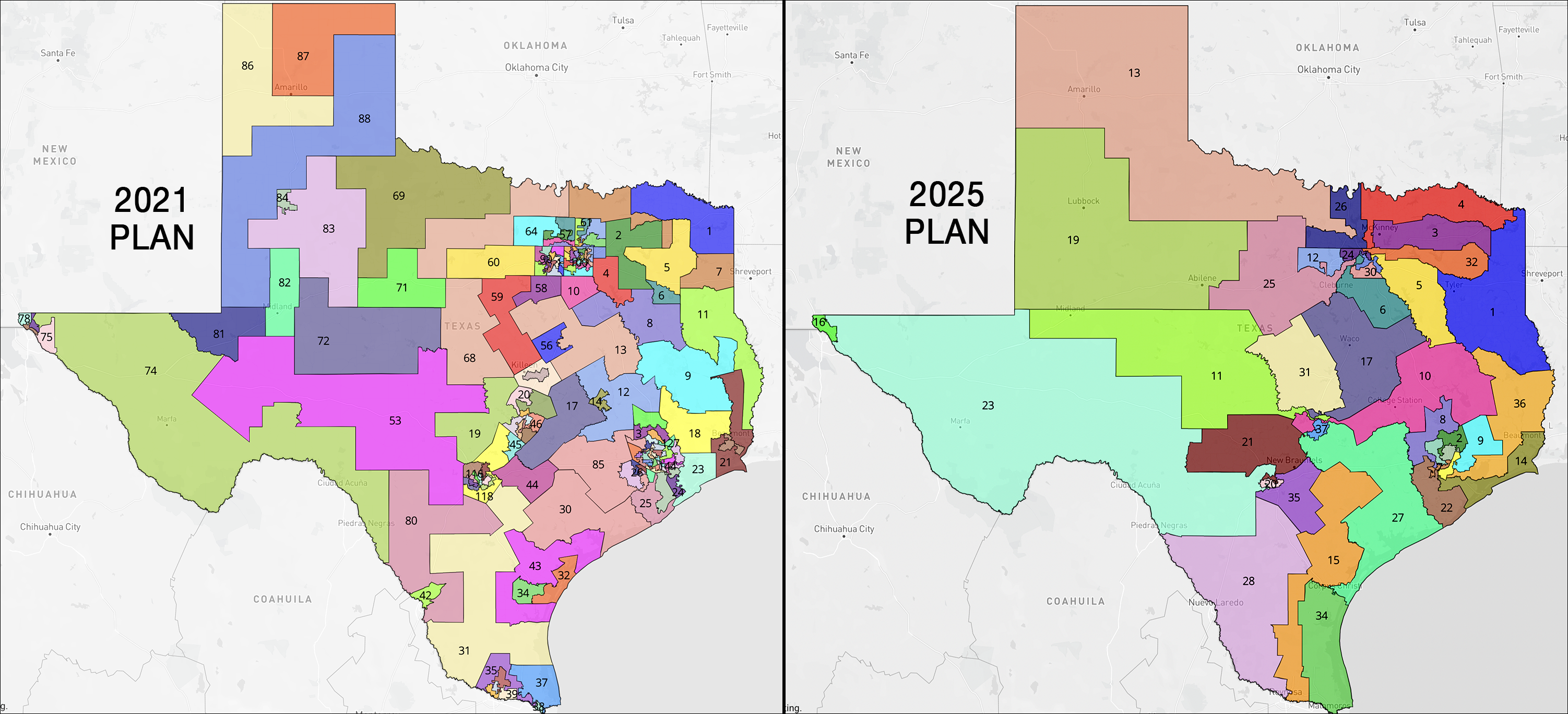
How Texas Changes

To see larger image, click on above map. To see interactive maps, go to Dave’s Redistricting App: Texas 2021 Plan | Texas 2025 Plan

By Jim Ellis — Thursday, Nov. 20, 2025

Redistricting

The El Paso three-judge panel ruling that invalidates the new Texas map, if allowed to stand, will greatly disrupt the Lone Star State political cycle as candidates currently prepare for an early March 3, 2026, primary election.

In reverting to the 2021 map, 37 of the state’s 38 congressional districts will change, thus altering virtually all the candidates campaign strategies and geographic targets.

Only District 19, now the open seat of retiring Rep. Jodey Arrington (R-Lubbock), remained constant between the two maps. A total of 26 districts experience only minor changes, while 11 see major alterations.

Under the 2025 Texas plan, nine seats are open, but returning to the 2021 map will likely mean that number drops to seven. It is also probable that one member who announced his retirement under the 2025 map, Rep. Lloyd Doggett (D-Austin), will return to run again if the 2021 map is formally reinstated.

In the invalidated plan, Reps. Doggett and Greg Casar (D-Austin) were paired in a new 37th District, while Rep. Casar’s 35th CD was created as an open seat that stretched into rural counties east of San Antonio. If the 2021 plan is in place for next year’s election, both will have back their previous districts. Doggett said earlier that he would return to seek re-election if the 2025 map was tossed and the previous plan restored.

In the ’25 draw, a new 9th District was created in eastern Harris County. Should the three-judge panel’s ruling be upheld, this district will go away and the candidates seeking this seat will have no place to run.

Should the previous 9th District return, Rep. Al Green (D-Houston) would again seek re-election in this district and would not be paired in a new 18th CD with the winner of the Jan. 31 special runoff election to fill the vacancy created when Rep. Sylvester Turner (D) passed away.

Rep. Michael McCaul’s (R-Austin) 10th District would still be an open seat, and though the territory is different from the invalidated map, the candidate pool would likely remain the same. This is similar to the situation in the 8th and 21st Districts where Rep. Morgan Luttrell (R-Magnolia) is retiring, and four-term incumbent Chip Roy (R-Austin) passed on re-election to run for state Attorney General.

Turning to South Texas, Rep. Monica de la Cruz (R-McAllen) will naturally see a return to her original 15th District configuration. The new 15th would have given her more Republican voters. Still, she should again be able to win re-election in the 2021 version.

Rep. Henry Cuellar (D-Laredo) saw some of the territory that gave him the most trouble go away under the new version of District 28. Rep. Cuellar had two close calls in the Democratic primary largely because of the San Antonio region. The 2025 map moved this district further into South Texas. If the previous districts are reinstated, he may again draw a more combative Democratic primary opponent, while still facing a competitive general election.

One of the districts most affected in South Texas was Rep. Vicente Gonzalez’s (D-McAllen) 34th CD anchored in Brownsville. The Congressman would have been in serious trouble under the new plan, but the 2021 version returns his much stronger Democratic base. Still, his victory margin in 2024 was only 51-49 percent over former Congresswoman Mayra Flores (R), and he can expect to face her again. She would have been favored in the new district, but Rep. Gonzalez returns to having the stronger political position under the 2021 map.

The Dallas area was changed greatly under the 2025 plan. The two members most affected were Reps. Marc Veasey (D-Ft. Worth) and Julie Johnson (D-Farmers Branch). Under the new plan, all of Rep. Veasey’s home Tarrant County turf was moved into different districts, leaving his 33rd CD as a self-contained seat within Dallas County.

Under the new plan, Veasey was looking to leave the House to run for Tarrant County Judge (Executive). If the previous map returns, it is possible that he will seek re-election.

Rep. Johnson, who saw her 32nd District moved largely into Republican East Texas, would return to the previous district under the 2021 plan. She was looking to move into Rep. Veasey’s vacated 33rd District if the new map were in place.

Republicans had calculated a gain of five seats under the new map, though some of the predictions might have been overly optimistic, such as, beating Rep. Cuellar in his new 28th CD and securing the open 35th CD.

If the three-judge panel’s decision holds, it is probable that we will see no Republican gain under the 2021 map thus making the chances of retaining their slim majority even more precarious.

Decision Time in Texas

(Click on map above to see full-size detail.)

By Jim Ellis — Wednesday, Aug. 27, 2025

Redistricting

Now that the new Texas redistricting map has been signed into law displaced Democratic incumbents and potential candidates are deciding where they will run.

In the Dallas area, a game of political musical chairs must be played. All three Texas Democrats who currently represent part of Dallas County no longer live in the district for which they will likely run.

It is probable that Rep. Jasmine Crockett (D-Dallas), whose home is now in Rep. Marc Veasey’s (D-Ft. Worth) 33rd District, will still run in District 30, where almost 69 percent of her current constituency resides. By the same token, Rep. Veasey’s best opportunity is in District 33, but he loses all of his Ft. Worth and Tarrant County base. Only 33 percent of his current constituency lies in the new District 33.

The Dallas Democrat with the least favorable choices is freshman Rep. Julie Johnson (D-Farmers Branch/Dallas). While 41 percent of her current constituency will reside in new District 32, that district now stretches into East Texas and becomes a Republican seat.

Almost one-third of her constituents move to District 33, but Rep. Johnson says she is looking at potentially challenging Republican Rep. Beth Van Duyne (R-Irving) in new District 24. Rep. Johnson sees only three percent of her current constituents landing in TX-24 but says a large portion of her former state House district is included. President Trump carried new CD-24 with a 57-41 percent margin, so Rep. Van Duyne, who finds 87 percent of her current district comprising the new 24th, remains in the driver’s seat for re-election.

Moving to Houston, veteran Rep. Al Green (D-Houston) says he is surveying the new 18th District as a place to run. He would be paired with the winner of the current special election to replace the late Rep. Sylvester Turner (D), but the latter individual will only have two months to organize a primary campaign against Green after winning the special election.

Rep. Green’s 9th CD transforms into an eastern Harris County Republican seat, while none of his district will move to CD-18. Much of the current Green constituency, almost 44 percent, goes to Rep. Sylvia Garcia’s (D-Houston) 29th District, of which Garcia would represent only 37 percent of the new CD. Still, Green would be well known in the 18th, and not having to face another entrenched incumbent should be a favorable setup for the 77-year-old House member who was first elected in 2004.

Looking at Austin, Rep. Lloyd Doggett (D-Austin) says he will not seek re-election rather than squaring off with fellow Democratic Rep. Greg Casar (D-Austin) in the new 37th CD. Mr. Doggett says he would seek re-election if the court restores the previous map.

In South Texas, Rep. Henry Cuellar (D-Laredo) sees a much different district, but one that he should like. Gone is the San Antonio portion of the current TX-28 seat where Cuellar experienced trouble in two close Democratic primary challenges. He is still under federal indictment with several charges for bribery, obviously a significant hurdle to overcome, while rumors still abound that he may switch parties. If he doesn’t, his likely opponent will be Webb County Judge (Executive) Tino Tijerina, who also hails from Cuellar’s home domain.

A major development affecting the South Texas seats occurred the other day when former Rep. Mayra Flores (R) indicated that she will move back to TX-34 to again challenge Rep. Vicente Gonzalez (D-McAllen) in a re-match of the 2024 campaign that saw Gonzalez prevailing 51-49 percent. Earlier in the year, Flores said she would challenge Rep. Cuellar in District 28.

In a new 34th that now contains almost 40 percent new territory for Gonzalez and all coming from Rep. Michael Cloud’s (R-Victoria) Republican 27th District, the partisan lean of the newly configured TX-34 will favor a strong GOP candidate.

A lawsuit challenging the new map as a racial gerrymander will quickly be filed in an attempt to void the new districts. This will likely put further pressure upon the Supreme Court to finally rule on the Louisiana racial gerrymandering case, which has now been scheduled for a second oral argument session on Oct. 15.

If the high court upholds the previous federal three judge panel ruling, then the Texas map will also likely stand and we would see re-draws forced in Louisiana and likely Alabama, which is in an identical situation to that of the Bayou State. In a related ruling, the 5th Circuit Court of Appeals upheld the Galveston County case that affected the Texas minority districts and was the reason Gov. Greg Abbott (R-TX) added redistricting to the legislative special session.

With the Lone Star State candidate filing deadline set for Dec. 9 in conjunction with the March 3, 2026, primary election, much will happen in the political and legal arenas during the next few weeks.

New Texas Map Passes;
Rep. Chip Roy Running for AG

(Click on map above to see full-size detail.)

By Jim Ellis — Friday, Aug. 22, 2025

Texas

REDISTRICTING — The Texas state House of Representatives, with the Democrats returning to create a quorum, passed the new redistricting map on a party line vote. The bill then moved to the state Senate where passage became pro forma since the body passed the plan in the previous legislative special session. Gov. Greg Abbott (R) is expected to sign the new map into law as early as today.

While Republicans believe they can gain five seats in the Texas delegation, the number is largely predicated on winning Hispanic voters in numbers that President Trump similarly attained. Whether the new Trump Hispanic voter returns in a midterm election to vote the Republican line becomes a point of conjecture.

The new Texas map creates three open seats, two of which, one in Houston and the other in the San Antonio area, have large Hispanic populations. To reach their goal of converting five districts, the Republican candidates will have to carry the three open seats:

  • District 9 (Houston)
  • District 32 (Dallas area)
  • District 35 (San Antonio area)

Also, Republicans must defeat Reps. Henry Cuellar (D-Laredo) and Vicente Gonzalez (D-McAllen) in South Texas Districts 28 and 34, respectively.

Former Congresswoman Mayra Flores (R), who lost to Rep. Gonzalez 51-49 percent in November while President Trump was carrying the 34th District in the present configuration (51.8 – 47.4 percent), announced earlier in the year that she would move to District 28 to oppose Rep. Cuellar. Since District 34, now moving northward toward Corpus Christi and losing the McAllen portion of the current CD, becomes more Republican it is unclear if she will go through with the plan to run in CD-28 or return for a second re-match with Rep. Gonzalez in new CD-34.

The new map pairs several Democratic members: Reps. Lloyd Doggett (D-Austin) and Greg Casar (D-Austin), although Rep. Doggett is saying he will retire if this map stands; likely, Reps. Julie Johnson (D-Farmers Branch/Dallas) and Marc Veasey (D-Ft. Worth) in a Dallas County 33rd District that would contain neither of their home bases; and Rep. Al Green (D-Houston) with the winner of the TX-18 special election to be held later this year.

Rep. Chip Roy (R-Austin) — Rep. Roy, who had been publicly contemplating entering the open Texas Attorney General’s race, yesterday announced his candidacy for that position, thus opening his Central Texas 21st Congressional District for the 2026 election cycle.

Counting the Roy open seat along with the Texas trio of new open CDs, the national US House open seat count would rise to 29 (15R-11D-3 New).

Once the four special elections are filled beginning on Sept. 9 in Virginia with the VA-11 district and concluding with TX-18, which could stretch into January (under Texas election law, the Governor calls a special runoff once it becomes certain that the top finisher will not reach the majority support level in the initial election), the national open-seat count will revert to 25.

In the GOP Attorney General’s primary, Congressman Roy will face state Sen. Mayes Middleton (R-Galveston), state Sen. Joan Huffman (R-Houston), former Assistant US Attorney General Aaron Reitz, and possibly others. For the Democrats, state Sen. Nathan Johnson (D-Dallas) and former Galveston Mayor and ex-AG candidate Joe Jaworski are the announced contenders.

The new 21st District will be similar but not identical to the seat that Rep. Roy is vacating. The new TX-21 will contain northern Bexar County (San Antonio), move north to capture Comal and part of Hays County which borders Austin, and then travels west into the Texas Hill Country to include the flood-ravaged area around Kerrville when the Guadalupe River overflowed on the 4th of July.

The current CD-21 partisan lean is 61.0R – 36.7D. The new 21st would lose about 30 percent of the territory to other districts but gain a commensurate amount. The new partisan lean, again through the work of the Dave’s Redistricting App statisticians, would calculate as a similar 60.3R – 38.4D. Therefore, it is highly likely that Rep. Roy’s successor will be the winner of the next Republican nomination campaign.

Texas Redistricting:
Doggett/Casar Paired in New TX-37

To see this and more detailed maps and District breakdowns go to data.capitol.texas.gov.

By Jim Ellis — Monday, Aug. 18, 2025

House

With the Texas House Democrats likely returning to Austin this week for a new legislative special session, the Republican redistricting map appears set to become law.

The new plan is drawn in response to the US Justice Department informing the state leadership that a recent en banc 5th Circuit Court of Appeals decision pertaining to minority district composition made certain Texas congressional districts illegal.

For political reasons, Republicans are making the most of the redrawing opportunity to craft more favorable districts for their incumbents and candidates. With the Hispanic vote particularly in South Texas turning more GOP favorable, a new map has the potential of producing significant Republican gains.

A byproduct of the redraw is the pairing of several Democratic US House members in newly constructed districts. The one attracting the most attention occurs in Travis County, where Austin-based House members Lloyd Doggett and Greg Casar are preparing for a head-on battle to represent the new 37th CD, which is fully contained within the county and will be heavily Democratic.

Earlier this week, Rep. Doggett released an open letter to his key supporters informing them of his intention to run in new District 37 and suggesting Rep. Casar run in the new 35th District. The 35th contains none of Travis County and is anchored in San Antonio, but a district in which Casar currently sees an approximate 10 percent overlay between the population of his current CD and that part of the new TX-35.

Part of the new CD 35 configuration is similar to Rep. Casar’s current Austin-anchored district, but the addition of Republican voting counties east of San Antonio help create a significantly Hispanic seat that President Trump carried by approximately 10 percentage points.

Casar, who is currently the chairman of the House Progressive Caucus and served for seven years on the Austin City Council, quickly rejected Rep. Doggett’s suggestion. Therefore, we can expect both men to compete for new District 37.

The new 37th, however, is comprised mostly of Rep. Doggett’s territory from his current 37th CD. In the new configuration, 68 percent of the new TX-37’s populace is currently in Rep. Doggett’s domain versus just 32 percent who reside in Rep. Casar’s current district, according to The Down Ballot political blog researchers.

The Federal Election Commission 2nd Quarter disclosure reports also reveal another major Doggett edge. For the ’26 election cycle, Rep. Doggett has raised only a little over $130,000 but sits on a war chest of more than $6.2 million. Rep. Casar posted in excess of $264,000 raised for the current year and holds slightly over $450,000 in his campaign account, less than 10 percent of the money that Rep. Doggett commands.

The looming Doggett-Casar contest is another example of some Democratic primaries popping up around the country that pit an older incumbent against a young rising star. In this case, Rep. Doggett is 78 years old and will be 80 by the time of the next election. He has been a House member since 1995.

Prior to winning a congressional seat, Doggett served as a Justice of the Texas Supreme Court after initially winning election to the state Senate in a 1973 special election. He also ran unsuccessfully for the US Senate in 1984, losing to Republican Phil Gramm.

Casar, 36, was elected to the House in 2022 after taking his seat on the Austin City Council in 2014. An advantage he may have in the new 37th is the large Travis County Hispanic population. The new district configuration yields a Hispanic base of close to 38 percent, but the proportion will certainly be higher among likely Democratic primary voters. The remainder of the populace is comprised of approximately 44 percent Anglo residents, 10 percent who are Black, and eight percent Asian.

The Texas map also pairs Democratic members in two other districts. It is likely that Rep. Marc Veasey (D-Ft. Worth) would lose his Tarrant County power base and run in a new 33rd CD that is fully contained within Dallas County. It is possible that freshman Rep. Julie Johnson (D-Farmers Branch/Dallas), who faces only poor options for re-election, could run against Rep. Veasey.

In Houston, the winner of the November (and possibly early January election should the first vote lead to a runoff, which is likely) special election will have to immediately turn around and face veteran Rep. Al Green (D-Houston) in a new 18th CD that will contain a large portion of the Congressman’s current 9th District.

Once the map becomes law, incumbents and candidates will then make definitive decisions regarding the districts in which they will run.

Redistricting Sabre Rattling

By Jim Ellis — Monday, Aug. 4, 2025

Redistricting

A look at how things might play out in the redistricting tug of wars

Though we are only at the midpoint before beginning a process that traditionally happens only once a decade, we could soon see redistricting action happening in several locations.

With the redistricting bill on the floor of the Texas House of Representatives for debate as early as this afternoon, a map that could add several seats to the Lone Star State’s Republican delegation could pass into law. Reports suggest that enough Democrats have already bolted to Illinois in order to break the quorum and freeze the legislature from acting. It will be confirmed once the session begins. The Democrats will need a minimum 51 of their 62 House members to not attend in order break the two-thirds quorum rule.

The escape move has been tried over the years but merely prolongs the process because the Governor can simply call additional 30-day special sessions. At some point the members will return home. Therefore, in delaying the process, the stunt has probably increased chances for eventual final passage because Republicans will be more united.

Soon, the Ohio legislature will begin their own redistricting process in order to comply with state law. Under the Buckeye State redistricting procedure, any plan that does not pass the legislature with at least a three-fifths vote in each chamber, to assure bipartisan concurrence, can only be in effect for two election cycles. The 2021 congressional map passed with only majority support; therefore, it could stand for only the 2022 and 2024 elections. This means the state must put a new plan in place for the 2026 election and beyond.

In response to the occurring action, California Gov. Gavin Newsom (D) and Sen. Alex Padilla (D-CA) have both threatened that California could counter the Texas and Ohio action with their own redraw and urges other Democratic controlled states to do the same.

Setting the record straight, neither Texas nor Ohio is entering into a mid-decade redistricting merely for partisan purposes. The US Justice Department sent a letter to Texas Gov. Greg Abbott (R) and Secretary of State Jane Nelson (R) informing them that some of the state’s congressional districts are illegal based upon a recent en banc US 5th Circuit Appellate Court ruling that affirmed a three judge federal panel’s initial decision.

Naturally, the Republicans will use the Texas and Ohio situations to improve their partisan standing, but is the Newsom-Padilla retaliation threat probable or even realistic? Chances are, no.

To even think about launching a mid-decade redistricting effort, a state realistically must have a trifecta, meaning one party controls both state legislative chambers and the Governor’s office. Under current state party division ratios, Republicans have 23 trifectas and Democrats’ 15.

Therefore, let’s look at where the Democrats could realistically counter the future Texas and Ohio maps with a more partisan congressional redistricting plan from their universe of 15 states.

In seven of these places, Connecticut, Delaware, Hawaii, Maine, Massachusetts, New Mexico, and Rhode Island, the Democrats already hold every congressional seat, so no new map could improve upon their current standing.

In three more states — Newsom and Padilla’s own California, Colorado — as well as New York, the legislature does not have the power to redraw districts. Citizens’ commissions were created through ballot proposition to handle redistricting.

In two more Democratic trifecta states, New Jersey and Washington, the redistricting process must begin before a specified commission of elected officials or those whom elected or political party officers appoint.

In the Commission states, the legislature and Governor would have to take action to eliminate the current structure in order to move forward on a new redistricting plan. In most instances, that would require a vote of the people since a ballot proposition is typically the way these panels came into existence.

In California’s case, the Governor has said he would ask the legislature to adopt an emergency measure so he could call a special election. The people would then have to reject their previous vote and eliminate the commission process thus returning redistricting power to the legislature and Governor. Only then could redistricting begin the way Newsom and Padilla are suggesting. Clearly, this would be time consuming and a tall order.

Looking at Colorado, the commission process has arguably performed as the best in the nation. Furthermore, the elimination steps would even be more difficult here because the state Supreme Court is a part of the official redistricting process. Not only would a proposition vote be needed to eliminate the citizens commission, it would also have to remove the state Supreme Court from having final approval power.

It is unrealistic that Gov. Jared Polis (D) would initiate such a move, especially when the various Colorado redistricting commissions experienced very little controversy during their initial cycle in 2021.

Thus, in only three of the Democratic controlled states, Illinois, Maryland, and Oregon, could the party leaders move forward with introducing new map legislation, but even in these places it would be a difficult call.

Many people believe that Illinois has already enacted the most gerrymandered map in the country, as Republicans are relegated to only three of 17 seats. Considering President Trump received 43.5 percent of the 2024 Illinois presidential vote, it is difficult to see how a new map could take even more seats from the Republicans when they only control 18 percent of the districts and none north of Peoria.

The Maryland and Oregon congressional maps only allow the Republicans one seat in each state, so like in Illinois, it is difficult to see how either place can produce a more Democratic map. In Maryland, President Trump received 34 percent of the vote, yet Republicans have just 12.5 percent of the congressional seats. The situation is similar in Oregon. In 2024, President Trump garnered 41 percent of the vote, but the GOP controls just 17 percent of the Beaver State congressional seats.

Even if California could redraw, they would find themselves in a similar situation to that of Illinois, Maryland, and Oregon. The Golden State has 52 congressional districts and Republicans hold only nine seats. President Trump received 38 percent of the 2024 vote, and the Republican challenger to Gov. Newsom in 2022, then-state Sen. Brian Dahle, attracted 41 percent support. Yet the GOP is relegated to only 17 percent of the seats.

Therefore, it is difficult to see how the Democrats could improve their allotment of congressional seats in these places without beginning to endanger some of their current incumbents who would be left with more competitive districts; hence, they would risk opening a political Pandora’s Box.

Certainly, the Texas Democrats’ action will prolong, but not necessarily end, the current redistricting situation. We await the principals’ next moves.

Redistricting:
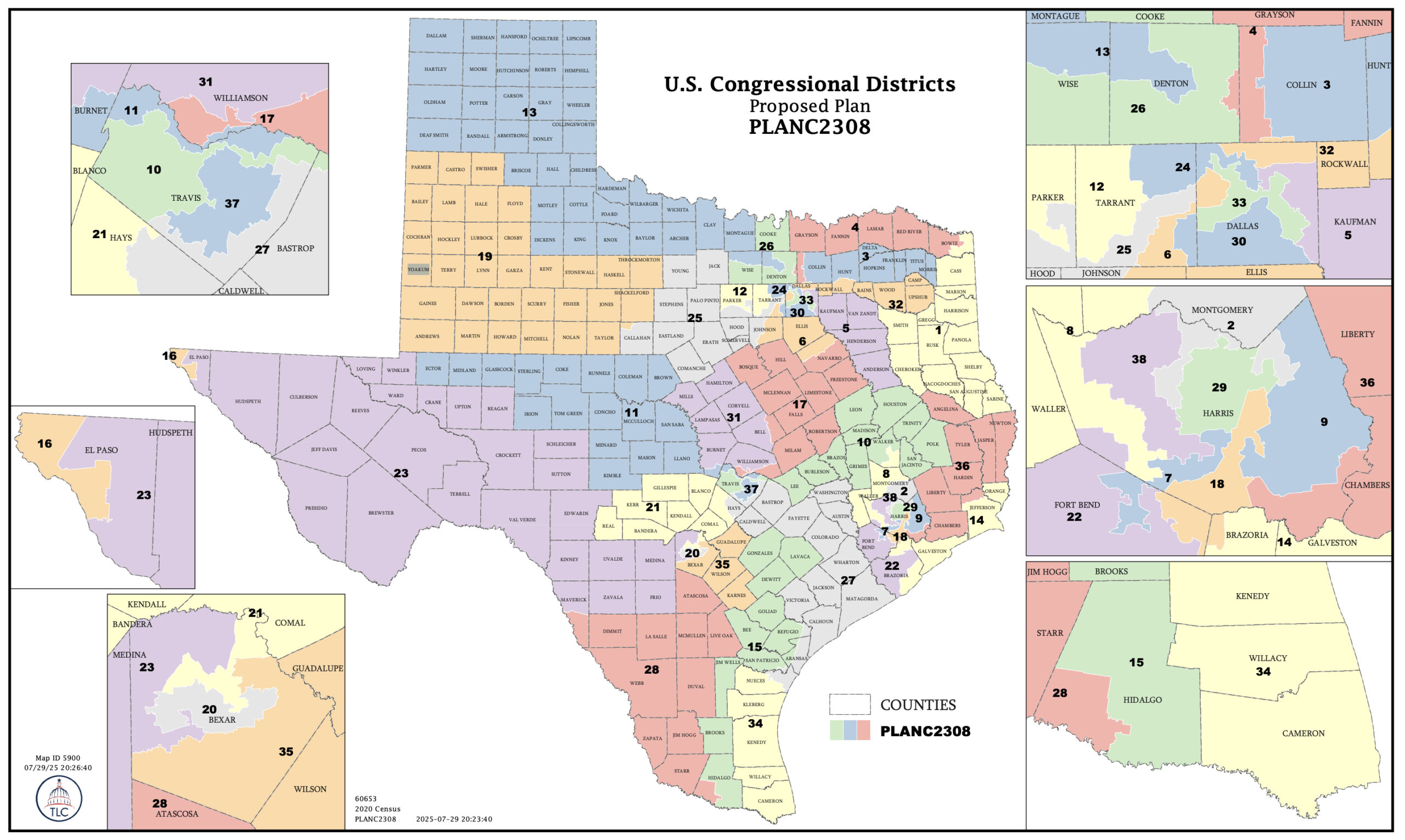
New Texas Map Unveiled

Newly proposed Texas redistricting map
(Click here to see current CD interactive version: Texas)

By Jim Ellis — Friday, Aug. 1, 2025

Redistricting

The new Texas proposed congressional map was unveiled Wednesday and, as President Trump predicted, the new draw could produce a net of at least four and possibly five more Republican seats in the 38-member delegation.

The redistricting process started, and Gov. Greg Abbott (R) added the issue to his special legislative session agenda, because the US Justice Department informed the Governor and Secretary of State that several of the state’s congressional districts are now illegal due to a recent en banc ruling from the 5th Circuit Court of Appeals on a Galveston County redistricting lawsuit.

The ruling paved the way for the state Republican map drawers to create more favorable political districts.

The legislative battleground will be in the state House of Representatives. There, the Republicans have an 88-62 majority, but Speaker Dustin Burrows (R-Lubbock) was elected via coalition as Democrats crossed over to support him. The action sent the Republican Caucus candidate down to defeat. The state Senate is even more Republican, 19R-11D, with one GOP vacancy.

Internal Texas legislative politics pertaining to partisanship, committee chairmanships, and the Speakership itself could all turn based upon how this redistricting issue unfolds over the next few days. The special legislative session began on July 21 and can last no longer than 30 days. The Governor, however, can call additional 30-day sessions if the issue call is not completed.

Several times in the past 20 years, Democratic members have left the state in order to break the chamber quorum and thus prevent legislative business from progressing. Texas is perhaps the only state where the legislature holds a two-thirds quorum requirement, so Democrats have enough to prevent the House from convening should at least 50 of their members not appear.

US House Minority Leader Hakeem Jeffries (D-NY) is coming to Texas to speak to the House Democratic Caucus and convince them to do what is within their power to prevent the map, and its likely Republican seat gain, from being enacted into law.

To further complicate matters, the state has the power to arrest lawmakers who refuse to attend session and force them into the chamber, so the next few days will become interesting.

While the Democrats could temporarily freeze the House, their power is limited. Gov. Abbott could simply end the session and then call the members into a new 30-day special conclave if not enough members are present. He can stop and start special sessions at will. Additionally, at least five other issues, including flood relief for Central Texas, are also on the issue call, meaning more than redistricting must be addressed.

If the presented redistricting plan is enacted, several Democratic members will face tough political situations.

Beginning in Harris County, the map would create a new open eastern Houston area district that would be heavily Hispanic but favor Republicans based upon recent voter history. This would lead to Rep. Al Green (D-Houston) being paired with the winner of the TX-18 special election in a new Harris/Ft. Bend County 18th CD.

Moving to the Dallas area, freshman Rep. Julie Johnson (D-Farmers Branch) would find her district moved to east Texas, thereby likely forcing her into a paired incumbent situation with Rep. Marc Veasey (D-Ft. Worth). Veasey could also choose to run against Rep. Jasmine Crockett (D-Dallas). Her new 30th District would venture into Tarrant County, which is part of Veasey’s home base.

In the Rio Grande Valley, Rep. Vicente Gonzalez (D-McAllen), saw his 88 percent Hispanic Voting Age Population seat vote for President Trump (52-47 percent). Therefore, Gonzalez’s 34th District becomes 11 percentage points more Republican by moving out of Hidalgo County and then northward to Nueces County, annexing a portion of Corpus Christi city.

In Austin, Reps. Lloyd Doggett (D-Austin) and Greg Casar (D-Austin) would find themselves paired in a new 37th District that would be fully contained within Travis County. The result of this draw would create a new open 35th District anchored in east San Antonio that appears politically marginal but is more likely to land in the Democratic column.

The removal of the Bexar County (San Antonio) portion from Rep. Henry Cuellar’s (D-Laredo) 28th District is likely welcome news for the veteran Congressman who is widely cast as the House’s most conservative Democratic member. Cuellar had not performed well in the San Antonio area, so this new map likely strengthens him.

More will be known about the districts when further data is calculated and released, but the current available statistics find just two districts, TX-19 (Rep. Jodey Arrington, R-Lubbock) and TX-23 (Rep. Tony Gonzales, R-San Antonio), untouched. Two districts (TX-9 and TX-35) would be new. Of the remaining 34 CDs, 19 would become more Republican to varying degrees and 15 would become more Democratic, again to varying degrees.

While this map would greatly help the Republicans hold the US House majority in the 2026 elections, it is not certain that such a plan will ultimately be enacted.