
Monthly Archives: October 2025

Rep. Schweikert Announces for
Governor in Arizona

By Jim Ellis — Friday, Oct. 3, 2025

House

Arizona Rep. David Schweikert (R-Fountain Hills/Scottsdale) / Photo by Gage Skidmore via Flickr

Another US House seat came open Wednesday as eight-term Arizona Rep. David Schweikert (R-Fountain Hills/Scottsdale) announced that he will enter the competitive Republican primary for Governor.

The House open seat count now grows, at least temporarily, to 33. Two more special elections will be held before the end of the year to fill vacancies in Tennessee and Texas.

Rep. Schweikert’s 1st Congressional District becomes the third Republican open in the volatile toss-up category. After the Arizona Independent Redistricting Commission members turned Rep. Schweikert’s safe Republican 6th District into a politically marginal 1st District, he has seen two very close re-election results along with a tight presidential contest within his current constituency.

In 2022, Rep. Schweikert was re-elected with just 50.2 percent of the vote over political newcomer and businessman Jevin Hodge (D). Two years later with Hodge not returning for a re-match, the incumbent scored another tight re-election victory but with an improved 51.9 percent against former state Representative and physician Amish Shah (D). This, after winning renomination with just under 63 percent of the vote.

Considering, however, that Schweikert had just agreed to violating 11 different House ethics rules and campaign finance violations resulting in an agreed to $50,000 fine, his strong campaign skills allowed him to politically survive.

President Trump defeated Kamala Harris here with a similarly close 51.1 – 48.0 percent victory margin. In 2020, Joe Biden nipped Trump within the current District 1 confines with a 50-49 percent margin.

Clearly, the 1st District congressional campaign will move further up the Democratic target list now that the seat is open. Already in the race originally vying for the opportunity of challenging Rep. Schweikert is a return appearance from Dr. Shah and former news anchor Marlene Galan-Woods, who lost the 2024 Democratic primary.

Republicans will now have to find a new nominee with Schweikert pursuing his new statewide venture. Potential GOP candidates reportedly are state Rep. Matt Gress and Phoenix City Councilman Jim Waring.

Already, however, announcing they will not run for Congress, according to The Down Ballot political blog reporters, are Maricopa County Board of Supervisors’ chairman Thomas Galvin and state Sen. Carine Werner.

While Rep. Schweikert would have faced another difficult re-election campaign for the House, his path toward the Republican gubernatorial nomination is also far from secure. In the race for months have been fellow Rep. Andy Biggs (R-Gilbert) and 2022 statewide candidate Karrin Taylor Robson.

At least at one point, President Trump had endorsed both Biggs and Robson but then appeared to rescind his endorsement of the latter. The President indicated he didn’t feel that she was using his endorsement to the fullest extent.

A recent Pulse Decision Science survey (Sept. 8-10; 502 likely Arizona Republican primary voters; live interview) finds Rep. Biggs opening a large GOP primary lead. According to the Pulse ballot test, the Congressman would lead Robson 55-31 percent. The poll was taken just after Rep. Schweikert initially said he was considering entering the race. Adding him to the gubernatorial ballot test question found Schweikert trailing badly with only 11 percent support.

An August, Noble Predictive Insights survey (Aug. 11-18; 365 registered Arizona Republican voters) gave Robson a 37-27 percent advantage over Rep. Biggs. This poll, however, appears to be an outlier.

Previously, four other surveys were released since the beginning of the year from four different pollsters and all cast Rep. Biggs with a substantial advantage. Within the four studies, Biggs averaged 55 percent preference among Republican primary voting respondents as compared to 20 percent for Robson.

The eventual Republican nominee after the Aug. 4, 2026, primary election will face incumbent Gov. Katie Hobbs (D). Polling is already forecasting a close race irrespective of who becomes the ultimate GOP challenger.

With a tight Governor’s race, two open US House seats, and either primary or general election competition in five of the state’s nine congressional districts, Arizona will be a key electoral state in the 2026 midterm cycle.
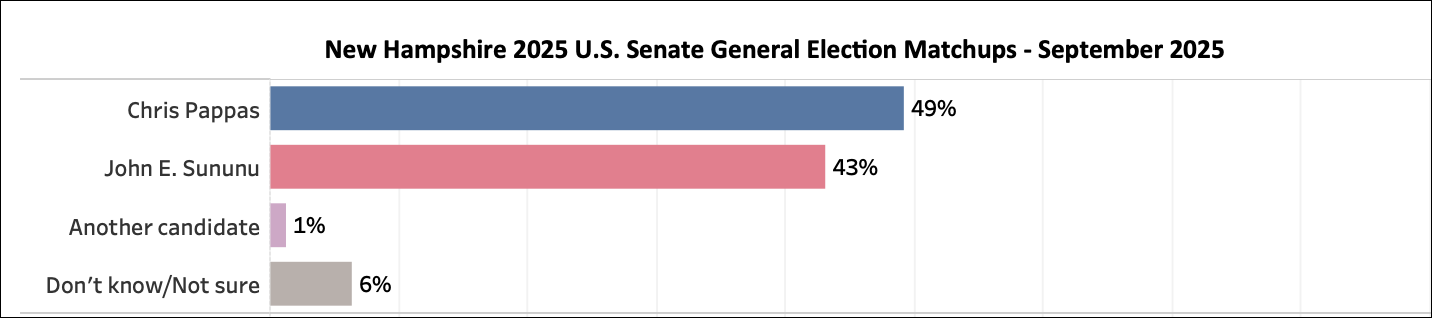
New Pappas-Sununu Data

Click on image to see full poll results.

By Jim Ellis — Thursday, Oct. 2, 2025

Senate

The University of New Hampshire just released another of their regular Granite State polls, and we see further evidence of a budding competitive open New Hampshire US Senate contest between Rep. Chris Pappas (D-Manchester) and former Sen. John E. Sununu (R), son of former Governor and White House Chief of Staff John Sununu and brother of four-term New Hampshire Gov. Chris Sununu.

The UNH poll (Sept. 17-23; 1,361 New Hampshire adults; 1,235 likely general election voters; 529 likely New Hampshire Republican primary voters; online) finds Rep. Pappas leading a ballot test question with ex-Sen. Sununu 49-43 percent, but the sampling universe leans more Democratic than the actual voting data suggests. Therefore, it is likely that Sununu is a bit closer to Pappas than this spread foretells.

If ex-Massachusetts Sen. Scott Brown (R), who ran for the New Hampshire Senate seat in 2014 and lost to now-retiring Sen. Jeanne Shaheen (D) 51-48 percent, were the 2026 Republican nominee the Pappas lead would grow to 52-37 percent. On the current Republican Senate primary ballot test, Sununu posts a landslide lead over Brown, 42-19 percent.

Several data points provide evidence that the poll skews somewhat Democratic, though the answers have been weighted to balance the responses, at least to a degree.

The skew clues come from several questions. In terms of setting the sampling parameters, the official state voter registration party preference categorization totals 32.0 percent Republican, 28.3 percent Democratic, and 39.7 percent Unaffiliated voters. Total registration is recorded at 1,099,033 individuals.

The UNH poll divides the party identification categories into two different questions. First, is the partisan-registered voter query, and this number is consistent with the official state voter reg totals. In the poll, the self-identified partisan total is 32-29-39 percent Republican, Democratic, and Unaffiliated voters.

A second “Party ID” cell segmentation, however, asks an additional question, and the responses swing toward the Democrats with a 44-41-14 percent partisan division (Democratic; Republican; Unaffiliated). It is surmised that the pollsters are attempting to see how the unaffiliateds break, which explains the partisan switch and the severe reduction from the actual number of Unaffiliated registered voters (39 percent) to those who self-identify as Unaffiliated (14 percent).

Such a partisan break is seemingly consistent with New Hampshire’s federal election results even though the Dave’s Redistricting App partisan lean calculations suggest a very different pattern.

In terms of the statewide partisan lean, DRA calculates a 52.0R – 45.2D party break. While the federal delegation (two Senators, two Representatives) is unanimously Democratic, the Republicans back home enjoy a statewide trifecta (Governor; majorities in both legislative houses). Thus, the voting split between federal and state offices is diametrically opposed. Together, these points largely explain the high number of close elections seen in the state over the past few years.

Perhaps the most definitive skew clue is the reported presidential vote within the polling sample. In the 2024 election, the actual vote count found then-Vice President Kamala Harris defeating then-former President Donald Trump with a 50.3 – 47.6 percent victory margin.

According to the poll respondents the presidential break is 51-45 percent in Harris’s favor; hence, these calculations suggest the 49-43 percent Pappas swing is potentially 2-3 percentage points closer.

Rep. Pappas was first elected to the House in 2018 after serving six years on the New Hampshire Executive Council [a unique five-member panel elected in districts that retains certain veto powers over the Governor relating to budget matters and personnel appointments], four years as Hillsborough (Manchester) County Treasurer, and four years in the state House of Representatives.

Pappas, in his four US House terms, has turned what was the most volatile congressional district in the United States (from 2004 thru 2016, NH-1 had defeated more incumbents that any CD in the country), into a safe domain for himself, thus bringing some political stabilization to the eastern New Hampshire area.

John E. Sununu was elected to the 1st District US House seat in 1996 and held the position for three terms. He was elected to the Senate in 2002, defeating then-Gov. Shaheen. Six years later, Shaheen returned to challenge Sen. Sununu, and successfully unseated him. She, of course, was then re-elected in 2014 and 2020.

Assuming Sununu enters the 2026 US Senate race, and all indications suggest he will, the New Hampshire open seat moves into the highly competitive category. Without Sununu as the GOP nominee, Rep. Pappas, who adroitly has positioned himself as the consensus Democratic candidate long before the state’s late September 8th primary, would see a clear path toward succeeding Sen. Shaheen.

A Serious Pelosi Challenge?

By Jim Ellis — Wednesday, Oct. 1, 2025

House

Saikat Chakrabarti

Saikat Chakrabarti, a Democratic challenger to Speaker Emeritus Nancy Pelosi (D-CA), released an internal poll that he says positions him to end her congressional career. Pelosi, who was elected to the House in 1987 after being the California Democratic Party chair, began her tenure after winning a special election victory in ’87 that would eventually lead to eight years directing the US House.

Chakrabarti quarterbacked Alexandria Ocasio-Cortez’s shocking upset 2018 Democratic primary victory over veteran New York Rep. Joe Crowley and now believes he can engineer a similar result for himself against a Democratic Party icon.

A Chakrabarti campaign poll from Beacon Research (Sept. 12-20; 600 likely California June jungle primary voters; text and live interview) finds Rep. Pelosi leading Chakrabarti 47-34 percent. After the respondents are read push questions featuring the 85-year-old incumbent’s age and whether or not a new generation of Democratic leadership should come to power, the ballot test then flips to 44-36 percent in Chakrabarti’s favor.

Though the poll could arguably be within the realm of accuracy at this early date, the results should not be taken particularly seriously. Most importantly, we are not looking at a Democratic primary battle on June 2. Instead, California uses the top-two jungle primary system that places all candidates on the same ballot irrespective of political party affiliation. The top two finishers in what is ostensibly a qualifying election then advance into the general election regardless of the percentages attained on the initial vote.

Thus, to think Rep. Pelosi would not advance into the general election under this system is absurd considering her consecutive 20 congressional election win streak from her San Francisco-anchored CD.

The general election will yield an entirely different campaign because the turnout will be much larger in the November election, which benefits the former Speaker. Thus, it will not be enough for Chakrabarti to outpace Pelosi in the lower turnout June election because both contenders would advance into the general no matter what their attained percentages.

It is already becoming clear, however, that we will see a number of intra-party challenges to aging Democratic incumbents around the country from younger candidates. Several, such as Sen. Jeanne Shaheen (D-NH; 78 years old), and Reps. Danny Davis (D-IL; 84), and Jan Schakowsky (D-IL; 81), have already announced their retirements in the face of potential challengers who said they would use the “new generation of leadership” theme.

Others looking at serious challenges and facing the same theme are Reps. John Larson (D-CT; 77) and David Scott (D-GA; 80). Other Democratic members who are 75 years old or older and are seeking re-election may have nomination challengers, but the opposition at this point does not look particularly strong. This list includes two past leadership members, Reps. Steny Hoyer, (D-MD; 86) and Jim Clyburn, (D-SC; 85), along with Reps. Maxine Waters (D-CA; 87) and Frederica Wilson (D-FL; 82).

While Rep. Pelosi has filed a 2026 campaign committee with the Federal Election Commission, she has yet to formally announce her re-election candidacy. It is presumed, however, that she will seek a 21st term.

The California Congresswoman’s 11th District, fully contained on the San Francisco peninsula, is one of the most Democratic seats in the country. According to the Dave’s Redistricting App statisticians, the CA-11 partisan lean is 86.6D – 11.6R. In California, only two districts are more Democratic, and only by a point or two. The pair are the Oakland seat of freshman Rep. Lateefah Simon (D) along with two-term Rep. Sydney Kamlager-Dove’s (D) Los Angeles domain.

Should voters approve the proposed California redistricting map in the Nov. 4 special election, the three strongest Democratic districts will remain virtually intact. This means that Pelosi’s general election opponent will almost assuredly be a Democrat, and very likely Chakrabarti.

Assuming the former Speaker runs for re-election, the chances of Chakrabarti or any other Democrat dethroning her are minimal at best. Therefore, though an early poll such as his Beacon Research study may suggest a modicum of weakness for the long-time House member, the final vote will again return her for yet another term.