
Tag Archives: Rep. Filemon Vela

2022: Three More House Retirements

By Jim Ellis

March 24, 2021 — A trio of veteran House members announced Monday that they won’t seek re-election in 2022. Reps. Tom Reed (R-NY) and Filemon Vela (D-TX) will retire, while Rep. Jody Hice (R-GA) declared his candidacy for the Georgia Secretary of State position.


Rep. Tom Reed (R-NY)

Tom Reed was first elected in 2010 and, at the time of his initial campaign, took a six-term limit pledge. The next election brings him to the end of his originally promised congressional service calendar. Earlier in the year, however, Rep. Reed had been making overtures about running for governor, especially when incumbent Andrew Cuomo (D) began running into political trouble. Rep. Reed even went so far as to begin hiring statewide campaign staff.

Late last week, however, accusations of him being drunk in public and becoming inappropriate with a female lobbyist several years ago began to surface. Originally, Rep. Reed said such accusations were false, but yesterday accompanied his retirement message with an apology for his past behavior.

The Reed retirement decision is likely good news for neighboring GOP Rep. Claudia Tenney (R-New Hartford). You will remember that she defeated former Rep. Anthony Brindisi (D-Utica) by just 109 votes in the November election, a race that consumed more than three months to determine the final outcome. She originally won the 22nd District in 2016, but lost to Brindisi, then a state assemblyman, in 2018.

New York looks to lose at least one seat in reapportionment, and the Reed and Tenney districts rank 27th and 26th in population, respectively, among the 27 New York congressional seats. With Reed departing, the upstate map becomes much easier to draw in that his seat can be collapsed into hers, presenting Tenney with a larger but very likely more Republican district from which she could seek re-election.

Under this scenario, should it occur as described, her most serious competition would very likely come in the Republican primary instead of the general election. Securing local party support in her new counties would become Tenney’s first step in securing the GOP nomination under such a redistricting projection.


Rep. Filemon Vela (D-TX)

Rep. Vela’s retirement announcement after what will be five complete terms in the House comes as a surprise. He did, however, experience his tightest election of his five victories in November, but still won with a 55-42 percent majority. President Biden, however, only carried the 34th District, anchored in Brownsville on the Texas-Mexico border, with a 52-48 percent margin, down from 59-38 percent victory spread Hillary Clinton recorded in 2016.
Continue reading

Texas Data

By Jim Ellis

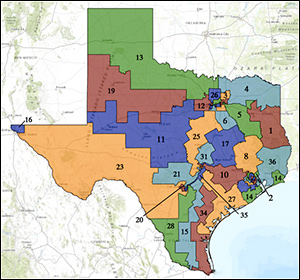
Texas US House Districts

Dec. 17, 2020 — Yesterday, we analyzed the California official 2020 Statement of the Vote and today we turn out attention to voting statistics from the Lone Star State of Texas, a particularly interesting domain for the coming redistricting process. Estimates project that Texas will gain three congressional districts from reapportionment, which should become official at some point in January.

Despite predictions of a “blue wave” hitting Texas and putting the state in play for Joe Biden, Republicans once again swept the competitive races. Though President Trump’s margin did decline from 2016, his 52-46 percent margin was still more than comfortable, especially when considering he was simultaneously losing the nationwide vote.

As was the case in California, down-ballot GOP candidates, as a rule, performed better than President Trump. Sen. John Cornyn (R) was re-elected, and the GOP won 23 congressional races in the state, accounting for almost 11 percent of their party’s national total.

Sen. Cornyn topped 53 percent of the vote in recording a nine-point win over his Democratic opponent, retired Army helicopter pilot M.J. Hegar. In the 23 victorious Republican House races, the winning GOP candidate outpaced President Trump in 19 districts most of which were competitive at least to a degree.

Compared with the Democratic improvement in elections two years ago, the GOP rebounded in 2020. A total of 16 Republican incumbents sought re-election, and 11 of those improved their vote percentages from 2018. Additionally, all five of those falling below their previous benchmark did so by less than one percentage point.

For the Democrats, all 13 of their House incumbents saw a downgrade in their voter support from 2018. Rep. Henry Cuellar (D-Laredo), who fought off a tough Democratic primary challenge in early March, saw the biggest drop for any Texas House incumbent, falling from 84.4 percent in 2018 to a 58.3 percent win in November. The more serious drop, however, was for Rep. Vicente Gonzalez (D-McAllen) who won re-election to a third term from his South Texas district with just 50.5 percent of the vote against an opponent who spent only $404,000. Gonzalez’s victory percentage slipped from 59.7 percent in 2018.

The TX-15 district is largely a Mexican border seat that starts just east San Antonio in the Seguin area and travels south all the way through the city of McAllen in Hidalgo County. The latter entity hosts three-quarters of the 15th District’s population. Republicans, including President Trump, improved their standing throughout the Mexican border area in the 2020 election, which was a principal reason that Democratic gains in the Dallas, Houston, Austin, and San Antonio metropolitan areas were somewhat offset.

Statewide turnout was up a strong 23.7 percent when compared to 2016, enabling the state to exceed 11 million voters (11,315,056) for the first time. The Texas population grew 3.9 percent during that same time interval.

Continue reading

The Texas Re-Draw

By Jim Ellis

Aug. 21, 2017 — The special three-judge panel considering Texas redistricting, which long ago declared the state’s 35th Congressional District as a racial gerrymander, issued a ruling earlier this week that contains re-drawing deadlines.

Early in the decade the panel declared District 35, a seat containing parts of both Austin and San Antonio connected by a thin strip traveling south on Interstate 35 between the two cities and represented by veteran Rep. Lloyd Doggett (D-Austin), as violating parts of the Voting Rights Act. The ruling cited the intent of map creators to draw the seat using race as a primary basis. The evidence for such a decision consisted of emails among Republican staff members in the state legislature and Congress that proclaimed such a desire.

At the heart of the current issue is then-Attorney General Greg Abbott’s (R) decision to adopt the court’s temporary correction map as the state’s official plan. Once the legislature and governor agreed with his idea, the temporary map became permanent, which theoretically ended the process. The flaw in Abbott’s strategy, however, is the court declared at the time of issuance that the fixes were temporary and all of the problems were not corrected, meaning the plan was designed only to get through the 2014 election after which time the legislature was to create a permanent map.

Continue reading