Tag Archives: Gallup

Cliff Deal Poorly Received

Last Friday, the Gallup survey research organization (Jan. 3; 1,026 adults as part of their daily national tracking program) released an analysis poll that showed a bare plurality of their national polling sample disapproved (46-48 percent) of the final fiscal cliff deal.

Yesterday, the Pew Research Center for the People & Press publicized their own data (Jan. 3-6; 1,003 adults, nationally) providing much more detail. Though both polls clearly show that people believe Pres. Obama performed better in the negotiations than his Republican legislative counterparts, a far greater number of respondents see little positive value pertaining to how the deal affects themselves or the nation’s economy.

The Pew data confirms Gallup in that their sample shows an overall disapproval tilt of 38-41 percent; but the numbers nosedive when probing further to understand the respondents’ true views. When asked if the deal will help or hurt people like themselves, by a 30-52 percent margin the individuals comprising the sampling universe said “hurt.” Similarly, the group believes the final deal will hurt the budget deficit (33-44 percent) and the economy (36-46 percent).

Interestingly, while the sampled individuals have a negative opinion of the overall deal they, as in Friday’s Gallup survey, overwhelmingly see Obama as the political winner in the process of developing an agreement. By a margin of 57-20 percent, Continue reading >

Fiscal Cliff Poll

The Gallup research organization, moving forward after poorly forecasting the 2012 presidential election, released the results of their fiscal cliff agreement study. According to their Jan. 3 question to 1,026 adults as part of their ongoing national issues tracking program, the country is split as to whether it favors the final deal.

By a virtually even 43-45 percent margin, the respondents opposed the agreement but the closeness of the tally was largely due to a huge positive majority from Democrats. The self-identified Dems supported the congressional action by a 67-23 percent spread. In contrast, Republicans opposed the measure 27-65 percent, as did self-described Independents, but in a much closer 39-46 percent split.

Segmenting the numbers from an ideological perspective, liberals favored the settlement legislation 66-27 percent, while conservatives opposed it 28-62 percent. Self-identified moderates favored the plan 52-34 percent, a much greater positive percentage than did the voting Independents.

As has been the pattern ever since Pres. Barack Obama took office, he again polled far better than his rival Republican political leadership. Obama scored a relatively even 46:48 percent favorable to unfavorable ratio in regard to his handling of the fiscal cliff negotiations. House Speaker John Boehner (R-OH-8), on the other hand, fared badly registering only 31:50 percent on the favorability index.

The Gallup reporting information did not reveal how the partisan respondents viewed their own party’s leader, but it is a virtual certainty that Democrats had a much better opinion of the President than Republicans held of the Speaker.

Gallup Shows Likely Voters Skew to Romney

Source: Gallup

The Gallup organization released their likely voter model on Oct. 26, which, along with Rasmussen Reports, has consistently shown much better numbers for Mitt Romney than other national polls. It is important to note that Gallup and Rasmussen are the only two pollsters that have tracked the presidential race every day for the entire election cycle. Both have found consistently similar results, too. The myriad of other pollsters have conducted benchmark or brush fire polls, meaning they are surveying the national electorate for just a short period in time and producing a snapshot of the voters’ intentions rather than a trend.

Right now, all of the polling suggests a Romney lead in the national popular vote among those considering themselves likely to vote, with Pres. Barack Obama doing better in the critical states and among the registered voter universe. The likely voter numbers are producing a very unique and inverted situation because similar situations in the past have always shown the Democratic candidate leading the popular vote, while the Republican fared better in the states.

According to the Gallup analysis, the electorate looks virtually the same as it did in 2008, but the voting intensity model is quite different. There is either no, or only a one-point, difference in the demographic categories when comparing today with four years ago, and as much as a four-point increase among non-white voters when overlaying 2012 data against what was found within the 2004 electorate that re-elected George W. Bush.

Gallup maintains that their likely voter model, culled from a series of seven screening questions (see below), has correctly predicted the final trend in the past two elections. Their 2004 pre-election projection suggested a two-point Bush popular vote win, which is what happened. In 2008, the final data correctly predicted Obama’s win, but over-shot his performance. The Gallup data predicted an 11-point Obama spread; in actuality the final count was +7 points over Republican John McCain.

Today’s model shows virtually no demographic difference between 2008 and 2012, but a major swing in terms of self-identified party registration. Four years ago, 39 percent of the likely voter sample considered themselves Democrats to only 29 percent for Republicans.

According to Gallup’s latest data, the 2012 partisan self-identified likely voter ratio breaks Republican 36-35 percent, a swing of 11 net points for the GOP (+7R; -4D) in comparison to 2008. When the “lean Democrats” and “lean Republicans” are added, the model expands to 49-46 percent Republican (based upon tracking data collected over the Oct. 1-24 period). This is highly significant in detecting electoral intensity. If correct, the 2012 vote will be very different from 2008 and much more Republican. Today, Gallup shows a 50-46 percent spread in Romney’s favor among likely voters. Rasmussen finds Romney’s lead to be a similar 49-47 percent.

But, it all comes down to which of the pollsters’ likely voter model is correct. Gallup has actually posted the seven questions they ask to determine voter participation intent, as reported on Gallup.com.

They are:

  1. Thought given to election (quite a lot, some)
  2. Know where people in neighborhood go to vote (yes)
  3. Voted in election precinct before (yes)
  4. How often vote (always, nearly always)
  5. Plan to vote in 2012 election (yes)
  6. Likelihood of voting on a 10-point scale (7-10)
  7. Voted in last presidential election (yes)

Answers are graded on a scale of 1-7 and the results categorized accordingly. The latest numbers from their registered voter pool gives Obama a 48-47 percent edge, but the likely voter group goes significantly for Romney, as previously mentioned, 50-46 percent.

It’s going to be a very close and interesting election. Next week will determine which of all predictions are correct, but Gallup has already provided the most information to help us understand their support methodology.

A Close Look at Swing State Electoral Votes

Let’s assume, for the sake of argument, that all of the latest publicly released presidential election state polls are accurate. If so, then the nationwide electoral vote count would post Pres. Barack Obama and Mitt Romney to within four votes of each other.

First, from a national popular vote perspective, seven polls have been completed within the past few days (Gallup, Rasmussen Reports, Investors Business Daily TIPP, Gravis Marketing, Ipsos Reuters, Public Policy Polling, and the University of Connecticut) and the president leads in four of them, Romney two, and one is tied. Obama’s largest lead is three points. Romney’s best margin, via Gallup, is six points, 51-45 percent. This tells us that with two weeks remaining, the presidential race is still undecided.

Turning to the all-important swing states, the CNN/ORC Florida poll (Oct. 17-18; 681 likely Florida voters) gives Romney a 49-48 percent lead. Fox News (Oct. 17-18; 1,130 likely Florida voters) posts the Republican to a 48-45 percent advantage. Rasmussen Reports (Oct. 18; 750 likely Florida voters) registers a 51-45 percent spread, also in Romney’s favor.

Turning to Iowa, Public Policy Polling (Oct. 17-19; 869 likely Iowa voters) finds Romney holding a 49-48 percent razor-thin margin over the president.

The Mellman Group, polling for the liberal Americans United for Change organization (Oct. 15-17; 600 likely Nevada voters) finds the president commanding the advantage within the Nevada electorate by a 51-43 percent margin. This is the largest Nevada spread shown for either candidate in quite some time, so the result should be looked at skeptically. For the sake of our model, however, we will place Nevada in the president’s column.

Public Policy Polling, also during the Oct. 17-19 period, surveyed 1,036 likely voters in New Hampshire. There, they found Romney leading Obama 49-48 percent.

In North Carolina, we have split results. Grove Insight, polling for the liberal Project New America (Oct. 17-18; 500 likely North Carolina voters) actually gives Obama a slight lead, 47-44 percent. More in line with all other polls conducted in the Tar Heel State, TelOpinion for the North Carolina Republican Party (Oct. 12-13; 500 likely North Carolina voters) projects Romney with a 49-45 percent advantage. Since the preponderance of recent polling gives Romney the edge here, we will project North Carolina in the Republican column for the purposes of this spot analysis.

Looking at critical Ohio, the Fox News Poll (Oct. 17-18; 1,131 likely Ohio voters) continues to show the president holding a small advantage, 46-43 percent. While other places seem to be leaning toward Romney, Ohio has not fully turned. It is this state that could be the determining factor, as it is one of the few big states that does vote for both parties.

Virginia is another swing state that could be determinative and the new Rasmussen Reports data (Oct. 18; 750 likely Virginia voters) puts Romney ahead of the President 50-47 percent.

And, in Wisconsin, Rasmussen Reports (Oct. 18; 500 likely Wisconsin voters) gives the president the slightest of leads, 50-48 percent.

Understanding that a two- or three-point poll is within the margin of error, the actual vote could go either way; however, we can develop an electoral vote model based upon the above data just presented. Remember, for the sake of our analysis exercise, we are going to presume that all of these polls are exactly accurate, with the one exception of placing North Carolina in the Romney column because more polls favor Romney.

Factoring the aforementioned states as they are currently polling, and using the 2008 results for the ones not recently surveyed, with the exception of adding Indiana and the 2nd Congressional District of Nebraska to the Romney column, the national count would give the president 271 electoral votes and Romney 268. This means that any additional Obama state converting to Romney would give the national victory to the challenger.

It will be an interesting two weeks.

Everything Hinges on Florida

Pres. Barack Obama in the Oval Office. (Official White House Photo by Pete Souza)

We’re now within three weeks of Election Day, and after witnessing the two presidential candidates trading direct and core-striking barbs in Debate #2, the electoral vote map continues to refine itself. As we all know, this election is very close and likely still undecided.

While Republican nominee Mitt Romney still performs well in national polls, and in fact is slightly leading most of them, it is Pres. Barack Obama who continues to hold the superior position in the key states. Though Gallup, Public Policy Polling and Rasmussen Reports all show Romney leading nationally by two to four points, the new YouGov panel back survey still gives the president a similar advantage in all-important Ohio. Returning to again survey 851 voters who answered their Sept. 7-14 polling questions (the new poll was conducted during the Oct. 4-11 period), YouGov found Obama leading among these representative Ohio respondents, 50-46 percent. Interestingly, the Obama statewide margin held despite his numbers falling among Ohio Independent voters.

As the map continues to develop and with Romney showing signs of possibly pulling ahead in three of the four key core states (Florida, North Carolina and Virginia), the trends in Ohio are not following suit. Therefore, can Romney win without carrying Ohio?

The answer is yes, but he must prevail in some non-traditional Republican states in order to do so. Clearly, the GOP nominee must carry Florida first, as this is the most important state on the Romney conversion chart. It is becoming unalterably true that he simply cannot win nationally without carrying the Sunshine State. If he adds North Carolina and Virginia but fails in Ohio, what other states must come his way in order to compensate?

Without the Buckeye State, then Wisconsin and its 10 electoral votes become extremely important. But, even with those 10, he would still need another eight votes just to compensate for Ohio, not counting the one extra Obama state he must carry to reach the minimum 270 electoral vote level that clinches national victory.

This could happen by adding Colorado to Wisconsin, which neutralizes Ohio, and then win in either Iowa or Nevada, both of which possess six electoral votes. The combination of 25 electoral votes from the trio of states would allow Romney to reach the 270 mark assuming he holds all of the places John McCain carried in 2008, which does appear likely, and keeps three of the four core states, understanding that Florida must be one of the three.

So, instead of looking at the map from the perspective that the four core states are critical to unseating Obama, the Romney camp now sees two separate viable state clusters, thus adding further victory options.

All of these secondary core states are very much in play, but the president does maintain either a small lead or remains on even footing in each of the four states (Wisconsin, Colorado, Iowa, and Nevada).

Though Romney now has alternative victory paths, in order to carry enough states to win the Electoral College he must convert about a half-dozen states where he is trailing slightly or tied (Virginia, Ohio, Colorado, Wisconsin, Nevada, Iowa), which is no small feat even considering his strong national standing. Though the national numbers are promising for the challenger, the state numbers continue to present more formidable obstacles and the difficulty factor in defeating the President is still quite high.

Romney Strikes Back

Just before the Oct. 3 presidential debate, conventional wisdom held that the national race had effectively ended and President Obama was on the threshold of clinching re-election. He was consistently ahead in all nationwide polls, and in every key swing state. Oh, what a difference a week makes.

With his debate performance as the catalyst propelling Republican nominee Mitt Romney back into contention, a series of new polls now shows a complete race reversal.

Eight national surveys were released yesterday and, for the first time, it is Romney who leads or is tied in the preponderance of them. Gallup, the American Research Group (ARG), Public Policy Polling, and the Investors Business Daily’s TIPP poll all post Romney to a lead of one or two points. Two studies, Ipsos/Reuters and Rasmussen Reports, project a tie between the two candidates, while UPI/CVoter and Zogby Research for The Washington Times still find the President leading by a lone percentage point.

But the national data tells only part of the story. In the most important core and secondary states of North Carolina, Ohio, Colorado and Nevada, Romney has gained strong momentum and leads in several polls.

North Carolina, by all accounts a critical core conversion state, yields to a Gravis Marketing study (Oct. 6-8; 1,325 likely North Carolina voters) that projects Romney to a major 50-41 percent lead, obviously his biggest margin of the campaign in the Tar Heel State. Along with Florida, Ohio and Virginia, North Carolina is in virtual must-win status for the Romney campaign.

Ohio, another of the four core states, features trends that are mixed in declaring a leader, but all polls show significant movement for Romney. The American Research Group (Oct. 5-8; 600 likely Ohio voters) gives the challenger a one-point 48-47 percent edge. Survey USA (Oct. 5-8; 808 likely and actual Ohio voters) also finds a one point difference between the candidates, but their data still has the President in front, by a scant 45-44 percent margin. Finally, in better news for Obama, the CNN/ORC survey (Oct. 5-8; 888 likely voters) gives the president a 51-47 percent lead.

In the secondary states, the places Romney would need to win should he fail to carry all four of the core states, are also turning in favorable numbers for the GOP challenger. Colorado, a state trending blue in 2008 and electing a Democratic senator in the Republican landslide year of 2010, has been showing signs of returning to the GOP column. The latest ARG poll (Oct. 5-8; 600 likely Colorado voters) gives Romney his first Centennial State lead, 50-46 percent, after following closely behind Obama even in the days when the president was beginning to break away in other places.

Staying out west in Nevada, another state showing signs of returning to the Republican fold after four years of relatively consistent Democratic voting patterns, Rasmussen Reports (Oct. 8; 500 likely Nevada voters) projects the two candidates being tied at 47 percent.

The latest swing toward Romney is actually quite consistent with voter behavior throughout this election cycle. The electorate has often moved both quickly and wildly in responding to late-breaking events. Such is the case with the Romney debate performance. It remains to be seen if this direction holds or if voters will soon snap back toward the president.

The next two presidential debates have now assumed an aura of much greater importance in determining the final outcome of this hotly contested race. Will Romney again be dominant? Will the president rebound? Is the swing toward Romney the beginning of a trend, or a mere blip? Time will soon bring us the answers.

Romney’s Debate Win Has Legs

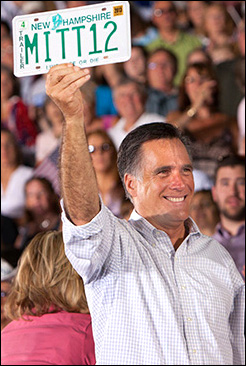
Mitt Romney

The Gallup organization projects Mitt Romney to be the most decisive debate winner in the history of the presidential debates. According to a cell sample of 749 debate watchers questioned over a two-day period following the Oct. 3 forum, Romney was viewed to have won by a 72-20 percent margin, the largest-ever spread. But, does a debate win really carry over into the presidential campaign itself? At least in the short-term, apparently so. Gallup shows the race closing to 48-46 percent in favor of President Obama from the previous 50-45 percent, and the post-debate track reveals a dead even 47-47 percent result.

The Pew Research Center was also in the field during this same time period (Oct. 4-7), recording the responses of 1,112 likely voters from a polling universe of 1,511 adults. Though a few more Republicans were polled than Democrats (403-396), all the aggregate answers were weighted to bring the sampling universe in line with the actual national totals. The weighted responses gave Romney a similar 66-20 percent split in terms of perceiving the debate winner.

Pew also found Romney gaining in some other key areas. In terms of answering which of the two candidate has new ideas, it is now the Republican who is perceived to have them by a 47-40 percent margin, and he’s pulled even with Obama (47-47 percent) as to who is the stronger leader. Romney also is favored to be more successful in reducing the federal budget deficit (51-36 percent), improving the job situation (49-41 percent), and in handling tax policy (47-43 percent). The president is still perceived as the better person to handle Medicare (51-38 percent), health care (47-44 percent, though that margin swung a net 10 points in Romney’s favor since their Sept. 12-16 poll), and in making wise foreign policy decisions (47-43 percent).

The next presidential debates, scheduled for Oct. 16 and 22 will take on a whole new aura and meaning, after what happened in the first meeting. If Romney has accomplished anything, he has put national debating on center stage.