Tag Archives: California

The Losing Regions – Part I

By Jim Ellis

Dec. 23, 2020 — With the Census Bureau readying the national apportionment formula to present to the Clerk of the House at some point next month, it is a reasonable time to again look at the states projected to lose congressional districts and begin to determine where a dragging population could cost a region its current representation.

Today, we look at four states projected to lose a district: Alabama, California, Michigan, and Minnesota. Tomorrow, we will examine Illinois, Ohio, Pennsylvania, and New York. Rhode Island and West Virginia are also going to lose seats but because they are two- and three-district states, the new redistricting map becomes obvious, particularly in the former’s case.


Alabama

The Alabama population suggests that it is too small to keep its seventh congressional district, but such makes the remaining six districts very large, likely well over population figures of 800,000 residents apiece. It is an ironic problem for the states losing districts in that the remaining CDs actually become much larger. If Alabama is on the losing end in final reapportionment, the scenario of dropping a district and making the remaining seats much larger will certainly come to pass.

As with all redistricting, those in a corner of a state, i.e., either bordered by another state, body of water, or country are in the best shape because their districts can only expand or contract one or two ways. In Alabama, the 1st and 5th CDs, those of incoming Rep. Jerry Carl (R-Mobile) and Mo Brooks (R-Huntsville) are in the most favorable geographic positions.

The district appearing to lose the most population is Rep. Terri Sewell’s (D-Birmingham) 7th CD, but this is a protected Civil Rights district meaning it must be protected. The seat could need to gain almost 150,000 people according to rudimentary calculations, and the most likely place for the increase comes from Montgomery County at the expense of the 2nd District and possibly the 3rd.

The 2nd District, even when bordered by states on two sides, appears the most vulnerable to collapse. Needing to likely gain over 140,000 individuals before almost certainly losing population to the current 7th District, the collapsing of the 2nd and 3rd Districts into one seat appears to be a potential outcome. This would place incoming freshman Rep. Barry Moore (R-Enterprise) and veteran Congressman Mike Rogers (R-Anniston) in the same district.


California

For the first time in history, California looks to lose congressional representation. In the last census, the state remained constant for the first time. In every previous census apportionment, the Golden State had gained representation. In the 1980 census, for example, California gained seven new congressional districts. Now, it appears they will reduce representation from 53 to 52 seats, but still be the most populous state by a wide stretch.

The region not keeping up with the rate of growth appears to occur in the southern California expanse from Bakersfield through Los Angeles County and portions of Riverside, Orange, and San Bernardino Counties. Such a region covers 18 congressional districts, 16 of which will need to gain population under a rudimentary calculation suggesting that each of the state’s 52 CDs will require approximately 760,000 residents. Of the 18 districts, Democrats represent 15 and Republicans’ three.

Only two of these 18 districts, those of Reps. Brad Sherman (D-Sherman Oaks) and Norma Torres (D-Pomona), are either at or slightly over the approximated population goal.

Continue reading

Florida Data

By Jim Ellis

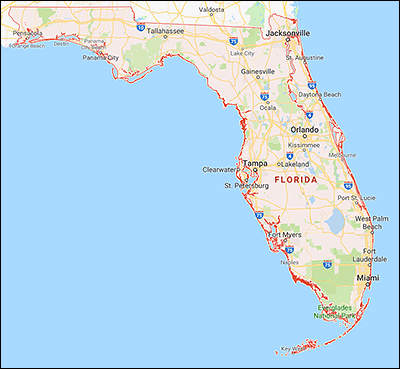
Dec. 18, 2020 — Continuing with our project this week of analyzing statewide data now that official final election results are being published from around the country, today we look at the Sunshine State of Florida, another key redistricting state.

Though having only three-quarters of Texas’ population, the Florida presidential turnout came within only a few hundred to equaling that of the Lone Star State (FL: 11,067,366; TX: 11,315,056).

On the statewide tally, President Trump carried Florida with a 51.2 – 47.5 percent margin over former vice president Joe Biden. The result represents a net 2.2 percentage increase for the president when compared with his 2016 statewide total, while Biden’s performance registered a decline of 0.3 percent from Hillary Clinton’s Sunshine State aggregate vote.

The House performance detected in California and Texas, showing that the average victorious congressional candidate performed better within their particular district than President Trump, was not nearly as pronounced in Florida.

On average, Texas US House Republican candidates ran 2.8 percentage points better than Trump, and the average California GOP House candidate ran 4.2 points ahead of the president’s statewide percentage. In Florida, however, the number was virtually equal to the president’s, with the average House Republican contender running just 0.2 percent above Trump’s statewide total.

Because two of the Republican incumbents, Reps. Neal Dunn (R-Panama City) and Mario Diaz-Balart (R-Miami/Hialeah), ran either without Democratic opposition (Dunn) or totally unopposed (Diaz-Balart) the Florida Secretary of State does not record votes in such a district. Therefore, for purposes of this exercise, a projected result of 65-35 percent for the two congressional districts was added as an estimated total. This percentage spread was extrapolated when comparing the performance of Republican and Democratic congressional candidates in similar Florida districts.

To review, in California, Democratic House incumbent performance fell below their 2018 recorded vote in 33 of 44 districts, while results improved for four of the six Republican incumbents on the ballot. In Texas, vote percentages for 11 of the 16 Republican incumbents seeking re-election improved from 2018, while the Democratic incumbent performance index declined for all 13 who ran for a succeeding term.

Continue reading

Biden Elected; Calif. Data Published

By Jim Ellis

Dec. 16, 2020 — The Electoral College met in the various state capitols Monday, as scheduled, and the electors cast their ballots in the exact correlation with the state election data. Since the Electoral College increased to 538 members in time for the 1964 presidential election, we’ve seen faithless electors — those who vote for a candidate other than whom the state voters supported — in seven presidential elections.

No faithless elector appeared in Monday’s vote, however, meaning the final official count is Joe Biden, 306; President Trump, 232; the exact numbers produced on election night. The Supreme Court issued a ruling earlier in the year codifying that the states have the right to bind their electors. A total of 29 states and the District of Columbia had previously taken such action, so the court’s July 6, 2020 ruling in the Chiafalo v. Washington State case meant that these 30 entities’ votes would be forced to directly follow their respective electorates.

The remaining 21 states do not bind their electors, so those electors were still free to vote for someone outside of the Nov. 3 election totals. Monday, however, none did.

The action now means that Joe Biden is officially the President-Elect. The Electoral College will now report their results to the Congress on Jan. 6, 2021, where the votes will be counted and recorded. At that point, Biden will be officially elected and ready to take the oath of office as the 46th president of the United States on Jan. 20, 2021.

The California delegation is the group that put Biden over the top, allowing him to first clinch a majority vote in the Electoral College. Also coming from the Golden State is the official Statement of the Vote from the 2020 election, and it contains some interesting numbers to analyze.

Biden received more than 11.1 million votes in California, or 63.5 percent of the total ballots cast. President Trump obtained just over 6 million votes, good for 34.3 percent. Though the latter percentage is small, it is almost three full points beyond than his 2016 showing within the state.

Continue reading

Analyzing the Patterns

By Jim Ellis

President Trump | via Flickr

Dec. 2, 2020 — Now that election results are being certified around the country, we can begin to analyze the numbers in an attempt to detect what voting patterns developed throughout the electorate.

In looking at the presidential state-by-state totals from all 50 states and the District of Columbia, we can begin to see that President Trump fell below his previous vote marks not only in places like Arizona, Georgia, and the Great Lakes region, but in several other places, as well. This, despite seeing over 10.5 million more people voting for him in 2020 when comparing his totals from those recorded four years ago.

In a total of 18 states, Trump dropped below his 2016 performance rate, including eight places that he carried in both 2016 and 2020. In all eight, however, his drop-off rate was less than one-half percentage point.

Conversely, in 32 states, he exceeded his 2016 performance mark and surprisingly so in such left of center states as California (+2.7 percent), Hawaii (+4.9 percent), Nevada (+2.2 percent), New Mexico (+3.5 percent), New York (+5.6 percent), and Washington (+2.2 percent). Mind you, he came nowhere near carrying any of these states, with the exception of Nevada, but the president did record slight improvement when compared with his 2016 vote performance.

The state where Trump outperformed his 2016 total by the most is Utah (12.6 percent), but that is largely because there was no strong Independent or significant minor party candidate on the ballot in the 2020 election. Four years ago, Independent Evan McMullen did well in Utah, attracting 21.5 percent of the Beehive State vote thus allowing Trump to carry the state with only a plurality of 45.5 percent. In 2020, his victory percentage improved to 58.1 percent.

One of the key reasons former vice president Joe Biden won the election is because he increased Democratic performance over Hillary Clinton’s 2016 vote totals in every state but New York. This allowed him to tip the balance away from President Trump in the critical states of Arizona, Georgia, Michigan, Wisconsin, and Pennsylvania, those states the latter man carried in 2016 but were lost to Biden in this current election.

Continue reading

Final House Tally: 223-212?

By Jim Ellis

Dec. 1, 2020 — The latest outstanding congressional race numbers suggest that the House may break 223 Democrats to 212 Republicans when some very close elections are finally decided. If this is indeed the final party division among the 435 seats, the GOP will only be six congressional districts away from re-claiming the House majority in the 2022 elections.

Currently, we see Real Clear Politics projecting California Rep. Mike Garcia (R-Santa Clarita) as the winner over state Assemblywoman Christy Smith (D-Newhall) in the state’s 25th CD, which lies in parts of both Los Angeles and Ventura Counties.

With still a small undetermined number of votes to be verified and counted, Garcia’s tight 405-vote margin appears to be holding. Our own rudimentary projections suggest that the freshman Republican congressman will hold by just under 400 votes. It is probable we will see a recount and potential ballot challenges, so the result may be challenged before and after certification. Under California election law, certification for all races must occur by Dec. 11.

We have seen several projections made suggesting former California Rep. David Valadao (R-Hanford) has defeated freshman Rep. T.J. Cox (D-Fresno) in the state’s Central Valley 21st CD. Valadao has a 1,820-vote lead according to the California Target Book organization’s in-depth analysis.

Our more rudimentary estimates suggest that Valadao will win the final count by approximately 1,400 votes based upon the potential number of outstanding ballots in the three counties, Kern, Kings, and Tulare, that are still verifying and counting mail votes. Fresno County has completed its count.

Later today, we expect to see the second certification of Iowa candidate Mariannette Miller-Meeks (R) in the state’s 2nd Congressional District. Under Iowa law, a certification had to be issued one week after the election, in this case Nov. 10, and Miller-Meeks, a state senator from Ottumwa who is in her fourth run for the US House, was originally certified as the winner with a 47-vote margin. The full recount finds former state senator and 2018 lieutenant governor nominee Rita Hart (D) gaining votes but still losing by a total of just six votes districtwide from more than 394,400 ballots cast, a Miller-Meeks winning percentage of 50.0008 percent.

Continue reading

It’s Now Down to Three

By Jim Ellis

David Valadao (R)

Nov. 24, 2020 — Unofficial victory projections are being made for California’s 21st Congressional District in favor of Republican former Rep. David Valadao (R-Hanford). It is becoming clearer as more mail votes are being counted and the pool of remaining ballots diminishes to under 10,000, that Valadao has defeated freshman Rep. T.J. Cox (D-Fresno) in one of the few remaining undetermined congressional campaigns.

Real Clear Politics, the Cook Political Report, and the local Fresno Bee newspaper are all reporting that Valadao has won the race, though the former Congressman himself has yet to declare victory and Cox has not conceded defeat.

Valadao, who previously served three terms in the House after his original election in 2012 before losing to Rep. Cox in a tight 862-vote margin two years ago, currently leads the 2020 outcome by 1,618 tabulations.

Cox has attracted 58.5 percent of the vote in Kern County, the district’s largest population entity, but with approximately 9,000-11,000 votes remaining at most even such a large percentage will likely leave him over 1,000 tallies short of Valadao’s total. Over 1,500 votes remain in Kings County, in which the Republican recorded 62.1 percent support. Tulare County, which finds only eight percent of the voting population contained within the congressional district, split almost evenly between the two men as Cox leads there by just 21 votes. Fresno County has fully reported.

The Valadao victory means the Republicans have now gained a net 10 seats with three races remaining outstanding. A fourth undetermined race, that in Louisiana’s 5th CD, is going to a post-election runoff on Dec. 5. While the winning candidate is yet unidentified, the secondary election is between two Republican candidates, former congressional aide Luke Letlow and state Rep. Lance Harris (R-Alexandria), so the GOP is assured of holding the seat.

Also, in California, freshman Rep. Mike Garcia (R-Santa Clarita) is claiming to have won the north Los Angeles/Ventura County 25th District. Though only leading by exactly 400 votes with what looks to be in the neighborhood of 4,500 ballots waiting for verification and counting, this razor-thin race looks to be coming down to the final few ballots.

Democratic opponent Christy Smith, a first-term state assemblywoman, accused Rep. Garcia’s victory declaration as being “dangerous to our democratic process.” She then immediately filed a 2022 congressional committee with the Federal Elections Commission. Therefore, if Garcia does in fact win the contest, it appears we will see the third edition of a Garcia-Smith campaign two years from now.

Continue reading

Outstanding Races Near Conclusions

By Jim Ellis

Nov. 23, 2020 — We are now down to four undetermined US House campaigns and one that will go to a double Republican runoff on Dec. 5.

Last week, the NJ-7 race that was called for Rep. Tom Malinowski (D-Rocky Hill) on election night but rescinded when the post-election votes were drawing state Senate Minority Leader Tom Kean, Jr. (R-Westfield) close to dead heat range, has now culminated. Again, Rep. Malinowski was determined to be the winner when the number of uncounted votes became less than the margin between the two candidates.

The open 5th District in Louisiana is headed to a Dec. 5 runoff election. Here, Republicans Luke Letlow and state Rep. Lance Harris (R-Alexandria) will battle to replace retiring Rep. Ralph Abraham (R-Alto). Since both finalists are Republicans, the GOP keeping this seat is not in doubt.

The Iowa 2nd District race between state Sen. Mariannette Miller-Meeks (R-Ottumwa) and former state senator and 2018 lieutenant governor nominee Rita Hart (D) continues in full recount. Miller-Meeks had a 47-vote lead as the recount began. Under Iowa law, the leader has been certified as the winner, but that would change should the recount produce a different result.

Hart filed recount petitions in all of the district’s 24 counties. The various election officials have 18 days to complete their additional canvass, which means we should see a conclusion here sometime near Dec. 1.

In New York, counting continues in the 22nd District where former US Rep. Claudia Tenney (R) continues to lead freshman Rep. Anthony Brindisi (D-Utica) by a relatively substantial margin as the number of uncounted ballots slowly dwindles. The latest count finds the former congresswoman and ex-state Assembly member leading Rep. Brindisi by 10,967 votes according to the CNN count, which appears to have the most updated data.

Almost 292,000 ballots have been counted with an estimated 26,000-plus votes remaining. To overcome the difference, Rep. Brindisi would have to attract approximately 71 percent of the outstanding ballots. In the 2016 election, 296,086 individuals voted in the congressional race. Therefore, if the estimated outstanding total of 26,000-plus is near correct, then turnout would have increased approximately nine percent from the last presidential election turnout model when compared to the current vote.

In the last group of approximately 25,000 votes, Congressman Brindisi garnered closer to 68 percent in reducing Tenney’s lead from 21,812 votes to the current number. Unless the remaining ballots are even more Democratic than the latest batch, Tenney will likely remain in the lead and soon claim victory.

Continue reading