Category Archives: Polling

First Alabama Poll

By Jim Ellis

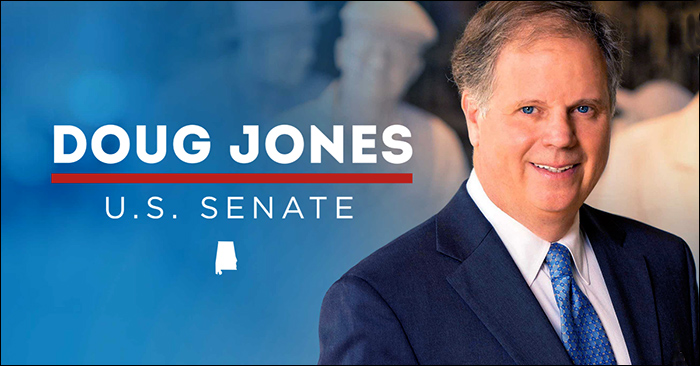
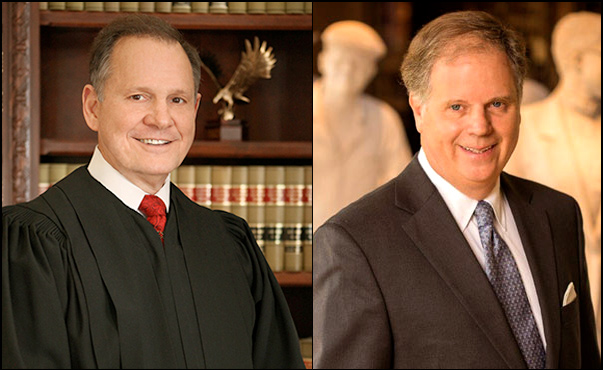
Oct. 4, 2017 — The Opinion Savvy research firm went into the field to test the Alabama electorate immediately after last week’s special Republican run-off election, and found the winner of that special primary election, former state Supreme Court Chief Justice Roy Moore, holding only a tenuous lead over his Democrat opponent, ex-US Attorney Doug Jones.

Left: Former state Supreme Court Chief Justice Roy Moore (R) Left: Ex-US Attorney Doug Jones (D)

Left: Former state Supreme Court Chief Justice Roy Moore (R)
Right: Ex-US Attorney Doug Jones (D)

The survey results, which other pollsters will probably soon confirm, should lead to the Democratic leadership launching a major offensive campaign here with the long shot goal of stealing the Republican stronghold seat. They have the resources but are hamstrung in this cycle because few offensive Senate opportunities exist; hence, they must make a serious play for this seat that would not normally be in play.

The Opinion Savvy poll (Sept. 27-28; 590 registered Alabama voters; 514 “definite” Dec. 12 special general election voters; 76 “considering” whether they will vote) finds Judge Moore leading Jones, 50-45 percent. Among the definite voters, Moore’s margin expands slightly to 51-44 percent. Within the lesser-motivated voting group, the Republican’s edge slides to just one point, 46-45 percent.

As we saw during the Republican run-off, a huge split – with diametrically opposite totals – exists between self-described evangelicals and non-evangelicals. Considering that the Census Bureau classifies 49 percent of the entire state population as evangelical, and 55.6 percent of this polling universe, this demographic segment was obviously a crucial block in determining the outcome of the Republican run-off and will have an equally large say in the upcoming special general.

Continue reading

Alabama: Strange vs. Moore

By Jim Ellis

Sept. 27, 2017 — Voters returned to Alabama polling places yesterday, as Republican run-off participants voted to choose a nominee to advance to the Dec. 12 special general election. To re-cap, former state Supreme Court Chief Justice Roy Moore placed first in the Aug. 15 special Republican primary election, taking 40 percent of the vote from the over 423,000 individuals who cast their ballots. Appointed Sen. Luther Strange took second with 32 percent, which allowed both to move into yesterday’s run-off election. That’s almost exactly the way election turned out yesterday. Judge Moore scored a robust victory last night over Sen. Strange in the special Republican Alabama Senate run-off election. Sen. Strange went down to a 55-45% crushing defeat, just as the pre-election polls predicted. Judge Moore now advances to the Dec. 12 special general election against the Democratic nominee, former US Attorney Doug Jones.

Sen. Strange was the choice of the GOP establishment, which, in this case, somewhat surprisingly included President Trump, who usually lines up on the other side. But all the firepower this group brought to bear and Strange’s minimum 3:1 spending advantage was insufficient to overtake and defeat the former state Supreme Court chief, who was twice removed from the bench for disobeying federal court orders that violated his principles.

Since the primary, polls had shown Judge Moore holding the advantage heading into yesterday’s vote. So did the very last published polls released within the past 48 hours preceding election day.

The Trafalgar Group, proving to be the most accurate pollster from the 2016 election through the special elections held earlier this year, went into the field during the Sept. 23-24 period and interviewed 1,073 likely run-off voters. According to their results, Judge Moore’s lead was major: 57-41 percent, far beyond any reasonable margin of error.

Continue reading

A Virginia Polling Bonanza

By Jim Ellis

Sept. 21, 2017 — Four different pollsters released new data for the Virginia governor’s campaign within the past few days, and the spreads range from a tie to a 10-point lead for Lt. Gov. Ralph Northam, the Democratic nominee.

The polls are all reputable, but one seems a bit skewed toward the Republicans, while another favors the Democrats. Most of the statistical information appears sound, and all of them have reasonable splits regarding the numbers of Democrats and Republicans in the respondent universes when compared to the actual percentages.

The four pollsters are: Suffolk University/USA Today, Mason-Dixon Polling & Research, Princeton Survey Research Associates, International partnering with the University of Mary Washington, and Quinnipiac University. The ballot test results follow, from earliest to most recent.

Princeton Survey Research Associates/International/University of Mary Washington:
Sept. 5-12; 1,000 Virginia adults; 867 registered Virginia voters; 562 likely Virginia voters
Lt. Gov. Ralph Northam (D) — 44%
Ex-RNC Chairman Ed Gillespie (R) — 39%
Continue reading

It’s All About the Evangelicals

By Jim Ellis

Sept. 20, 2017 — A brand new poll may be providing some last-minute life for appointed Alabama Sen. Luther Strange as he continues to trail for the upcoming Sept. 26 Republican run-off election.

Yesterday, we covered a Voter Surveys & Consulting firm poll that found the interim senator behind former state Supreme Court Chief Justice Roy Moore by only a single point, but the Senate Leadership Fund, major financial supporters of Strange, sponsored the poll. This brings their 41-40 percent results into question because all other recently published surveys give Judge Moore a comfortable, if not substantial, lead. Additionally, Voter Surveys did not release their supporting data.

JMC Analytics & Polling released their new data yesterday (Sept. 16-17; 500 Alabama GOP run-off likely voters based upon previous primary participation; automated system) that provides much more in the way of tangible numerical information. According to JMC, Judge Moore’s advantage over Sen. Strange is 47-39 percent with 13 percent undecided, which represents a definitive swing toward the appointed incumbent. In their mid-August poll, the firm’s pollsters found Judge Moore leading 51-32 percent. Thus, the new tally means a net 11-point swing in the senator’s favor.

Continue reading

One Week Remaining

By Jim Ellis

Sept. 19, 2017 — Now that we’ve entered the last full week of campaigning in the Alabama special Senate Republican run-off election, several items of interest occurred in the past few days that are likely putting both candidates on edge.

As one might guess after so many polls found former state Supreme Court Chief Justice Roy Moore leading appointed Sen. Luther Strange by double-digits, the Strange campaign would find a way to counter the preponderance of data.

Late last week, the Voter Surveys and Consulting firm released a new poll for the Senate Leadership Fund (Sept. 9-10; 604 previous Alabama Republican primary voters) that finds the interim incumbent trailing Judge Moore by just one percentage point, 40-41 percent, vastly different from the spreads in most of the previously released surveys.

Often we have pointed to a potential flaw in the pro-Moore polling illustrating that the evangelical percentage represents too great a proportion of the respondent universe (between 68-81 percent in the previously published data) as compared to the statewide data as a whole. Since Judge Moore brandishes overwhelming strength within this group, it is reasonable to conclude that most of the pro-Moore polling results may be at least slightly skewed.

Continue reading

Arizona Shock Poll: Down 27

By Jim Ellis

Sept. 15, 2017 — GBA Strategies, polling for the Democratic leadership’s Senate Majority PAC (Aug. 30-Sept. 7; 600 likely Arizona general election voters and 500 Arizona Republican primary voters), just produced stunningly poor numbers for first-term Arizona Sen. Jeff Flake (R) from their new Grand Canyon State survey.

What makes matters even worse for the senator is that the 27-point deficit referenced in the title is from the Republican primary voter sample segment. The GBA ballot test finds former state Sen. Kelli Ward, who held Sen. John McCain to a 51-40 percent re-nomination victory in 2016, leading Flake by an incredible 58-31 percent margin. While other polls have found Flake in difficult political shape within his own Republican Party base, almost exclusively attributable to his national public feud with President Trump, none have detected anything close to this spread.

On the other hand, GBA is a Democratic pollster and not known for testing a Republican primary sample. Therefore, doubt exists regarding this survey’s reliability because the pollsters may not have the necessary experience to understand the nuances within this particular voter segment. But, the margin is so large that few if any findings exist to conclude anything other than Flake is today likely trailing badly in the fledgling Republican primary contest.

The other results don’t give the Flake team much reason for optimism, either. Among Republicans, his personal favorability is a poor 25:56 percent while his job approval ratio is a slightly better, but still an abysmal 34:58 percent positive to negative. Majority Leader Mitch McConnell (R-KY) is in even worse shape within the party base. Only 17 percent rate Sen. McConnell in a favorable light, with 42 percent of Republicans expressing disapproval of the national party leader. But, that is of little solace to Sen. Flake since McConnell doesn’t face the Arizona electorate.

Continue reading

More Troubling Signs in Alabama

By Jim Ellis

Sept. 14, 2017 — Now just 13 days away from the Sept. 26 special Alabama Republican Senate run-off election two new polls have entered the public domain, likewise bringing bad news for appointed Sen. Luther Strange.

The senator has been languishing in surveys to varying degrees since the Aug. 15 primary election. All show him trailing, but the ones with sampling groups comprised primarily of evangelical voters find him down by very large margins, well into double-digits. Unfortunately for the Strange camp, these new polls project former state Supreme Court Chief Justice Roy Moore to be holding equally large margins. They, however, do not feature strong evangelical-based sampling universes.

Strategic National (Sept. 6-7; 800 registered Alabama voters) polled the Alabama electorate and surveyed a respondent group that is 84 percent Republican with all saying there is minimally a 50/50 chance that they will vote in the run-off election, and the overwhelming majority claiming a much larger participation preponderance (81 percent certain to vote; 13 percent very likely; 6 percent, 50/50). Alabama does not register voters by political party; hence, the sample correctly included a fraction of self-identified Democrats and Independents who are eligible to cast ballots in a partisan run-off election.

Continue reading

Strange Still Down, Lashes Back

(Alabama Sen. Luther Strange campaign’s latest ad)

By Jim Ellis

Sept. 11, 2017 — A new Alabama Senate Republican runoff poll was released late last week, and it provides a similar result but with potentially the same skew as we saw from earlier surveys.

According to the Southeast Research firm (Aug. 29-31; 401 likely Alabama GOP runoff voters), former state Supreme Court Chief Justice Roy Moore enjoys a 52-36 percent advantage over appointed Sen. Luther Strange. But, in comparison with two other polls, the number of evangelicals who comprise the respondent universe may be overestimated. In this particular Southeast Research poll, 79.5 percent of the Republican respondents are self-identified evangelicals. Within this segment, Moore commands a 54-32 percent margin, and 58-32 percent among those who consider themselves conservatives.

Conversely, Sen. Strange performs best with those identifying as non-evangelical Christian voters. Within this much smaller segment, Strange receives a clear majority of 55 percent versus Moore’s 40 percent. The appointed incumbent also attracts stronger support with self-described moderates. Within this segment cluster, Strange’s edge is 49-39 percent.

T Continue reading

Another Trump Appointment;
A Double-Digit West Virginia Poll

By Jim Ellis

Sept. 7, 2017 — White House personnel this week announced that President Trump will nominate Pennsylvania Rep. Tom Marino (R-Williamsport) as the new director of the Office of National Drug Control Policy. The appointment was expected to happen much earlier in the year, but a serious illness in the congressman’s family forced him to ask the administration for a postponement.

Should Rep. Marino move quickly through the confirmation process we would likely see another congressional special election called, similar to the situation involving Rep. Jim Bridenstine’s (R-OK) appointment as NASA administrator, in order to fill the remainder of the current term.

There is a good bet, however, that Senate Democrats will want to delay Marino’s confirmation as long as possible. With a live redistricting lawsuit making its way through the Pennsylvania court system, the Dems hope a potential re-draw will significantly change the statewide map, and specifically this district, in time for the 2018 regular election.

The 10th District, which contains 10 complete Pennsylania counties and parts of five others, occupies the entire northeastern corner of the Keystone State that borders New York and New Jersey, encompasses the territory around the cities of Scranton and Wilkes-Barre, and then shoots southwest past the Harrisburg-Carlisle area as far as the Tuscarora State Forest. Since 1952 inclusive, the district has voted Democratic only three times in congressional elections. During much of the succeeding six decades, veteran Rep. Joe McDade (R-Scranton) represented the region. He was in office for 36 years from the early 60s to the late 90s.

Continue reading

Florida: Close Again

By Jim Ellis

Sept. 5, 2017 — Last week, Florida Atlantic University released new survey research data (Aug. 25-26; 800 registered Florida voters via online questioning and telephone automated response) that tested the Sunshine State electorate about the impending Senate contest between three-term incumbent Sen. Bill Nelson (D) and term-limited Gov. Rick Scott (R).

Though we haven’t seen numbers here for months, the FAU data shows little has changed since the last surveys were released. Accordingly, Sen. Nelson tops Gov. Scott by only a 42-40 percent margin, meaning a virtual tie. Close races are nothing new in Florida, as we all know, so the polling results seem plausible.

Gov. Scott is not yet an official Senate candidate and repeatedly says he is no hurry to make a decision. But, the Florida political establishment and other prospective candidates believe he is going to run, which explains why there is so little activity around a Democratic incumbent who could be vulnerable.

Through his first term, the governor had been routinely plagued with poor job approval ratings but still managed to win a close 2014 re-election battle against former governor and now Congressman Charlie Crist (D-St. Petersburg). Though the FAU poll did not publicize candidate favorability ratios, previous 2017 studies found the governor’s index significantly rebounding into positive territory. It is likely Gov. Scott is sustaining a positive image, since he continues run close to Sen. Nelson on the ballot test question.

Continue reading